Early history of the site
The site of the Brian Brake House lies in Titirangi, within the forest of Tiriwa (Te Wao Nui a Tiriwa).
Early traditions refer to the Waitakere Ranges as a place where Turehu and Patupaiarehe resided. The area was settled by Toi Te Huatahi’s descendants, by Maruiwi (Maui’s descendants), and by Ngaoho (Te Kawerau a Maki’s forebears). Titirangi (the edge of the heavens) was named by the tohunga Rakataura of the Tainui canoe. Te Kawerau a Maki are acknowledged as manawhenua, but Waiohua and Ngati Whatua peoples also have ancestral interests.
The first recorded European visitor to the area was the missionary Samuel Marsden, in 1820. Following Ngapuhi incursions during the Musket Wars in 1825, most Te Kawerau a Maki sought refuge with kin in the Waikato. Returning in 1836, they initially resettled at Kakamatua.
In 1840, Ngati Whatua’s offer to transfer a large area of land to the British Crown for the creation of a colonial capital at Auckland was formally agreed. Crown purchases of Te Kawerau a Maki land commenced in 1848. Timber milling had begun on the eastern side of the Waitakere Ranges in the early 1840s. In 1854-5 the Crown granted Hibernia Smyth (d.1883) adjoining Allotments 27 and 50 in the Parish of Waikomiti. Smyth, a pioneer of the timber industry of the Auckland province, had arrived in Northland in 1839. His Waikomiti grants encompassed a place known as Okaurirahi (Big Kauri).
In 1925, an Auckland-based company created the extensive Kaurilands Estate subdivision on part of the recently purchased Smyth holding. At this time, road improvements and growing rates of car ownership were increasing public awareness of the Waitakere Ranges. The site of the Brian Brake House was part of a three-lot View Road parcel bought in 1927 by former jewellery retailer Alfred Mills Skeates (1876-1936). John and Marguerite Chinnery-Brown bought two of the lots in 1963. The western portion of View Road was renamed Scenic Drive, shortly before Lot 104 was subdivided into two in 1968. Hong Kong-based photographer John Brian Brake (1927-88) bought both lots in 1974.
After the Second World War (1939-45) a distinctive artistic community had developed in Titirangi, attracted by the physical environment and availability of cheap land beyond traditional suburbia. An increasingly design-aware clientele and the bush environment provided opportunities for architectural innovation. Throughout the 1950s and 1960s a number of experimental and modernist houses were built; followed in the 1970s by pole houses on sites previously deemed too steep or unstable.
Construction of the Brian Brake House (1976-7)
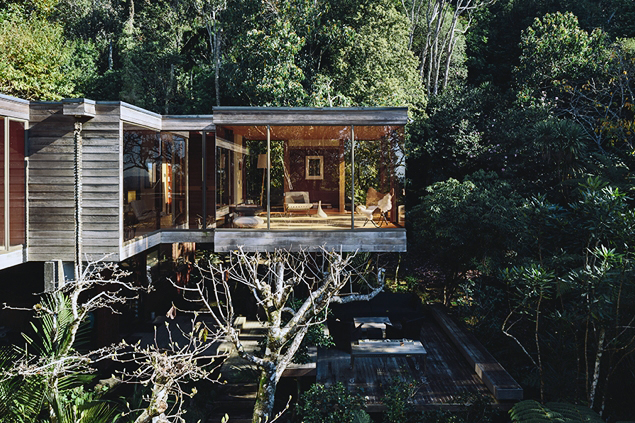
The pavilion-style Brian Brake House designed by Auckland architect Ron Sang (b.1938) of Mark-Brown, Fairhead, Sang and Carnachan, is regarded as one of the finest works of modern architecture in New Zealand. Pavilion-style buildings of the Modernist era were typically freestanding, low, flat rectangular prism forms, with a single flat roof extending beyond the building footprint. They often included an open plan and large amounts of floor-to-ceiling glazing. The archetypical Modernist pavilion was Mies van der Rohe’s German Pavilion for the Barcelona Exhibition of 1929.
Wellington-born Brake had moved overseas in 1954 and in 1957 doubted he could return, on account of the undeveloped state of the arts. In 1976, he commissioned a house on the site found by portrait photographer Spencer Digby for whom he had worked as assistant in the late 1940s.
Hong Kong-based Brake engaged an overseas architect to design a traditional Japanese-style farm house for the Titirangi property. However, after New Zealand artist Guy Ngan introduced Brake to Ron Sang, Brake adopted an alternative concept. Fiji-born Sang, whose parents had migrated from South China in 1925, had moved to New Zealand in 1957 and studied architecture between 1958 and 1961.
When Brake returned in the 1970s, New Zealanders were becoming more aware of their place in the Asia Pacific region and less reliant on Britain. Intensely aware of Japan throughout the Second World War (1939-45), New Zealand experienced an attitudinal change in the late 1950s. Domestic architecture such as Ivan Juriss’ own house (1953-6); the Sumpter House by James Hackshaw (1956-7); and Toomath and Wilson’s Mackay House (1959-60) reflected the growing influence of Japanese architecture in the local vernacular. By the early 1960s local magazines featured articles on Japanese culture, and a developing awareness of Japanese-influenced aesthetics (partly attributable to a growing local studio pottery movement) was increasingly reflected in the home and particularly the pavilion-style house. Brake’s images of contemporary life in Japan in 1964, published in Life in the lead-up to the Tokyo Olympic Games, also contributed to the interest.
Sang’s visually striking design for the steep Titirangi site was the result of an interactive process undertaken by correspondence with Hong Kong-based Brake, a collector of fine art and perfectionist with an eye for detail. The outcome was a rectangular cantilevered structure of two linked pavilions. Two elevations were clad in cedar; two in glass. The entire roof, visible from Scenic Drive, was covered by a shallow pool designed to reflect the bush and fallen leaves. The design accommodating Brake’s sophisticated sensibilities incorporated a studio suite, enabling him to take on fewer assignments but still work internationally.
Internally, the front door opened onto an entrance gallery in a living pavilion. Spaces flowed in traditional pavilion style notwithstanding full-height partition walls defining living, dining and kitchen areas. The kitchen was hidden. Walls were needed for the display of Brake’s sizable art collection. At the east end of the living pavilion was a roofed deck.
A glass-walled bridge spanned what became a Japanese-inspired water garden. A second pavilion housed an open-plan study, two bedrooms, and two bathrooms. A Tatami room (a stylised tea room named for a set of mats that were a gift from Brake’s Japanese publisher) was linked to the front gallery of the sleeping pavilion.
The lower storey consisted of two half-basements. The west basement was a workshop.
The east basement contained Brake’s photographic studio. The main studio space, shown as a rumpus room on the floor plan, doubled as a private theatre. Two rooms opened off the west side: a lavatory; and a large store / strong room with built-in bench space and shelving. Built-in furniture in the rumpus room included a bench and cupboard unit; and a workbench with built-in light box, drawers, cupboards and knee space. Off the east side of the rumpus room was the darkroom in which a stainless steel tray and a printing bench occupied opposing walls. The northeast corner of the basement accommodated the developing room, which was accessed from the rumpus room via a small lobby that contained a stainless steel tray, the projectionist’s window and controls for lighting in studio with its drop-down screen.
The technically challenging project was erected by Mt Roskill company J.W. Jenkin Construction Limited. Engineered landscaping retaining walls were built alongside the house which spanned a gully. These diverted stormwater and facilitated the creation of a Japanese water garden fed by a natural spring. Brake, sculptor Guy Ngan, and Ron Sang spent three weeks living at the address in 1977, ‘to tune the house to the landscape through the precise placement of plants and rocks’.
Subsequent use (1977- )
The Titirangi residence was the permanent home of Brake and his partner Wai-Man Raymond (Aman) Lau.
Although the achievements of the intensely private Brake had never been set out in any detail, New Zealanders had a distinct sense of him as a celebrity. As a photojournalist during the golden age of international picture magazines his work provided a clear window on the world, bringing far away places into readers’ living rooms. Conversely his New Zealand, Gift of the Sea published in 1963 gave New Zealanders an image of, and for, themselves. Creating stronger connections with the outside world was important to Brake when he returned in 1976. His belief that New Zealand could be better promoted overseas intensified over the following decade.
Prior to leaving New Zealand, Brake was a cinematographer and director at the National Film Unit (NFU). His Snows of Aorangi (1955) was made when colour was a relative novelty at the Unit. Placed first equal at the Brussels International Tourist Film Festival in 1954, an edited version of the film was later nominated in the documentary category for an Academy Award in 1959. With few opportunities to pursue a film career locally, Brake went to Britain in 1954.
After joining photo agency Magnum Pictures, he traveled as a photojournalist selling his work to international magazines including Life, Paris Match and National Geographic. Chance photographs taken of artist Pablo Picasso at a bullfight were an early coup. Brake, for many years the only Magnum member from outside the United States or Europe, was elected the agency’s European vice-president in 1958. As the only independent Western photographer to cover the tenth-anniversary celebrations of the People’s Republic of China in Beijing in 1959, his images were keenly sought by American magazines as entry to China was barred to United States citizens. Along with earlier photographs taken in 1957, Brake’s images of China have increasing historical value.
Brake’s landmark photo essay ‘Monsoon’ shot entirely in colour in India and first published in Life in 1961, took photojournalism in a new direction. Drawing upon his experience at the NFU the sequencing of the photographs created the narrative. Life subsequently commissioned assignments on Japan; the Roman Empire; and, a notable six-part series on ancient Egypt.
With the collapse of big-budget picture magazines in the early 1970s, Brake turned to illustrative and studio work; and set up Hong Kong-company Zodiac Films for documentary making. Three cultural works relating to Indonesia (Borobudur, Batik and The Ramayana) appeared on New Zealand television.
Brake returned to New Zealand to photograph for New Zealand Potters: Their Work and Words (1976); and in 1975 was commissioned for a project realised as Art of the Pacific (1979). The singular style and commercial success of his earlier New Zealand, Gift of the Sea co-authored with Maurice Shadbolt had changed the way pictorial books and publications by New Zealand artists were conceived, sequenced and designed. The 1963 publication, a touchstone for New Zealanders, was closely echoed by the New Zealand Film Unit in This is New Zealand! created for Expo ’70, the World’s Fair in Osaka, Japan.
Brake and Lau undertook alterations and additions to their Titirangi home in 1980. Reflecting the owners’ changing needs and use of the house, these collaborative changes designed by Ron Sang included conversion of the east deck into a family room with a north-facing deck. Natural light was improved in the kitchen by re-glazing the south-facing tinted window to which a low window was added immediately above. Built-in fittings were added in the study on the west pavilion ground floor. A new stairway provided access for a guest suite in the former west workshop basement. Here the doorway in the south wall was in-filled with concrete blocks and a new doorway created at the northern end of the east wall and a new north-facing deck was provided. In the east basement, a laundry facility (relocated from the ground floor) and a combined editing room occupying part of what was originally shown as the developing room and wet area now opened onto a ground level deck.
Brake was awarded an OBE (Order of the British Empire) in 1981. At this time work for corporate clients including The Fletcher Group, and object photography was becoming increasingly important. Brake’s dramatic style of photography for museum and craft objects in the 1970s and 1980s led New Zealanders to equate his name with large format photography of cultural treasures. His images of taonga Maori achieved iconic status, New Zealanders associating them with Te Maori exhibition that toured the United States in the 1980s. The photographs portrayed the dramatic potential of an object as a stunning example of taonga and exhibited an awareness of Maori values and attitudes to taonga.
In 1985, the New Zealand Institute of Architects (NZIA) made an Auckland Branch Award to the Brake House.
Brake promoted a New Zealand Centre for Photography (1985-2010) as a way of improving the profile and quality of local photography. When Indian Prime Minister Rajiv Gandhi visited in 1986, the New Zealand government presented a portfolio of Brake’s ‘Monsoon’ series as a demonstration of connection between the two countries.
Following Brian Brake’s premature death in 1988, his work continued to appear under Lau’s stewardship. A 1990 exhibition, Brian Brake’s New Zealand visited many international venues. Locally, an audiovisual title Gift of the Sea was shown at a sesquicentennial exhibition touring 34 centres. Brian Brake: The Beautiful New Zealand, an audiovisual using 3,000 images, was shown in the New Zealand pavilion at Expo ’92, the World’s Fair in Seville, Spain. Lau subsequently donated Brake’s film, photographs and archival material to the nation for the benefit of future New Zealanders and scholars.
The Titirangi house was sold in 1991, and fell into decline. In 1999 new owners refurbished the kitchen and bathrooms. With architects Martin Chant and Toni Roberts as advisors, part of the partition wall was removed between the kitchen and dining room and more extensive glazing introduced in place of existing windows on the south wall of the kitchen to provide better light to both rooms.
Possibly at this time also, the laundry was relocated into the darkroom within the eastern area of the basement studio and a wash-hand basin installed in the former developing / editing room.
In 2001, 25 years after its completion, the Brake House was awarded an Enduring Architecture Award by the NZIA.
The work of architects like Ron Sang who pursued a more international, less colonial type of architecture in the 1970s in New Zealand, constituted a rare individualism that would in other places be termed late-modernism. As part of a growing support for the recognition of the heritage values of modern buildings, the New Zealand subsidiary of DOCOMOMO - an international working party for the documentation and conservation of buildings, sites and neighbourhoods of the Modern Movement - put together a ‘top 19’ places. The Brake House was included in the international publication, The Modern Movement in Architecture: Selections from the DOCOMOMO Registers (2000), for its special architectural significance. More recently, the house was one of seven New Zealand buildings featured in The Phaidon Atlas: 20th-Century World Architecture (2010) which includes over 750 outstanding works built between 1900 and 1999.
The house remains a private residence.