Early History
Historically, Kāi Tahu had a tauraka waka (canoe landing place) at the head of the Ōtākou Harbour. The slope of the foreshore and the tidal flats where the Toitū Stream entered the sea was bisected by a hill (called Bell Hill by colonists). Swampy land provided a rich habitat for birds, eels and plant life.
In 1847 the Free Church of Scotland immigrants arrived in Dunedin. Between February and May 1846, New Zealand Company surveyor Charles Kettle and his assistants laid out the settlement. The layout was based on the Edinburgh city plan. The numbers of settlers grew only slowly, from 890 in 1857 to 2,262 by 1859. This trickle became a flood with the discovery of gold at Gabriel's Gully in 1861. By 1865, 10,000 people lived in Dunedin. Gold brought commerce and wealth. The city was the major port of entry for the goldfields and it prospered beyond all imagining.
Wealth translated itself into the city’s buildings and to people’s behaviour – the Presbyterian settlement found itself inundated with hopefuls bound for the goldfields, with all the attendant drunkenness and loutish behaviour. For this Free Church of Scotland settlement, railing against the intemperate tide became a social movement, as it did elsewhere in New Zealand.
The Scourge of Alcohol
New Zealand’s settler men drank a lot – in 1879 there was one pub per 287 people in New Zealand. The average Pākehā man in the 1840s drank 45 litres of commercial spirits a year and 14 litres of beer. Until the 1890s, alcohol related crime was higher in New Zealand than Great Britain. The chaos of the Otago gold rush era led to debates about morality and in particular, the role of alcohol in causing a wide range of ills – ‘poverty, ill health, neglect and abuse of families, immorality, and social and economic instability.’ Temperance became a political cause throughout New Zealand.
Temperance was a cultural movement: sociologist Harry Levine writes that only some societies developed temperance movements in response to drunkenness, and that these societies tended to be those which drank a large portion of their alcohol as distilled liquor, and were predominantly Protestant. The English-speaking cultures that developed temperance movements were US, Canada, UK, Australia and New Zealand. In wine drinking societies, alcoholic drinks did not have a negative symbolism, and indeed wine had a positive symbolism. The culture of Protestantism with its emphasis on self-sufficiency and self-control was reflected in the temperance movement – alcohol was a concern because it was a threat to self-regulation.
Internationally, temperance societies first appeared in the 1820s and 1830s. New Zealand’s disorderly ‘frontier’ society led to the saying that the country’s leading causes of death were ‘drink, drowning, and drowning while drunk.’ Temperance movements were centred in the country’s urban areas, with non-conformist churches encouraging their congregations to abstain, and a wider blossoming of temperance societies. Women were ‘frequently the victims of men’s alcohol abuse’ – drunkenness often involved violence against women and children, and pouring money down the bar. Women, and the Women’s Christian Temperance Union, were keys to the fight for reform, which tied itself to the cause of women’s franchise. The disparate campaigners needed a centre for their activism.
Dunedin’s abstainers joined the fight. In August 1866, a meeting was held at the Odd Fellows Hall on George Street to discuss forming a Total Abstinence Society. Mr Jago told the meeting that ‘three temperance societies had been organized but all had signally failed.’ Jago had been a leader in those societies and while he didn’t want to lead the society, he was prepared to support one. Another attendee, Mr Hooper identified that the other societies failed because ‘the temperance question had been treated too exclusively in its religious light’ and suggested plans ‘to make the movement popular and effective.’
The first meeting to discuss the erection of a temperance hall in Dunedin was held in the Congregational Hall (in the basement rooms of the Moray Place Congregational Church) on Moray Place on 21 March 1873. Some twenty men attended the meeting and resolved to form a committee to select a site and decide on a suitable building.
Many of those involved had been founding members of the Dunedin Abstainers’ Union, formed in February 1864. The founding resolution was: 'that in the opinion of this meeting the drunkenness of a people is in proportion to the prevalence amongst them of social drinking habits and the facilities afforded for obtaining intoxicating liquor; and that social and moral debasement characterises every community amongst whom intemperance prevails…[the meeting] views with considerable alarm the very general observance of drinking customs in society here, and the widespread and increasing growth of the traffic in strong drink, and believes it to constitute an evil loudly calling for actively remedial measures'.
The meeting further resolved that ‘no means short of the entire abolition of social drinking customs, and the entire abolition of the traffic in intoxicating beverages, will be sufficient for the removal from society of the drunkenness which it has now so greatly to deplore; and that the universal adoption of the principles and practice of total abstinence from all intoxicating liquors as beverages would be conducive to the highest well-being of the state.’ In forming the Dunedin Abstainers’ Union, the attendees pledged to give the union ‘cordial support in every legitimate effort for the creation of a public opinion antagonistic to the prevailing social drinking customs, and in favour of the restraint and suppression of the traffic in intoxicating liquors.’
Building the Temperance Hall
Reporting back to the around 40 attendees of the next meeting of the hall supporters, the committee’s suggestion of leasing the Odd Fellow’s Hall was rejected, and it was instead moved that the committee investigate a Moray Place site. In May 1873, the Dunedin Temperance Hall Company (Limited) was formed to facilitate the building of a hall on the Moray Place site. The hall was to have ‘the requisite accommodation for carrying on the business of the several Total Abstinence Societies, and the front part of the building is to be built as shops.’
Plans were well underway by October 1873, when the Bruce Herald reported that the plans were for a main hall to accommodate 600, as well as a smaller hall and other accommodation. ‘This hall will supply a felt want here, provided the acoustic properties and ventilating conveniences be attended to so as to make the hall a comfortable place for speaking and hearing.’ The provisional directors were A. Mercer, John Mackay, John Hughes, John W. Jago, Alexander Rennie, James Pryor, John Neil, Edward Moss and R. Rutherford.
In 1874, the Company leased the land on which the hall was to be built from James McLeod Nicholson. Dunedin architect Robert Forrest designed the building. Company secretary James McCulloch advertised for tenders in November 1873. Dunedin builder James Gore won the tender with his price of £2,778.
The Otago Daily Times described the proposed building as of
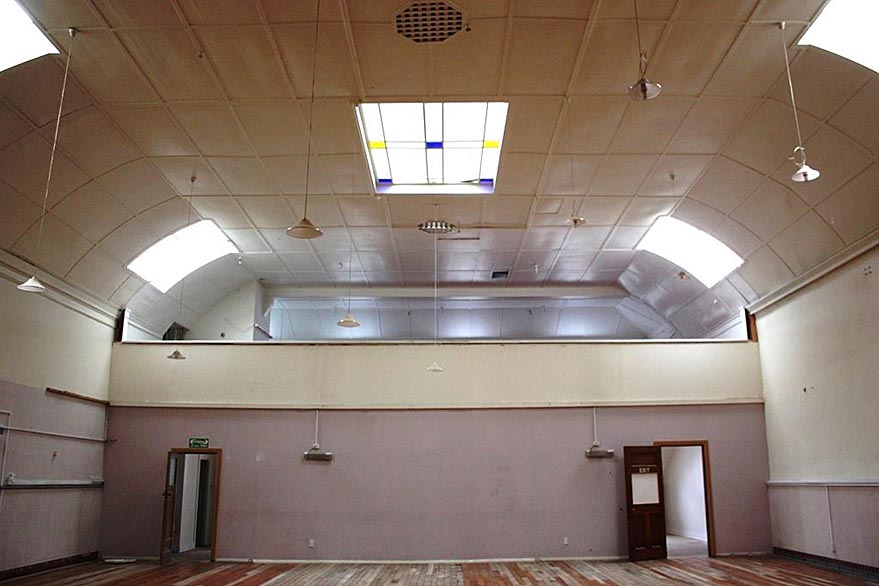
"a very substantial appearance, though not a very pretentious one. There will be three front entrances – a main one in the middle and two side ones, leading upstairs, and adjoining which will be two ante-rooms, 15 ft 10in by 7 ft [4.8 by 2.1 metres]. The hall on the ground floor is to be 42ft by 25ft [12.8 by 7.6 metres] and to the hall upstairs access will be gained through very handsome side lobbies leading up staircases of polished kauri. Its length will be 77ft 8in by 43ft [23.5 by 13.1 metres], and it is calculated to seat over 800 persons, besides having a gallery to contain over 120, and a platform 19 feet by 10 [5.7 by 3 metres] feet, ladies rooms, lavatories, &c, will be added. The base portion of the building will be of Port Chalmers blue stone, and the rest of brick, and the ventilation being on the most approved style."
Dunedin mayor (and temperance supporter) Andrew Mercer laid the foundation stone on 26 December 1873. By July 1874, the ‘skeleton building’ had assumed ‘a striking appearance’, as the workmen put on the roof.
Twelve hundred people took part in the procession to the site on opening day, and celebrated with a soiree, concert and dance on 14 August 1874. The Tuapeka Times reported that the ‘building is one that reflects infinite credit on the various temperance organizations which have co-operated in its erection. It is a commodious, substantial erection, and contains one of the largest halls in the city, thus supplying a want that has long and severely felt by the various temperance bodies in Dunedin.’ The article continued ‘[t]he pluck of the I.O.G.T.’s [International Order of Good Templars] in erecting such a handsome and useful building , deserves substantial recognition, and it is to be hoped that the carrying capacity of the new Hall will be strained to the utmost on the opening night.’ Not all agreed on the merits of the building, an Otago Daily Times correspondent, noting the building was receiving its final ornamentation, grumbled ‘[i]f a few more feet elevation had been allowed, the external appearance of the structure would be much more imposing and handsome.’
A Public Venue
The hall provided a venue for balls, dancing lessons, concerts and other entertainments. Popular events included the Kennedy family playing their Scottish ballads (1874) world billiards champion John Roberts (1876), tight rope walkers Henry Morris (1878), wax works exhibitions and a series of chamber music concerts, and a Māori carnival in 1902.
The hall was an important venue for religious meetings for nearly forty years. The Salvation Army’s first New Zealand meetings were held at the hall on 1 April 1883, preceding the well-known outdoor meeting commemorated by a plaque on Cargill’s Monument at The Exchange (List No. 4754, Category 1). The Salvation Army continued to use the hall for three years, before building the Salvation Army Fortress on nearby Dowling Street (List No. 2215, Category 2).
The Dunedin Temperance Hall Company transferred the lease to Donald Cameron in January 1883. Scottish-born Cameron (1850-1932) arrived in Dunedin as a twelve year old, and as a young man became involved in the temperance movement. He became the Grand Secretary of the Good Templar Order in 1875, as well as pursuing journalism and commercial interests. He was the proprietor and manager of the Temperance Herald, and of its successor the Temperance Standard – newspapers that had a national circulation for some twenty three years. He was active in the Independent Order of Rechabites and the Sons and Daughters of Temperance Benefit Societies. His wife, the former Christina McNeil, was also an enthusiastic temperance worker. Cameron advertised ‘The Choral Hall’, noting ‘this favorite Hall has now been considerably improved and thoroughly renovated’ and was available to let for entertainments. ‘The floor is in splendid condition for dancing, and the Hall is fully seated with chairs, etc., to comfortably accommodate 750 persons.’
From 1886, the Brethren congregation hired the building, now renamed the Choral Hall. Evangelist Alfred Brunton led Brunton’s Choir, a group of some 100 singers known throughout Otago. Brunton (1828-1900) arrived in Dunedin where he became the relieving minister for the Moray Place Congregational Church (List No. 2218). In 1867, he became the leader of a group of Plymouth Brethren, meeting first at Milton Hall and then with other Brethren at Farley’s Hall on Princes Street. He was an engaging preacher who attracted a sizable following. The congregation shifted to Garrison Hall in 1880, a venue that could accommodate over 2,000 people. His open air meetings were also popular. His close relationship with other Protestant churches caused dissension in his congregation, and a group split off to set up closed meetings. Brunton’s Assembly moved to the Choral Hall. Brunton was ‘one of the most popular and dynamic evangelists of nineteenth century Dunedin’, and was also known for being successfully sued for libel in a highly publicised case. This association with the choir may explain the change of name. Brunton died in 1900. The Brethren continued to hold their meetings in the hall until 1920.
Many other significant groups met at the hall – the Dunedin Burns Club, the Otago Art Society held its annual exhibitions in the building between 1891-1906. Frances Hodgkins, then at the beginning of her career, exhibited there. The art society led a peripatetic existence, mostly operating out of rented premises – with painter and arts supporter William Hodgkins, Frances’ father, the president from 1880-1898.
A Meeting Place for Activism
The 1880s was a time of activism for workers, particularly in the context of the ‘Long Depression’, the misery of which caused unrest about working conditions. The Temperance Hall was the venue for the founding of New Zealand’s first women’s trade union. On 11 July 1889, following a series of public meetings at the hall that discussed the evils of ‘sweated labour’ among women workers, the inaugural meeting of the Tailoresses’ Union was held. The meeting was attended by 300 people (the majority women and girls). At the meeting Reverend Rutherford Waddell denounced sweated labour and poor working conditions, ultimately leading to a change in labour laws. The union was instrumental in the passing of the Factories Act and other legislation by the new Liberal Government. The Union also campaigned for women’s suffrage – Secretary of the union from 1891-1896, Harriet Morison, was a member of the Women’s Christian Temperance Union and campaigned among working class women.
Other women’s groups made particular use of the hall – especially after the campaign for suffrage proper got under way in 1885. Dunedin and Christchurch were ‘hotbeds for the women’s suffrage cause’, which spread from these centres. Otago had the most signatures in the main 1893 suffrage petition, with 7471 signatures out of a total of 23,991. Dunedin has ‘long been recognised’ as ‘the primary centre of women’s suffrage agitation.’
In 1891, when Parliament discussed Sir John Hall’s Women’s Franchise Bill, the Dunedin Tailoresses’ Union adopted a resolution that parliamentary franchise be extended to adult women and that there was desire among the city’s women to bring this about. During the debate Dunedin Member of the House of Representatives Henry Fish made a ‘venomous attack’ on Dunedin women, and particularly Harriet Morison, in response to which ‘a monster meeting’ was held in the Choral Hall, demanding the immediate enfranchisement of women.
As the first vice president of the Tailoresses’ Union of New Zealand (formed in 1889), Morison had worked hard to organise women workers in Dunedin and in other provinces. She canvassed for the suffrage petitions in 1891 and 1892. She was a founding member of the Women’s Franchise League, the first in New Zealand. She was also a member of the Women’s Christian Temperance Union.
Out of the Dunedin branch of the WCTU (established in 1885) grew the Women’s Franchise League of New Zealand, which held its inaugural meeting at the hall on 28 April 1892. The Women’s Franchise League of New Zealand played a pivotal role in promoting women’s suffrage and was responsible for circulating the petition that was influential in the successful campaign for women to be given the vote. The campaign for the vote was formalised by a meeting on 28 April which saw the foundation of the Women’s Franchise League. The public meeting held at the Choral Hall on 28 April 1892, attended by 150 women.
Mrs Marion Hatton presided over the meeting at which the Hon. William Downie Stewart and John Jago spoke ‘strongly in favour of the formation of the league.’ Mr Boot moved that a league be formed ‘for the parliamentary enfranchisement of the women of New Zealand’ with headquarters in Dunedin. The group was open to women eighteen years and over, with ‘honorary membership’ available for women under that age.
The first chair of the Women’s Franchise League, Marion Hatton (1835-1905) had strong links with temperance. Having chaired a pro-suffrage meeting in April 1892, Hatton provoked the anti-suffrage mayoral candidate, Member of the House of Representatives, and head of the liquor lobby Henry Fish. The league was formed two weeks later. The League focused on organising – collecting signatures for the suffrage petitions, making sure women of all classes were canvassed, and reaching out to country districts. Dunedin was New Zealand’s largest city in the 1890s, and was therefore an important centre for the group. Otago returned by far the largest number of signatures. After women won the right to vote in 1893, Hatton went on to initiate the National Council of Women, attending the inaugural conference in Christchurch in 1896. Marion would sit alongside other heavyweights of the suffrage movement such as Annie Schnackenberg, Margaret Sievwright and Anna Stout as vice-presidents of the NCW. Kate Sheppard was its first president.
Later History
In 1896, the lease of the property was offered up as a mortgagee sale: the unexpired lease to sections 28 and 29, Block XIV (a 99-year term from 1 September 1873 at £48 per annum) ‘together with substantial Building thereon known as “Choral Hall,” well let to permanent tenants.’ Men’s outfitter and mercer John Taylor (c.1839-1914) purchased the lease, with the Taylor Trustees managing the property after Taylor’s death.
In the early 1920s, the first floor hall was converted to a clothing factory for Messrs Butterworth Brothers. Butterworths was a well-known clothing manufacturer and retailer. They were known for the ‘Globe’ brand. Established in 1860, and given a boost by the gold rushes of that decade, the company was successful, with its warehousing in a substantial High Street building and its factory on Moray Place.
The first floor and roof were damaged by a fire on 16 March 1927. The ground floor was largely undamaged. The building was repaired, and the upstairs space was used by Sharland & Co. (wholesale druggists) and the Dunedin Frock Manufacturing Company.
In 1932, Taylor Trustees commissioned architects Miller & White to alter the building. Glue Construction Company carried out the £2,500 alterations which saw the removal of the lower hall, and the building of three shops on the ground floor. The new shops were sheltered by a verandah with Wunderlich pressed metal, while the shop fronts featured Australian rose mahogany woodwork, decorative leadlights, and orange and black terrazzo slabs. The Evening Star described the alterations as ‘ultra-modern’ in style. The main staircase was rebuilt and a lift was installed. A decade later, the building was given a new façade in the stripped-back style popular at the time. A new name ‘Oxford Buildings’ was added to the parapet in relief lettering, and it seems to have been known by that name from around 1934.
Modern Books (1943-1954)
A bookshop, Modern Books, occupied one of the ground-floor retail premises for eleven years from 1943. It was founded by the Dunedin Co-operative Book Society, which had explicit socialist ideals. The bookshop was part of the Popular Front movement in New Zealand, a left wing response to the rise of fascism in Europe. The co-operative movement developed out of existing left-wing bookshops with links to either the Communist Party or the Friends of the Soviet Union. The bookshops (there were shops in Auckland (1936), Wellington (1938) and Christchurch (1938)) were run by elected committees representing a range of liberal and left opinion. Dunedin’s Modern Bookshop articulated its task: ‘to foster the reading and writing and production of books, pamphlets, circulars and other publications of a nature that will promote an active and intelligent interest in progressive ideas and activities by the largest possible number of the reading public’ and noted a special relationship with the working class movement and their position in the world. John (Otago University Librarian) and wife Rita Harris were founding members and key figures in the bookshop. The shop was frequented by local literati - Janet Frame browsed there hoping to ‘glimpse one of the literary figures of Dunedin or one visiting from up north.’ Also significant was the role of Charles Brasch who headed the book selection committee from 1948 and was the chair of the society from 1949. After some conflict between Brasch and the bookshop manager Dick Reynolds, sales fell, and the shop closed in 1954.
The Society had socialist and progressive ideals and was frequented by local literati.
From 1956 to 1976 the same shop was occupied by Catholic Supplies.
Later Use (1960-2018)
In 1960 the upper hall became the Manhattan lounge, the space remaining largely unchanged. The gallery became first a coffee bar and then a licenced bar, with a dance area below. The Lounge was popular into the 1980s, and later became the Manhattan Theatre.
In 2018, the upper hall provides theatre/studio space, while the shops are occupied by the vintage clothing shop The Preservation Society, and the café/bar The Dog with Two Tails. In 2019 The Preservation Society Closed and the space they occupied became part of Dog with Two Tails and is utilised as performance space.