Early history
Both iwi history and archaeological evidence show Māori occupation in the Ōtākou Otago region over an extended period, with the inhabitants utilising a wide variety of natural resources from the diverse environment. Archaeological evidence supports the date of earliest settlement around the 12th century.
Today, Kāi Tahu mana whenua is recognised over a large part of Te Wai Pounamu. Kāti Māmoe and Waitaha whakapapa and shared occupation are always acknowledged. Tūpuna such as Waitai, Tukiauau, Whaka-taka-newha, Rakiiamoa, Tarewai, Maru, Te Aparangi, Taoka, Moki II, Kapo, Te Wera, Tu Wiri Roa, Taikawa, and Te Hautapanuiotu are among Kāti Māmoe and Kāi Tahu tūpuna whose feats and memories are embedded in the landscape, bays, tides and whakapapa of Ōtākou Otago. The hapū Kai Te Pahi, Kāti Moki, and Kāti Taoka still maintain their presence and responsibility as kaitiaki in this region.
Historically, Kāi Tahu used the tauraka waka at Ōtepoti (Dunedin city) when they visited the head of the Ōtākou harbour as either the gateway to the route to Kaikarae (Green Island) or when off on other mahinga kai expeditions. The soft slope of the foreshore and the tidal flats in the upper harbour where the small stream, Toitū, entered the sea was bisected by a prominent hill Ngā-moana-e-rua (called Bell Hill by colonists), the foot of which lay at the very edge of the high water mark. No permanent kaik or villages were situated at the mouth of the Toitū, simply because there was no need for it.
While not as densely populated as the North Island, numerous kaik in the Ōtākou region still hosted a good number of Waitaha, Kāti Mamoe and later Kāi Tahu peoples. Various bays and beaches around the Tairaoa Heads supported several hundred people with kaik in Karitāne, Waikouaiti and at the mouth of the Mata-au or Clutha hosting a similar number. Pā kāinga on the Ōtākou coast included Māpoutahi (Pūrākaunui), Pukekura (Taiaroa Head), Kōpūtai, Huriawa and Moturata (Taieri Island). Whareakeake, one of several pounamu manufacturing sites, attested to another facet of lifestyle for the artisans of the iwi.
While the population numbers are still debated by academics and historians, there is no argument that through epidemics and intertribal warfare, the numbers of Kāi Tahu living in the region had dwindled considerably by the time the Treaty of Waitangi was signed at Kōpūtai (Port Chalmers) on 30th June 1840.
Built history
In the nineteenth century the Moray Place site of the building had been part of a large coal and firewood yard. In 1909 a single-storey structure was built for the engineer William James, as an office and shop. In 1913 more offices were added to the premises. In the mid-1930s the property was taken over by share broking firm S. R. Burns and Co. Ltd. Stanley Burns was a decorated returned soldier, who served in France in the First World War. He ran a tailoring business in Dunedin before setting up a company dealing in shares and the promotion of subsidiary companies with diverse interests in property, printing, caravans and camping equipment, cosmetics, and other areas.
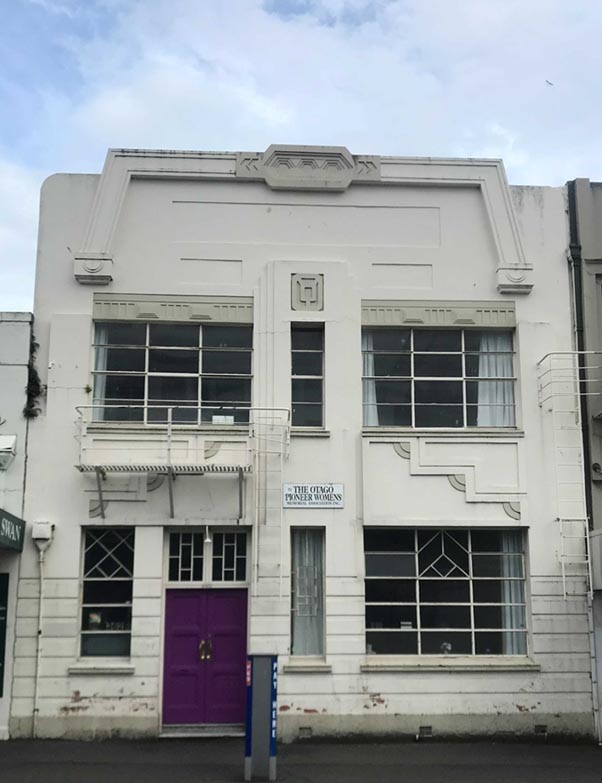
After taking over the 1913 office building, Burns employed Dunedin architect Cecil Gardner Dunning to redesign the building. A second storey was added and the façade redesigned. Dunning, was the son of Tasmanian-born architect William Henry Dunning who took over his father’s practice after his death. The younger Dunning’s other Dunedin designs include the former customhouse and numerous private residences. The design of the façade is striking example of Egyptian Revival. Bold and contrasting colours originally emphasised the angular design of the façade. The interior continued the theme, with its modern fittings. In 1934 the additions and new façade were completed by Love Construction Co.
The cosmetic side of Stanley Burns’ business was run by Sandford Sinclaire, a graduate of the Wilfred Academy of New York. From a six by four foot cubicle in Burns’ building came Roxana Beauty Preparations, with their ‘special exotic properties anticipated to appeal to women of fashion throughout New Zealand’.
An advertising feature in the Otago Daily Times gave an evocative description:
The Roxana Salon, recently opened in Burns’ Buildings, Moray place [sic], has an air of up-to-date efficiency about it. Its lounge, approached by marble stairs and furnished with a brown patterned carpet, tawny hangings, and comfortable couches, has modern lights and modern furniture …". Unfortunately, by 1941 Burns’ small empire was crumbling amid financial losses and fraud (he was imprisoned in 1943); and his building was sold to the newly-formed Otago Pioneer Women’s Memorial Association.
A Nationalist Narrative: The Dominion Centennial Celebrations
In 1940 New Zealand celebrated ‘a century of European effort and progress in New Zealand.’ The main event was the Centennial Exhibition in Wellington. The provinces fed into a series of national events – unveiling of memorials, historical re-enactments, and festivals. The celebration was very much a narrative of nationalism and progress, celebrating European settlement. It is interesting to note however that the narrative promoted by the Centennial was of pioneer women standing alongside pioneer men. Māori history and the centenary of the signing of the Treaty of Waitangi were put on the ‘back seat.’ It was not the Māori narrative of ‘struggle, resistance and survival in the face of dispossession of land, population decimation, and systematic erosion of the base on which to support a distinct culture’ that was being told. As poet Denis Glover wrote in the stanza of a poem looking back at the celebrations:
The politicians like bubbles from a marsh
Rose to the platform, hanging in every place
Their comfortable platitudes
— Without one word of our failures.
Similarly, women’s roles were tightly proscribed. Given New Zealand was the first nation of the British Commonwealth to grant women the vote, the centennial memorial had the potential to give women’s role a special feature – but only within certain bounds. Women’s role in society, as portrayed in the Exhibition, reflected the lived experience of the majority of New Zealand women at the time, that of wives, mothers and homemakers.
Otago’s Provincial Celebrations
In July 1936, the Otago Provincial Centennial Council (consisting of Dunedin’s town clerk, the Mayor, and several other members) was established to bring forward suggestions as to the form of provincial centennial memorials. The Provincial Centennial Council governed expenditure and subsidies on projects approved by the National Council.
In August 1936 a meeting of women’s interest groups and organisations was invited to form the Otago Women’s Centennial Committee to ‘take in hand certain arrangements in connection with the centennial celebrations in 1940.’ Dunedin’s Mayor, the Reverend Edwin Cox, chaired the meeting and noted that ‘[p]artly as a result of the granting of the franchise to women’ there were some very important women’s organisations. He added ‘the contribution of women to the social and national life of the Dominion has been very great and important, and should be worthily recognised in our commemoration.’
Dr Emily Siedeberg-McKinnon, New Zealand’s first woman graduate in medicine, with over forty years of ‘professional success and civic leadership’, was given the chair of the meeting. Emily Siedeberg was born in Clyde in 1873, her family had emigrated to New Zealand in 1861. She moved to Dunedin at the age of three. She was later educated at the Normal School and Otago Girls’ High School. Siedeberg went on to study medicine at the University of Otago from 1891-1896, at times in the face of pronounced gender prejudice, and became the first woman in New Zealand to graduate with a medical degree. After a short period working as a locum at Seacliff Lunatic Asylum, Emily went abroad for postgraduate study in obstetrics, gynaecology and children's diseases in Dublin and Berlin. On returning to Dunedin, she set up her own medical practice and it became the ‘core of a life dedicated to welfare and community work’. Involved in various organisations which promoted the rights and health of women, she fought ‘the wrongs of womankind as she would fight for the life of a patient’.
Accepting the chair, Dr Siedeberg-McKinnon told the meeting that it was the ‘spirit of endeavour, and the willingness to endure’ which should be recognised and paid homage to. She also asked the ‘men who have made material fortunes out of this favoured land… was it not the daily service of their helpmeets, the encouragement when circumstances were adverse, which helped them to win through and attain material success? I would now ask that they publicly acknowledge that indebtedness to their mothers, wives and daughters and give of their wealth to help in erecting a memorial which will do credit to women and enable them to continue their valuable service to their city and to humanity, under more favourable circumstances.’
Recognising Otago’s Pioneer Women
The newly-formed Otago Women's Centennial Council, representing around 40 women’s groups, took on the project of setting up a centennial memorial to pioneer women. At the second meeting of the Council, Dr Siedeberg-McKinnon was elected president of the committee. Proposals for the centennial included a memorial arch, an improvement to the existing rest rooms, the cleaning up of slum areas, an addition to the Art Gallery, and a quaintly-described ‘home for gentlewomen of slender means’. Siedeberg-McKinnon suggested the erection of a ‘Women’s Centenary Building.’
Siedeberg-McKinnon was a vocal advocate for women. In 1928 on a visit to Vancouver, she had visited a purpose-built women’s building and saw New Zealand’s centennial as an opportunity to raise support for such a centre in Dunedin. In doing so, historian Charlotte Macdonald argues, ‘Emily was creating, in the language of her proposal, another figure to add to the popular pantheon of national remembrance: the ‘pioneer citizen’, specifically, the worthy woman forebear.’ Significantly, women’s ‘model of citizenship’ was at the basis for the pioneer women’s claims on ‘civic space and recognition of women as rightful subjects of public remembrance.’
Separating themselves from the common discourse of the 1920s and 1930s, they made almost no reference to women as mothers instead arguing that it was through the history of their citizenship, and sense of responsibility that women’s roles should be commemorated.
In August 1937 Dr Siedeberg-McKinnon and Mrs F.J. Drake, the Dominion President of the Women’s Division of the Farmer’s Union first sought support from the City Council for ‘a memorial building as a women’s commemoration’. They foresaw it would be available to both women and men’s organisations to make ‘quite sure that the structure would be suitable and useful to all sections of the community….’.
In February 1938 a deputation headed by Dr Siedeberg-McKinnon and Mrs Drake attended a meeting of the Otago Provincial Centennial Council. They again proposed the erection of a woman’s building in Dunedin, ‘the need for which was keenly felt by women visitors to the city, [and] would provide a much-needed centre for social and other activities.’ Building plans had already been drawn up and would cost approximately £10,000 with another £2,000 required for furnishings The Provincial Council gave their formal approval for the memorial venture.
In April 1938 Siedeberg-McKinnon outlined the proposal in more detail to the City Council. The two-storey building was intended to have five committee rooms, a conference and concert room, a public lounge, two smaller lounges, a kitchen, and caretaker’s quarters. The site had not been decided on and because of the public rest-room it had to be very central.
Crisis and Opportunity
Mayor Cox was defeated at the local body elections in May, and existing Committees were dissolved and new ones formed. The new Executive of the Centennial Council consisted solely of men. Opposition to the women’s scheme now found traction, arguing women had no business wanting to go to meetings, and that their place was in the home. In October 1938, the Provincial Centennial Council rescinded its earlier support for the memorial hall, to allow it to consider other suggested memorials.
To say Siedeberg-McKinnon and her colleagues, ‘were stunned is to underestimate the sense of complete shock and surprise’, writes Macdonald. Without official status as a provincial centennial project the women’s building was not eligible for the government funding subsidy or other forms of public assistance. To further deepen the insult, the women received a letter from the Provincial Committee’s secretary advising them that they were in breach of the law in using the name Centennial Council – as the Women’s Centennial Committee was not an officially dedicated body.
The defeat was a telling illustration of the ‘powerlessness of women’s groups.’ Despite the early achievement of female franchise, women had struggled to make progress and build on those gains. Siedeberg-McKinnon and her fellows ‘encountered the limits to women’s citizenship in an era well beyond the initial phase of women’s enfranchisement and first exercise of political power.’ At an ‘indignation meeting’ Siedeberg-McKinnon told the meeting of her disappointment that ‘[f]or all the thousands of women who had expressed their desire for the building to have their wishes suddenly vetoed by 12 men was more than the Women’s Council could tolerate.’ She blamed political and class bias, and noted the Women’s Centennial Council had been formed as a result of a meeting called by the then mayor – not by any ‘private choice of a few people, as the present provincial executive seemed to have been set up.’
Meanwhile the Provincial Centennial Committee ‘flailed around in an unseemly and embarrassing manner… seizing one idea only to drop it in favour of another.’ Indeed an Otago Daily Times correspondent mused:
‘I had always supposed that the privilege of changing one’s mind belonged to the so-called weaker sex, but the oscillations and vacillations of the men make me blush for my own sex. My head is becoming dizzy revolving the different suggestions of swimming baths, a scenic drive, a coloured fountain, and improvements to the Town Belt…With regard to that form of memorial the men have changed from one idea to another, but throughout the whole controversy the women have remained firm to their original scheme of a building to commemorate the pioneer women. Now there is something rather fine about this idea, and I cannot understand how it has come to be turned down, or, rather, ignored completely.’
Finally, in November 1938, the Committee decided to support a ‘Centennial Park’ on Signal Hill – consisting of a monument with walks and plantings, and a scenic drive. Dispirited, Siedeberg-McKinnon had a vivid dream in which she climbed from a walled enclosure, found her way through marshy ground, and looked up to see a large unfinished building with scaffolding around it. Encouraged, she found support to renew her efforts. In March 1939 the group reformed as the Otago Pioneer Women’s Memorial Association (OPWMA). The objective of the Association was to erect a community building as a memorial to the pioneer women of Otago.
In April they launched an appeal for a memorial: ‘to be dedicated to the Pioneer Women of Otago. The pioneer women helped their men, now we look to the sons and daughters of these pioneers for financial help in this Women’s effort to erect
A COMMUNITY BUILDING
To serve the interest of all women in this and future generations, a centre for Social, Educational, Recreational, and other activities.
A SPOT WHERE THE WEARY MAY REST
Circulars were delivered throughout Dunedin and the country districts comprised in Dunedin’s postal area. Women went house to house to collect the attached coupons.
362 Moray Place: A memorial at last
While dreams are free, central building sites were not. With no official support, the OPWMA fell back on fundraising and a mortgage. Finding ‘nothing satisfactory’, it was not until October 1941 that the opportunity arose to buy the S.R. Burns and Co. Building at 362 Moray Place for a ‘moderate’ sum. The building was comparatively new and after some alteration would serve the Association’s purposes.
It was the same ‘spirit of self-sacrifice and endurance’ that enabled the OPWMA to commemorate their foremothers – volunteer work, perseverance in the face of adversity and opposition that saw the fulfilment of their long held dream. It was a make-do-with-what-you- can-get result; appropriate to the sacrifices typical of many women – a refurbished property rather than the purpose-built facility of their dreams. Siedeberg-McKinnon noted ‘[n]ow, we can have something concrete to show posterity…even if, through want of official support, it never becomes as worthy a memorial as our dreams have depicted.’ The refurbished building opened in early 1942 - a monument to both the pioneers and the city's tradition of strong, innovative women. Those women who ‘…helped and are still helping Otago’.
Gender Equity /Women’s movement
The mid-twentieth century saw some significant changes in roles women held in society, changes that began to address some of the gaps in equality between men and women as citizens. While women were eligible to stand for parliament from 1919, it wasn’t until 1933 that we gained our first woman MP in Elizabeth McCombs. Other firsts followed with Edna Pearce the first woman police officer in 1941, Iriaka Rātana was the first Māori woman MP, and Mary Anderson became New Zealand’s first woman judge in 1945.
The Otago Woman’s Centennial Council purchase of S. R. Burns and Co. building in 1941 and the establishment of it as place for women’s groups to meet, sits firmly in the period where women’s roles were taking their pioneering strides into new realms of citizenry and leadership in New Zealand. While a purpose of this Memorial Building was to memorialise the pioneer mothers, it’s future purpose was set on supporting the educative and social aspects of women’s lives, those beyond being wife and mother, by providing a physical place for women’s groups to meet. The Otago Women’s Centennial Council represented 40 women’s groups.
Women have a long history of organised groups to lobby and support communities in New Zealand; the nineteenth-century saw the establishment of such groups, many of which focused on health and welfare or political issues. The mid-twentieth century saw the development of new groups and chapters that addressed these and broader issues for such as education, business, ethnicity and immigration, and religion. Dr Emily Seideburg was a true pioneer amongst modern New Zealand women in Dunedin. She was New Zealand’s first female medical graduate and she made good use of her position and authority to represent causes focusing on women’s and children’s health and the place of women in society through her initiation of a number of organisations, or Otago branches of established organisations.
Otago Pioneer Women’s Association Memorial Building (OPWAM Building)
The kerfuffle caused by the Otago Provincial Committee’s withdrawal of support was mentioned in papers around New Zealand, and the Pioneer Women’s Memorial group garnered support from women’s groups outside of Dunedin. The Evening Star congratulated the women’s committee on their perseverance after the ‘prospects for the scheme seemed distinctly lowering when it was not chosen for the main provincial commemoration, but, with a persistence and a resolution worthy of the pioneers themselves, its sponsors refused to abandon it, and pressed steadily ahead with their collection of funds.’ The building was ‘not set among grassy lawns, but central; not queenly, but modern and substantial.’
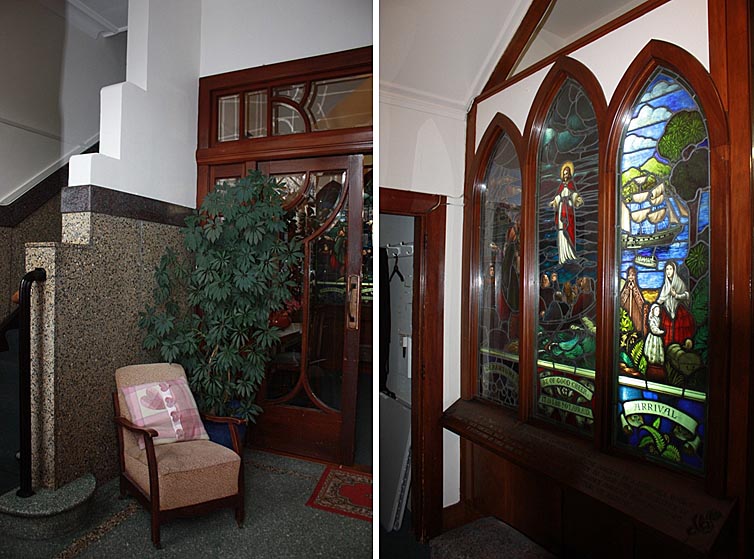
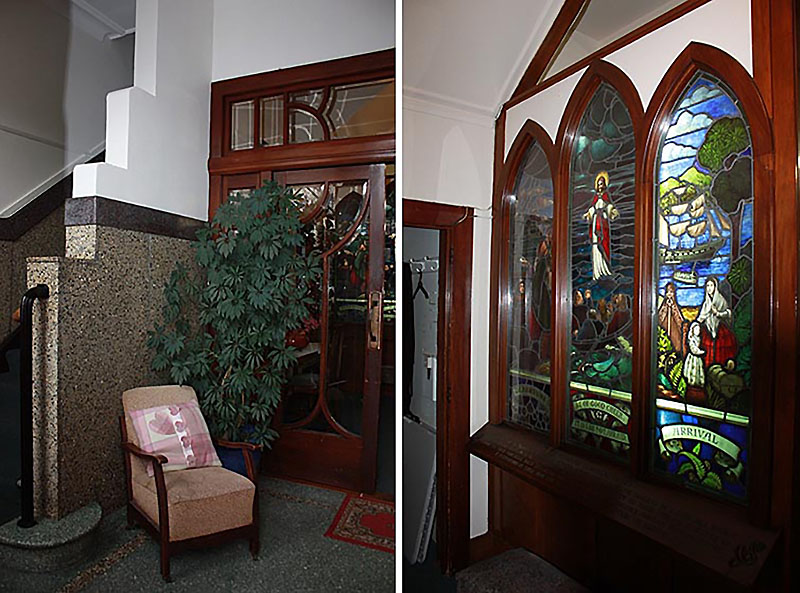
The Association refurbished the building to suit its requirements. The official opening of the Otago Pioneer Women’s Memorial Building took place on 24 February 1942 with a dedication service at nearby First Church and a procession to the new premises. Vice President Mrs Park, on handing over the key, told the crowd ‘[i]t is the devout wish of the association that in this building, and through it, the pioneer women of Otago, being dead, will yet speak to their children in a free land; a land hallowed no less by their pious endeavours than by the gallantry and self-sacrifice of their descendants to the third and fourth generations.’ The two-storey building included a committee room, kitchen, hall with raised stage and seating for 200. The entrance hall and stairway were finished in terrazzo, with bevelled plate glass doors leading into the hall or conference room. Upstairs were a series of small rooms ‘beautifully appointed with walnut and ash panelling, decorative glass and vitrolite’. The Association also planned a small upstairs chapel or ‘shrine which is to consist, when completed of a memorial window, and a book of records, containing the names of all the pioneer women of Otago, who arrived before 1869.’
Although plans got underway in 1943, it was not until 1946 that the Shrine of Remembrance was completed. Designed by architect Frank Sturmer, it was furnished with an oak chair made by Dunedin’s first cabinetmaker, John Hill, and a new oak refectory table by local Swedish-born cabinetmaker Alfred Gustafson. Robert Fraser designed a memorial stained-glass window set within three gothic arches, but due to his failing health the work was taken on and executed by John Brock. The hall and rooms were made available to a wide range of community groups, and not exclusively women’s organisations.
Those using the building in the 1940s and 1950s included the Dunedin Kindergarten Association, Lancashire and Yorkshire Society, Rialto Bridge Club, Dunedin Burns Club, Federation of University Women, Practical Psychology Club, Sutcliffe School of Radiant Living, Musicians’ Union, Radio DX League, Otago Women’s Hockey Association, Registered Nurses’ Association, the Dunedin Utility Poultry Club and many more. In 1960 over fifty organisations were using the hall and rooms. The Dunedin Spiritualist Church met in the building for nearly 50 years, from 1945 to 1994. Members of the committee were often delegates from women’s associations such as Rural Women New Zealand and the East Otago Institute.
In 1958, the Pioneer Women’s Memorial Association purchased a new property in York Place with a view to designing a new building, and again entered a period of active fundraising. It appeared to be close to realising Siedeberg-McKinnon’s vision for a purpose-built building, but again fell short of its ambitious target. Nevertheless, the Moray Place venue continued to be actively used. As of 2017, the Building was being used by groups such as the Red Cross Choir, the East Otago Federation Women's Institute, children's art classes, a monthly creative market, the business Careerwise, and community artist Janet de Wagt’s Pioneering Plastics exhibition was hosted there for several years. During 2017-2017, historian Rachael Francis collected oral histories and created a Maintenance Alphabet booklet, “which details the A to Z of maintaining the historic Moray Pl[sic] hall as a community asset.” A play, Indignation – Determination – Celebration devised and directed by Karen Elliot in 2018, narrated the struggle for the building. That same year, Janet de Wagt chose the building as Dunedin’s venue for her national Suffrage Banner Project. In 2020, the Otago Pioneer Women’s Memorial Association Building continues to provide a valuable meeting place for a variety of community groups.