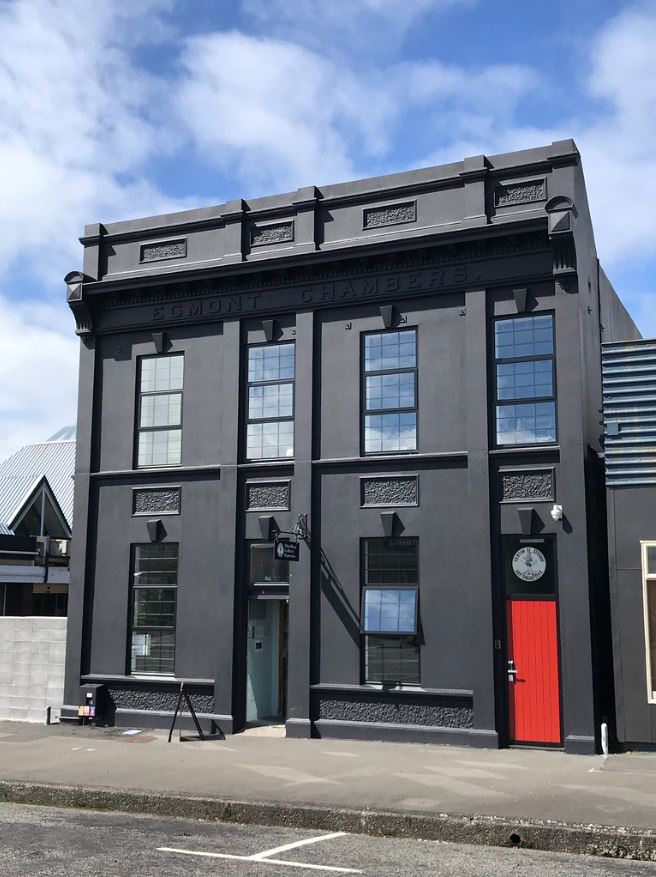
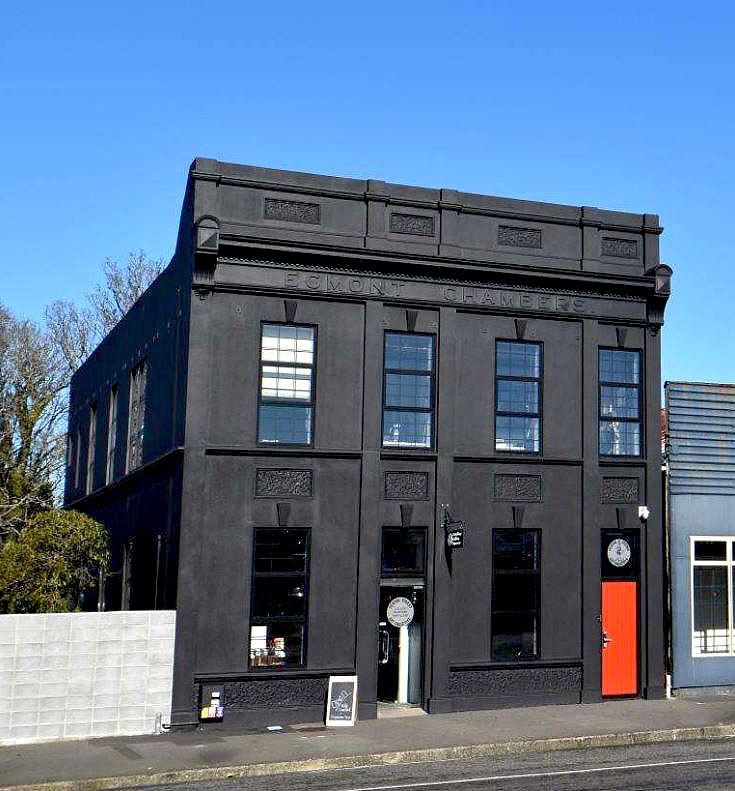
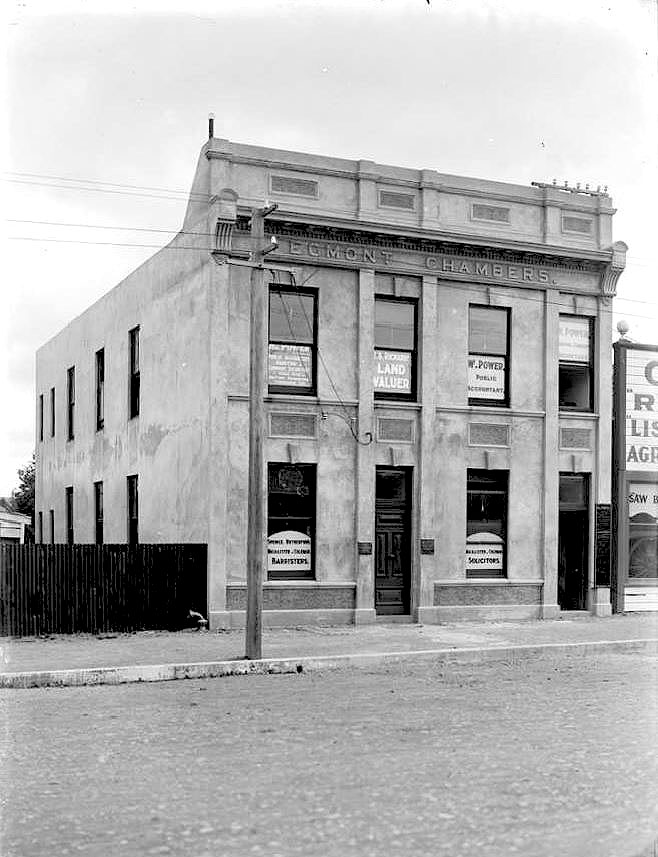
Egmont Chambers, built in 1920, has historical significance as a physical testament to a period of Stratford’s development when it experienced growth as a provincial service centre for the surrounding dairy farming industry. A substantial office building for a law firm, it signifies the town’s maturation and also reflects the second generation of the town centre’s commercial and public building stock in the interwar years, a phase that has defined the character of Stratford’s central business district. The building has architectural significance as an enduring and elegant example of the Stripped Classical style, with a clear design connection to prominent and prolific Stratford architect John D. Healy’s other work in the town centre.
Previously thickly forested, there is little evidence of permanent Māori settlements in the vicinity of Stratford, although the area was traversed by many people travelling along the Whakaahurangi Track, near to the future town site. Stratford was laid out in 1877 by the colonial government, and developed steadily to become the district’s main hub for the surrounding farmland. As export commodity prices boomed during World War One, Stratford’s commercial and public building stock began to transition from Victorian timber premises to more substantial masonry structures, a change which picked up pace during the 1920s, despite fluctuations in the economy. Law firm Rutherfurd, Macalister and Coleman were amongst the town’s businesses that had prospered enough to commission the construction of a purpose-built office building, in Fenton Street, at the south of the town centre.
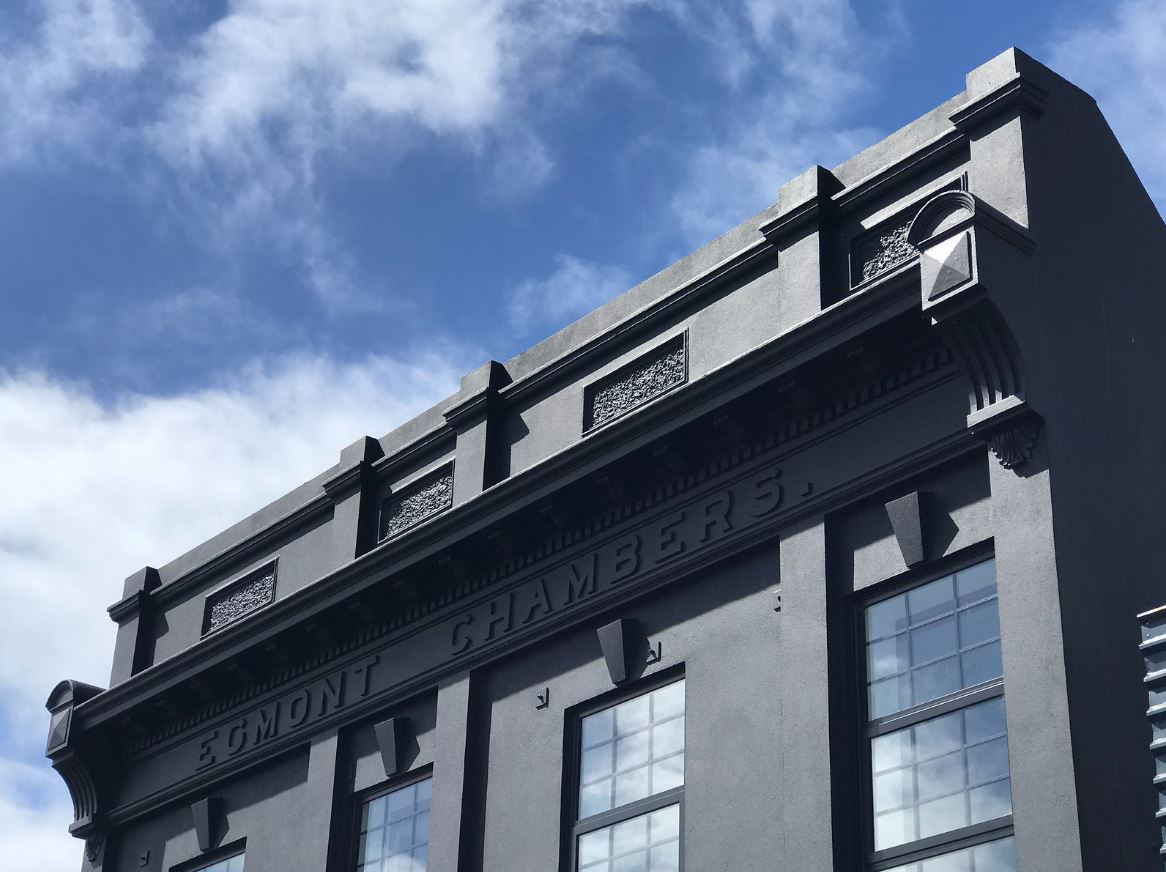
Prominent architect John D. Healy designed the two-storey reinforced concrete building, to be known as ‘Egmont Chambers’, in the Stripped Classical style popular at the time. Distinguished by the restrained classical decoration of its front façade, featuring a cornice supported by bracketing and decorative fluted corbels at each end, Healy’s design drew on elements of a decorative scheme he had employed six years earlier in the building’s near-neighbour Otago Chambers (including the pilaster strips and the frieze bearing the building’s name), and in the 1916 Municipal Building (such as sharp-edged keystones projecting above each window opening, and inset panels providing a textured contrast with the otherwise smooth finish). Healy’s legacy of stylistically-related business premises along Broadway and the surrounding streets demonstrates the significant impact he had on Stratford’s built landscape.
Egmont Chambers opened on 4 September 1920 and continued as legal and accountancy offices for nearly a century, also being well-used as a meeting space for many companies, societies and clubs. In 2016 it entered a new phase when Till Henderson Lawyers moved out, and new owners Stuart Greenhill and Jo Stallard enacted their vision of restoring a heritage building for use as a space for creative activities, living, and a café, art gallery and gin distillery. Having been little altered except for minor changes in 1979 to the interior of the ground floor, the building required substantial refurbishment as well as earthquake strengthening. Between 2017-2018 they carried out this work, remodelling the upstairs to transform the series of offices into a loft-style apartment, and paring the interiors back throughout to celebrate the bones of the building and the artwork adorning it. Since opening in October 2018 with a contemporary black paint scheme on the exterior, the Fenton Street Art Collective has been credited with injecting new energy into Stratford.