Legendary voyager Kupe is said to have explored the length of the west coast of the North Island and named geographical features in Wellington harbour. Following permanent settlement, the rangatira Tara, son of Whātonga and the eponymous ancestor of Ngāi Tara, settled at the harbour, which came to be known as Te Whanganui-a-Tara (the great harbour of Tara). In the seventeenth century Ngāti Ira of Hawke’s Bay joined Ngāi Tara; Ngāti Kahungunu, Rangitāne, Ngāi Tahu and Ngāti Māmoe also settled in the region. Later, in the 1820s and early 1830s, Te Āti Awa, Ngāti Mutunga and Ngāti Tama moved to Wellington from Taranaki. When the colonial settlement of Wellington commenced in 1839 land acquisition by the New Zealand Company, and then the Crown, alienated land from its Māori owners. Place names, such as Te Aro, convey the cultural landscape on which the modern city has developed.
Town Sections 440 and 441 in Woolcombe Street, the future site of McLean Flats and Gordon Wilson Flats, were granted to Robert Strang (section 440) and R. and J.M. Stokes (section 441) in 1853 and 1856 respectively, although both properties had been settled by 1842. Robert Stokes built a house called ‘St Ruadhan’ and the Strang family named theirs ‘Dalmuir Hill’.
Donald McLean (1820-77) married Robert Strang’s daughter Susan at ‘Dalmuir Hill’ in 1851, subsequently becoming the property’s owner. McLean acquired ‘St Ruadhan’ in 1895. McLean’s son Douglas (aka Douglas Maclean, 1852-1929) inherited both properties from his father and ‘St Ruadhan’ became his town house when he was not in residence on his farm ‘Maraekakaho’ in Hawke’s Bay. Douglas McLean, knighted in 1927, was a Member of Parliament and noted animal breeder. The contents of McLean’s two Wellington houses were put up for auction in August 1941, following the death of his wife Lady Florence in 1940. Eventually both dwellings were demolished to make way for the site’s redevelopment by the government.
State housing flats
The first Labour government initiated a programme of state housing construction after it was elected in 1935. There had been previous government housing schemes, such as under the Workers’ Dwelling Act of 1905 and by the Railways Department for staff. However, the first Labour government’s programme represented state housing’s ‘first boom period’. Houses and, to a lesser extent, flats were built throughout New Zealand to increase both the nation’s housing stock and the quality. Although the English cottage style was the dominant mode for the design of early state houses, the impact of Modernism was also felt in some single-family and duplex dwellings and it was to provide the basis for the government’s apartment buildings, beginning with the Berhampore (Centennial) Flats in 1939-40.
After a brief initial period when private architects provided designs, the Department of Housing Construction (DHC) undertook the planning of state houses and flats and oversaw their construction. Architects within the DHC, led by chief architect Francis Gordon Wilson (1900-59) between 1936 and 1948, were interested in the aesthetic and societal potential of European Modernist architecture to create high quality living environments that made a positive contribution to urban form. Modernism was also attractive to architects and builders because its emphasis on planar form over applied ornament was an economical response to contemporary material and labour shortages.
Although it was thought that ‘in a country such as New Zealand … the detached house is the ideal’, apartment buildings and blocks of flats were erected by the government because they could achieve higher residential densities than single-family state houses, accommodate the shortages brought about by the Second World War, and also, in some settings, facilitate urban renewal through slum clearance. Notwithstanding these advantages, the early multi-storey blocks of state flats were more expensive to build per unit than single-family state houses; as a result tenants of the flats were charged a higher rental. Through newspaper advertisements and opinion pieces, the Labour government worked to counter the prevailing negative public opinion that equated the term ‘flats’ with ‘a tall barracks-like structure with poor accommodation and poor appearance’.
Tenancy of state housing accommodation was achieved by applying to the State Advances Corporation. Typically only a small number of applicants specified a preference for a flat over a house. It was generally assumed that the flats would house childless couples and single people, but the provision of two-bedroom units clearly signalled they were intended for family occupancy. Priority access to state housing, including flats, was given to ex-servicemen and women even before the war had ended.
The DHC, which had been established in 1936, was renamed the Housing Division of the Ministry of Works (MOW) in 1943. By 1949, when it lost power, the Labour government had built a total of 13 blocks of flats in Auckland and Wellington; five of these were multi-storey buildings. This accounted for around 1.5 per cent of the total number of state residences constructed. Medium-density blocks of flats were also built in a number of urban centres around the country in the late 1950s; an example of this typology was the Rolleston Street Flats of 1955 in Mount Cook, Wellington.
Meanwhile a National Housing Conference held in 1953 reframed government housing policy to some extent, placing a greater emphasis upon private provision of affordable houses for purchase by families. The Group Housing Scheme was the primary vehicle developed by the first National government to increase single-family home numbers, but ‘encouragement [was] also being given to the building of blocks of residential flats’. High-density housing was seen by the government at this time as a step ‘to arrest the urban sprawl’ and ‘stop abnormal use of first-class land close to built-up areas.’ To that end it was reported in 1955 that ‘[t]he Government is proceeding with the building of large blocks of multi-story flats in Wellington and Auckland, each to contain 80 two-level two-bedroom maisonette flats, and smaller blocks in other cities both for rental and sale’. After the completion of the Gordon Wilson Flats and Auckland’s Upper Greys Avenue Flats in the late 1950s, central government abandoned such high-density housing models, favouring instead single-family and medium-density, low-rise residential forms. Nevertheless high-density social housing developments were still being built in the 1960s, 1970s and 1980s, by local, rather than central, government.
McLean Flats
The concentration of state rental flat construction in Wellington is an expression of the growth of the capital city in the mid-twentieth century within an environment in which building sites were limited by both the topography and historic development of the inner suburbs.
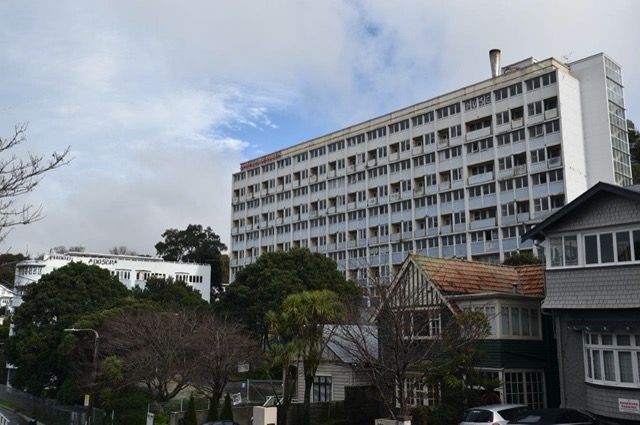
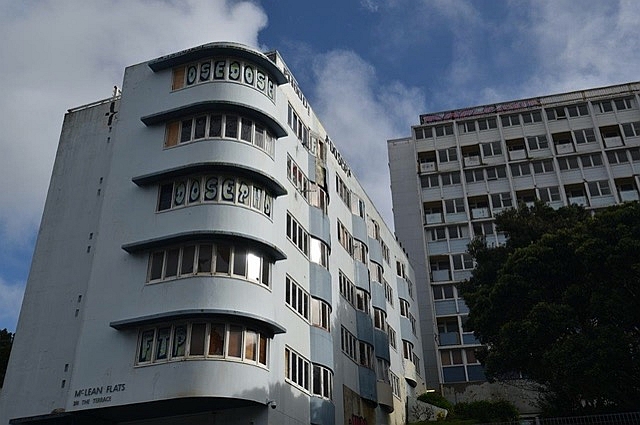
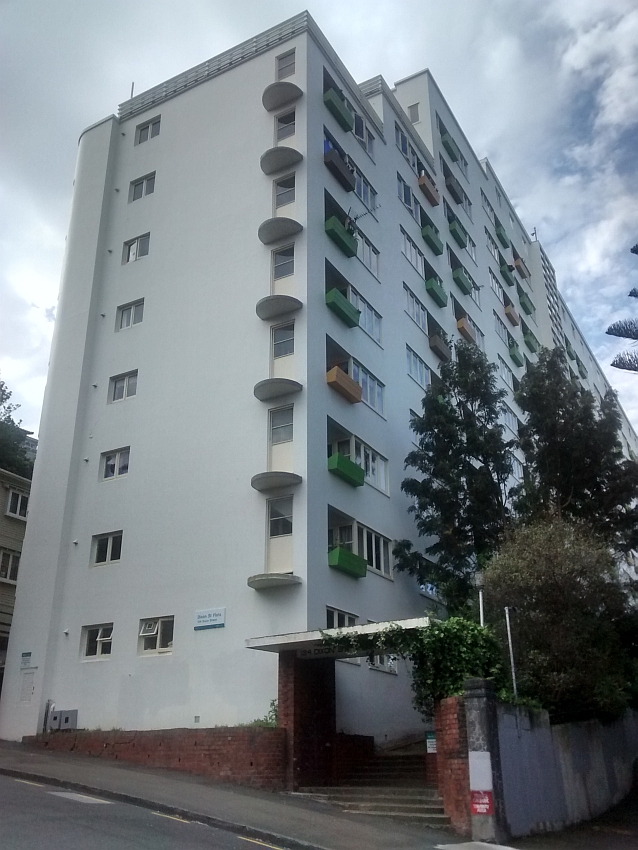
Named in honour of the previous landowners, the McLean (State) Flats were erected in 1943-44 by the first Labour government. Minister of Housing Robert Semple announced in February 1943 that the McLean estate on The Terrace had been purchased by the government for housing purposes; construction of the first block of what was to be a staged work programme was under way by late April 1943. The government had been criticised for the exclusive provision of one-bedroom units in the Dixon Street Flats (1940-44), so of the McLean Flats’ 18 flats five were two-bedroom units.
The lead architect for the project was Frederick Newman (1900-1964), although Ernst Anton Plischke was involved in preparing the original design concept for the site. Born in Vienna as Frederich Neumann, Newman came to New Zealand as a refugee in 1939 and gained work in various government departments, starting with the DHC. McLean Flats may have been the first major project he completed, in a career which later saw him appointed the Ministry of Work’s Housing Architect, and a Fellow of the New Zealand Institute of Architects. Like other émigré architects, Newman imported European experience and the Modernist approach and principles to architecture. Newman brought strong socialist ideals to his design work, contributing through government housing projects to the realisation of ‘New Zealand as a field for ideological experimentation’. As Housing Architect from 1956 a particular focus of Newman’s was to ‘provide socially responsive proposals for medium- and high-density rental accommodation’; designs for the Star Flats and various duplex and multi-unit flats, and also a change in appearance of state houses, date from his tenure.
The McLean Flats were built under war-time provisions for essential works. In 1943 it was expected that the building would provide temporary dormitory accommodation for Women’s Auxiliary Air Force (WAAF) and Women’s Auxiliary Army Corps (WAAC) members before becoming state rental accommodation. In the event the WAAF’s and WAAC’s were housed elsewhere, although one of the two historic houses on the site was briefly used as a mess before being converted into two temporary flats for use by large families; this building was later demolished to make way for the Gordon Wilson Flats.
The McLean Flats were built by W. Angus Limited from reinforced concrete with ‘special attention to earthquake resistance’. Two earthquakes centred near Masterton that occurred on 24 June and 2 August of 1942 caused extensive damage in Wellington and were a reminder of the need for earthquake-resistant construction in the city. The 1929 Murchison and 1931 Hawkes’ Bay earthquakes had already led to changes to the law in regard to earthquake-resistant construction, which was embodied in the 1935 building code.
By September 1944 the flats were almost ready for occupation. Among the early residents of the McLean Flats was Helen Heketa, the mother of Private John Heketa of the 28th Māori Battalion who died in Italy on 23 September 1944. Mrs Heketa also appears to have been the widow of an ex-serviceman and, therefore, was likely to have been on the priority list for state housing.
McLean Flats featured in the 1946 film Housing in New Zealand as representing ‘the forms of future cities – tall, white buildings rising out of the past’. The film documents the desperate need for housing at the time, complicated by difficulties obtaining construction materials due to post-war shortages. McLean Flats was used as an example of state housing which catered to those who wanted, or needed, to be in the hustle and bustle of the city; but it was also acknowledged that this was not everyone’s ideal. The flats were also illustrated in Cedric Firth’s 1949 booklet State Housing in New Zealand, for which Gordon Wilson chose the illustrations, although the text makes no mention of the building.
Gordon Wilson Flats
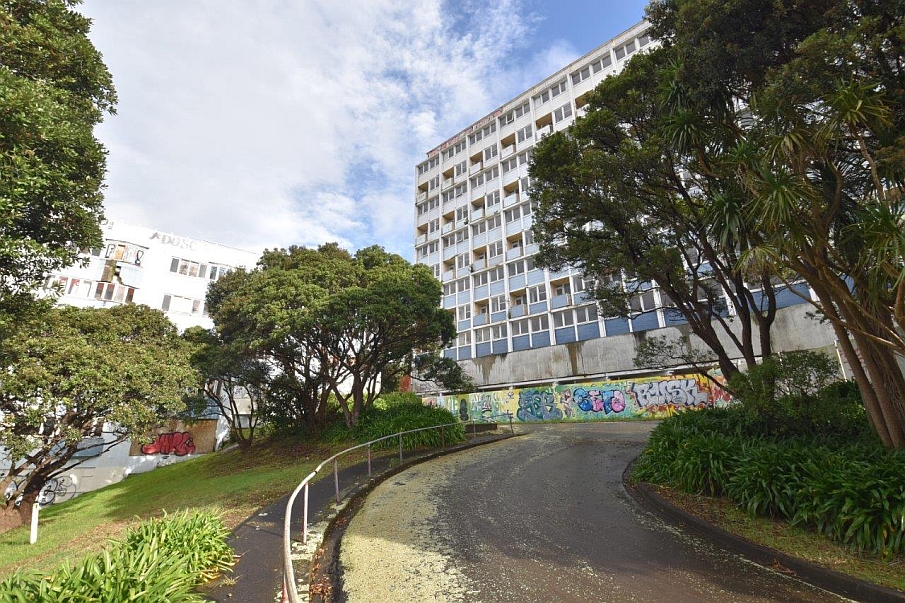
The second, somewhat delayed, stage of development undertaken on the former McLean estate involved the erection of the Gordon Wilson Flats. Although a high-rise scheme of similar scale for the site had been published in the Evening Post in 1943, the design was finalised during the term of the first National government (1949-57), by which time wartime building restrictions had been lifted but concern about the negative impacts of suburban sprawl was increasing.
The Gordon Wilson Flats are a redesign of the block originally planned to extend the McLean Flats. Plans dated May 1947 show the intention at that time was to build a curved link containing six flats between the rear of the McLean Flats and a new L-shaped block containing 52 flats in total. This did not eventuate and by 1954 the design had been reduced to a single narrow building, with major similarities to the block being designed in tandem for the Upper Grey’s Avenue site in Auckland.
The project had resumed in 1953, and working drawings for stage two of the Terrace Flats were signed off by Gordon Wilson, now the Government Architect, in August 1954; the local district office then undertook the detailed design work for the building. MOW architect Jack Wight appears to have been responsible for the technical design. Wellington District Architect for the MOW with oversight of the project was John Blake-Kelly, who later served as the Government Architect; MOW Clerk of Works was R. Patterson. Private contractors Downer & Company Limited (est. 1933), and McKenzie Thomson Hoskins Limited were awarded the contract; foreman of works was W. Christensen.
The piling system used in the Gordon Wilson Flats was reportedly a New Zealand first; the challenging hillside site and the presence of fill necessitated piling to rock, with the longest piles being 14.6 metres in length. Pre-drilled holes were filled with reinforcement and aggregate and then filled with wet mixed sand and cement, left to set for a few months. The maisonette design was adopted because of advantages such as the timber flooring between the two levels of the maisonettes reducing the overall load of the building on its foundations.
Construction delays meant that the foundation stone was not laid by Dean Eyre, Minister of Housing, until 6 August 1957. The Labour government returned to power in December of the same year. Gordon Wilson died suddenly in February 1959, and before the flats were finally opened in mid-1959 a decision was made to name them in his honour. The total cost of the build was given as £372,000 in July 1959.
Open days held in the first week of April 1959 were poorly attended and those who inspected the units complained that there was inadequate storage, no room for a refrigerator or a washing machine in the kitchen, and that the open staircase in the living room would make the maisonettes draughty and hard to heat. In the same month screening was undertaken of the 644 applications received for the 86 units available in the building (a flat for the caretaker was in addition to this number). While it had been determined by mid-May who was to be offered each of the twelve bedsits, there were initially only 30 approvals for the two-bedroom maisonettes. With a relaxation of both the maximum income threshold and requirements around sufficiency of income to cover the rent, a total of 45 approvals had been reached by the end of the month. Although a ballot was signalled as a possibility to select tenants if the building was heavily oversubscribed it does not appear that one was ever held, although by the end of 1959 there was a waiting list.
After some delays finishing the building to the government’s satisfaction, the flats were released to the State Advances Corporation for occupancy by tenants from 5 June 1959; the caretaker Gerald Higson had earlier uplifted keys for Flat 103 on 9 May. Contrary to the prevailing notion that social housing was built for low-income individuals and families, rents were higher than usual for these state housing units on the basis of the cost of construction and future maintenance requirements, and the accommodation was aimed at workers and middle-income earners. The government felt that the location of the flats would be attractive to prospective tenants and facilitate savings for them in travel time and expenditure.
Foundation tenants photographed by the Evening Post as they were moving into the flats in mid-June 1959 included Mrs C. Glennie, a widow with two teenage daughters who originally hailed from Scotland, and Mr and Mrs W. Shaw and their two young sons. The bedsits were originally allocated to single working women over 45 years of age and two-bedroom maisonettes were assigned to families, some led by single mothers. Urban historian Ben Schrader notes that ‘numerous single men had applied for the bedsitter flats even though they were ineligible and many couples had applied for the maisonettes in the view of marrying after finding suitable accommodation…the occupational profile of tenants was diverse and included: milkmen, bakers, [a] plumber, clerks and civil servants.’ Schrader considers that this offers ‘a rare and fascinating perspective on how a socially diverse mix of tenants lived alongside each other and negotiated social relations in a high-density environment’. In later years some tenants complained about the noise from neighbours’ children, but there were few demands for transfers. Many tenants were particularly appreciative of having their own bathrooms, after years of shared facilities in rooming-houses.
Gas water heating was initially installed to demonstrate supply advantages at a time when security of supply for electricity was under increasing pressure. The system resulted in higher construction costs and was replaced in two stages (1962 and 1968) by electricity when the gas heaters’ ignition mechanism and flues did not meet the required performance standards and were causing health concerns.
The Gordon Wilson Flats was the first building in New Zealand to be comprehensively instrumented for seismic engineering research. Seismic monitoring equipment–strain gauges and strong-motion accelerographs–was installed by the Department of Scientific and Industrial Research (DSIR) at the time of the building’s construction; the strain gauges likely still remain in the foundations. The equipment was a precursor to the accelerographs installed in a range of building types by the DSIR from 1963 onwards. These instruments provided useful information and field experience for DSIR scientists, as well as being of interest to the leader of Japan’s institutes of seismic research in high-rise construction, Toshihiko Hisada. Scientific papers were published with reference to the data collected in the building and the development for commercial sale, both nationally and internationally, of the M.O.2 Accelerograph by DSIR staff in the mid-1960s could be considered an outcome of the programme of scientific seismic measurement. The strong motion accelerograph provided information pertaining to building performance in the event of an earthquake and thus created a New Zealand-specific data set for engineers wanting to assess ‘earthquake resistance in large structures’ during earthquakes. As the DSIR director of the research stated:
‘There is no question of the value of the results that can accrue from this very long-term undertaking. The loss to New Zealand from a large earthquake is gigantic. We are using the Terrace Flats not to find how the Terrace Flats would behave for their own sake but to find how to make all future buildings in New Zealand safe against earthquakes.’
Engineering research continued in 1964 when the Gordon Wilson Flats was subjected to forced-vibration testing. This is thought to have been the first building in New Zealand in which this physical testing – vital as a comparison with laboratory tests – occurred.
Described by architectural historian Nikolas Pevsner as ‘particularly interesting’, the Gordon Wilson Flats featured in the Architectural Review in October 1959 as part of Pevsner’s review of commonwealth architecture. Pevsner had visited New Zealand in 1958 and was hosted by the Architectural Centre during his stay in Wellington. In February 1961 the Wellington District Branch of the New Zealand Institute of Architects featured the Gordon Wilson Flats in their journal. A photograph of the building in the 1975 history of the MOW was used to illustrate high density housing provision by the state.
Nonetheless, by the late 1950s the government’s focus had already shifted away from vertical flats towards low-rise medium-density housing (blocks no higher than three storeys), with these accounting for 54 percent of all units built in 1960. A decade later the design focus had swung further towards single units, with only 11.9 percent being multi-units. After the Gordon Wilson Flats and Upper Greys Avenue Flats, the construction of high-rise blocks of state flats stalled for 60 years, although with more New Zealanders now considering medium and high-density inner city living as a desirable option, and increased concerns about urban sprawl, in 2020 Kāinga Ora (Housing New Zealand Corporation) is again employing this urban design solution on the Upper Greys Avenue site.
Recent history of the flats
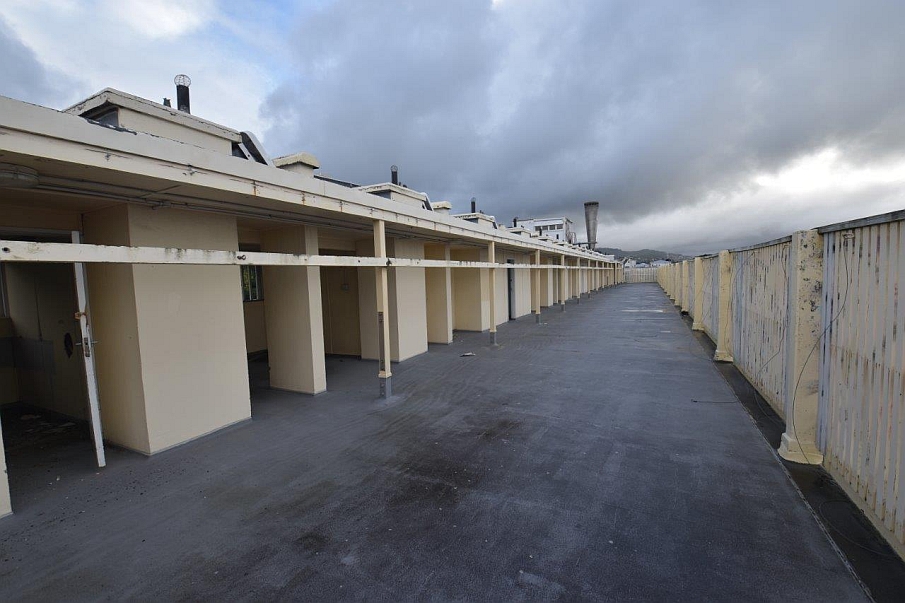
After decades of residential use, the McLean and Gordon Wilson Flats were vacated in 2011 and 2012 respectively after the buildings were identified as being potentially earthquake-prone and in need of remedial work; the façade of Gordon Wilson Flats was deemed particularly unsafe. Residents were given a week to move out; some expressed their distress and sentimental attachment to the place (‘This is my castle, I love it here’), while others noted issues with anti-social tenants and a lack of building maintenance. The Gordon Wilson Flats were purchased by Victoria University of Wellington from Kāinga Ora in 2014; purchase of the McLean Flats by the university took place in 2019. In June 2018 building consent for redevelopment of the McLean Flats, including seismic strengthening, refurbishment of the existing units and a three-storey extension, was lodged with Wellington City Council (WCC) but not yet actioned.
Since late 2015 the heritage status of the Gordon Wilson Flats and the university’s desire to redevelop the site as a whole to create a pedestrian link between the city centre and its Kelburn campus has been under discussion, and subject to a planning hearing in 2015 and Environment Court proceedings in 2016-2017. The latter was led by the Architectural Centre, who successfully argued that Gordon Wilson Flats’ significant heritage values merited its inclusion in the Wellington City District plan heritage schedule. Expert advocates described the building as being ‘a prominent marker of an alternative vision’; ‘a remarkable example of a heroic period of modern architecture in New Zealand’; and ‘the most developed form of its type…thus an architectural milestone in New Zealand.’
Despite this endorsement of the building’s significance by the Environment Court, arguments for and against the building’s architectural quality and heritage values have continued to be put forward in the public domain, highlighting in part conflicting views about the merits of Modernist architecture in terms of its aesthetic and functional qualities. In July 2020 Victoria University announced plans to refurbish the McLean Flats and demolish the Gordon Wilson Flats to make way for new teaching and research facilities and create an entrance plaza for the campus that overlooks the site.