Early History
Before 1840 Te Whanganui-a-Tara (Wellington) was heavily forested. The region was named for Tara, the first person to settle there. During the 17th century his descendants were joined by Ngāti Ira; other iwi also settled for different lengths of time. From the 1820s people from Taranaki (Ngāti Mutunga, Ngāti Tama, and Te Āti Awa) migrated to the region. In the early 1830s Patukawenga of Ngāti Mutunga gifted the area east of the Heretaunga (Hutt) River to the recently-arrived Te Āti Awa leader Wīremu Tako Ngātata (Wī Tako). It may have been at this time that Te Mako pā at Naenae was founded. It was located at the corner present-day Daysh Street and Park Avenue and might have been used as a base for Te Āti Awa cultivations and food gathering sites in the district. In the early 1850s Wī Tako moved from Wellington to the (unoccupied) Te Mako pā site, where he built a large European-styled house. In 1856 he commissioned Horonuku of Tūwharetoa to build a pātaka (storehouse) to show his support for a Māori King. In 1861 Wī Tako leased Te Mako to settler William Beetham, who lived there until his death in 1888. The house was subsequently consumed by fire.
Following the First World War, the Reform government established a poultry and market garden settlement for partially disabled servicemen in Naenae and the area became Wellington’s main market garden. In the late 1930s the Labour government proclaimed the land as the site for its new state housing scheme. Market gardeners relocated to Ōtaki, and Naenae and its neighbouring communities of Epuni and Taitā were built as state housing suburbs.
The spatial and social planning of these suburbs was strongly informed by garden city ideology. Naenae is the best realisation of this planning idea in New Zealand and its most innovative social housing suburb. The scheme’s lead planner was the prominent architect Ernst Plischke, ‘one of the foremost early exponents of modernism in New Zealand architecture’. Streets, services and amenities were designed to encourage social interaction and the development of a community spirit. This was especially evident in Naenae. Its 1943 plan featured a substantial community centre designed in the modernist style. This was based on St Mark’s Square in Venice and included pedestrian squares, shops, offices, public amenities, and a tower (akin to a campanile) to relieve the horizontal line of the buildings.
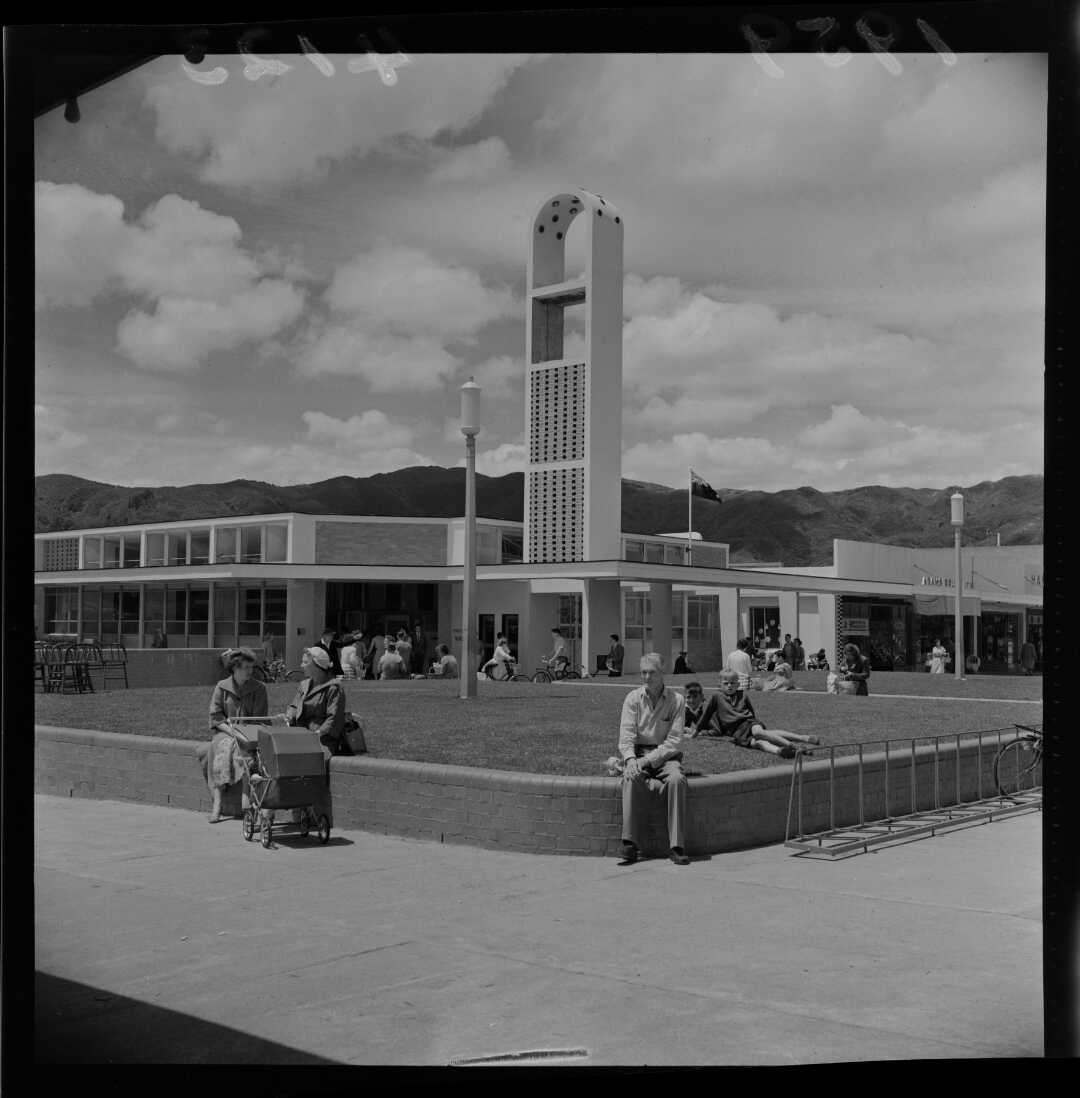
Due to the pressure to build houses first, the community centre was delayed until 1951. By then Plischke had left government service and other Ministry of Works (MOW) architects finalised the plan. Most of the space would be given over to shops, but it would also include a cinema, hotel and professional offices. It was to be New Zealand’s biggest and most costly pre-planned centre and its first comprehensively planned commercial centre and purpose-built pedestrian mall. The form owed much to Plischke’s original plan of pedestrian courts with car parking assigned to the centre’s edges. The centre’s main axis ran from the railway station, through the shopping court, to the Olympic swimming pool. In 1953 the government invited applications for sites in the complex. All buildings had to be constructed in a modernist style and have common parapet and veranda heights. These restrictions increased both architectural unity and streetscape appeal of the complex. The centre was built in a piecemeal fashion in the following years and named Hillary Court after the national hero Edmund Hillary, who had recently been the first person to summit Mt Everest.
Post Office
The post office site was the last to be developed. From the late 1940s the Post and Telegraph Department experienced rapid growth, spurred by increasing demand for its communication and financial services. This made it among the largest and most widely spread businesses in New Zealand. As the Postmaster General Walter Broadfoot stated in 1954, the post office was ‘closely bound up with the economic and social life of the country. Its activities concern every business, every family unit, and every citizen.’ The importance of the post office in national life was reinforced by the fact that official distances were measured from one post office to the next.
The post office had long been a social hub in communities – a place to post letters, bank, or chat with neighbours – and was typically among the most impressive public buildings. As the Postmaster General again explained:
“The post office is often one of the architectural features of a town or suburb and because of this an effort is always made to ensure the building is aesthetically pleasing. In planning the layout of a commercial area in new suburbs, the planner usually endeavours to make the post office the focal point. This in turn calls for a high standard of design in planning the building.”
The first post office in Naenae was an ex-Army building that was located on the corner of Seddon Street and Naenae Road from 1946. With the state housing suburb growing rapidly the facility soon became inadequate. In December 1955, the Commissioner of Works sold a parcel of Crown land in Hillary Court to the Post and Telegraph Department. In line with the aforementioned policy, the corner site was the most prominent in the whole development, situated at the nexus of the precinct’s two main axes. The first design was completed in August 1956 and overseen by the Government Architect Gordon Wilson and District Architect John Blake-Kelly. As well as accommodating post office functions – mail room, public service area, staff offices – the initial design included a health clinic at the building’s northern end.
Architecture
The Naenae Post Office was part of a wider shift in modernist architecture in New Zealand that was reflected in public buildings, including post offices. Those designed in the early 1950s showed a strong Bauhausian influence (as evolved in post-war New Zealand), exemplified by the massing of forms like stairwells at post offices in Feilding (1950) and Hokitika (1953) or the austere, Le Corbusian-influenced, lines of buildings like the Taitā Post Office (1958). Naenae displayed the beginnings of a move from this international modernism to Brutalism, a change Wilson was championing with other buildings like The Terrace Flats (1959).
Wilson had been appointed chief architect of the Department of Housing Construction in 1936 and oversaw major state housing projects, including the Berhampore Flats (1939-40; List No. 7432) and the award-winning Dixon Street Flats (1941-44; List No. 7395) in Wellington, and the Greys Avenue Flats in Auckland (1945-47; List No. 583). He remained chief architect when Department of Housing Construction was folded into the MOW in 1943 and was appointed Government Architect in 1952. Wilson was a highly active and interventionist leader ‘who had a strong influence on all the work of the architectural office’, and the Naenae Post Office was no exception.
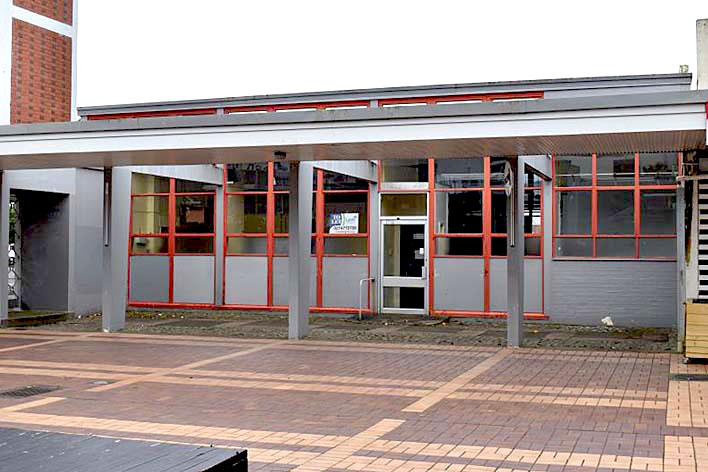
The Naenae design owes much to Aquinas Hall at Otago University (1954) designed by Ted McCoy, who was strongly influenced by the work of early British Brutalist architects like Alison and Peter Smithson. Aquinas Hall featured a white painted concrete frame with regular window bands and red brick infill walls; the Naenae Post Office bears the same white plastered concrete frame, red brick infill walls and geometric window bands.
Clock Tower
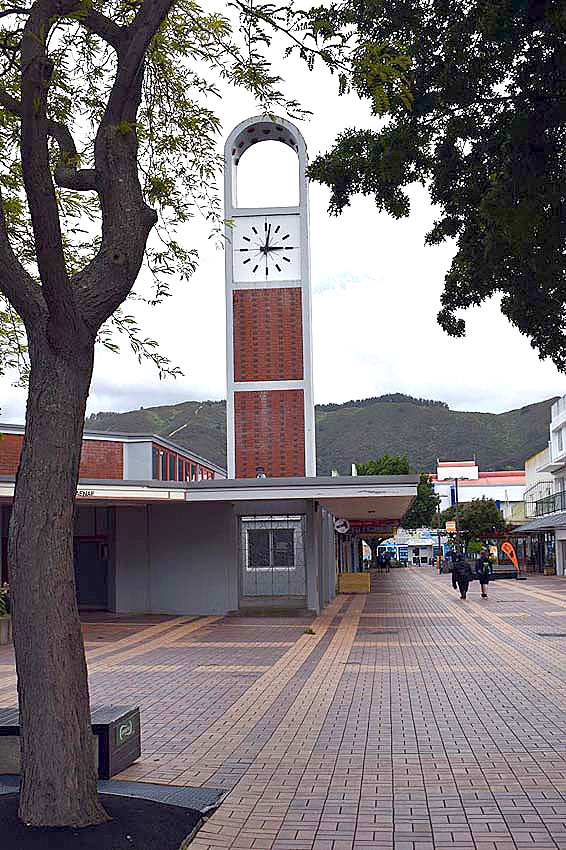
Naenae’s most prominent feature was to be a slab-like, free-standing clock tower. These had been a standard element in larger post offices from the 1860s, rising either at the middle or corner of the building and often indicating the public entrance below. They were major landmarks, expressing the importance of the post office in daily life and signalling the passage of the commercial day. The 1931 Hawke’s Bay earthquake highlighted the risk such towers posed to the public if they collapsed. This led to a discontinuation of post office tower building and the removal or reduction of some existing towers, such as those on Palmerston North and Wellington’s chief post offices.
The inclusion of a tower at Naenae was initially opposed by the post office management. The department’s policy at that time was not to build towers and there was concern a precedent would be set. The Commissioner of Works pointed out that the demolition of clock towers had been due to their seismic risk and not because ‘the community no longer desired them.’ He explained that the Hutt Valley was lacking in vertical features and there was nothing to visually signal Hillary Court’s location: ‘A modest feature in the new Post Office would relieve the horizontal monotony and make the building a focal point. Its function would be emphasised and anonymity replaced with distinction’. Naenae’s circumstances were unusual and it wouldn’t be regarded as precedent-setting.
The Director General was persuaded by the explanation and agreed to an exception being made, which signified the influence of the government architects. The need for a vertical landmark to signal Naenae’s commercial hub had been recognised by Ernst Plischke, who had included a tower or campanile in his 1943 design for Naenae’s community centre. Gordon Wilson understood its aesthetic value and ensured Plischke’s idea was carried over into the revised Naenae commercial centre scheme.
The clock tower symbolised past and modern times simultaneously. Following tradition, it was sited to one side of the building and near the building entrance. Rising 47 feet high (14.3 metres), it dominated the Naenae townscape. But in light of the Hawke’s Bay earthquake of 1931 and departmental policy, consideration of seismic issues was paramount. New thought about the tower’s placement in relation to the rest of the building was required and unlike in earlier post offices, the tower was not fully integrated into the rest of the building, which was seen to reduce the seismic risk. This combined with a reinforced concrete frame permitted the existence of its slender form.
As predicted, the tower did not lead to a flurry of other ones elsewhere. Neither the new Masterton (1961) nor Stratford (1964) post offices included towers. It was not until the 1970s that clock towers re-emerged as a feature of new post office buildings, most notably the brutalist Nelson Post Office (1976). This made the Naenae Post Office unique in the 1950s and 1960s. The simplicity of its form and the arrangement of materials gave the tower an elegance that was arguably unsurpassed by any similar structure in the period; the Palmerston North Clock Tower in The Square (1957) was its closest rival but this was demolished in the early 2000s and rebuilt anew.
Construction and Opening
The construction contract was awarded to J. M. Construction in September 1958 with a bid of £32,000 (equivalent to $1.49 million in 2019). The need for a health clinic in the building had passed and this area was converted into a shop until the space was required for post office use. The foundation laying ceremony was held on 1 May 1959 and the building was opened on 4 December by the Post Office Director General Michael Moohan. Also in attendance was the Prime Minister Walter Nash. He had been a driving force in the development of Naenae since 1944 and, as the local Member of Parliament, had retained a strong interest in its continuing growth. He told the assembled crowd that the new building was the ‘last piece in the mosaic of the Naenae commercial centre’. He was particularly delighted to see a new post office clock tower, noting that they were once as integral to post offices as stamps: ‘Not only will the clock mark the time for all who see it, but the 47ft. high tower is undoubtedly the architectural focal point for the whole Naenae community centre’. The customer service area featured a wooden counter, elegant pendant ceiling lights and a striking abstract mural from the emerging Stokes Valley artist Guy Ngan, who had joined the MOW in 1956 at the behest of Gordon Wilson. Ngan went onto design sculptures and murals for several government buildings in the 1960s and 1970s.
The Naenae Post Office received public recognition at the time of its construction, appearing in professional and popular New Zealand architectural journals, and representing modern post office design in the Encyclopaedia of New Zealand (1966).
Later history
Due to a paucity of archival evidence, the building’s post-1960s history is patchy. There are many anecdotal reports about the importance of the building in daily community life. A popular collective memory is how teenagers would scale the clock tower as a local rite of passage. The practice damaged the clock mechanism in 1979 and led to the tower’s brick lattice work being filled in to stop would-be climbers. In 1984, substantial modifications to the building were proposed, which would have added a second storey to the structure and radically reconfigured interior spaces. In the end changes appear to have been restricted to renovating the public service area (which likely included the removal of the original counter and lighting), replacing the fabric roof with an iron one, installing new entrance doors, plastering over lattice brick work above the western parapet, and the repainting of the interior and exterior. It might have been at this time that the Guy Ngan mural was taken down. Its location and whether it still exists is uncertain.
The original clock was removed from the tower in 1991 and apparently dumped at a local tip. A new clock was installed around 2002 after publican Gary O’Keefe campaigned for its reinstatement, arguing that it was ‘greatly missed’. He recalled ‘setting his watch by the Post Office clock during the 1960s in his way to and from school’ and reported that ‘hotel patrons still talk about the clock’.
In the late 1980s, following the creation of New Zealand Post as a state-owned enterprise, over 400 post offices were sold in a cost-cutting exercise and closures continued into the 21st century. With the growth of electronic communication and the demise of letter mail, the post office ceased to be the social and commercial hub it once was. During the 2010s New Zealand Post closed many more post offices due to reducing demand for its services and to save costs. These were usually sold to private buyers and buildings were converted to other uses. Remaining post office services were now franchised out. Where the post office had once been among the most conspicuous building in the high street, it was now consigned to a corner of newsagent, dairy or even petrol station.
In 2015 New Zealand Post closed its Naenae branch and sold the building to private buyers. Groups like the Naenae Residents’ Association have lobbied for the building’s retention and expressed a desire for the tower to remain standing in the face of seismic concerns. In 2018 the building was used as a temporary community art space, in part because its aesthetic qualities were well-suited for this function. During the 2019 Naenae Matariki Festival the wall facing the mall was the backdrop for an outdoor screening of the movie Hunt for the Wilderpeople, advertised as taking place ‘under the clock tower’. The Hutt City Council announced it was in negotiations to lease the building for community purposes in late 2019. Earlier that year it was added to the District Plan heritage schedule; the proposal garnered supportive community submissions.
The tower remains an emblem of both Hillary Court and Naenae. It is often depicted in media reports on the suburb and is used in branding for local organisations and events, such as promotional group Naenae Proud – Shop Local, the ‘This is Naenae: Ko Naenae Tēnei’ facebook page and the 2019 Naenae Matariki Festival. When the clock was repaired in 2019 social media posts elicited positive community comments, like ‘the clock is and was a landmark’. Its soaring form is a prominent element in the Daysh Street mural at the entrance to Naenae.