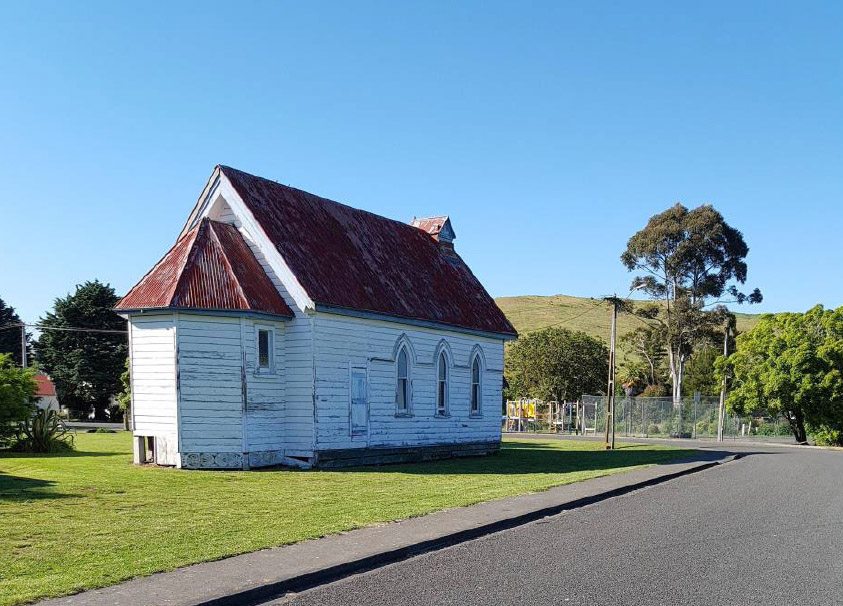
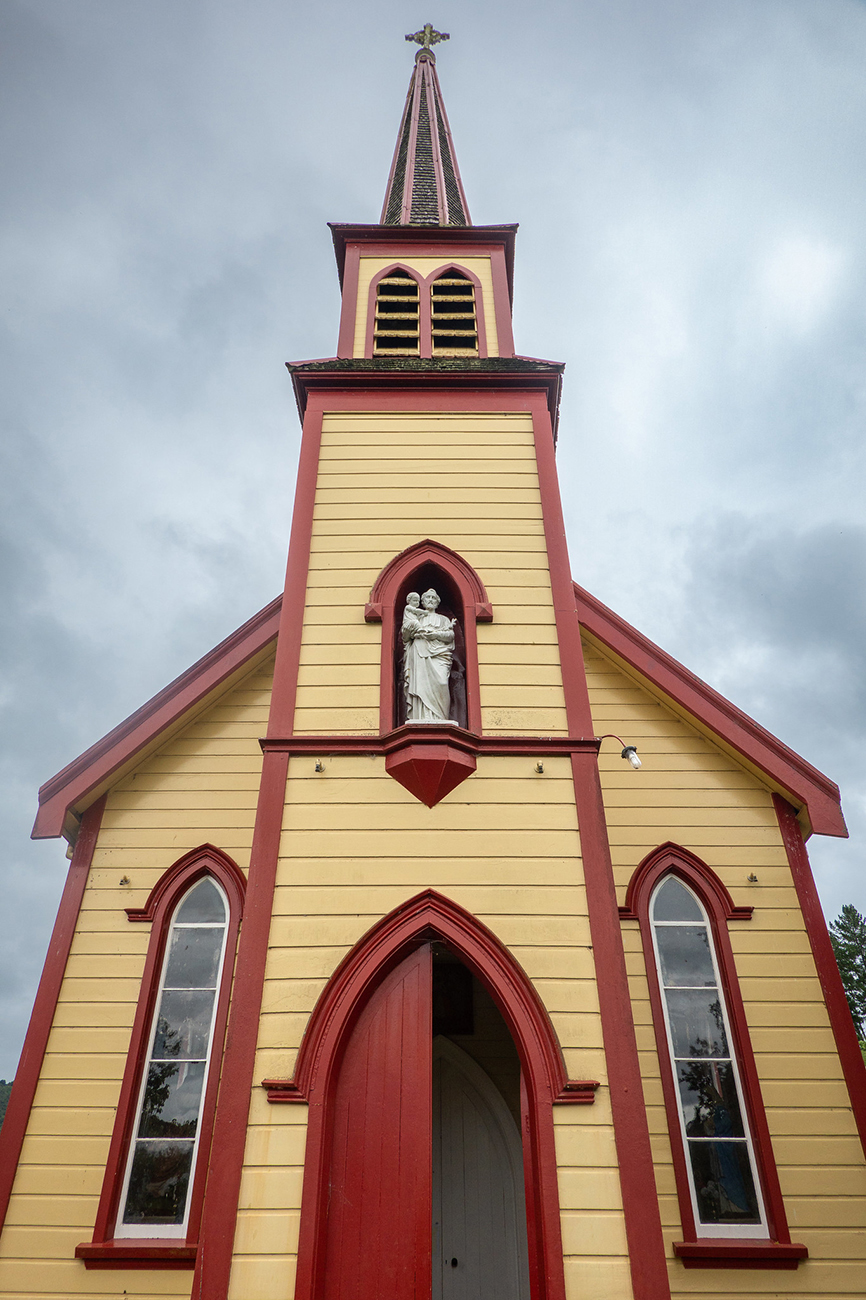
The Church of the Immaculate Conception was built at Pakipaki, a small papakāinga (village) south-west of Hastings, in 1880. The name is an abbreviation of Te Pakipaki-o-Hinetemoa. This tells the story of Hinetemoa, who gathered up her rāpaki (skirt) after being seen bathing and threw it around her shoulders, which made a clapping (‘pakipaki’) sound.
Her son Te Whatuiāpiti was the eponymous ancestor of Ngāti Te Whatuiāpiti, an iwi resident in Heretaunga (Hawke’s Bay) when Ngāti Kahungunu arrived in the early seventeenth century. Ngāti Te Whatuiāpiti eventually became part of the Ngāti Kahungunu whānui but nevertheless ‘retained a separate identity’.
War and exile
Ngāti Te Whatuiāpiti and Ngāti Te Ūpokoiri, a hāpu of Ngāti Kahungunu, battled for control over Heretaunga in the early decades of the nineteenth century. Ngāti Te Ūpokoiri enlisted the assistance of Ngāti Tūwharetoa, who raided Heretaunga from their lands around Taupō. In 1819 Ngāti Tūwharetoa unsuccessfully attacked Ngāti Te Whatuiāpiti at the pā in the middle of Roto-a-Tara, a lake near Te Aute. A few years later, with Ngāti Te Ūpokoiri and other allies, including Ngāti Maniapoto, Ngāti Tūwharetoa again besieged Roto-a-Tara. Te Pareihe, war-leader of Ngāti Te Whatuiāpiti, built a pūhara (tower) after the invaders put a causeway across the water. The defenders threw rocks from the tower and one launched by a warrior called Hawaikirangi killed the Ngāti Maniapoto leader Te Arawai. He was named Puhara to commemorate this feat.
Ngāti Te Whatuiāpiti were victorious but Te Pareihe knew the invaders would return with muskets. He took his people north to Nukutaurua on the Māhia Peninsula, where most of the Heretaunga population ended up living in exile during the so-called ‘musket wars’ period. There Puhara Hawaikirangi must have met the Marist Father Claude-André Baty because he was described as ‘the chief supporter of the Papists’ (Catholics) by Anglican missionary William Williams in 1841. Catholic missionaries had first arrived in New Zealand in 1838, some 24 years after their Anglican counterparts.
Catholic Māori mission
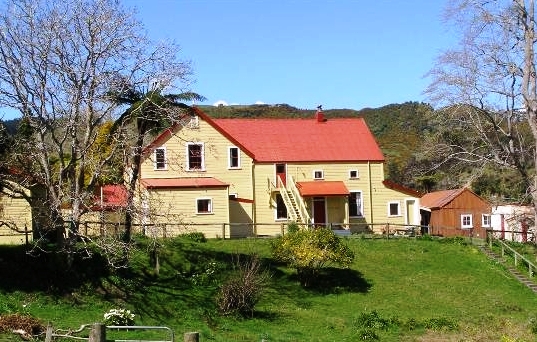
The people returned to Heretaunga over the next few years. Puhara Hawaikirangi became the patron of the Catholic Māori mission in Hawke’s Bay when Marist missionaries settled on his land at Pākōwhai in late 1850 and built a station. Having a rangatira for a patron offered security but the mission was vulnerable to shifting iwi politics. In 1857 Puhara Hawaikirangi was killed during an inter-tribal battle over land sales to the government. He was said to have been baptised a Catholic before he died, during which his blood mixed with the baptismal water. After his death the pā at Pākōwhai was ceremonially burned and the community was separated ̶ the mission shifted north to Meeanee in 1858 under the leadership of Father Euloge Reignier and the Māori Catholics founded a new settlement at Pakipaki a few years later.
Suzanne Aubert
In 1871 the French Catholic lay sister Suzanne Aubert (1835-1926) joined the Marists at Meeanee. Missionary work had ground to a halt during the wars of the 1860s and in the following decade a growing Pākehā population diverted the priests’ attention away from their Māori flock. With Father Reignier now ageing, Hawke’s Bay was effectively without a Māori missioner until Aubert, a proficient speaker of te reo Māori whose skills and energy were recognised by Reignier, took up the role in an unofficial capacity. . By 1872 she was ‘visiting fairly regularly six or seven pa [sic], and the chiefs, who were a bit unfriendly and suspicious at first, now give me a warm welcome’. Missionary work was to be a key aspect of her life and a significant portion of this work was carried out in Hawke’s Bay.
Aubert had worked as a volunteer nurse in France and her medical skills were in demand as infectious diseases like smallpox followed Pākehā settlers into the region. She treated 1,353 people in 1874 and twice that in 1877. She brought her medicine bag on pā visits and treated Māori and Pākehā patients at the mission station, administering the unique remedies created from native plants (collected with the help of knowledgeable Māori women) for which she later became known nationwide. She was a much-trusted medical practitioner, described by the rangatira Renata Kawepo as ‘the doctor of doctors’. She baptised babies when a priest was not available and became a godparent to some, including Maria Makerema, the daughter of Marata Te Heuheu and Urupene Puhara (the son of Puhara Hawaikirangi) of Pakipaki.
Though she believed in freedom of religion and co-operation between denominations, Aubert was a strong advocate for Catholicism and worked hard to shore up and grow the faith among Hawke’s Bay Māori. As a woman, she could not carry out sacramental duties so she vigorously lobbied her superiors for an official Māori missioner, an appointment she believed was essential for the faith’s survival in the region. She was concerned that Māori were becoming Protestants or returning to their customary spiritual beliefs in the absence of such a person.
Francis Redwood (1839-1935), the new Catholic Bishop of Wellington, was sympathetic. Aubert invited him to Pakipaki during a trip to Hawke’s Bay in 1875 and he promised to find a priest. The people wanted a young man, whom they believed would be better placed than an older man to learn the te reo Māori and tikanga (customs). Such a person was not quickly forthcoming. In 1877 Urupene Puhara lamented the delay: ‘where in the world does this bishop live, who came to see us two years ago and promised us a priest? He’s just like all the rest, he forgets us….’
That year Hawke’s Bay rangatira held a series of hui at which religion was much discussed. The outcome was a commitment to freedom of choice with Protestantism and Catholicism seen as ‘equal in goodness’. Aubert, with Urupene Puhara’s words in mind, worried that ‘everything [would] end up the protestant way’ if Pakipaki didn’t get its priest. By the end of 1877, with Anglican churches served by ministers springing up at Hawke’s Bay pā, she stopped telling the Pakipaki community a priest was coming: ‘I can see only too clearly the disbelieving smiles on my listeners’ lips’.
In the meantime Redwood commissioned her to revise the Māori Catholic prayer-book and catechism. The first edition had been published in 1847; copies were scarce and transliterations outdated. The almost-500 page Ko te ako me te karakia o te hahi Katorika Romana was published in Napier in 1879, followed by a much shorter edition in 1881.
A new priest and church
The prayers of Aubert and the Pakipaki community were answered in early 1879 when they received word that Frenchman Father Christophe Soulas had volunteered for the position of Māori missioner. He arrived in Pakipaki in midsummer and by the end of the year community fundraising for a church had begun. Who instigated the church is unknown, but Aubert had witnessed first-hand the importance of church building to the maintenance of the faith and would have been closely involved. It is highly likely that she donated some of the inheritance she received on her father’s death in 1874 to the building fund.
Her single-handed achievement in gaining a dedicated Māori missioner for Pakipaki was undoubtedly a critical precondition for the church and had a wider significance. Aubert has been credited with playing ‘a major role in the revival of the Marist mission in the Wellington diocese’, which Hawke’s Bay was part of, and the church symbolises this revival. It is the oldest known surviving building she was involved in constructing.
The church was built on land owned by Urupene Puhara and he helped with the construction. It was blessed by Father Yardin of the Meeanee Mission on 8 June 1880 before a crowd of Māori Catholics, mission priests, and nuns from the Sisters of Our Lady of the Missions. Aubert described it as a:
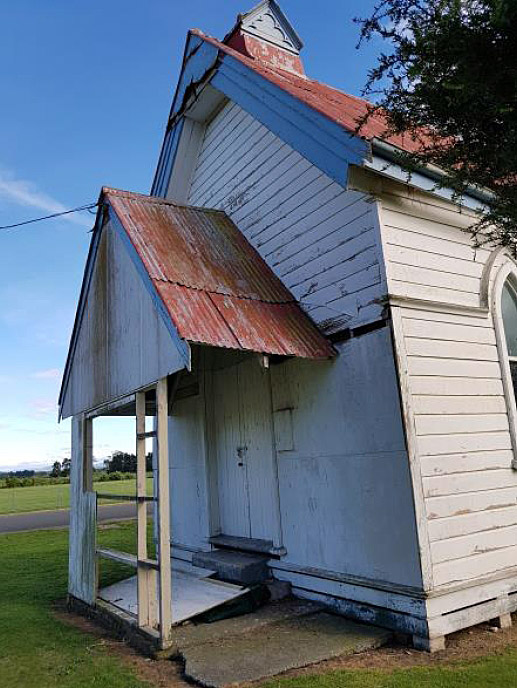
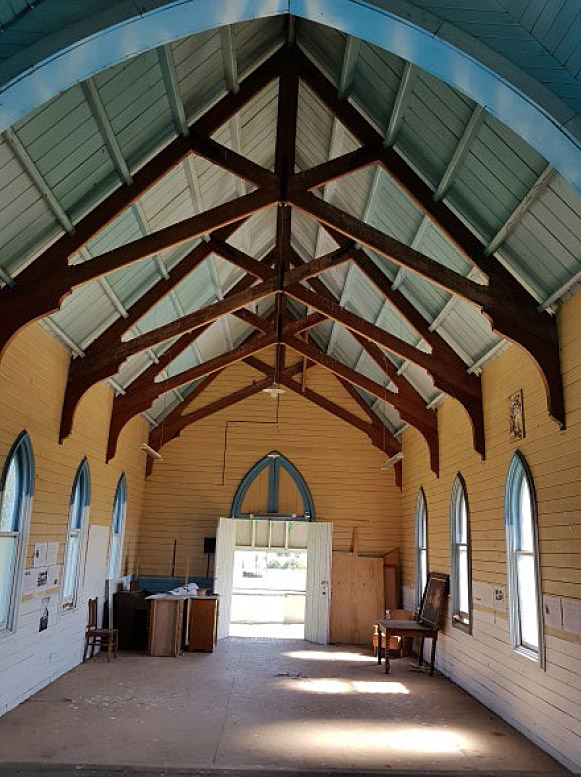
‘pretty little Church…well-constructed in semi-Gothic style: a high, graceful vaulted roof, a large double window adorning the back of the sanctuary, four beautiful windows spaced down each side, and at the back a big double door. The belfry has a spire and the little bell reminds you of an abbey bell.’
An old altar from Meeanee was ‘transformed’ by decorations including fresh flowers, laces, beadwork and an altar cloth embellished with ‘a large lamb embroidered in white wool lying down before a cross’. A pearl chandelier hung in the nave. The church furnishings were French in style and there were no Māori elements to any aspect of the design.
After mass the Pakipaki community put on a hākari (feast). Of all the Pākehā guests, only Aubert and two Marist brothers attended, the remainder causing offence by dining at a local hotel owned by a settler family. Aubert’s knowledge of and respect for tikanga was evident and the incident highlighted a long-standing gulf between Māori and Pākehā Catholics that she was rare in bridging. This could not, however, detract from what was for her ‘a day of great happiness in New Zealand’.
Aubert stayed in Hawke’s Bay until 1883, when she and Father Soulas were sent to establish a Māori mission at Hiruhārama (Jerusalem) on the Whanganui River and subsequently built St Joseph’s Convent (List No.961; Category historic place) in 1892, followed by St Joseph’s Church (List No.161; Category historic place) in 1893. She had spent the last years living at Pakipaki and the people were loath to see her go. They wrote to her at Hiruhārama, asking her to come back or at least send medicines in her stead. When she left, Ngāti Kahungunu woman of mana Airini Karauria (1854/55?-1909) gave her a silver cup.
Aubert went on to found a new religious congregation, the Daughters of Our Lady of Compassion (known as the Sisters of Compassion), and moved to Wellington in 1899. Over time her focus widened from solely rural Māori communities. She devoted her final two decades to the urban poor, opening a soup kitchen, crèche and children’s home in Wellington and another in Auckland. At her death in 1926 she was nationally renowned for her wide-ranging charitable work and her funeral was said to be ‘the largest ever held for a woman in New Zealand.’ In her later years she described her time in Hawke’s Bay as the happiest period of her life.
Subsequent history
Aubert and Father Soulas were not immediately replaced and the congregation was served by Māori catechists (teachers of the faith) and visiting priests. Those based at Pakipaki were often on the road visiting other villages. The Church of the Immaculate Conception nevertheless remained a centre of Māori Catholic life in Hawke’s Bay for almost ninety years. Wiremu Te Awhitu (1914-1994), the first Māori to be ordained as a priest, celebrated his first mass at Houngarea Marae across the road only because the church was not big enough to hold all the guests, and later became Pakipaki’s priest. Waimarama Puhara was buried in its grounds in 1947, a tangible demonstration of the deep connection between the Puhara whānau and the church. His father Urupene Puhara had gifted the land on which it stood to the Archbishop of Wellington in his 1911 will.
The church was an integral part of life in mid-twentieth century Pakipaki, as one kaumatua described in the early 2010s:
The Catholic Church was a part of the whānau I was [brought] up with. The priest would bike from Taradale to celebrate mass monthly….We [used] to have church parades and masses; they [used] to run the parade up and down the road, and we would have masses on the marae because there were too many people for the church.
In 1967 the Church of the Immaculate Conception, by now deemed by some to be in a ‘poor state’ was moved approximately 40 metres west to make way for a new church that opened the following year. The move was controversial, causing in the words of Father Gordon Kerins, the instigator of the new church, ‘the usual rows’. During the move the bell tolled once, provoking tears among the crowd watching. The last person to lie in state within the church was Pakipaki kaumatua Jim Kenrick, who had argued for its retention as a church. The building remained a valued part of the Pakipaki community and was used for wānanga, haka practices, accommodation and storage. It hosted a youth carving school in the 1980s and a programme for unemployed youth in 2009.
Suzanne Aubert’s legacy
The Pakipaki community and the Sisters of Compassion were reconnected as participants in the Herbal Remedy (Rongoa) Analysis Project, which from 1993 investigated the ingredients of Suzanne Aubert’s herbal remedies. Three years earlier the Sisters had begun the lengthy (and still on-going) process required to have Aubert recognised as New Zealand’s first saint and her time in Hawke’s Bay was used a supporting evidence. In 2003 Pakipaki kaumatua and descendant of Urupene Puhara Ira Te Au testified to Aubert’s significance at a diocesan inquiry.
Following a meeting between Pakipaki residents and the Sisters of Compassion, the Paki Paki Whare Karakia Charitable Trust was created in 2016 to restore the Church of the Immaculate Conception to honour the tipuna Urupene Puhara and Suzanne Aubert. By then it was already on the international Catholic pilgrimage trail. Trustees include representatives of Houngarea Marae and members of the wider Catholic community. Among the trust’s objectives are vows to honour ‘the stories of the generations of our culture and our traditions’ and ‘cherish and celebrate our treasured relationship with Mother Aubert for her work within our hapu’, highlighting the enduring links between the people of Pakipaki, the tipuna Urupene Puhara and Suzanne Aubert.