Early Māori History in Wellington
Wellington’s Māori history extends back to Kupe, who according to oral tradition was the first Polynesian to reach New Zealand. Before returning to Hawaiki, Kupe provided names for a number of distinctive landforms in the Wellington area including: Matiu (Somes Island) and Mākaro (Ward Island) in the harbour and Pari-whero (Red Rocks) on the south coast. Sometime after the arrival of the Kurahaupō canoe led by Whātonga, his son Tara settled in the area of Wellington and his descendants became known as Ngāi Tara.
As the centuries passed, other tribes joined Ngāi Tara, some settling in the vicinity of the harbour and others who were only passing through on their way to the South Island. In the early nineteenth century, European muskets changed the balance of power and settlement among the Māori throughout New Zealand. The Taranaki tribes Te Āti Awa, Ngāti Tama, and Ngāti Mutunga moved south with Ngāti Toa during the 1820s, with the Taranaki arrivals ultimately displacing Ngāi Tara as Wellington’s tangata whenua. Ngāti Mutunga established Te Aro Pā in 1824 and it continued to be occupied by Taranaki iwi, including Ngāti Ruanui, after Ngāti Mutunga’s departure for the Chatham Islands. Covering approximately five acres with an additional sixty to eighty acres of related cultivated land, Te Aro Pā was one of the largest Māori settlements in the Wellington region when European colonisation began in 1840. There were also a number of settlements on Wellington’s South Coast, including several pā and kainga on the foreshore and hills of Island Bay and Tapu Te Ranga Island.
The Rise of Newtown
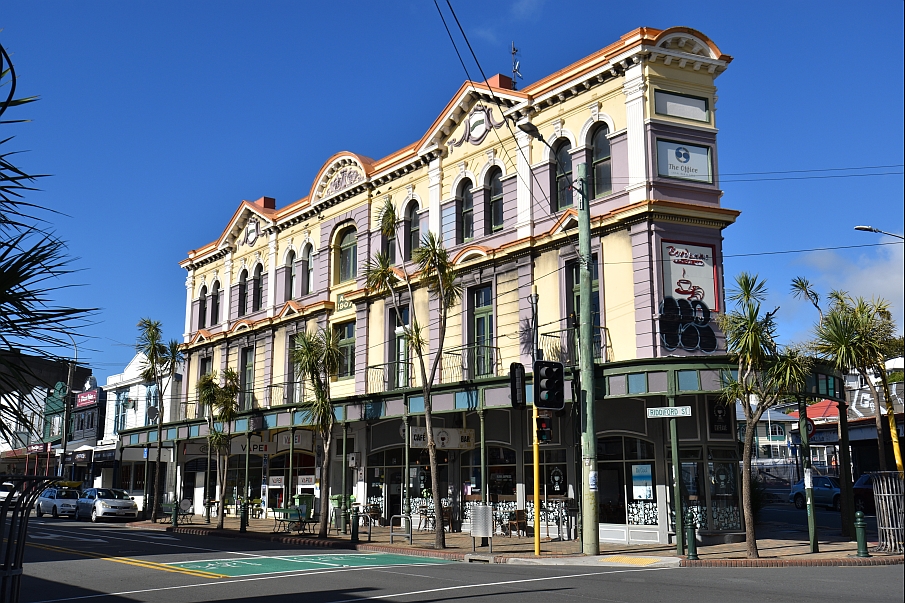
Ashleigh Court is arguably the most prominent and best known architectural cornerstone marking the commercial centre of Newtown, one of the Wellington’s earliest, largest, and best-known suburbs. William Mein Smith laid out what became Newtown in 1840 as town acres in the original plan devised for Wellington by the New Zealand Company, a plan that included the acute-angled lot at the corner of Riddiford and Rintoul Streets. Existing Māori pā and kāinga, including Te Aro Pā, were located further north and were oriented to the waterfront, and even sites of cultivation do not appear to have extended as far to the south as Newtown, although the area would have been travelled through to access the settlements on the South Coast. The town acres that would come to make up Newtown and Berhampore were in an outlying part of Wellington as surveyed and the area remained thinly populated by households engaged in farming for the first generation of European settlement.
The sparse settlement of Newtown gave way to more intensive (sub)urban development beginning in the 1870s. The topography of the broad, comparatively level valley made rapid subdivision and construction a better prospect than other outlying areas of the city. Employment opportunities, increased amenities, and better access all catalysed Newtown’s establishment as a residential suburb and commercial hub, highlighted by such milestones as: the relocation of Wellington Hospital (1876; opened in 1881); the opening of the Newtown Hotel (1876); the extension of the tramline along Riddiford Street to a terminus at Constable Street and the opening of Newtown School (1879); the construction of a fire and police station and (1880); the opening of Newtown Park (1881); the creation of a branch of the post office (1885); and the opening of a number of manufactories by the mid-1880s. These events also coincided with the increased use and formalisation of the association between the prosaic name ‘Newtown’ and the physical locale, rather than ‘South Wellington.’
The fortunes of Riddiford Street rose with those of Newtown. While all of the land in Newtown had for the most part been subdivided into lots by 1889, construction remained most strongly evident on the parcels on or nearby the tramline with both residential and retail establishments lining Riddiford Street. In 1904, horse-drawn cars gave way to electric trams at last making the suburb both convenient and affordable to workers who flooded Newtown. As blocks further away from the tramline filled with houses, Riddiford Street became even more intensively developed with retail establishments. In short order, Newtown became a self-contained shopping destination of its own that in terms of numbers of retail outlets was only outpaced by Cuba Street and Lambton Quay. It is within this context of feverish development and firm establishment of Newtown’s identity that Ashleigh Court came into existence.
An Intriguing Site and Its Intriguing Proposals
Building contractors John Thomas Hawthorn (ca. 1864-1936) and Colin Campbell Crump (1859-1930) became associated with the prominently located triangular property at the intersection of Riddiford and Rintoul Streets in August 1898. At that time, they entered into a twenty-one year lease with the option to buy with landowner Lucy Mary Compton. They may have become familiar with the site and its potential while they developed a commercial premises for a chemist across Riddiford Street in 1898.
Hawthorn & Crump were in active partnership between 1897 and 1908, sometimes in collaboration with Colin Crump’s brother, the well-known speculative builder Harry Crump. Among the small number of documented Hawthorn & Crump works in Wellington, Ashleigh Court was by far the firm’s most ambitious project. Colin Crump retired from contracting and building activities around the time that the building was completed and later served in public office before his death in 1930. John Hawthorn’s activities after Crump’s retirement up to his death in 1936 remain obscure.
The site seems to have remained underdeveloped when, in 1902, Wellington City Council acquired the property as part of the widening of Riddiford Street. The subsequent compensation to the land owner and the leasees became the topic of complicated court proceedings. The resolution of the case also saw Hawthorn & Crump purchase the property, minus the road reserve, from the city in November 1903. The outcome also required the removal of a ‘dwellinghouse’ that was located in part on the property transferred to the city for the road widening. The Thomas Ward map documents that no building was present in 1892 and it is not known whether Lucy Mary Compton had previously constructed the dwelling or whether Hawthorn and Crump did so under their lease.
On the newly resized and cleared site Hawthorn & Crump envisioned something much bolder and in keeping with the intensive development trends in Newtown and along Riddiford Street. In January 1904, they initially proposed a wedge-shaped, two-storey building of masonry construction with no basement that was estimated to cost £4000. The plans show four shops on the ground floor and a public hall with men’s and women’s toilets on the first floor. There were no exterior wall elevations included in the set, but the verandah appears in plan, elevation, and section, which shows it stopping just after turning the corner onto Rintoul Street. The stunted verandah and location of the door for the public hall on Riddiford Street indicates that the building was conceived to principally address the more important thoroughfare.
More than two years passed with presumably no activity occurring on the site when in the autumn 1906 Hawthorn & Crump submitted an even more ambitious three-storey plus basement design for consideration by the city. As with the earlier scheme, retail shops occupied most of the ground floor, but the upper two levels now accommodated a hotel. The building not only featured an additional storey, but also had an enlarged footprint. The original proposal had four shops on the ground floor and a straight party wall between Riddiford and Rintoul Streets. Space for the stair up to the public hall was borrowed from the area of one of the stores. The new design took in additional land to the south—presumably now the entire parcel—and the party wall was angled following the property line. The enlarged ground-floor plan accommodated five shops plus a central hallway extending fully between Riddiford and Rintoul Streets containing the stair. The upper levels included all public spaces, bedrooms, and service areas required for a hotel and a substantial cellar under the entire building was envisaged, which would have included necessary storage for the hotel.
At present, Hawthorn & Crump’s reasoning for so dramatically altering the development scheme for the parcel is not conclusively known. The Newtown branch of the city library opened less than a year prior to the submission of their first proposal. The building featured ‘a large hall…fitted with a platform and seating accommodation for 150 to 200 people…with anterooms for both ladies and gentlemen,’ a description of a space not unlike the one originally proposed by Hawthorn & Crump. Perhaps they believed that Newtown could support two such spaces and later reconsidered, possibly in light of the fact that the library was public space and would not have required the fees that likely would have been associated with a privately-owned facility. Still, their turn to a hotel as an alternative was a possibly risky one in terms of investment. By 1906, the residents of Newtown had already backed a prohibition of licensed premises and this goal would be fully accomplished just a few years later. Perhaps the proximity of Athletic Park, slightly further south along Rintoul Street was enough to consider a hotel for the property regardless of an impending liquor licensing ban.
An Impressive Architectural Anchor for Newtown’s Commercial Centre
The high level of architectural ambition evident in the scale and design of the building almost certainly would have involved an architect or, at the very least, a very highly skilled draftsman. However, the drawings are unsigned and no other evidence at present confirms an individual or firm. James Bennie is a tempting architect to consider as he was involved in the design of at least two other buildings on wedge-shaped sections in Wellington. Yet, the drawing style used for Ashleigh Court’s plans is distinct from the one used by Bennie around the same time for other buildings.
If Bennie can likely be eliminated for simple associative reasons, then a few others can be introduced as intriguing possibilities using the same approach. Aspects of Edward Blake and Joseph Burr’s drawing and lettering styles are similar to the first (unbuilt) or second (built) schemes for Ashleigh Court. Blake was one of the more prolific Wellington architects around the turn-of-the-twentieth century. Burr was a celebrated draughtsman, and later architect, who around the time of Ashleigh Court’s design worked for Blake’s firm with Francis Penty. Finally, William Chatfield who ‘had a reputation for designing buildings of great strength and with High Victorian forms of plaster decoration’ was also active at the time of its design and construction. Additionally, Chatfield lived in Island Bay from the late-1880s and must have been quite familiar with Newtown and its rapid development.
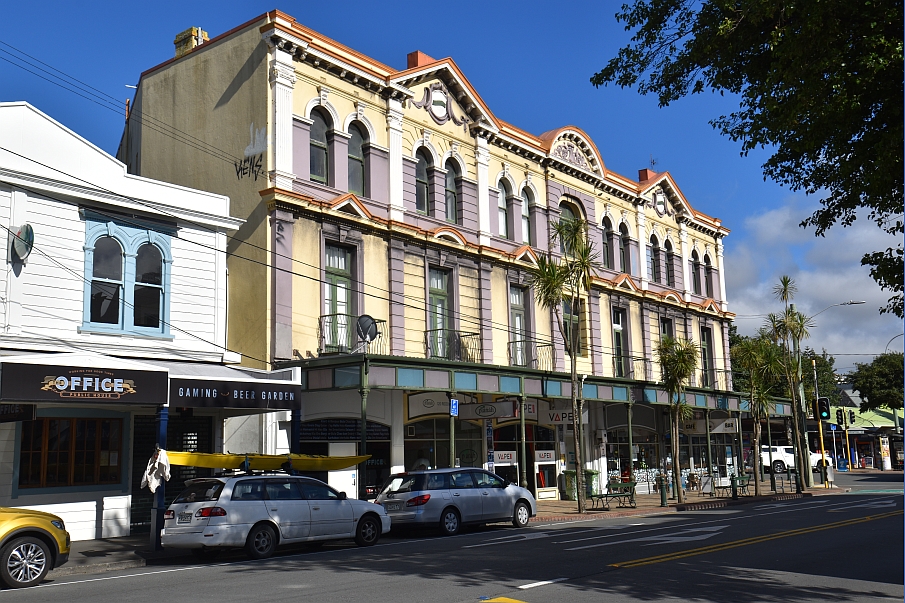
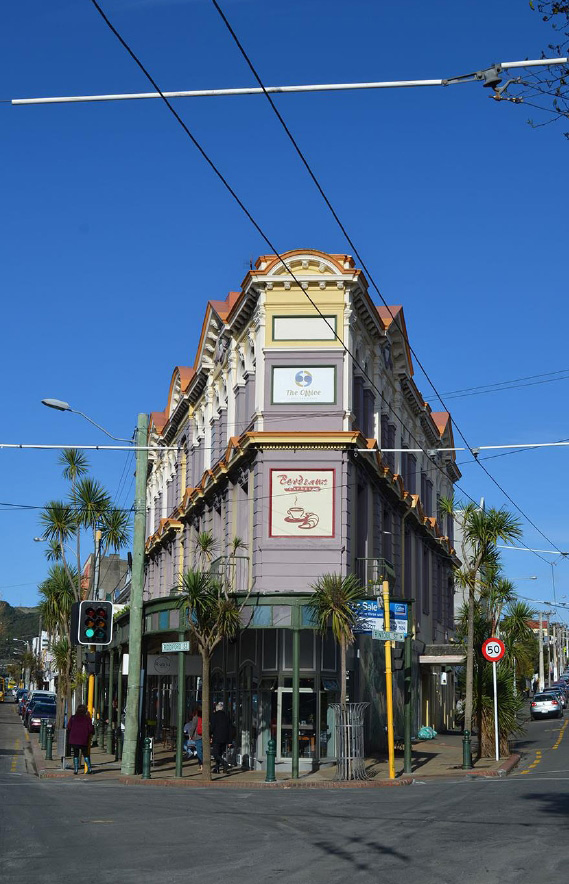
In devising an eye-catching building for the site, the architect or designer would have immediately benefited from the parcel’s location and shape as well as prevailing architectural trends for commercial buildings. Although reduced in size for the road widening, the lot’s prime position at the intersection of Riddiford and Rintoul remained the same and assured that the building would have a high level of visibility in the Newtown commercial streetscape. Additionally, its acute triangular shape delineated a striking wedge or ‘flatiron’ form for the building. The building further stood out among its neighbours in its scale—three tall storeys among more modest two storey structures—and with its masonry construction. Finally, the building was, essentially, all façade, featuring an array of fully articulated classical elements rendered in plaster applied to its load-bearing brick walls along both the Riddiford and Rintoul fronts.
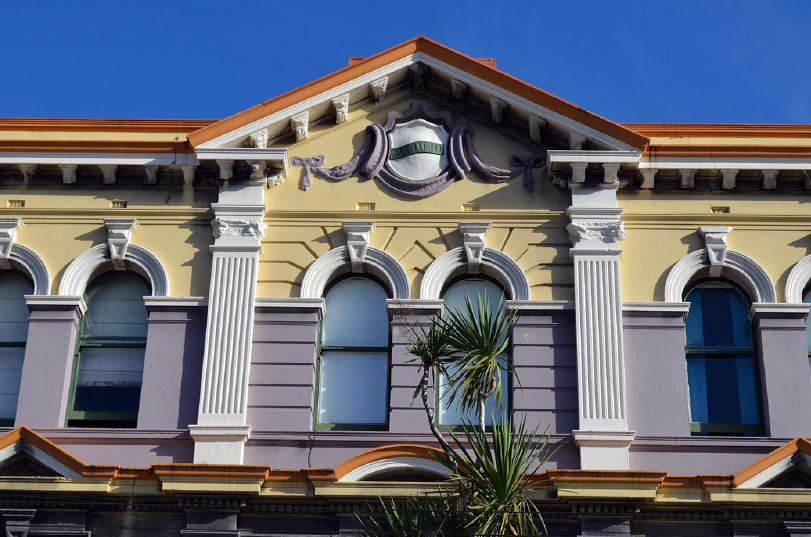
Lacking sources of quality building stone for fashioning street facades, architects and builders most often turned to plaster for executing the decoration widely seen in late-Victorian and Edwardian Wellington. While part of a harsh philosophical critique about what constitutes integrity in architectural design, an architect-writer in 1907 still provides a reasonable explanation for how plaster was utilised for architectural effect:
‘in the process of erection we see a rough brick structure raised without form...certainly without architectural form, and void of any beauty whatever. The builder, so far as construction is concerned, has done his work…[and] the building might be ready for occupation. Now a transformation takes place…[and the building receives] new and imposing garb [crafted in stucco].’
True to its age, Ashleigh Court’s ebullient architectural detailing merged aspects of popularised Renaissance design with contemporary sensibilities favouring aesthetic excess and a multiplicity of architectural components drawn mostly from classical sources. The assured presence of the building was further underscored by an ornate, continuous verandah along the ground floor that curved around the acute corner, providing shelter for the footpath and a spacious terrace off the hotel’s first-floor rooms. This feature and its location was favourably described ten years after its construction: ‘it is a comfortable, clean, bright, and cheerful spot, encircled by a balcony 12ft wide, from which and from the flat roof there is a wide and beautiful view north and south.’
Construction appears to have taken longer than anticipated. The east elevation submitted with the 1906 drawings includes a central plaque bearing the year ‘A.D. 1906,’ but major construction dragged on through 1907, the year ultimately recorded in the plaque on the facade. Finishing work and the interior fit-out seems to have taken even longer as the Langham Private Hotel did not open for business until May 1908. Even then, completion of the interiors and the business opening seems to have been rushed as the New Zealand Times reported in September 1908: the ‘hostelery [sic] has recently been taken over by Mr J. Russell…[and] has been converted into an up-to-date house, having been renovated throughout, as well as being refurnished from top to bottom, with new furniture.’ The article appears to have misrepresented the name of the proprietor, known to have been Russel J. Langham.
The building was of interest to photographers almost immediately following completion with one of the earliest known photographs possibly taken as early as 1909. This view, looking south from the intersection of Riddiford and Rintoul Streets, remains the signature one for the building. Over time, its individual appeal based on distinctive architecture and urban form came to be a marker of the specific locale—Newtown. This association appears to be purely a visual and aesthetic one. There is no evidence in the historical record of a particular affection for its varied commercial establishments, which have been typical or, at times, marginal in terms of function. Rather, the association is based in its intimately related architectural presence and position within Newtown’s urban landscape.
Hotels, Hostels, and Apartments: A Long History of Accommodation
The original business may have prospered for a time; however, despite being ‘full of boarders,’ it was put up for sale—for ‘immediate possession’—in January 1915. There were apparently no takers as the ‘sale by public auction of the entire contents of the Langham Private Hotel’ amounting to 30 rooms was announced on 24 April. It is not known whether it was a case of simple mismanagement or whether the business struggled because Newtown was among the Wellington suburbs that voted to become dry in the year the hotel opened (although there was no bar indicated on the 1906 drawings for the hotel). Hawthorn and Crump had previously sold the building in 1912, yet that could as much suggest building contractors disinterested in also being landlords as any concern about the financial health of their investment.
The subsequent history of the building saw its continued use for ground-floor retail and the upper floors for various types of accommodation. In January 1916, the Defence Visiting Committee leased the hotel as ‘a home for returned soldiers who are out-patients at the hospital, or are convalescent, or on furlough.’ The prime minister formally opened the ‘soldiers’ hostel’ the following April at which time the press described its bedrooms as ‘airy, clean, simple, and comfortable’ and reported that ‘the soldier inmates look happy and very pleased with their surroundings.’ After the war the facility reopened as the Langham Private Hotel catering to long-term boarders and remained in operation as the Langham Hotel into the 1950s. The hotel’s proximity to the ‘show and sports grounds’ (Newtown Park and Athletic Park) and to the hospital was included in its marketing.
Frank B. Baudinet purchased the property around 1950 and over the next two decades made a number of changes that remain evident as well as proposed alterations that for the most part never eventuated. One of the first changes Baudinet made after purchasing the property was to alter the stair and to cut a new door through the masonry along Rintoul Street, which became the main building entrance and permitted the transformation of the original entrance/stairhall into a small commercial premises.
In the mid-1950s, Baudinet believed that the verandah ‘on the Rintoul Street side was not in good condition and we demolished it,’ necessitating the construction of fire escapes and the redesign of the Rintoul Street entrance. Aside from the partial loss of this public (shelter along the footpath) and private (first-floor terrace) amenity, the demolition also had a significant aesthetic drawback in that it left the ornamental plaster pilasters on the first-floor suspended in the air with no visual ‘support.’
Baudinet used the first floor for his own company offices in the mid-1950s, but the remainder of the property continued to be essentially utilised as a boarding house that, with some upgrades to the shared toilet and bathing facilities, Baudinet later positioned as having been a ‘High Class Private Hotel.’ These upgrades occurred after a Department of Health investigation into complaints about the living conditions at the Langham Hotel, an event that likely also resulted in its rebranding as the ‘Ashleigh Court Private Hotel,’ a name in use by 1957.
As the property owner and no longer an occupant, Baudinet still seemed uncertain of how to best utilise the edifice. In 1966, he was again considering its full conversion to offices before proposing its transformation into modern ‘ ‘Batchelor’ type of Flats’ three years later. This scheme stalled when the city requested seismic upgrades and it was eventually abandoned. In ca. 1974-75, the building ‘got a facelift without and within and now its proprietors…can boast of one of the spickest and spannest private hotels in the city.’ Not long after the renovations, a proposal was also put forth to put a restaurant in the cellar that seems to have included the removal of the small shop in the former entrance/stairhall and the installation of an open stair down to below grade space. The restaurant seems to have been scuttled in all or part because of dampness and drainage issues and although the 1976 proposal for the stair was rejected the work eventually occurred as the stair presently (2017) exists in the building.
Ashleigh Court remained a hotel/boarding house until at least 1989; however, one year later the first floor again seemed to be viewed as possible commercial office space. By the early- to mid-1990s, the first and seconds storeys of the building had been divided into four self-contained apartments, two on each floor one to either side of the stair. A degree of seismic strengthening occurred in the mid-1990s and, in 1997, consent was granted for the restoration of the façade. This work included: the removal of external fire escapes; repair and repainting of the exterior; and the reinstatement of continuous glazed panels below the verandah eaves. While stopping a bit shy of a full restoration, the work eliminated incompatible elements and moved the building closer to its original exterior heritage character obscured since the mid-twentieth century.
One year later, parts of the cellar and ground floor were incorporated into a bar/café/gaming establishment that largely occupied a two-storey, timber heritage building on the adjacent section to the south. The construction linked the two, previously non-communicating buildings via door openings cut through the masonry of the south wall of Ashleigh Court. One opening (and connecting ramp) provided access to the southernmost ground-floor shop in Ashleigh Court, which became a gaming area. A second opening in the cellar wall permitted the installation of stair down to a lower level of the new bar/café. The four apartments on the upper levels of Ashleigh Court continue to be used for residential purposes, with the other ground-level stores tenanted by cafes and the office of the Newtown Community Constable.