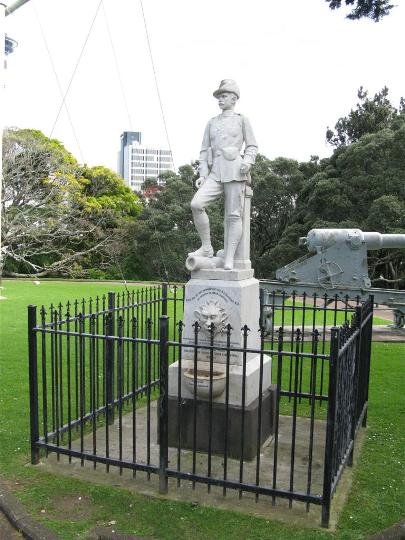
Among the many statues and memorials in Albert Park, Auckland, is a statue of a New Zealand artilleryman of the South African War (1899-1902). The South African War Artillery Memorial, unveiled in 1902 by New Zealand Premier Richard John Seddon, is the only memorial dedicated to men of New Zealand’s South African War artillery battery. The monument is unique in depicting an artilleryman rather than a mounted rifleman as other South African War memorials do, and was the first memorial to be unveiled by Seddon on his return from South Africa and Great Britain following the cessation of hostilities. Others closely associated with the memorial, include Colonel C.T. Major C.B.E., D.S.O., V.D., and Major J.T. Bosworth M.B.E., who played significant roles in Auckland and New Zealand military and social life.
The memorial was erected by returned soldiers of the Fourth and Fifth Contingents who had served in South Africa in the New Zealand Battery, Royal Artillery, in memory of their battery comrades who had been killed in action or died from illness (1900-1901). Lieutenant (later Major) J.T. Bosworth was a Lieutenant in A Battery, New Zealand Artillery Volunteers when he enlisted and went to South Africa in the Fifth Contingent. On his return he led the move to have this memorial erected and ensured that the statue depicted an artilleryman. Bosworth was prominent in the ceremonial unveiling of the memorial by Premier Richard Seddon on 25 October 1902. Seddon, who had that morning arrived back from his visit to South Africa and the Coronation of King Edward VII, described himself as proud to have been asked to unveil the monument.
The memorial comprises a life-size marble sculpture of an artillery trooper, on a marble pedestal, with bluestone base. The figure is standing at ease, with a number of details specific to an artillery trooper, particularly the sword on which the left hand rests. Full details are shown of his uniform, slouch hat, revolver pouch, haversack, and water-bottle. Part of a broken gun barrel and shells are depicted on the marble base. The memorial incorporated a drinking fountain; there are believed to be nine South African War memorials in New Zealand that are drinking fountains. The inscription that surrounds the fountain outlet reads:
'Erected by members of the NZ Battery R.A., In memory of their comrades, Lieutenant Geo. Leece, Corporal Herbert A. Edwards, Bombardier John Mays, Driver John Beck, Gunners Joseph Brown, Frederick Forbes, Arthur W. Kendall, and Driver Thomas Withers. Who lost their lives in the South African War, 1900-1.'
The New Zealand Artillery Regiment did not exist until 1905, but a New Zealand artillery unit did take part in the South African War of 1899-1902. The Fifth Contingent arrived by ship in Portuguese East Africa in April 1900 and transferred to Rhodesia by rail. In response to a call for volunteers to man a battery of six 15-pounder guns, Captain (later Colonel) C.T. Major, commander of the Auckland troops in the Fifth Contingent, offered his whole company. These were joined by others of the Fifth Contingent as well men of the Fourth Contingent. Together they formed the 1st New Zealand Battery in the Rhodesian Field Force Artillery. The Battery saw service at Mafeking, Lichtenburg and Zeerust. The Fifth Contingent sailed for New Zealand on 12 June and was disbanded on 21 July 1901.
Changes to the monument over time include railings, and the removal and replacement of the head, left hand and sword. The lion head and the bowl of the drinking fountain remain intact, but the water supply has been disconnected. The memorial, including the iron railing installed after 1986, is currently [2015] in excellent condition.