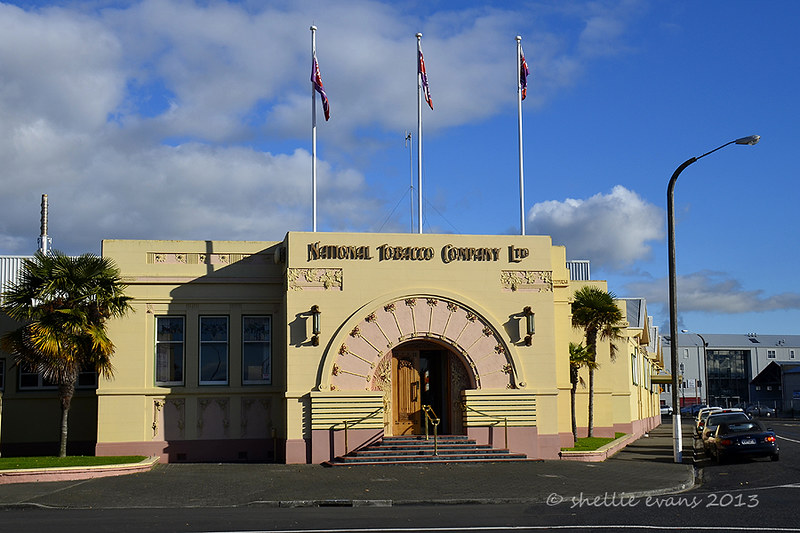
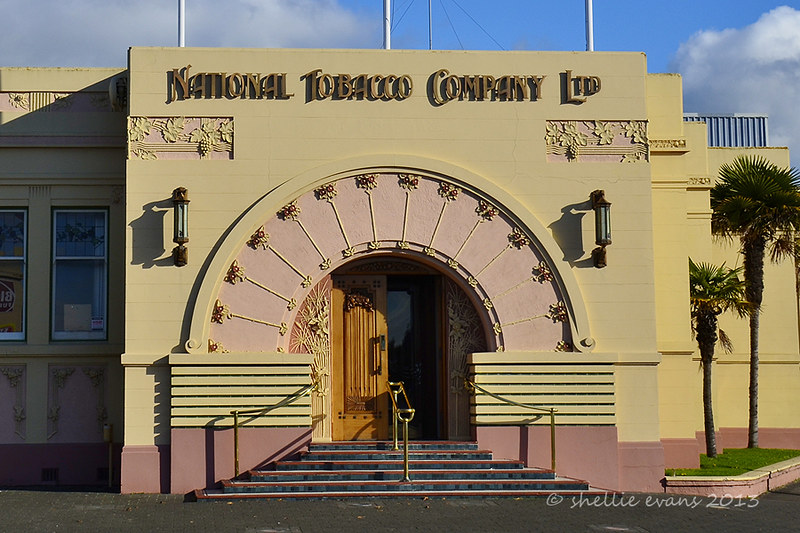
The Rothman's Building, also known as the National Tobacco Company Building, is regarded by many as one of Napier's most elegant commercial buildings dating to the 1930s. It can be regarded as a monument to Gerhard Husheer, one the founding members of the New Zealand tobacco industry, and an important work of the architect Louis Hay.
Johann Gerhard Husheer (1864-1954), a German by birth, immigrated with his family to New Zealand from South Africa in 1911, with the intention of establishing a tobacco industry in the country. In 1913, following successful experiments in growing tobacco crops at Paki Paki, Hastings, Husheer established the New Zealand Tobacco Company and opened a processing factory at Ahuriri, Napier, in 1915. Although the company did well, Husheer and his sons were forced to leave through the actions of some of its directors. Husheer moved to Auckland where he set up in 1921 the National Tobacco Company, eventually purchasing the assets of the New Zealand Tobacco Company, which had gone out of the business in the meantime. He returned to Napier in 1924. The company prospered and in 1925 Husheer commissioned Louis Hay (1881-1948), a Napier based architect, to design a factory at the Ahuriri site. Hay had previously been involved in renovating Husheer's three houses in Elizabeth Street, on Bluff Hill. Although the external walls of the factory were to collapse during the 1931 Hawke's Bay earthquake, the internal structure remained largely intact and production continued relatively unhindered following the disaster. The Depression also had little impact on the National Tobacco Company, as demand for the company's product remained high.
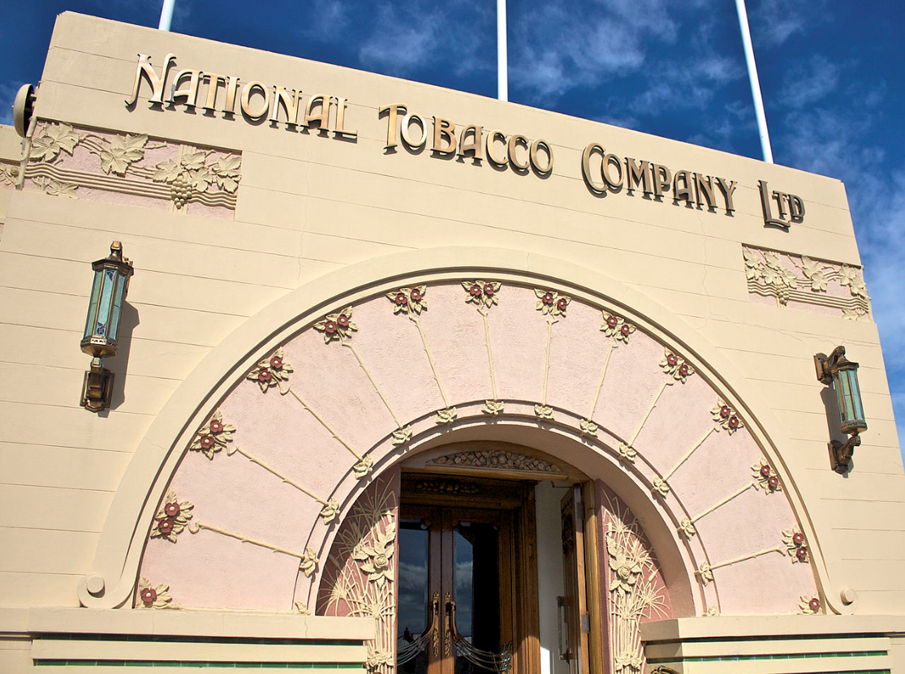
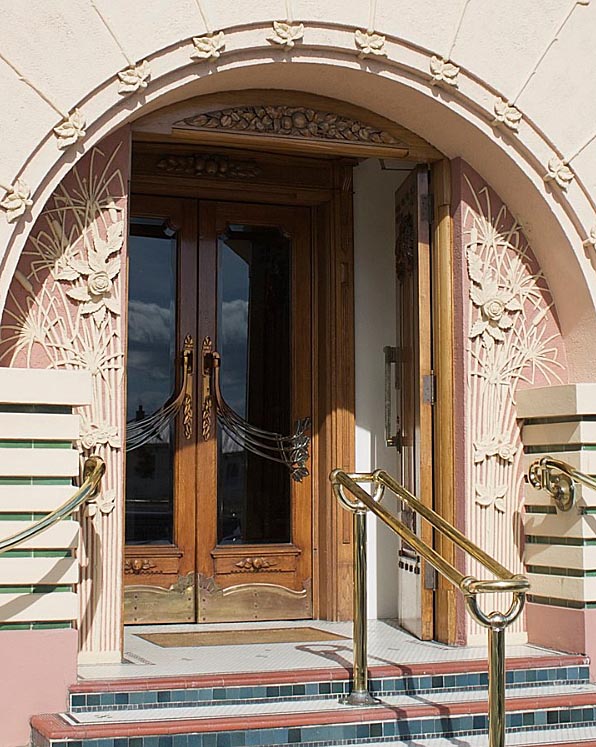
By 1932 the National Tobacco Company was one of the wealthiest industries in Napier and certainly the largest employer of local labour. In that year Husheer commissioned Louis Hay to design a main frontage for his factory to replace the structure that had collapsed in the earthquake. Hay's initial sketches were rejected by Husheer for not being extravagant enough. Hay's second plan, which was eventually built, was for a deceptively simple building based on the idea of an 'arch within a square', decorated with detailed representations of plants such as roses, raupo, and vine leaves. The motif of roses also featured on the lamps on the side of the entrance and lead-light windows. Leading up to the doors were steps decorated with tiles, and brass handrails. Entering through an elaborately carved set of doors, the foyer featured a marble dado, and oak panelling, combined with a domed lead-light skylight to create an overall feeling of elegance and luxury. The entire design, particularly the use of simple geometric forms decorated with applied decoration, reflected Hay's interest in the Art Nouveau or Secession style developed in Europe at the turn of the twentieth century. Hay was to use similar ideas in the design of Napier's AMP Building (1933/34) and the Hawke's Bay Art Gallery and Museum (1935). Tenders for the construction of the National Tobacco Company Building were called for in October 1932, and the work was nearly finished by the end of December 1932.
Although built in the middle of the Depression, Husheer suffered no adverse reaction for this obvious display of wealth, as he was also known for his philanthropic gestures, handing out food to those in need in during the hardest years of the economic crisis. The high regard for the company within the community at the time can be seen in the actions of the Napier Chamber of Commerce when, in 1933, it sought to defend the National Tobacco Company's objection to the introduction of taxation on local tobacco.
After Husheer's death in 1954 the company was acquired by Rothmans of Pall Mall. The entranceway was largely disused after the 1960s when a new administration building was built adjacent. In the mid 1980s interest in the older building increased and work was begun on restoring the building to its former glory. A glazed screen that had been removed at some time was rebuilt based on a photograph of the original. During the 1990s the paint-work was restored to its original colour and a number of the lead-light windows that had been removed, were remade. In 1999 Rothman's merged with British American Tobacco Ltd. The company continues to process tobacco at the Ahuriri plant, and the Hay designed entrance building is open to the public during working hours.
The Rothman's Building (recently renamed the National Tobacco Company Building) is a testimony to the success of the tobacco industry in New Zealand in the early twentieth century, and in particular the role of Gerhard Hussheer, considered to be one of New Zealand's foremost industrialist. At a local level it was the entranceway to what was once Napier's largest employer. Architecturally it is regarded as the jewel in Napier's architectural crown. The building is perhaps one of Louis Hay's best preserved public buildings, and it is an excellent example of the craftsmanship of local artists in post earthquake Napier. Today, located on a corner site amongst the industrial buildings of Ahuriri, it is a noted landmark, and is a popular destination for visitors to Napier.