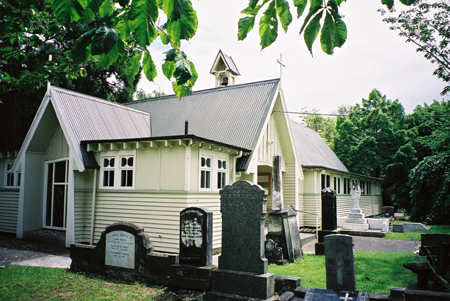
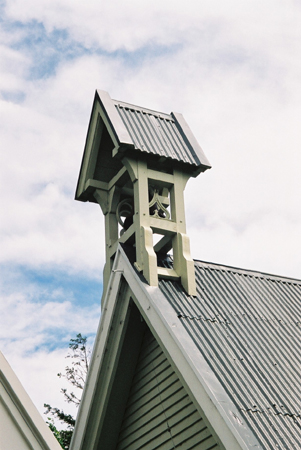
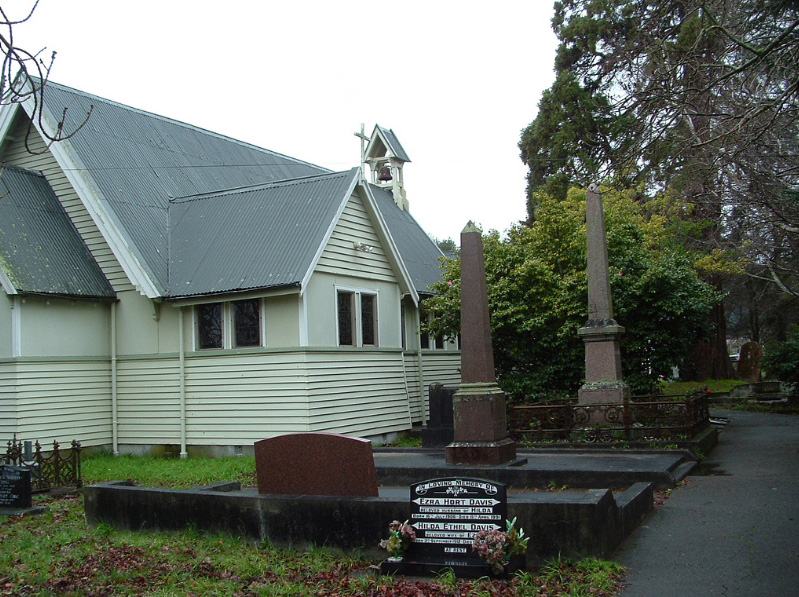
St John the Evangelist Church, Upper Hutt, is one of the oldest surviving Anglican churches in the Wellington region. With the help of local pakeha settlers Richard and Hannah Barton, the Trentham Missionary Parochial District was formed in 1861, with John Herring appointed as the first vicar. Richard Barton had originally settled in what was known as the Whirinaki district in 1846, naming his 100-acre property Trentham after the Staffordshire estate of his previous employer, the Duke of Sutherland. Barton actively encouraged the establishment of a church in the area, offering a home to Herring and his wife Margaret. It is also generally believed that Barton contributed money to acquire land for the new church.
St John's was completed in 1863 and was consecrated by Bishop C. J. Abraham, the first Bishop of Wellington, in 1865. It is thought that Frederick Thatcher (1814-1890), at the time vicar of St Paul's parish, Thorndon, was involved in the planning of the building, but it is uncertain whether he designed it. Thatcher and George Selwyn, Bishop of New Zealand, were heavily influenced by the teachings of the English Ecclesiological Society. The latter was a movement that advocated a return to a Gothic style of religious architecture. Initially the church consisted of just the nave, but as the population of the district expanded, encouraged by the construction of the Hutt Valley railway, a larger church was needed. In 1884 a chancel and sanctuary were added by Frederick de Jersey Clere, the diocesan architect for the Anglican Church. Clere was also responsible for the reconstruction and enlargement of the vestry room in about 1914. De Jersey Clere's son carried out further major additions in 1955, during which time the nave was extended beyond the pillars and the vestry rooms were built.
Inside the church are many memorials and fittings, donated by parishioners over the years, which have symbolic or commemorative significance to the local community. These include a number of memorial stained-glass windows commemorating past parishioners. In the churchyard are the graves of a number of early pakeha settlers to the district, including Richard and Hannah Barton. A lych-gate and a stone wall erected as a war memorial in 1923 has special significance to the community as during the First World War St John's was the closest Anglican Church to Trentham Military Camp. In 1976 a Friends of St John's Trust Board was formed, which recognised the uniqueness of the church as the oldest existing parish church within the Wellington Diocese. This trust undertakes to preserve and beautify the church and its surrounds.
St John the Evangelist is one of the oldest Anglican churches in the Hutt Valley. It is important for its association with early pakeha settlers to the area, in particular Richard and Hannah Barton who supported the construction of the church.
St John's was completed in 1863 and was consecrated by Bishop C. J. Abraham, the first Bishop of Wellington, in 1865. It is thought that Frederick Thatcher (1814-1890), at the time vicar of St Paul's parish, Thorndon, was involved in the planning of the building, but it is uncertain whether he designed it. Thatcher and George Selwyn, Bishop of New Zealand, were heavily influenced by the teachings of the English Ecclesiological Society. The latter was a movement that advocated a return to a Gothic style of religious architecture. Initially the church consisted of just the nave, but as the population of the district expanded, encouraged by the construction of the Hutt Valley railway, a larger church was needed. In 1884 a chancel and sanctuary were added by Frederick de Jersey Clere, the diocesan architect for the Anglican Church. Clere was also responsible for the reconstruction and enlargement of the vestry room in about 1914. De Jersey Clere's son carried out further major additions in 1955, during which time the nave was extended beyond the pillars and the vestry rooms were built.
Inside the church are many memorials and fittings, donated by parishioners over the years, which have symbolic or commemorative significance to the local community. These include a number of memorial stained-glass windows commemorating past parishioners. In the churchyard are the graves of a number of early pakeha settlers to the district, including Richard and Hannah Barton. A lych-gate and a stone wall erected as a war memorial in 1923 has special significance to the community as during the First World War St John's was the closest Anglican Church to Trentham Military Camp. In 1976 a Friends of St John's Trust Board was formed, which recognised the uniqueness of the church as the oldest existing parish church within the Wellington Diocese. This trust undertakes to preserve and beautify the church and its surrounds.
St John the Evangelist is one of the oldest Anglican churches in the Hutt Valley. It is important for its association with early pakeha settlers to the area, in particular Richard and Hannah Barton who supported the construction of the church.