

Ngāi Tara were early residents of Te-Whanganui-a-Tara, Wellington. By the 17th century, Ngāti Ira, Rangitāne, Ngāti Kahungunu, Ngāti Māmoe and Ngāi Tahu also occupied parts of the region.. From 1822 to 1834, during a period of upheaval, Te Ātiawa, Ngāti Tama and Ngāti Mutunga moved south from Taranaki. Te Aro Kāinga, associated with Ngāti Mutunga, Taranaki, and Ngāti Ruanui, was located 450 metres southeast of the house’s present location. In 1844 Te Aro was brought into the New Zealand Company purchase and colonial settlement ensued. In 1845 Te Aro fortification was constructed in response to tensions between colonists and Māori. Its northwest flank extended towards the Willis Street intersection.
In the 1890s, building contractor John McGill (1874-1934) purchased the land at the corner of Boulcott and Willis Streets. Dr Henry Pollen purchased 12 Boulcott Street in 1901 and contracted J. Carmichael to build a residence and surgery to William Turnbull’s design. Immigrating to New Zealand from Ireland in 1895, Pollen moved to Wellington in 1900 and served as president of the New Zealand branch of the British Medical Association, Port Health Officer, Military Pensions Board member, and medical advisor to the New Zealand Government Life Insurance Department and several friendly societies. His adult daughters Henrietta 'Effie' (1879-1934) and Dorothy (1881-1963) moved to the residence too. Effie’s long-time companion, the poet Ursula Bethell (1874-1945), stayed with her at the house in 1909. Following Henry’s death from influenza in 1918, the house was sold to Eric Lachlan Marchant. Over the following years it functioned as a series of eateries and bars. A brothel, The House of Ladies, also operated out of the building in the 1970s and early 1980s.
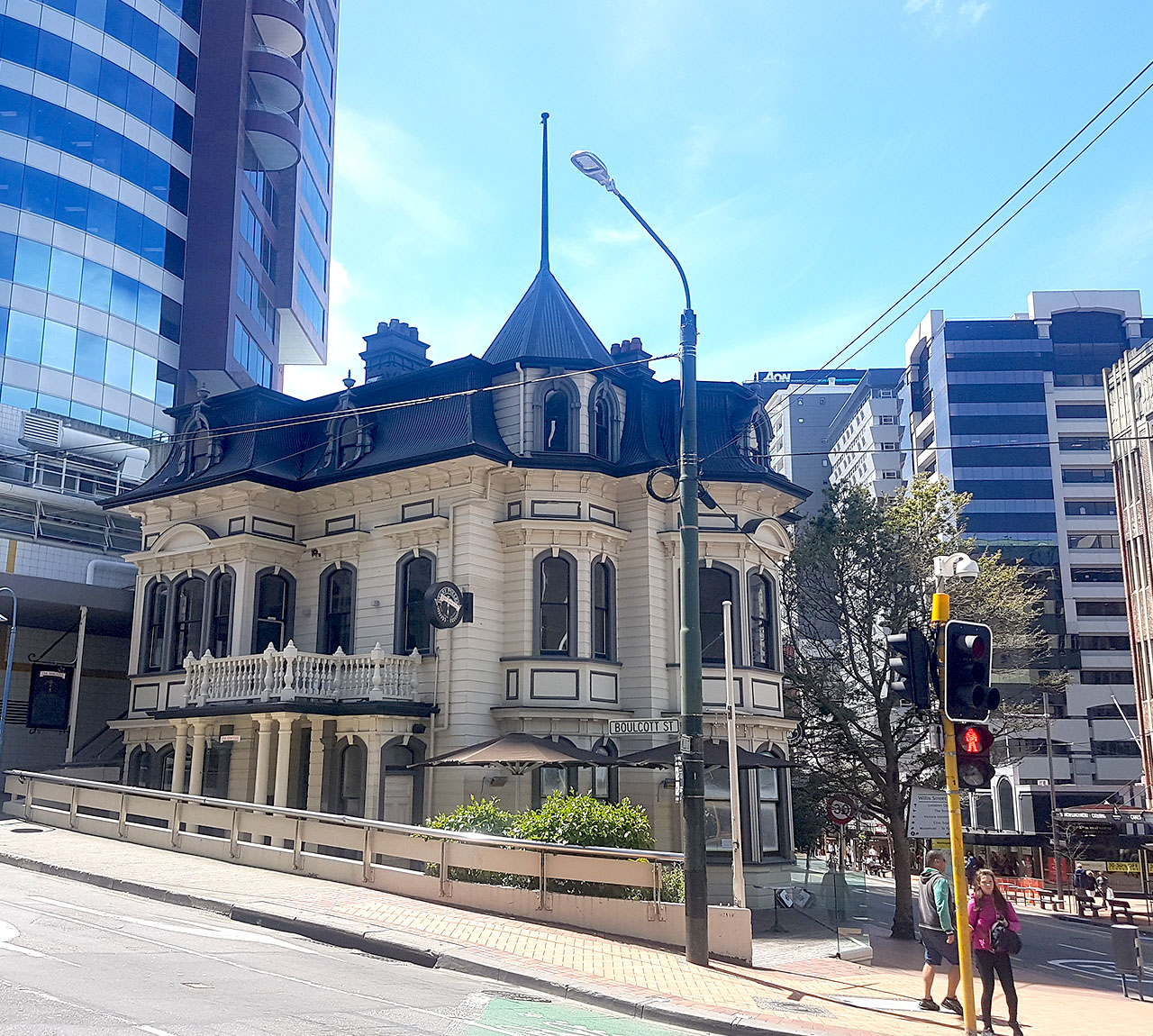
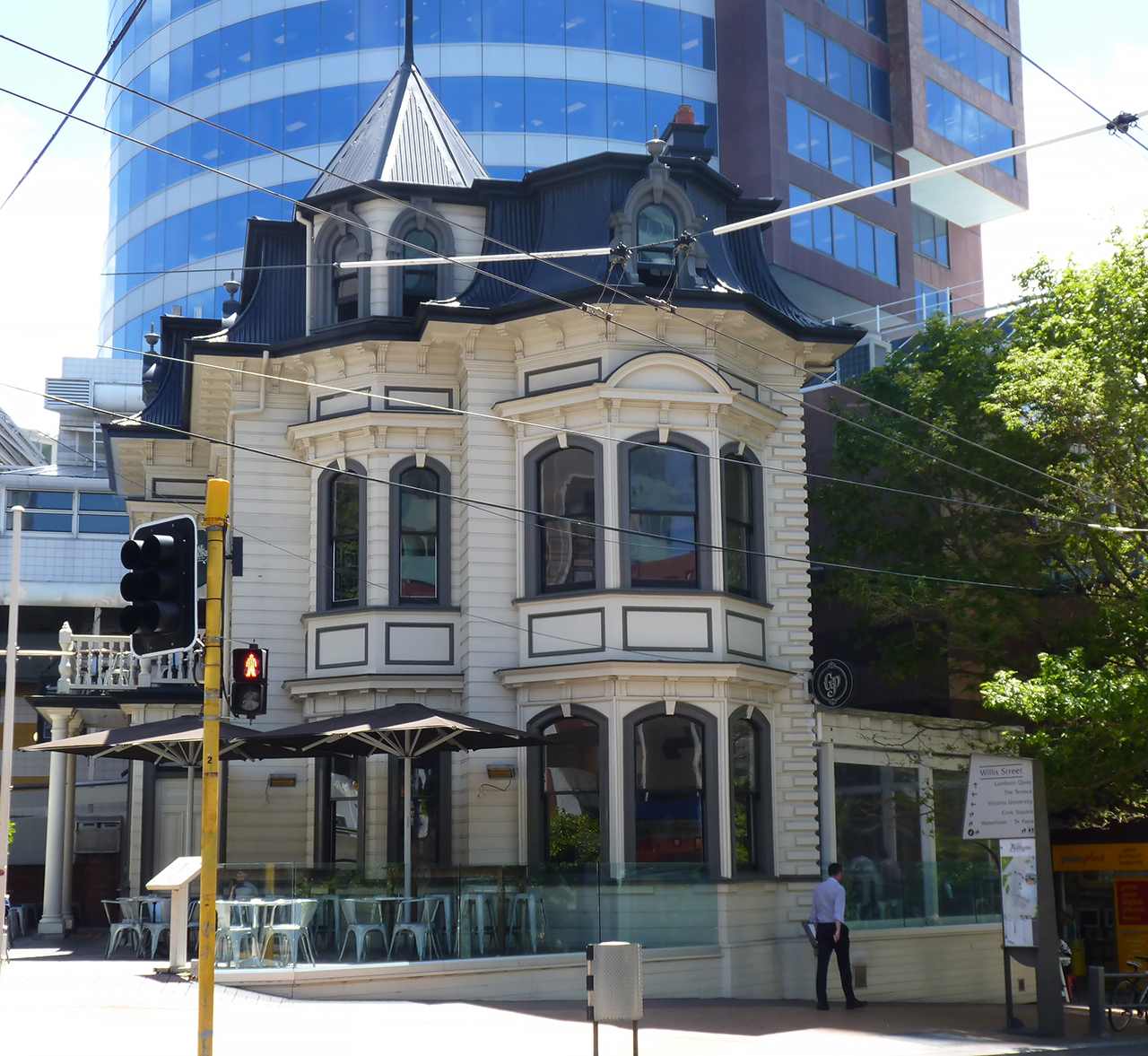
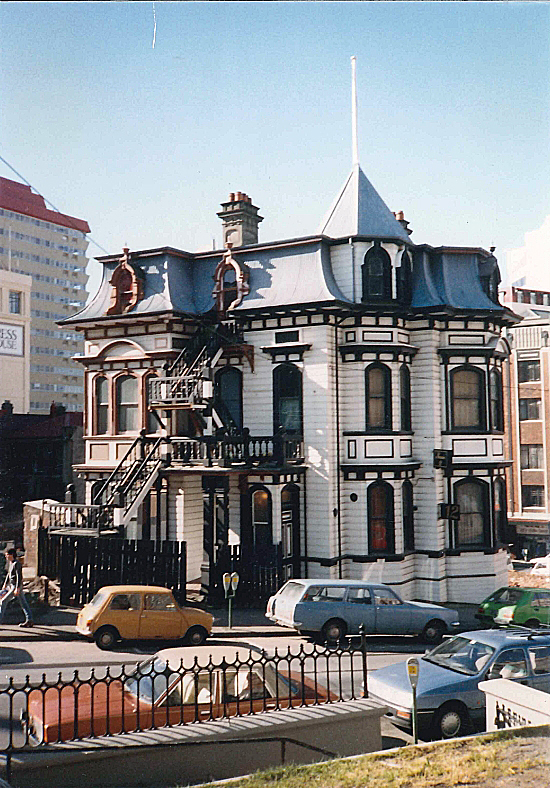
With an irregular floor plan to fit its original triangle section, the three-storey house features a mansard roof, pavilion-roofed turret and double-bay windows. Rusticated timber weatherboard is interspersed with round-headed windows, heavy architraves, segmented hood moulds, and finial urns. Panel moulding features above the windows on both floors with quoins on two corners of the building and corbels underneath the upper cornice and window architraves. Two chimneys are located on the original southeast and central north of the structure. There is a portico over the main entrance, and upper-floor balconies. The original five-bedroom two-bath house had a waiting room, surgery, dispensary, dining room, drawing room, and a kitchen and washroom in the basement.
Alterations were made to the dwelling in 1907 and an addition made in 1935. In the 1970s, architect (Sir) Ian Athfield coordinated structural and fire safety upgrades, and the conversion of the building to a licenced restaurant. As part of the Majestic Centre redevelopment in 1988, the house minus the basement was relocated to its current location at 122 Willis Street and rotated 90 degrees. Restoration work at the time included the installation of new reinforced concrete foundations and steel roof, replacing brick chimneys with replicas, adding a replica portico and veranda, a new dormer, adaptation of internal stairs, and decorative timber work. The building has since housed a series of bar/restaurant businesses.
List Entry Information
Status
Listed
List Entry Status
Historic Place Category 1
Access
Private/No Public Access
List Number
1420
Date Entered
24th November 1988
Date of Effect
24th November 1988
City/District Council
Wellington City
Region
Wellington Region
Extent of List Entry
Extent includes part of the land described as Pt Lot 1 DP 62238 (RT WN43C/224), Wellington Land District, and the building known as House (Dr Henry Pollen’s) thereon. Refer to map tabled at the 1 June 2023 meeting of the Rārangi Kōrero Committee
Legal description
Pt Lot 1 DP 62238 (RT WN43C/224), Wellington Land District
Status
Listed
List Entry Status
Historic Place Category 1
Access
Private/No Public Access
List Number
1420
Date Entered
24th November 1988
Date of Effect
24th November 1988
City/District Council
Wellington City
Region
Wellington Region
Extent of List Entry
Extent includes part of the land described as Pt Lot 1 DP 62238 (RT WN43C/224), Wellington Land District, and the building known as House (Dr Henry Pollen’s) thereon. Refer to map tabled at the 1 June 2023 meeting of the Rārangi Kōrero Committee
Legal description
Pt Lot 1 DP 62238 (RT WN43C/224), Wellington Land District
Why is this place significant?
Historic Significance
Historical Significance or Value The house was built for Dr Henry Pollen as a residence ands surgery. Pollen (1853-1918) was born in Dublin, Ireland, and studied medicine at Trinity College, Dublin, qualifying in 1875. The following year he accepted the position of Surgeon Superintendent of the New Zealand Government Emigration Department, coming to New Zealand on the Hudson. Later he settled in Gisborne and practiced medicine there until 1890. He organised the local hospital there and was surgeon in charge. In 1890 he accepted the position of surgeon to the Antipodean Lodge of Oddfellows in Wellington. He also acted for other friendly societies and was medical referee for the Australian Mutual Provident Society and the New Zealand Government Life Insurance Department. He was also one of the physicians at the Wellington Hospital, Port Health Officer for a number of years and a member of the Military Pensions Board. In 1885 he obtained the MD degree from Trinity College, Dublin. He died at 12 Boulcott Street after contracting influenza in the epidemic of 1918 subsequently succumbing to pleurisy which is listed on the death certificate as the cause of death. The house was sold by Pollen's daughter Dorothy Desmond Pollen to Eric Lachlan Marchant, a surgeon. In 1929, the house became Albert de Barthe Brandon's residence, and in 1967 was transferred to Anthony Thomas Tresch, Restaurateur, before being sold to City and Provincial Properties Ltd in 1972. Dr Henry Pollen bought the section (pt lot 5 DP 851 Part Section 506 until 1987) from William McGill in 1901, seven years after the death of his wife Katherine Jane (nee Bourke, daughter of Peter Bourke of Napier). He lived there with his two daughters Effie, and Dorothy Desmond Pollen who later inherited the property. Effie Pollen was the life-long companion of the famous New Zealand poet Mary Ursula Bethell. The latter may have lived in 12 Boulcott Street at some stage.
Physical Significance
ARCHITECTURAL SIGNIFICANCE: Itself historicist, being a revival and amalgamation of French Renaissance and post-Renaissance structural and decorative motifs, second Empire architecture had an influence which was worldwide. It is associated with an especially opulent and prestigious regime: the French of Napoleon III, Emperor from 1852 to 1870. The Dunedin Town Hall by Henry Mandeno and Thomas Mahoney's Custom House, Auckland are among the best examples in New Zealand. The Second Empire style is rare in Wellington only a few examples remaining. Notable amongst these is Frederick de Jersey Clere's Wellington Harbour Board Head Office of 1891 which has extended mansards with dormers. By comparison Turnbull's version of the second Empire style is exceptional in its originality. Rather than a straight revivalist essay in the style Turnbull has combined elements of High Victorian Gothic with French Renaissance features to form a picturesque ensemble. TOWNSCAPE/LANDMARK SIGNIFICANCE: This building makes an extremely original contribution to the Wellington townscape since its exuberant architecture has no real equivalent. However, the links to Thomas Turnbull and Son's Antrim House (1905) are clear. Both buildings are Edwardian domestic designs in the grand manner employing French Renaissance motifs like the Mansard roof as well as quoining which emulates stonework, and the turret device which enlivens the roofline and façade of both. In its verticality and reference to Gothic traditions No. 12 Boulcott Street also relates well to Frederick de Jersey Clere's St Mary of the Angels (1922) which is directly opposite.
Why is this place significant?
Historic Significance
Historical Significance or Value The house was built for Dr Henry Pollen as a residence ands surgery. Pollen (1853-1918) was born in Dublin, Ireland, and studied medicine at Trinity College, Dublin, qualifying in 1875. The following year he accepted the position of Surgeon Superintendent of the New Zealand Government Emigration Department, coming to New Zealand on the Hudson. Later he settled in Gisborne and practiced medicine there until 1890. He organised the local hospital there and was surgeon in charge. In 1890 he accepted the position of surgeon to the Antipodean Lodge of Oddfellows in Wellington. He also acted for other friendly societies and was medical referee for the Australian Mutual Provident Society and the New Zealand Government Life Insurance Department. He was also one of the physicians at the Wellington Hospital, Port Health Officer for a number of years and a member of the Military Pensions Board. In 1885 he obtained the MD degree from Trinity College, Dublin. He died at 12 Boulcott Street after contracting influenza in the epidemic of 1918 subsequently succumbing to pleurisy which is listed on the death certificate as the cause of death. The house was sold by Pollen's daughter Dorothy Desmond Pollen to Eric Lachlan Marchant, a surgeon. In 1929, the house became Albert de Barthe Brandon's residence, and in 1967 was transferred to Anthony Thomas Tresch, Restaurateur, before being sold to City and Provincial Properties Ltd in 1972. Dr Henry Pollen bought the section (pt lot 5 DP 851 Part Section 506 until 1987) from William McGill in 1901, seven years after the death of his wife Katherine Jane (nee Bourke, daughter of Peter Bourke of Napier). He lived there with his two daughters Effie, and Dorothy Desmond Pollen who later inherited the property. Effie Pollen was the life-long companion of the famous New Zealand poet Mary Ursula Bethell. The latter may have lived in 12 Boulcott Street at some stage.
Physical Significance
ARCHITECTURAL SIGNIFICANCE: Itself historicist, being a revival and amalgamation of French Renaissance and post-Renaissance structural and decorative motifs, second Empire architecture had an influence which was worldwide. It is associated with an especially opulent and prestigious regime: the French of Napoleon III, Emperor from 1852 to 1870. The Dunedin Town Hall by Henry Mandeno and Thomas Mahoney's Custom House, Auckland are among the best examples in New Zealand. The Second Empire style is rare in Wellington only a few examples remaining. Notable amongst these is Frederick de Jersey Clere's Wellington Harbour Board Head Office of 1891 which has extended mansards with dormers. By comparison Turnbull's version of the second Empire style is exceptional in its originality. Rather than a straight revivalist essay in the style Turnbull has combined elements of High Victorian Gothic with French Renaissance features to form a picturesque ensemble. TOWNSCAPE/LANDMARK SIGNIFICANCE: This building makes an extremely original contribution to the Wellington townscape since its exuberant architecture has no real equivalent. However, the links to Thomas Turnbull and Son's Antrim House (1905) are clear. Both buildings are Edwardian domestic designs in the grand manner employing French Renaissance motifs like the Mansard roof as well as quoining which emulates stonework, and the turret device which enlivens the roofline and façade of both. In its verticality and reference to Gothic traditions No. 12 Boulcott Street also relates well to Frederick de Jersey Clere's St Mary of the Angels (1922) which is directly opposite.
Construction Professional
Name
Turnbull, William (1868-1941)
Type
Architect
Biography
William Turnbull (1868-1941) entered the architectural office of his father Thomas (1825-1907) in 1882, and received a professional education from him. In 1890, William visited Melbourne and Sydney and was engaged in the office of J A Gordon, a Melbourne architect who at that time was engaged in the design of several major commercial buildings including the Melbourne (now Victoria) Markets. In 1891 William returned to Wellington and was admitted into partnership in the firm of Thomas Turnbull and Son. This was one of the foremost architectural practices in the city at the turn of the century and it continued after Thomas Turnbull's death in 1907. William became a Fellow of the Royal Institute of British Architects in 1906, designing many important early twentieth century buildings in Wellington such as 12 Boulcott Street (1902), Turnbull House (1918), and the Wellington Free Ambulance Building (1932). The range and variety of his adaptation of architectural styles show him to be fully versed in virtually every contemporary architectural style and to have special skills and flair for masonry design.
Construction Details
Start Year
1902
Type
Original Construction
Start Year
1907
Type
Modification
Start Year
1935
Type
Addition
Start Year
1974
Type
Structural upgrade
Description
Repiling
Start Year
1975
Type
Refurbishment/renovation
Start Year
1977
Type
Modification
Description
The building was converted to a licenced restaurant, involving the removal of several walls and the addition of a commercial kitchen
Start Year
1977
Type
Physical access improvements
Description
Fire escape stair added
Start Year
1979
Type
Physical access improvements
Description
Upgrades for fire and egress
Start Year
1988
Type
Relocation
Description
The house minus the basement was relocated 70 metres from 12 Boulcott Street to its current location at 122 Willis Street and rotated 90 degrees
Start Year
1988
Type
Restoration
Description
Restoration work following relocation included the installation of new reinforced concrete foundations and steel roof, replacing brick chimneys with replicas, adding a replica portico and veranda, a new dormer, adaptation of internal stairs, and decorative timber work
Construction Materials
Timber with corrugated iron roof.
Notable Features
Henry Pollen's house was a purpose-built surgery and residence. As such it has several features particular to this usage. The Bay Windows: The double bay window front is carried through two floors. As an architectural feature the bay window has its origin in a desire to introduce more light, better cross ventilation and additional floor space appropriate then for an environment where health and hygiene were to be emphasised. Fenestration: Throughout the main living areas of the house rooms have light entering from the ample window spaces. Large window areas are concentrated to face north to increase the amount of natural light and warmth form the sun which can enter the house. The scullery, larder and kitchen however, are at basement level and have smaller windows to protect food from spoiling. Balconies: These feature on two levels of the house, with easy access from the bedroom adjacent. The inclusion of these in the design along with the ample fenestration show Turnbull to be familiar with modern architectural thinking which provided for a confluence of indoor and outdoor living spaces (where the climate was equable) along with an orientation of the plan of houses to light and sun. Other architectural features of note are: -The Mansard roof and pavilion roofed turret -The rounded head windows with heavy architraves and segmented hood moulds The panel moulding above the window on both floors, which along with the architraves creates a strong demarcation of interior floor levels on the external façade. -The wooden replication of stone ornament, for example the quoins on the two rear corners of the building, and the corbels or brackets underneath the upper cornice and window architraves. - The string course which runs around the building at ground floor window sill level linking the disparate architectural elements together.
Construction Professional
Name
Turnbull, William (1868-1941)
Type
Architect
Biography
William Turnbull (1868-1941) entered the architectural office of his father Thomas (1825-1907) in 1882, and received a professional education from him. In 1890, William visited Melbourne and Sydney and was engaged in the office of J A Gordon, a Melbourne architect who at that time was engaged in the design of several major commercial buildings including the Melbourne (now Victoria) Markets. In 1891 William returned to Wellington and was admitted into partnership in the firm of Thomas Turnbull and Son. This was one of the foremost architectural practices in the city at the turn of the century and it continued after Thomas Turnbull's death in 1907. William became a Fellow of the Royal Institute of British Architects in 1906, designing many important early twentieth century buildings in Wellington such as 12 Boulcott Street (1902), Turnbull House (1918), and the Wellington Free Ambulance Building (1932). The range and variety of his adaptation of architectural styles show him to be fully versed in virtually every contemporary architectural style and to have special skills and flair for masonry design.
Construction Details
Start Year
1902
Type
Original Construction
Start Year
1907
Type
Modification
Start Year
1935
Type
Addition
Start Year
1974
Type
Structural upgrade
Description
Repiling
Start Year
1975
Type
Refurbishment/renovation
Start Year
1977
Type
Modification
Description
The building was converted to a licenced restaurant, involving the removal of several walls and the addition of a commercial kitchen
Start Year
1977
Type
Physical access improvements
Description
Fire escape stair added
Start Year
1979
Type
Physical access improvements
Description
Upgrades for fire and egress
Start Year
1988
Type
Relocation
Description
The house minus the basement was relocated 70 metres from 12 Boulcott Street to its current location at 122 Willis Street and rotated 90 degrees
Start Year
1988
Type
Restoration
Description
Restoration work following relocation included the installation of new reinforced concrete foundations and steel roof, replacing brick chimneys with replicas, adding a replica portico and veranda, a new dormer, adaptation of internal stairs, and decorative timber work
Construction Materials
Timber with corrugated iron roof.
Notable Features
Henry Pollen's house was a purpose-built surgery and residence. As such it has several features particular to this usage. The Bay Windows: The double bay window front is carried through two floors. As an architectural feature the bay window has its origin in a desire to introduce more light, better cross ventilation and additional floor space appropriate then for an environment where health and hygiene were to be emphasised. Fenestration: Throughout the main living areas of the house rooms have light entering from the ample window spaces. Large window areas are concentrated to face north to increase the amount of natural light and warmth form the sun which can enter the house. The scullery, larder and kitchen however, are at basement level and have smaller windows to protect food from spoiling. Balconies: These feature on two levels of the house, with easy access from the bedroom adjacent. The inclusion of these in the design along with the ample fenestration show Turnbull to be familiar with modern architectural thinking which provided for a confluence of indoor and outdoor living spaces (where the climate was equable) along with an orientation of the plan of houses to light and sun. Other architectural features of note are: -The Mansard roof and pavilion roofed turret -The rounded head windows with heavy architraves and segmented hood moulds The panel moulding above the window on both floors, which along with the architraves creates a strong demarcation of interior floor levels on the external façade. -The wooden replication of stone ornament, for example the quoins on the two rear corners of the building, and the corbels or brackets underneath the upper cornice and window architraves. - The string course which runs around the building at ground floor window sill level linking the disparate architectural elements together.
ARCHITECTURAL DESCRIPTION (Style): The style of the building is predominantly French Second Empire in origin but is most likely derived from subsequent French and especially American adaptations of the original early nineteenth century style during the 1870s and 1880s. The French Empire influence is combined with other features to form an unusual example of the domestic Edwardian ornate type. MODIFICATIONS: In 1972 City and Provincial Properties bought the house, and that company's principal shareholder, Ian Athfield began restoration of the interior. Restoration was completed in 1975 and sponsored by Winstones. A restaurateur rented the building from him and 'restored' the interior. An internal wall between the wash-house and kitchen was removed (along with subdivisions for coal storage and a toilet) so that the basement could operate as a large kitchen and range hoods which still remain. Windows on basement level are intact as in the store room halfway between the basement and ground floor, with original built-in cupboards and shelving. The ground floor has been altered to provide bathroom facilities in the former dispensary, and the door between the surgery and the dispensary has been walled up. The corner fireplace in the surgery is blocked off but the shape of it remains. The windows of the ground floor remain original. The dining room maintains much of its integrity with original fireplace and no alterations, though the ceiling has had stucco applied. The waiting room has become part of what is now a cloakroom and bathroom area, and the hall extends from the portico back to the base of the staircase at constant width. The small area at the rear of the dining room is currently adapted for use as a kitchen. The entire staircase and stairwell is in original position providing a vista from below up to a large rectangular skylight in the ceiling of the top (second) floor. The newel posts, balustrades and handrails of the staircase have been painted dark brown but are otherwise in good condition. The first floor 'best bedroom' retains much of its original character with fireplace and bay window unaltered but with a doorway connecting it to a large bathroom and toilet area replacing the original bathroom and dressing room. The drawing room has been subdivided into four and has a lowered ceiling. The fireplace is now in a small narrow hallway which leads to a bedroom at the south end whilst at the north end immediately adjacent to the stairwell is a large bathroom and sauna. A small bedroom is in between these two with the original three piece window lighting it. On the second floor there have been substantial alterations so that it is no longer easy to identify original rooms and purposes. Leadlights in the north facing windows in the stairwell are intact, though the western balcony has been walled in.
ARCHITECTURAL DESCRIPTION (Style): The style of the building is predominantly French Second Empire in origin but is most likely derived from subsequent French and especially American adaptations of the original early nineteenth century style during the 1870s and 1880s. The French Empire influence is combined with other features to form an unusual example of the domestic Edwardian ornate type. MODIFICATIONS: In 1972 City and Provincial Properties bought the house, and that company's principal shareholder, Ian Athfield began restoration of the interior. Restoration was completed in 1975 and sponsored by Winstones. A restaurateur rented the building from him and 'restored' the interior. An internal wall between the wash-house and kitchen was removed (along with subdivisions for coal storage and a toilet) so that the basement could operate as a large kitchen and range hoods which still remain. Windows on basement level are intact as in the store room halfway between the basement and ground floor, with original built-in cupboards and shelving. The ground floor has been altered to provide bathroom facilities in the former dispensary, and the door between the surgery and the dispensary has been walled up. The corner fireplace in the surgery is blocked off but the shape of it remains. The windows of the ground floor remain original. The dining room maintains much of its integrity with original fireplace and no alterations, though the ceiling has had stucco applied. The waiting room has become part of what is now a cloakroom and bathroom area, and the hall extends from the portico back to the base of the staircase at constant width. The small area at the rear of the dining room is currently adapted for use as a kitchen. The entire staircase and stairwell is in original position providing a vista from below up to a large rectangular skylight in the ceiling of the top (second) floor. The newel posts, balustrades and handrails of the staircase have been painted dark brown but are otherwise in good condition. The first floor 'best bedroom' retains much of its original character with fireplace and bay window unaltered but with a doorway connecting it to a large bathroom and toilet area replacing the original bathroom and dressing room. The drawing room has been subdivided into four and has a lowered ceiling. The fireplace is now in a small narrow hallway which leads to a bedroom at the south end whilst at the north end immediately adjacent to the stairwell is a large bathroom and sauna. A small bedroom is in between these two with the original three piece window lighting it. On the second floor there have been substantial alterations so that it is no longer easy to identify original rooms and purposes. Leadlights in the north facing windows in the stairwell are intact, though the western balcony has been walled in.
Historical and Associated Iwi / Hapū / Whānau
Information Sources
Alexander Turnbull Library
Alexander Turnbull Library, Wellington
New Zealand Freelance
New Zealand Freelance
New Zealand Medical Journal
New Zealand Medical Journal
Ward, 1928
L. Ward, Early Wellington, Wellington, 1928
Wellington City Council
Wellington City Council
Wright-St Clair, 2003
Wright-St Clair, Rex Earl, Medical Practitioners in New Zealand 1840 to 1930, Cotter Medical History Trust, University of Otago, 2003, p. 89.
Robertson, 2022
Jenny Robertson, Pollen Henry, URL: https://1918influenzakarori.weebly.com/henry- pollen.html, accessed 5 July 2022
Laura, 1988
Valerie Laura, ‘Bethell, Mary Ursula’, Dictionary of New Zealand Biography, first published in 1988, Te Ara-the Encyclopedia of New Zealand, URL:
Laurie, 2003
Alison Laurie ‘Lady-Husband and Kamp Ladies: pre 1970s Lesbian life in Aotearoa/New Zealand,’ PhD Thesis, Victoria University of Wellington,2003. P. 212-224
Other Information
This historic place was registered under the Historic Places Act 1980. This report includes the text from the original Building Classification Committee report considered by the NZHPT Board at the time of registration. Please note that entry on the New Zealand Heritage List/Rarangi Korero identifies only the heritage values of the property concerned, and should not be construed as advice on the state of the property, or as a comment of its soundness or safety, including in regard to earthquake risk, safety in the event of fire, or insanitary conditions.
Historical and Associated Iwi / Hapū / Whānau
Information Sources
Alexander Turnbull Library
Alexander Turnbull Library, Wellington
New Zealand Freelance
New Zealand Freelance
New Zealand Medical Journal
New Zealand Medical Journal
Ward, 1928
L. Ward, Early Wellington, Wellington, 1928
Wellington City Council
Wellington City Council
Wright-St Clair, 2003
Wright-St Clair, Rex Earl, Medical Practitioners in New Zealand 1840 to 1930, Cotter Medical History Trust, University of Otago, 2003, p. 89.
Robertson, 2022
Jenny Robertson, Pollen Henry, URL: https://1918influenzakarori.weebly.com/henry- pollen.html, accessed 5 July 2022
Laura, 1988
Valerie Laura, ‘Bethell, Mary Ursula’, Dictionary of New Zealand Biography, first published in 1988, Te Ara-the Encyclopedia of New Zealand, URL:
Laurie, 2003
Alison Laurie ‘Lady-Husband and Kamp Ladies: pre 1970s Lesbian life in Aotearoa/New Zealand,’ PhD Thesis, Victoria University of Wellington,2003. P. 212-224
Other Information
This historic place was registered under the Historic Places Act 1980. This report includes the text from the original Building Classification Committee report considered by the NZHPT Board at the time of registration. Please note that entry on the New Zealand Heritage List/Rarangi Korero identifies only the heritage values of the property concerned, and should not be construed as advice on the state of the property, or as a comment of its soundness or safety, including in regard to earthquake risk, safety in the event of fire, or insanitary conditions.
Current Usages
Uses: Trade
Specific Usage: Pub/bar/tavern/public hotel
Former Usages
General Usage: Accommodation
Specific Usage: House
General Usage: Health
Specific Usage: Doctor’s Surgery
General Usage: Trade
Specific Usage: Brothel
General Usage: Trade
Specific Usage: Restaurant/cafe/tearoom
Themes
Rainbow List
Current Usages
Uses: Trade
Specific Usage: Pub/bar/tavern/public hotel
Former Usages
General Usage: Accommodation
Specific Usage: House
General Usage: Health
Specific Usage: Doctor’s Surgery
General Usage: Trade
Specific Usage: Brothel
General Usage: Trade
Specific Usage: Restaurant/cafe/tearoom
Themes
Rainbow List
Location
Stay up to date with Heritage this month
