

Ōtautahi/Christchurch was an important part of Ngāi Tahu’s traditional takiwā (area) for centuries prior to colonial settlement utilising an interconnected network of traditional travel routes between kāinga, mahinga kai and resources. From 1849-1850 the Canterbury Association oversaw the systematic European settlement of Canterbury and surveyed the town of Christchurch. One of the first rural sections (Rural Section 136) taken up in ‘swampy’ St Albans, on the north side of the town, was allocated in 1851 to James Wyatt, whose son Benjamin began farming there in the early 1850s. After subdivision, the property was purchased in 1862 by brothers George and Francis Goldney, who arranged for the first stage of Chippenham Lodge to be built in that year. In 1865 the Goldneys sold to Henry Mytton, who straight away engaged the architectural partnership of Bury and Mountfort to substantially modify the existing building and create a large new wing at the north, giving Chippenham Lodge the main appearance it has today.
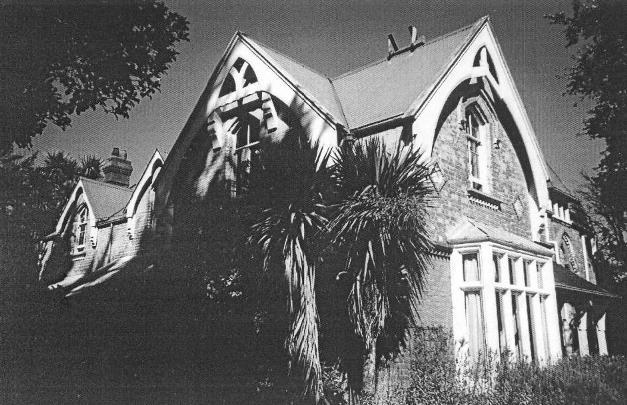
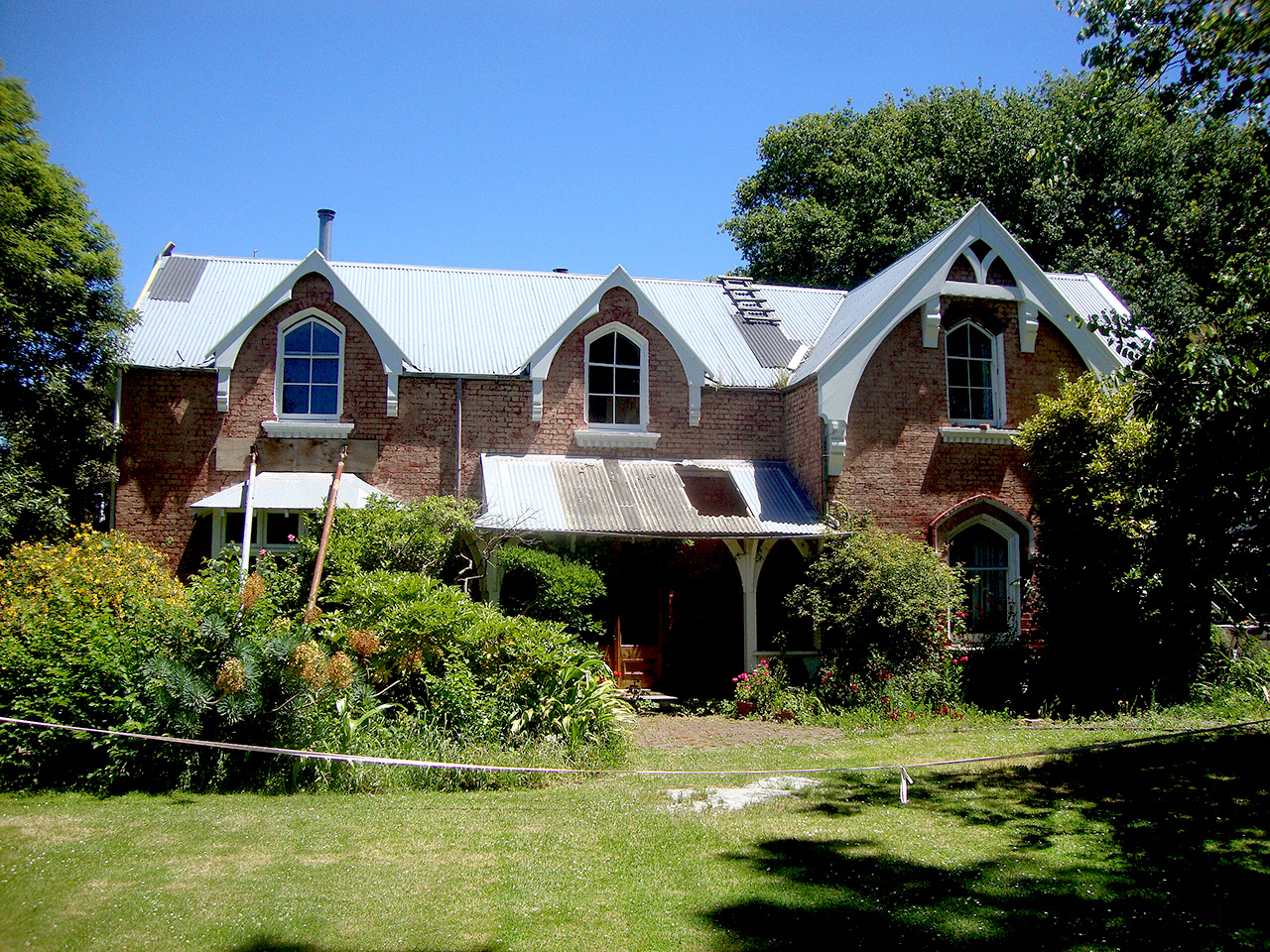
Tucked up a driveway off Browns Road, the two storeyed brick Chippenham Lodge is set in grounds containing mature trees and several smaller timber buildings, one of which has origins that may slightly pre-date the brick residence. The north wing is elaborately Gothic Revival in style, with an asymmetrical profile, ornamental string courses and hood moulds, heavy brackets and barge boards, and arched windows. The southern wing has some similar features, though plainer and smaller in scale. The roof, originally slate, is now corrugated steel. One and two storeyed weatherboard additions project on the south elevation.
Chippenham Lodge has been owned and associated with many prominent families and political figures, including the Honourable John Thomas Peacock, John Evans Brown and Sir Hugh Acland and their families. Through its many owners, it has strong connections with the early agriculture and secondary industry sectors that made Canterbury the most prosperous province in New Zealand. Throughout its history, many of its residents have been active in social justice and political issues of the time. This includes, since 1971, when Chippenham Lodge was purchased for an urban intentional community (commune) active in social justice, women’s rights and environmental and education causes. Mindful of the building’s heritage, the commune held numerous working bees and fundraiser open days to care for the property. Although badly damaged in the Canterbury Earthquakes of 2010-2011, Chippenham Lodge continues to be owned by an intentional community, who (as of 2026) aims to raise funds for repair and strengthening so that the building can once again be occupied for communal living.
List Entry Information
Status
Listed
List Entry Status
Historic Place Category 1
Access
Private/No Public Access
List Number
1846
Date Entered
25th June 2004
Date of Effect
14th May 2026
City/District Council
Christchurch City
Region
Canterbury Region
Extent of List Entry
Extent includes the land described as Lots 3-4 DP 22133 (RT CB3A/313), Canterbury Land District, and the building known as Chippenham Lodge thereon. The single-storeyed timber cottage to the south of Chippenham Lodge is included in the Extent but the other structures on site are not included in the Extent.
Legal description
Lots 3-4 DP 22133 (RT CB3A/313), Canterbury Land District
Status
Listed
List Entry Status
Historic Place Category 1
Access
Private/No Public Access
List Number
1846
Date Entered
25th June 2004
Date of Effect
14th May 2026
City/District Council
Christchurch City
Region
Canterbury Region
Extent of List Entry
Extent includes the land described as Lots 3-4 DP 22133 (RT CB3A/313), Canterbury Land District, and the building known as Chippenham Lodge thereon. The single-storeyed timber cottage to the south of Chippenham Lodge is included in the Extent but the other structures on site are not included in the Extent.
Legal description
Lots 3-4 DP 22133 (RT CB3A/313), Canterbury Land District
Why is this place significant?
Cultural Significance
Cultural Significance or Value Chippenham Lodge has high cultural significance, especially in its role as home to an intentional community since 1971. From the outset, the commune took on the name ‘Chippenham’, and its occupants, and their alternative ideas, flourished in the large house and grounds. It reflects a deliberate move by a group of people wishing to build a better community and live more consciously, challenging the norms of the suburban model. By living communally and sharing household and childcare duties, it meant the residents had more time to focus on activism in the matters that concerned them most – education, environment, human rights and peace. Early residents of the urban community of Chippenham were strongly politically active – the community was the site of Greenpeace and HART (Halt All Racist Tours) meetings, a place of gay activism, women’s rights, and critical planning and support for women’s refuge and alternative schooling. It was the seat of anti-apartheid work well before the controversial South African rugby tour of New Zealand. For a commune, Chippenham Lodge’s location might seem curious – a liberal, left-wing version of living in a wealthy, established area of conservative Christchurch – yet, largely because the residents have shown care for the house and extensive gardens, it has been accepted in the wider community. Social Significance or Value Chippenham Lodge has high social significance, locally, nationally and globally. With its many influential family owners, it has long been a place of gatherings and celebration. As the home of New Zealand’s longest-lived urban secular commune, it has played a crucial decades-long role in bringing people together who have been drawn to an alternative way of living. Until badly damaged by the Canterbury Earthquakes of 2010 and 2011, the property housed a changing mix of intentional community residents over time. It has brought people together physically, where they could share their common experiences and plan for environmental, educational, social and political activism. As a distinctive historic property, Chippenham Lodge is valued by a wider heritage community, too, who would likely feel a sense of loss if they were no longer able to interact with the site.
Historic Significance
Historical Significance or Value Chippenham Lodge has high historical significance. One of the earliest surviving homes in Christchurch today, Chippenham Lodge has layers of connection with several important aspects of New Zealand history. This includes strong links with the early agriculture and secondary industry sectors that made Canterbury such a prosperous province in New Zealand. The property has had a diverse mix of owners and residents throughout its history, many of whom were or became prominent figures in the commercial, social and political life of Canterbury and the nation. In fact, it is remarkable how many owners and residents of the house have been active in the political sphere, serving as elected members at local, provincial or national government level. Two sets of owners of Chippenham Lodge – first, the Goldney brothers and, later, the Aclands – were directly associated with important high country sheep stations, Cora Lynn and Mount Peel. The latter sheep station was financially administered from Chippenham Lodge in the mid-twentieth century, in conjunction with the practical manager, Jack Acland of the New Zealand Wool Board. As home to an intentional community since the early 1970s, Chippenham Lodge has served as a vital meeting place for historically significant activity. This includes meetings of environment and anti-war activists (= Green + Peace) associated with what became Greenpeace New Zealand during its formative years, hosting planning sessions and organising key environmental and anti-nuclear campaigns. It was a base for other activist groups such as HART (Halt All Racist Tours), gay rights advocates, and those involved in the women’s liberation movement. Chippenham-based members produced a range of publications, including Environment magazine and Men Against Sexism, and in the mid-1990s produced the St Alban’s Community Press at the property. In 1973 women in the commune were involved in establishing the first women’s refuge (in a separate location) specifically to protect women escaping from violent husbands, the first of more than 50 such refuges later established nationwide. In 1974, the Chippenham Lodge community’s Education Committee established New Zealand’s first state secondary alternative school, ‘Four Avenues’, which operated in central Christchurch between 1974 and 1992.
Physical Significance
Aesthetic Significance or Value Chippenham Lodge has aesthetic value. Tucked down a driveway, surrounded by sounds and dappling light in the garden, the picturesque historic brick architecture of Chippenham Lodge appeals directly to our senses and provides a sense of place. The subject of photography and sketching, this Gothic Revival building has long been a source of creative inspiration. In addition, knowledge that the building and its surrounds have long formed a hub for environmental and socially conscious activity for an intentional community stirs interest and intrigue. Archaeological Significance or Value Chippenham Lodge has archaeological value. Along with its surrounding grounds and timber cottage, Chippenham Lodge sits within a wider archaeological landscape that directly relates to its occupation and use, having the potential to elucidate more about the place and provide further clues about former occupants and activities. The main building, constructed in two phases in the 1860s, is notable as an early example of a brick residence in Christchurch, and its construction methods and fabric provide physical evidence of human activity that could be investigated using archaeological methods. The potential to understand the archaeology of the standing building may have become greater since early 2011 because damage caused by the Canterbury Earthquakes has exposed cavities and construction techniques that usually would be concealed. There is potential for future discovery about which building fabric relates to the original six-roomed cottage and which fabric is the 1865-1866 makeover of that wing, as well as furthering knowledge of phases of interior decoration such as wallpaper in the house. Architectural Significance or Value Chippenham Lodge has high architectural significance. One of the first brick buildings to be built on the Canterbury Plains, it displays architectural principles and theories of the Gothic Revival movement and is an important early remaining example of Victorian domestic architecture in Christchurch. Its exterior façades and overall form reflect a clear interpretation of this style of architecture, and its methods of construction are identifiable. Built in two main stages, the exterior façades are integrated and well balanced. Decorative details and craftsmanship – demonstrated in the bargeboards, cornicing, window hood moulds, verandah and bay window additions – contribute to the overall architectural composition and form. Many of the interior spaces remain in their original form and features such as the timber staircase, service hatch and fireplace surrounds survive. The designer of the original 1862 Chippenham Lodge six-roomed brick cottage is not known. Its substantial 1865-1866 redesign and addition is associated with the prominent colonial architectural partnership, Benjamin Mountfort and Maxwell Bury, with Bury suspected as being the primary designer for that phase of work.
Why is this place Category 1 / Category 2?
Detail Of Assessed Criteria
This place was assessed against the criteria set out in section 66(3) of the Heritage New Zealand Pouhere Taonga Act 2014 and found to qualify as a Category 1 historic place under the following criteria: a, b, g and j. (a) The extent to which the place reflects important or representative aspects of New Zealand history Since its construction, Chippenham Lodge has had a sustained and recurring connection to evolving ideals of democracy, social justice, public health and education. For most of its years, this part of New Zealand history was reflected through the notable families who resided at the property, many of whom were elected politicians. Chippenham Lodge is able to tell the story of both ends of the social spectrum, where, at times, privilege has been used to help or speak up for those who are disadvantaged. For much of its life, the property had wealthy owners who employed servants – this reflects an aspect of colonial Canterbury, where around 12% of the working class were employed as servants, though, compared to Britain, the wages were good and the turnover high since a shortage of women in the colony meant many were snapped up for marriage. Many activities carried out at the house, including work around and funding for charitable aid, gives insight into the realities of the time in the wider community – hardship for families without financial support, especially mothers left to raise children on their own, the elderly and widows. This work pre-empted the eventual implementation of the ‘welfare state’, a cornerstone of New Zealand’s history that is based on the principle that the state has some responsibility for citizens unable to provide for themselves. Since the early 1970s, Chippenham Commune has reflected a time of radical change both in New Zealand and globally. It tells the story of alternative ‘counterculture’ lifestyle patterns, especially those of living and working collectively. Its long history of collective action within the intentional community represents part of a wider protest movement, the Women’s Liberation Movement, and a challenge to accepted social structures promoting the ideal nuclear family. (b) The association of the place with events, persons, or ideas of importance in New Zealand history Throughout its history, Chippenham Lodge has been associated with numerous persons of influence. This includes elected politicians, John Thomas Peacock, Henry Webb, John Evans Brown, and Richard Walton – all owners at various times – and lawyer-politician, Thomas Joynt, who rented the house for some seven years. All of these men were representatives in the Provincial Government (abolished in 1875) and, later, Peacock, Webb and Brown were also elected to the New Zealand Parliament. A founding resident of Chippenham Commune was Marian Logeman (Hobbs), who became a Labour Member of Parliament from 1996 until 2008, becoming a cabinet minister and then Assistant Speaker of the House. Although he did not actually live at Chippenham Lodge, owner John Thomas Peacock had an extremely close involvement with it. In fact, Peacock, an early Canterbury settler and notable New Zealand businessman, philanthropist and politician, owned the property on two separate occasions, twenty years apart. Peacock was a key founding figure in numerous major industries, including the Kaiapoi Woollen Mills and the New Zealand Shipping Company, and was, for many years, a director of the Press and member of the Lyttelton Harbour Board. Peacock was elected the first Mayor of St Albans Borough on its formation in 1883. Thanks to Peacock, his brothers-in-law, John Evans (‘Yankee’) Brown and Henry Webb – also both politicians – were joint owners of Chippenham Lodge. Brown and his wife, Theresa (Peacock’s sister), lived at Chippenham Lodge from 1875, but he moved away a year after Theresa’s death in 1880. In 1881, Brown established the city’s first (steam) tramway system, giving Christchurch some of the world’s earliest motorised street traffic. Sir Hugh Acland – of the famous Aclands of the high country Mount Peel Station – and his wife Evelyn (Lady Acland) lived at Chippenham Lodge for over 30 years from 1924. New Zealand’s first full-time surgeon, Hugh Acland volunteered for service in three wars – South African (1899-1902), World War One (1914-1918) and World War Two (1939-1945) – and saved many lives with his surgical skill. He was actively involved in cancer research and campaigns for public health and served 17 years on the district health board. One of the first doctors in New Zealand to confine his private practice exclusively to surgery, Acland was regarded as a master of operating technique and raised the standard of surgery. He was a Christchurch City Councillor from 1936. Lady Acland was noted for her strong interest in social work, having served on many organisations including the Nurse Maude Association, the Seamen’s Institute, New Zealand Foundation for the Blind, Dr Barnardo’s children’s homes movement and the Victoria League. Among regular Chippenham Lodge visitors was close Acland family friend, world famous crime writer and noted Shakespearian theatre director, Ngaio Marsh. Since its time operating as a commune, Chippenham Lodge has been associated with people and ideas of importance in New Zealand history. Providing a steadfast space for grassroots activism and community engagement, Chippenham Lodge connects with broader activist movements. For example, throughout the late 1970s and into the 1980s, Greenpeace evolved into a national and international force. Not long after the first Greenpeace boat set sail in September 1971 to try to stop the world’s largest military superpower from testing nuclear weapons in Alaska, the campaign message quickly spread around the world and led to others launching their own sailing boat campaigns, including in New Zealand. The sinking of the Greenpeace ship, the Rainbow Warrior, in Auckland in 1985 was a defining moment in New Zealand’s nuclear-free history. Rosemary Howard and Diane Shannon were two of the Chippenham Lodge residents pivotal in bringing about change as part of New Zealand’s Women’s Rights Movement. They helped establish a separate safe house for women and children escaping abusive husbands and fathers – a New Zealand first sadly necessitated by this ongoing unsavoury aspect of New Zealand’s history of domestic violence – reflecting a movement of women responding to other women’s needs in escaping family violence. Women involved in the early refuges in Aotearoa New Zealand used their creativity and strength to run the safe houses in a way that was collective and used feminist rather than hierarchical structures. From Chippenham Lodge, logistical support was also provided to enable women to fly to Australia to obtain legal abortions, supported and hosted there by Australian women. This sheds light on New Zealand’s history of abortion law and related debates on women’s right to choose. Initially illegal except to save a woman’s life, in 1977 a new law allowed abortions under certain conditions, but it was not until 2020 that abortion was decriminalised, permitting women to obtain abortions without criminal penalties. (g) The technical accomplishment, value, or design of the place Chippenham Lodge displays considerable technical accomplishment in the craftsmanship of joinery and brickwork, as seen, for example, in its ornate window heads, including a trefoil-headed sash window to the landing, detailing in the main entrances, and in hood moulds and other decorative facing brick features. (j) The importance of identifying rare types of historic places There are two aspects of Chippenham Lodge that make it a rare type of historic place. When built in the 1860s, it was unusual for Christchurch to have a brick dwelling (especially in triple brick and with such decorative features) – and it is now even rarer as an early masonry survivor in a city dramatically affected by earthquakes in 2010-2011. In addition, Chippenham Lodge is the oldest and longest-lasting urban secular intentional community in New Zealand.
Why is this place significant?
Cultural Significance
Cultural Significance or Value Chippenham Lodge has high cultural significance, especially in its role as home to an intentional community since 1971. From the outset, the commune took on the name ‘Chippenham’, and its occupants, and their alternative ideas, flourished in the large house and grounds. It reflects a deliberate move by a group of people wishing to build a better community and live more consciously, challenging the norms of the suburban model. By living communally and sharing household and childcare duties, it meant the residents had more time to focus on activism in the matters that concerned them most – education, environment, human rights and peace. Early residents of the urban community of Chippenham were strongly politically active – the community was the site of Greenpeace and HART (Halt All Racist Tours) meetings, a place of gay activism, women’s rights, and critical planning and support for women’s refuge and alternative schooling. It was the seat of anti-apartheid work well before the controversial South African rugby tour of New Zealand. For a commune, Chippenham Lodge’s location might seem curious – a liberal, left-wing version of living in a wealthy, established area of conservative Christchurch – yet, largely because the residents have shown care for the house and extensive gardens, it has been accepted in the wider community. Social Significance or Value Chippenham Lodge has high social significance, locally, nationally and globally. With its many influential family owners, it has long been a place of gatherings and celebration. As the home of New Zealand’s longest-lived urban secular commune, it has played a crucial decades-long role in bringing people together who have been drawn to an alternative way of living. Until badly damaged by the Canterbury Earthquakes of 2010 and 2011, the property housed a changing mix of intentional community residents over time. It has brought people together physically, where they could share their common experiences and plan for environmental, educational, social and political activism. As a distinctive historic property, Chippenham Lodge is valued by a wider heritage community, too, who would likely feel a sense of loss if they were no longer able to interact with the site.
Historic Significance
Historical Significance or Value Chippenham Lodge has high historical significance. One of the earliest surviving homes in Christchurch today, Chippenham Lodge has layers of connection with several important aspects of New Zealand history. This includes strong links with the early agriculture and secondary industry sectors that made Canterbury such a prosperous province in New Zealand. The property has had a diverse mix of owners and residents throughout its history, many of whom were or became prominent figures in the commercial, social and political life of Canterbury and the nation. In fact, it is remarkable how many owners and residents of the house have been active in the political sphere, serving as elected members at local, provincial or national government level. Two sets of owners of Chippenham Lodge – first, the Goldney brothers and, later, the Aclands – were directly associated with important high country sheep stations, Cora Lynn and Mount Peel. The latter sheep station was financially administered from Chippenham Lodge in the mid-twentieth century, in conjunction with the practical manager, Jack Acland of the New Zealand Wool Board. As home to an intentional community since the early 1970s, Chippenham Lodge has served as a vital meeting place for historically significant activity. This includes meetings of environment and anti-war activists (= Green + Peace) associated with what became Greenpeace New Zealand during its formative years, hosting planning sessions and organising key environmental and anti-nuclear campaigns. It was a base for other activist groups such as HART (Halt All Racist Tours), gay rights advocates, and those involved in the women’s liberation movement. Chippenham-based members produced a range of publications, including Environment magazine and Men Against Sexism, and in the mid-1990s produced the St Alban’s Community Press at the property. In 1973 women in the commune were involved in establishing the first women’s refuge (in a separate location) specifically to protect women escaping from violent husbands, the first of more than 50 such refuges later established nationwide. In 1974, the Chippenham Lodge community’s Education Committee established New Zealand’s first state secondary alternative school, ‘Four Avenues’, which operated in central Christchurch between 1974 and 1992.
Physical Significance
Aesthetic Significance or Value Chippenham Lodge has aesthetic value. Tucked down a driveway, surrounded by sounds and dappling light in the garden, the picturesque historic brick architecture of Chippenham Lodge appeals directly to our senses and provides a sense of place. The subject of photography and sketching, this Gothic Revival building has long been a source of creative inspiration. In addition, knowledge that the building and its surrounds have long formed a hub for environmental and socially conscious activity for an intentional community stirs interest and intrigue. Archaeological Significance or Value Chippenham Lodge has archaeological value. Along with its surrounding grounds and timber cottage, Chippenham Lodge sits within a wider archaeological landscape that directly relates to its occupation and use, having the potential to elucidate more about the place and provide further clues about former occupants and activities. The main building, constructed in two phases in the 1860s, is notable as an early example of a brick residence in Christchurch, and its construction methods and fabric provide physical evidence of human activity that could be investigated using archaeological methods. The potential to understand the archaeology of the standing building may have become greater since early 2011 because damage caused by the Canterbury Earthquakes has exposed cavities and construction techniques that usually would be concealed. There is potential for future discovery about which building fabric relates to the original six-roomed cottage and which fabric is the 1865-1866 makeover of that wing, as well as furthering knowledge of phases of interior decoration such as wallpaper in the house. Architectural Significance or Value Chippenham Lodge has high architectural significance. One of the first brick buildings to be built on the Canterbury Plains, it displays architectural principles and theories of the Gothic Revival movement and is an important early remaining example of Victorian domestic architecture in Christchurch. Its exterior façades and overall form reflect a clear interpretation of this style of architecture, and its methods of construction are identifiable. Built in two main stages, the exterior façades are integrated and well balanced. Decorative details and craftsmanship – demonstrated in the bargeboards, cornicing, window hood moulds, verandah and bay window additions – contribute to the overall architectural composition and form. Many of the interior spaces remain in their original form and features such as the timber staircase, service hatch and fireplace surrounds survive. The designer of the original 1862 Chippenham Lodge six-roomed brick cottage is not known. Its substantial 1865-1866 redesign and addition is associated with the prominent colonial architectural partnership, Benjamin Mountfort and Maxwell Bury, with Bury suspected as being the primary designer for that phase of work.
Why is this place Category 1 / Category 2?
Detail Of Assessed Criteria
This place was assessed against the criteria set out in section 66(3) of the Heritage New Zealand Pouhere Taonga Act 2014 and found to qualify as a Category 1 historic place under the following criteria: a, b, g and j. (a) The extent to which the place reflects important or representative aspects of New Zealand history Since its construction, Chippenham Lodge has had a sustained and recurring connection to evolving ideals of democracy, social justice, public health and education. For most of its years, this part of New Zealand history was reflected through the notable families who resided at the property, many of whom were elected politicians. Chippenham Lodge is able to tell the story of both ends of the social spectrum, where, at times, privilege has been used to help or speak up for those who are disadvantaged. For much of its life, the property had wealthy owners who employed servants – this reflects an aspect of colonial Canterbury, where around 12% of the working class were employed as servants, though, compared to Britain, the wages were good and the turnover high since a shortage of women in the colony meant many were snapped up for marriage. Many activities carried out at the house, including work around and funding for charitable aid, gives insight into the realities of the time in the wider community – hardship for families without financial support, especially mothers left to raise children on their own, the elderly and widows. This work pre-empted the eventual implementation of the ‘welfare state’, a cornerstone of New Zealand’s history that is based on the principle that the state has some responsibility for citizens unable to provide for themselves. Since the early 1970s, Chippenham Commune has reflected a time of radical change both in New Zealand and globally. It tells the story of alternative ‘counterculture’ lifestyle patterns, especially those of living and working collectively. Its long history of collective action within the intentional community represents part of a wider protest movement, the Women’s Liberation Movement, and a challenge to accepted social structures promoting the ideal nuclear family. (b) The association of the place with events, persons, or ideas of importance in New Zealand history Throughout its history, Chippenham Lodge has been associated with numerous persons of influence. This includes elected politicians, John Thomas Peacock, Henry Webb, John Evans Brown, and Richard Walton – all owners at various times – and lawyer-politician, Thomas Joynt, who rented the house for some seven years. All of these men were representatives in the Provincial Government (abolished in 1875) and, later, Peacock, Webb and Brown were also elected to the New Zealand Parliament. A founding resident of Chippenham Commune was Marian Logeman (Hobbs), who became a Labour Member of Parliament from 1996 until 2008, becoming a cabinet minister and then Assistant Speaker of the House. Although he did not actually live at Chippenham Lodge, owner John Thomas Peacock had an extremely close involvement with it. In fact, Peacock, an early Canterbury settler and notable New Zealand businessman, philanthropist and politician, owned the property on two separate occasions, twenty years apart. Peacock was a key founding figure in numerous major industries, including the Kaiapoi Woollen Mills and the New Zealand Shipping Company, and was, for many years, a director of the Press and member of the Lyttelton Harbour Board. Peacock was elected the first Mayor of St Albans Borough on its formation in 1883. Thanks to Peacock, his brothers-in-law, John Evans (‘Yankee’) Brown and Henry Webb – also both politicians – were joint owners of Chippenham Lodge. Brown and his wife, Theresa (Peacock’s sister), lived at Chippenham Lodge from 1875, but he moved away a year after Theresa’s death in 1880. In 1881, Brown established the city’s first (steam) tramway system, giving Christchurch some of the world’s earliest motorised street traffic. Sir Hugh Acland – of the famous Aclands of the high country Mount Peel Station – and his wife Evelyn (Lady Acland) lived at Chippenham Lodge for over 30 years from 1924. New Zealand’s first full-time surgeon, Hugh Acland volunteered for service in three wars – South African (1899-1902), World War One (1914-1918) and World War Two (1939-1945) – and saved many lives with his surgical skill. He was actively involved in cancer research and campaigns for public health and served 17 years on the district health board. One of the first doctors in New Zealand to confine his private practice exclusively to surgery, Acland was regarded as a master of operating technique and raised the standard of surgery. He was a Christchurch City Councillor from 1936. Lady Acland was noted for her strong interest in social work, having served on many organisations including the Nurse Maude Association, the Seamen’s Institute, New Zealand Foundation for the Blind, Dr Barnardo’s children’s homes movement and the Victoria League. Among regular Chippenham Lodge visitors was close Acland family friend, world famous crime writer and noted Shakespearian theatre director, Ngaio Marsh. Since its time operating as a commune, Chippenham Lodge has been associated with people and ideas of importance in New Zealand history. Providing a steadfast space for grassroots activism and community engagement, Chippenham Lodge connects with broader activist movements. For example, throughout the late 1970s and into the 1980s, Greenpeace evolved into a national and international force. Not long after the first Greenpeace boat set sail in September 1971 to try to stop the world’s largest military superpower from testing nuclear weapons in Alaska, the campaign message quickly spread around the world and led to others launching their own sailing boat campaigns, including in New Zealand. The sinking of the Greenpeace ship, the Rainbow Warrior, in Auckland in 1985 was a defining moment in New Zealand’s nuclear-free history. Rosemary Howard and Diane Shannon were two of the Chippenham Lodge residents pivotal in bringing about change as part of New Zealand’s Women’s Rights Movement. They helped establish a separate safe house for women and children escaping abusive husbands and fathers – a New Zealand first sadly necessitated by this ongoing unsavoury aspect of New Zealand’s history of domestic violence – reflecting a movement of women responding to other women’s needs in escaping family violence. Women involved in the early refuges in Aotearoa New Zealand used their creativity and strength to run the safe houses in a way that was collective and used feminist rather than hierarchical structures. From Chippenham Lodge, logistical support was also provided to enable women to fly to Australia to obtain legal abortions, supported and hosted there by Australian women. This sheds light on New Zealand’s history of abortion law and related debates on women’s right to choose. Initially illegal except to save a woman’s life, in 1977 a new law allowed abortions under certain conditions, but it was not until 2020 that abortion was decriminalised, permitting women to obtain abortions without criminal penalties. (g) The technical accomplishment, value, or design of the place Chippenham Lodge displays considerable technical accomplishment in the craftsmanship of joinery and brickwork, as seen, for example, in its ornate window heads, including a trefoil-headed sash window to the landing, detailing in the main entrances, and in hood moulds and other decorative facing brick features. (j) The importance of identifying rare types of historic places There are two aspects of Chippenham Lodge that make it a rare type of historic place. When built in the 1860s, it was unusual for Christchurch to have a brick dwelling (especially in triple brick and with such decorative features) – and it is now even rarer as an early masonry survivor in a city dramatically affected by earthquakes in 2010-2011. In addition, Chippenham Lodge is the oldest and longest-lasting urban secular intentional community in New Zealand.
Construction Professional
Name
Bury, Maxwell
Type
Architect
Biography
Maxwell Bury (1825-1912) was born at East Retford, Nottinghamshire and was the son of an Anglican minister. He had training in architecture, civil and steam engineering and ship design, and it appears that some of his training was undertaken at Butterley Ironworks. He subsequently went to sea as an engineer officer. In 1853 he married Eleanor Sarah Deighton (known as Ellen) and the following year they travelled to Australia. They found, when they arrived, that Melbourne was suffering from a post-goldrush depression, and consequently the Burys moved to New Zealand. They arrived in Lyttelton in 1854 from Melbourne and settled in Nelson soon after. Bury established himself as an engineer, and became the chairman of the first Nelson Board of Works. He also became involved in various mining ventures and was churchwarden. By 1858 Bury decided to change professions, and took up architecture again. He was responsible for the first Masonic Hall in Nelson, the 1858 enlargement of Frederick Thatcher's Christ Church, and the Nelson Institute. His design for the Nelson Provincial Buildings did not win the 1858 competition but was successful none the less, as his was the only design that could be built for the specified price. None of these timber buildings now survive. The area's wealth, which enabled Bury to gain these commissions, was based on mining. When this boom slackened, the Burys moved, arriving in Christchurch in 1863. Their involvement in the church led to further commissions for Bury, including an orphanage in Addington, the Riccarton Parsonage and the Church of St John the Baptist in Latimer Square. He entered into partnership with Benjamin Woolfield Mountfort (1825-1898) in 1864. The partnership only lasted two years, but in that time Mountfort and Bury were responsible for a number of churches: St James-on-the-Cust, St Mark's at Opawa, St Joseph's at Lyttelton and St Patrick's at Akaroa and a few houses including Risingholme and Chippenham Lodge. Bury and his family then left for London in 1866. Although it seems he intended to return to New Zealand, various problems delayed this. His marriage appears to have broken up and family tradition has it that Bury went back to sea. Around 1870 Bury did make it back to New Zealand, settling by himself in Nelson. He designed the Chapel of the Holy Evangelists for Bishopdale in Nelson (1875-1876) By 1876 Bury was based in Dunedin and won the competition for the design of Otago University, Dunedin, in 1877. Unfortunately costs on this building overran to such an extent that a Commission of Enquiry into the matter was held in 1879. Thereafter Bury found his commissions dropping off. He did undertake further work for the University from 1883-1885. Some time after 1885 he returned to Nelson, and then to Sydney, where he set up office as a civil engineer in 1890. He retired in Sydney six years later, and in 1908 finally returned to England where he died in 1912. (Anne Marchant, 'Maxwell Bury of 'Bury and Mountfort', in Bulletin of New Zealand Art History, 19, 1998, pp.3-15)
Name
Baily
Type
Carpenter
Biography
Contractor carpenter for the 1865-1866 wing of Chippenham Lodge
Name
Mackie
Type
Builder
Biography
Contractor focusing on brickwork for the 1865-1866 wing of Chippenham Lodge
Name
Mountfort, Benjamin Woolfield
Type
Architect
Biography
Benjamin Woolfield Mountfort (1825-98) trained as an architect in England, in the office of Richard Cromwell Carpenter, a member of the Cambridge Camden Society (later the Ecclesiological Society). He arrived in Canterbury in 1850. Mountfort was New Zealand's pre-eminent Gothic Revival architect and, according to architectural historian Ian Lochhead, 'did most to shape the architectural character of nineteenth-century Christchurch.' The buildings he designed were almost exclusively in the Gothic Revival style. During his career he designed many churches and additions to churches; those still standing include the Trinity Congregational Church in Christchurch (1874), St Mary's Church in Parnell, Auckland and the Church of the Good Shepherd in Phillipstown, Christchurch (1884). In 1857 he became the first architect to the province of Canterbury. He designed the Canterbury Provincial Council Buildings in three stages from 1858 to 1865. The stone chamber of this building can be considered the greatest accomplishment of his career. He was involved in many important commissions from the 1870s, including the Canterbury Museum (1869-82) and the Clock-tower Block on the Canterbury College campus (1876-77). He was also involved in the construction of Christchurch's Cathedral and made several major modifications to the original design. Mountfort introduced a number of High Victorian elements to New Zealand architecture, such as the use of constructional polychromy, probably first used in New Zealand in the stone tower of the Canterbury Provincial Government Buildings (1859). Overall, his oeuvre reveals a consistent and virtually unerring application of Puginian principles including a commitment to the Gothic style, honest use of materials and picturesque utility. The result was the construction of inventive and impressive buildings of outstanding quality. He died in Christchurch in 1898. A belfry at the Church of the Good Shepherd in Phillipstown, the church he attended for the last ten years of his life, was erected in his honour.
Construction Details
Start Year
1865
Finish Year
1866
Type
Addition
Description
Brick house extended to the north and existing south wing extensively modified
Type
Modification
Description
Addition of hipped gable dormer on north elevation, partial removal of east elevation verandah and addition of bay window
Period
1890s
Type
Modification
Description
Replacement of bargeboards
Period
1980s
Start Year
1987
Type
Modification
Description
Slate roof replaced with corrugated steel
Type
Addition
Description
Timber additions and alterations made
Period
Various/Unknown
Start Year
2012
Type
Modification
Description
Interim stabilisation
Start Year
1862
Type
Original Construction
Description
Original brick house (south wing) constructed
Construction Materials
Brick, timber, corrugated steel (replaced original slate roof)
Construction Professional
Name
Bury, Maxwell
Type
Architect
Biography
Maxwell Bury (1825-1912) was born at East Retford, Nottinghamshire and was the son of an Anglican minister. He had training in architecture, civil and steam engineering and ship design, and it appears that some of his training was undertaken at Butterley Ironworks. He subsequently went to sea as an engineer officer. In 1853 he married Eleanor Sarah Deighton (known as Ellen) and the following year they travelled to Australia. They found, when they arrived, that Melbourne was suffering from a post-goldrush depression, and consequently the Burys moved to New Zealand. They arrived in Lyttelton in 1854 from Melbourne and settled in Nelson soon after. Bury established himself as an engineer, and became the chairman of the first Nelson Board of Works. He also became involved in various mining ventures and was churchwarden. By 1858 Bury decided to change professions, and took up architecture again. He was responsible for the first Masonic Hall in Nelson, the 1858 enlargement of Frederick Thatcher's Christ Church, and the Nelson Institute. His design for the Nelson Provincial Buildings did not win the 1858 competition but was successful none the less, as his was the only design that could be built for the specified price. None of these timber buildings now survive. The area's wealth, which enabled Bury to gain these commissions, was based on mining. When this boom slackened, the Burys moved, arriving in Christchurch in 1863. Their involvement in the church led to further commissions for Bury, including an orphanage in Addington, the Riccarton Parsonage and the Church of St John the Baptist in Latimer Square. He entered into partnership with Benjamin Woolfield Mountfort (1825-1898) in 1864. The partnership only lasted two years, but in that time Mountfort and Bury were responsible for a number of churches: St James-on-the-Cust, St Mark's at Opawa, St Joseph's at Lyttelton and St Patrick's at Akaroa and a few houses including Risingholme and Chippenham Lodge. Bury and his family then left for London in 1866. Although it seems he intended to return to New Zealand, various problems delayed this. His marriage appears to have broken up and family tradition has it that Bury went back to sea. Around 1870 Bury did make it back to New Zealand, settling by himself in Nelson. He designed the Chapel of the Holy Evangelists for Bishopdale in Nelson (1875-1876) By 1876 Bury was based in Dunedin and won the competition for the design of Otago University, Dunedin, in 1877. Unfortunately costs on this building overran to such an extent that a Commission of Enquiry into the matter was held in 1879. Thereafter Bury found his commissions dropping off. He did undertake further work for the University from 1883-1885. Some time after 1885 he returned to Nelson, and then to Sydney, where he set up office as a civil engineer in 1890. He retired in Sydney six years later, and in 1908 finally returned to England where he died in 1912. (Anne Marchant, 'Maxwell Bury of 'Bury and Mountfort', in Bulletin of New Zealand Art History, 19, 1998, pp.3-15)
Name
Baily
Type
Carpenter
Biography
Contractor carpenter for the 1865-1866 wing of Chippenham Lodge
Name
Mackie
Type
Builder
Biography
Contractor focusing on brickwork for the 1865-1866 wing of Chippenham Lodge
Name
Mountfort, Benjamin Woolfield
Type
Architect
Biography
Benjamin Woolfield Mountfort (1825-98) trained as an architect in England, in the office of Richard Cromwell Carpenter, a member of the Cambridge Camden Society (later the Ecclesiological Society). He arrived in Canterbury in 1850. Mountfort was New Zealand's pre-eminent Gothic Revival architect and, according to architectural historian Ian Lochhead, 'did most to shape the architectural character of nineteenth-century Christchurch.' The buildings he designed were almost exclusively in the Gothic Revival style. During his career he designed many churches and additions to churches; those still standing include the Trinity Congregational Church in Christchurch (1874), St Mary's Church in Parnell, Auckland and the Church of the Good Shepherd in Phillipstown, Christchurch (1884). In 1857 he became the first architect to the province of Canterbury. He designed the Canterbury Provincial Council Buildings in three stages from 1858 to 1865. The stone chamber of this building can be considered the greatest accomplishment of his career. He was involved in many important commissions from the 1870s, including the Canterbury Museum (1869-82) and the Clock-tower Block on the Canterbury College campus (1876-77). He was also involved in the construction of Christchurch's Cathedral and made several major modifications to the original design. Mountfort introduced a number of High Victorian elements to New Zealand architecture, such as the use of constructional polychromy, probably first used in New Zealand in the stone tower of the Canterbury Provincial Government Buildings (1859). Overall, his oeuvre reveals a consistent and virtually unerring application of Puginian principles including a commitment to the Gothic style, honest use of materials and picturesque utility. The result was the construction of inventive and impressive buildings of outstanding quality. He died in Christchurch in 1898. A belfry at the Church of the Good Shepherd in Phillipstown, the church he attended for the last ten years of his life, was erected in his honour.
Construction Details
Start Year
1865
Finish Year
1866
Type
Addition
Description
Brick house extended to the north and existing south wing extensively modified
Type
Modification
Description
Addition of hipped gable dormer on north elevation, partial removal of east elevation verandah and addition of bay window
Period
1890s
Type
Modification
Description
Replacement of bargeboards
Period
1980s
Start Year
1987
Type
Modification
Description
Slate roof replaced with corrugated steel
Type
Addition
Description
Timber additions and alterations made
Period
Various/Unknown
Start Year
2012
Type
Modification
Description
Interim stabilisation
Start Year
1862
Type
Original Construction
Description
Original brick house (south wing) constructed
Construction Materials
Brick, timber, corrugated steel (replaced original slate roof)
Early History Christchurch and the wider area have a long history of Māori occupation. The vast network of wetlands and plains of Kā Pakihi Whakatekateka o Waitaha (Canterbury Plains) is inherently important to the history of its early occupation. The area was rich in food from the forest and waterways. Major awa (river) such as the Rakahuri (Ashley), Waimakariri, Pūharakekenui (Styx) and Rakaia were supplied from the mountain-fed aquifers of Kā Tiritiri o te Moana (Southern Alps). Other spring-fed waterways such as the Ōtākaro (Avon) meandered throughout the landscape. The rivers teemed with tuna, kōkopu, kanakana and inaka; the wetlands were a good supply of wading birds and fibres for weaving, food and medicine; and the forest supplied kererū, kokopa, tui and other fauna as well as building materials. Ara tawhito (travelling routes) crossed over the landscape, providing annual and seasonal pathways up and down and across the plains and in some cases skirting or traversing the swamps. Permanent pā sites and temporary kāinga were located within and around the Plains as Ngāi Tahu established and used the mahinga kai sites where they gathered and utilised natural resources from the network of springs, waterways, wetlands, grasslands and lowland podocarp forests that abounded along the rivers and estuaries. The area now known as St Albans in Christchurch was part of the wetlands as a rich and valuable source of mahinga kai for tangata whenua. Except for very small reserves, the Canterbury region was controversially purchased from Ngāi Tahu by the Crown in 1848. The Canterbury Association oversaw the systematic European settlement of Canterbury and surveyed the town of Christchurch and rural sections outside of the town boundary. In the 1850s, when the land was being taken up by colonial settlers, St Albans was ‘swampy land’ bounded by sandy ridges with flax, raupo, toetoe, fern and manuka. Lack of roading and poor drainage with the swampy ground was problematic for many landowners, who banded together to install drains to drain the land for farming. However, draining the soil created issues of subsidence and inability to clear protruding former buried native forestry due to risk of peat fires. With road boards and municipal councils working together, gradually the situation improved and landowners began developing their land, subdividing and establishing large permanent homes. The land that Chippenham Lodge is situated on was part of one of the first sections (Rural Section 136) taken up in St Albans, in 1851. It was allocated to James Wyatt of Bangor, Wales, initially as a leasehold and officially purchased in 1856. James Wyatt did not live there but, rather, acquired the property for his son, Benjamin. By 1853, Benjamin Wyatt is recorded as a farmer at this 100-acre block of land bounded by St Albans Street, Innes Road, Rutland Street and Papanui Road, which he named Springfield. Benjamin Wyatt’s wife, Sophia, gave birth to a daughter at Springfield (Papanui Road) in January 1858, but Sophia died there early the following year, 1859, and Wyatt made moves to sell up. Auctioneer Joseph Longden was instructed to sell subdivided portions of Rural Section 136 and appears to have purchased much of this himself, in March 1859, for investment purposes. He on-sold sections the following year to the likes of millinery shop owner Jane Skillicorn and brothers George and Francis Goldney of Cora Lynn station near Arthur’s Pass. When the Press published ‘Claims to Vote’ in the Electoral District of Avon on 19 April 1862, F. B. Goldney had a freehold house and land on part of section 136 in St Albans and George Goldney had a freehold ‘red brick house’ in St Albans. This ‘red brick house’ is understood to be the six-roomed brick dwelling the Goldney brothers had built in 1862, which they named Chippenham Lodge, after their birthplace in Wiltshire. In mid-1865, following the decision of George Goldney to return to England, ‘Chippenham Lodge, consisting of 25 acres of meadow land, with a six-roomed brick cottage and outbuildings, at St Albans’ was put up for sale. It was purchased by Henry W. Mytton, an importer, wine merchant and bond store owner, who in 1865-1866 transformed the existing dwelling into a much grander house with a distinct Gothic Revival character through modifications and the addition of a substantial new wing. Designed by the firm Bury and Mountfort, it is thought that Maxwell Bury played the major architectural role in these 1865-1866 alterations and additions. Mountfort’s letter and account book for the contractors’ work for Mytton at Chippenham Lodge gives a flavour of the makeover done to the existing dwelling at this time: ‘Pointing old Building’, altering the fireplace in the kitchen, stairs from the kitchen, skylight, and alterations in the hall. Mytton’s wife, Maria (née Jackson) gave birth to a daughter at Chippenham Lodge in June 1867. However, almost immediately after this, he variously advertised all his household effects and livestock as well as trying to let the place, as follows: ‘CHIPPENHAM LODGE, ST. ALBANS. TO LET, A BRICK HOUSE, of ten rooms and offices, suitable for a gentleman’s residence. Good orchard, and twenty-five acres securely fenced and laid down in excellent pasture’. It turned out Mytton was in financial strife and needed to downsize, though he retained ownership of this property until 1875. From the late 1860s until 1874, Chippenham Lodge was rented to Thomas Ingham Joynt, an early New Zealand-trained lawyer. Joynt lived there with his wife, Edith, and growing family, some of whom were born at the house. Joynt became well known during his time living at this place. In 1871 he was defence lawyer for a high-profile murder case involving two servants employed by wealthy landowner, William ‘Ready Money’ Robinson (Margaret Burke stabbed by Simon Cedeno). Also in 1871, while living at Chippenham Lodge, he was elected a member of the Canterbury Provincial Council for Kaiapoi. When Joynt and his family vacated the house in 1874, his recent years of occupation there was part of its selling point. In 1875 the house and 39 acres were purchased by neighbouring landowner, the Honourable John Thomas Peacock, a wealthy Australian-born shipping merchant and former Lyttelton Member of Parliament and Canterbury Provincial Councillor. Later that same year Peacock transferred the house and five acres of land around it to his brothers-in-law, John Evans Brown and Henry Richard Webb. Peacock remained at his adjacent large property, Hawkesbury, and with his sisters Elizabeth (Garrick) and Augusta (Webb) nearby and the Browns at Chippenham Lodge, the area became something of a substantial extended family enclave. Although both Brown and Webb are named on the Certificate of Title, in fact, it appears that Peacock gifted Chippenham Lodge specifically to his sister, Theresa and her husband, John Evans (‘Yankee’) Brown. American-born Brown farmed at Swannanoa and served as the Member of Parliament for Ashley from 1871 to 1879, before moving permanently to Chippenham Lodge in 1875. From there, Brown continued activity in local body politics, both in rural North Canterbury and Christchurch, pushing for tram and train transport and taking up a position on the Christchurch Hospital and Charitable Aid Board. His busy work meant he was often absent, leaving Theresa and staff (servants and, later, a nurse) at the house. Sadly, the Browns had previously lost an infant to measles in 1875, and then within the space of one week, two children died of diphtheria in 1877. Theresa died in 1880, and the following year, 1881, Brown exchanged Chippenham Lodge for Richard Walton’s house, ‘Amwell’, on Papanui Road. Brown remarried in 1883 and returned to the United States at the end of the 1880s. Richard Walton, an auctioneer and land agent, his wife Alice and their five children lived at Chippenham Lodge from around 1881 until around 1887. A description of the house in early 1883 identified the functions of the 18 rooms of the brick house. On its ground floor there was a large drawing room, dining room, breakfast and day room, library, large kitchen, scullery, large pantry, jam closet room, store room, cellar and ante-room. On the first floor were seven bedrooms, a linen closet and bathroom. Also on the five-acre property were: ‘a House with large washhouse and man’s room’, a three-stalled stable, coach-house, large room, tool house, large store room, fruit room and hayloft. Between 1889 and 1893 the house was tenanted by Thomas Cheal Norris, accountant of the North Canterbury Charitable Aid Board, his wife Alice and family. In 1895, Peacock purchased Chippenham Lodge for the second time, this time for seven years, during which multiple smaller sections were subdivided off. A year after unsuccessfully trying to sell the house itself in 1898, Peacock employed architect R. W. England (Jnr) to design extensive improvements, including painting and paperhanging, in 1899. It is thought that the verandah was altered and a hipped gable added at this time. In 1902 the house and a portion of the property was sold to Walter Joseph Moore, an accountant and estate agent. Moore’s wife was Mary Louisa Whitcombe, stepdaughter of the wealthy businessman and politician, the Honourable Edward Stevens. Stevens family-funded the purchase of Chippenham Lodge, by way of mortgage. Further subdivision took place during Moore’s tenure. Variously in 1914 and 1915-1916, the Moores vacated the property to allow the house to be used by notable British guests, the Honourable James Borthwick and his wife. Borthwick was in Christchurch to oversee the construction of new freezing works for Borthwicks Meat Company, at Belfast, north of Christchurch. As well as being involved in community matters – for example, Mary Moore was vice president of the New Brighton Children’s Convalescent Home – the Moores led a social time at Chippenham Lodge, holding dances and other events. In December 1920, two of the Moores’ daughters – Freda and Gwen – were each married in a double wedding service at St Mary’s, Merivale. The large wedding reception of Freda and her new husband, Philip Keddell, and Gwen and her new husband, J. F. Mills, took place at Chippenham Lodge. In 1922 James and Nesta Maling purchased the property. Formerly mayor of Geraldine and then of Timaru, and a founding director of Pyne Gould Guinness, James Maling was a prominent Canterbury figure. Nesta was recognised as being particularly active in community service. In 1924 the house was bought by Hugh Thomas Dyke Acland (later Sir Hugh), who also carried out further subdivision. A prominent surgeon, Acland and his wife, Evelyn (Lady Acland) lived at Chippenham Lodge as their family home for over 30 years, regularly hosting family, friends and notable guests at functions at the house. The Aclands were keen gardeners and garden parties at Chippenham were common, often for the benefit of a charitable cause. At Chippenham, Lady Acland was particularly supportive of women’s causes – for example, in celebrating nurses associated with Nurse Maude, contributing to institutions supportive of homeless elderly women in London, and hosting large gatherings of doctors’ wives and women doctors. The Aclands maintained a close connection to Hugh’s family home at Mount Peel Station, of which he was part owner and was chairman of the Peel Forest Board. Ngaio Marsh had a close friendship with the Acland family, something which remained important to her throughout her life, and was a regular visitor to the Aclands at both Chippenham Lodge and Mount Peel. Marsh often asked Hugh Acland - a surgeon with an interest in theatre - for advice on how she could kill off one of the characters in her crime novels. In 1961, five years after Hugh Acland’s death in 1956, the property was owned briefly by (Arthur) Basil and Aileen Glubb and then in 1963 passed to (Walcot) Robin and Annette Wood. The Wood family especially continued the tradition of entertaining in the house and its spacious grounds. One of the Woods’ five children, Mandy, evocatively recalls the joy of growing up in Chippenham Lodge, which included eavesdropping on parental conversation via the dining room serving hatch. Chippenham as a Commune/Intentional Community In 1971 the house was bought by a group of mainly university students to establish a co-operative intentional community – an ‘urban commune dedicated to social change and environmental issues’. The idea for the commune in Christchurch had started around a year earlier, in 1970, with a group of senior students – some with young families – exploring a different version of shared living. While they admired James K. Baxter’s commune at Jerusalem, up the Whanganui River, they wanted something a little more stable and organised. Already calling themselves ‘the commune’, the Christchurch group gathered to share weekly meal nights and weekend group gardening, and began saving and looking for a cluster of older cheaper houses close together to buy. In readiness for such a property purchase, the group formed ‘Community Assistance Incorporated’ (‘C.A.I.’), whose suggested activities included ‘bulk buying scheme, workshop and tools, arts and crafts, banking facilities (on donation basis), Van, printing press, magazine and reading room, cooperation with other communities, crèche, darkroom’. In July 1971 one of the commune members, who worked as a proofreader at the Press, saw an advertisement for ‘INVESTMENT extraordinary, first day offered. A really unique opportunity for enterprising purchaser to acquire one of Canterbury’s early regal homes with terrific potential. This imposing two-storey brick residence of distinctive Gothic architecture is extremely well constructed and contains 7 spacious bedrooms with covered (sic) ceilings, elegant ballroom, drawing room and living room … Price $20,000’. The commune immediately viewed and purchased the house by gathering loans from its members (or their parents), with the help of a sympathetic lawyer who secured half the purchase price through a mortgage from an elderly private investor. The house required some repair and maintenance, but the grounds, including its old timber cottage thought to have been built before the brick house, added to the potential. Regardless of whether they had loaned money or not, all members paid the same weekly rent and had the same equal status in community decision making. Initially the place housed five or six couples (and babies) and two singles. Some of the founders included Walter and Marian Logeman (Hobbs), Wendy and Peter Low, Howard and Barbara Gray, Morris and Shonagh Love and singles Tim Court and Peter Williams. Based on an ethos of shared resources and governance, it was a very social city hub, continuing the tradition of previous owners who would frequently host neighbouring relatives or those from out of town. Over time the C.A.I. purchased nearby properties to form a wider cooperative community, but Chippenham Lodge remained the flagship commune. The commune shared tasks, including collectively raising children. In the early 1970s, they purchased a bakery in Redcliffs, for many years operating a worker cooperative style bakery – Vital Foods – to produce some of Christchurch’s first widely-distributed full grain breads. Residents of Chippenham Lodge shared part-time work at the bakery and the income generated helped with study, creative activities and political activism. From the outset it was agreed that Chippenham Commune would be a base and support system for radical political and social action in the wider community. They were active ‘greenies’ and the first 15 issues of New Zealand Environment magazine were published from there. Along with the neighbouring Mansfield commune, Chippenham Lodge residents were involved with Greenpeace gatherings and planning sessions during its formative years, contributing to the environmental and anti-nuclear activism that defined Greenpeace New Zealand’s early campaigns. Chippenham Lodge residents – notably teachers Walter and Marian Logeman and Roger Stoutjesdijk – were pivotal in the creation of an alternative high school. They convinced Minister of Education, Phil Amos, to attend a meeting of the ‘Chippenham Education Committee’ and he was hosted overnight at Chippenham Lodge. The result was the creation of New Zealand’s first alternative state secondary (libertarian) school, known as Four Avenues, which operated from a house in Gloucester Street in central Christchurch from 1975 until 1993. By the mid-1970s, Chippenham Commune had a strong feminist focus and for a time just about all its members were women. They were concerned about gender equality, shared roles and women’s health. Commune residents, particularly Rosie Howard and Diane Shannon, were instrumental in establishing New Zealand’s first women’s refuge, specifically for women escaping abusive husbands or fathers. While the refuge (or safe house) itself was not at Chippenham Lodge, commune residents and those of the neighbouring commune, Mansfield, provided financial backing through a pledge system and contributed volunteer labour and resources to help renovate and run the refuge. Chippenham Lodge residents also played a major role in arranging travel and support for women seeking legal abortions in Australia. A telephone in a cupboard under the staircase was used to coordinate these trips, as abortion was illegal in New Zealand at the time. While not flush with money, residents of the commune took seriously the matter of raising funds for restoration of the house and caring for its grounds. In 1981, for example, the residents raised money to replace the heavy bargeboards, replacing the guttering and cleaning the brickwork. They had multiple open days as fundraisers, often during Heritage Week, generally getting up to 100 visitors. While Chippenham has been a different community for different people at different times, the reasons for living communally have remained relatively consistent. Not only is it cheaper to live communally, but by sharing living resources, electricity, and food, it is an ecologically sound principle. As a centre for people exploring how they could have power over their lives, Chippenham became a place where ideas and ways of living could be experimented with. Strong debate and disagreement were part of democratic living at the commune – sometimes this was just too much for residents and they moved on. The commune, which reformed as the Heartwood Community Te Ngakau o te Rakau Incorporated in 1996, still occupied the house at the time of the Canterbury Earthquakes of 2010-2011. Structural damage caused by the major February 2011 earthquake meant the brick building had to be vacated. A proposal was put forward by former resident, David Welch, that the building be dismantled and reassembled in a more prominent and publicly accessible site such as Hagley Park. This did not eventuate. Instead, in 2023, part of the site was subdivided and the main part, with Chippenham Lodge and the timber cottage with its early origins, was transferred from Heartwood Community Te Ngakau o te Rakau Incorporated to Ōtākaro Land Trust. As of 2026, this Trust is seeking to raise funds for repair and strengthening so that the building can once again be occupied for communal living. Even while not occupied, due to earthquake damage, the place continues to have an activist connection, for example as a place of storage for protest placards.
Early History Christchurch and the wider area have a long history of Māori occupation. The vast network of wetlands and plains of Kā Pakihi Whakatekateka o Waitaha (Canterbury Plains) is inherently important to the history of its early occupation. The area was rich in food from the forest and waterways. Major awa (river) such as the Rakahuri (Ashley), Waimakariri, Pūharakekenui (Styx) and Rakaia were supplied from the mountain-fed aquifers of Kā Tiritiri o te Moana (Southern Alps). Other spring-fed waterways such as the Ōtākaro (Avon) meandered throughout the landscape. The rivers teemed with tuna, kōkopu, kanakana and inaka; the wetlands were a good supply of wading birds and fibres for weaving, food and medicine; and the forest supplied kererū, kokopa, tui and other fauna as well as building materials. Ara tawhito (travelling routes) crossed over the landscape, providing annual and seasonal pathways up and down and across the plains and in some cases skirting or traversing the swamps. Permanent pā sites and temporary kāinga were located within and around the Plains as Ngāi Tahu established and used the mahinga kai sites where they gathered and utilised natural resources from the network of springs, waterways, wetlands, grasslands and lowland podocarp forests that abounded along the rivers and estuaries. The area now known as St Albans in Christchurch was part of the wetlands as a rich and valuable source of mahinga kai for tangata whenua. Except for very small reserves, the Canterbury region was controversially purchased from Ngāi Tahu by the Crown in 1848. The Canterbury Association oversaw the systematic European settlement of Canterbury and surveyed the town of Christchurch and rural sections outside of the town boundary. In the 1850s, when the land was being taken up by colonial settlers, St Albans was ‘swampy land’ bounded by sandy ridges with flax, raupo, toetoe, fern and manuka. Lack of roading and poor drainage with the swampy ground was problematic for many landowners, who banded together to install drains to drain the land for farming. However, draining the soil created issues of subsidence and inability to clear protruding former buried native forestry due to risk of peat fires. With road boards and municipal councils working together, gradually the situation improved and landowners began developing their land, subdividing and establishing large permanent homes. The land that Chippenham Lodge is situated on was part of one of the first sections (Rural Section 136) taken up in St Albans, in 1851. It was allocated to James Wyatt of Bangor, Wales, initially as a leasehold and officially purchased in 1856. James Wyatt did not live there but, rather, acquired the property for his son, Benjamin. By 1853, Benjamin Wyatt is recorded as a farmer at this 100-acre block of land bounded by St Albans Street, Innes Road, Rutland Street and Papanui Road, which he named Springfield. Benjamin Wyatt’s wife, Sophia, gave birth to a daughter at Springfield (Papanui Road) in January 1858, but Sophia died there early the following year, 1859, and Wyatt made moves to sell up. Auctioneer Joseph Longden was instructed to sell subdivided portions of Rural Section 136 and appears to have purchased much of this himself, in March 1859, for investment purposes. He on-sold sections the following year to the likes of millinery shop owner Jane Skillicorn and brothers George and Francis Goldney of Cora Lynn station near Arthur’s Pass. When the Press published ‘Claims to Vote’ in the Electoral District of Avon on 19 April 1862, F. B. Goldney had a freehold house and land on part of section 136 in St Albans and George Goldney had a freehold ‘red brick house’ in St Albans. This ‘red brick house’ is understood to be the six-roomed brick dwelling the Goldney brothers had built in 1862, which they named Chippenham Lodge, after their birthplace in Wiltshire. In mid-1865, following the decision of George Goldney to return to England, ‘Chippenham Lodge, consisting of 25 acres of meadow land, with a six-roomed brick cottage and outbuildings, at St Albans’ was put up for sale. It was purchased by Henry W. Mytton, an importer, wine merchant and bond store owner, who in 1865-1866 transformed the existing dwelling into a much grander house with a distinct Gothic Revival character through modifications and the addition of a substantial new wing. Designed by the firm Bury and Mountfort, it is thought that Maxwell Bury played the major architectural role in these 1865-1866 alterations and additions. Mountfort’s letter and account book for the contractors’ work for Mytton at Chippenham Lodge gives a flavour of the makeover done to the existing dwelling at this time: ‘Pointing old Building’, altering the fireplace in the kitchen, stairs from the kitchen, skylight, and alterations in the hall. Mytton’s wife, Maria (née Jackson) gave birth to a daughter at Chippenham Lodge in June 1867. However, almost immediately after this, he variously advertised all his household effects and livestock as well as trying to let the place, as follows: ‘CHIPPENHAM LODGE, ST. ALBANS. TO LET, A BRICK HOUSE, of ten rooms and offices, suitable for a gentleman’s residence. Good orchard, and twenty-five acres securely fenced and laid down in excellent pasture’. It turned out Mytton was in financial strife and needed to downsize, though he retained ownership of this property until 1875. From the late 1860s until 1874, Chippenham Lodge was rented to Thomas Ingham Joynt, an early New Zealand-trained lawyer. Joynt lived there with his wife, Edith, and growing family, some of whom were born at the house. Joynt became well known during his time living at this place. In 1871 he was defence lawyer for a high-profile murder case involving two servants employed by wealthy landowner, William ‘Ready Money’ Robinson (Margaret Burke stabbed by Simon Cedeno). Also in 1871, while living at Chippenham Lodge, he was elected a member of the Canterbury Provincial Council for Kaiapoi. When Joynt and his family vacated the house in 1874, his recent years of occupation there was part of its selling point. In 1875 the house and 39 acres were purchased by neighbouring landowner, the Honourable John Thomas Peacock, a wealthy Australian-born shipping merchant and former Lyttelton Member of Parliament and Canterbury Provincial Councillor. Later that same year Peacock transferred the house and five acres of land around it to his brothers-in-law, John Evans Brown and Henry Richard Webb. Peacock remained at his adjacent large property, Hawkesbury, and with his sisters Elizabeth (Garrick) and Augusta (Webb) nearby and the Browns at Chippenham Lodge, the area became something of a substantial extended family enclave. Although both Brown and Webb are named on the Certificate of Title, in fact, it appears that Peacock gifted Chippenham Lodge specifically to his sister, Theresa and her husband, John Evans (‘Yankee’) Brown. American-born Brown farmed at Swannanoa and served as the Member of Parliament for Ashley from 1871 to 1879, before moving permanently to Chippenham Lodge in 1875. From there, Brown continued activity in local body politics, both in rural North Canterbury and Christchurch, pushing for tram and train transport and taking up a position on the Christchurch Hospital and Charitable Aid Board. His busy work meant he was often absent, leaving Theresa and staff (servants and, later, a nurse) at the house. Sadly, the Browns had previously lost an infant to measles in 1875, and then within the space of one week, two children died of diphtheria in 1877. Theresa died in 1880, and the following year, 1881, Brown exchanged Chippenham Lodge for Richard Walton’s house, ‘Amwell’, on Papanui Road. Brown remarried in 1883 and returned to the United States at the end of the 1880s. Richard Walton, an auctioneer and land agent, his wife Alice and their five children lived at Chippenham Lodge from around 1881 until around 1887. A description of the house in early 1883 identified the functions of the 18 rooms of the brick house. On its ground floor there was a large drawing room, dining room, breakfast and day room, library, large kitchen, scullery, large pantry, jam closet room, store room, cellar and ante-room. On the first floor were seven bedrooms, a linen closet and bathroom. Also on the five-acre property were: ‘a House with large washhouse and man’s room’, a three-stalled stable, coach-house, large room, tool house, large store room, fruit room and hayloft. Between 1889 and 1893 the house was tenanted by Thomas Cheal Norris, accountant of the North Canterbury Charitable Aid Board, his wife Alice and family. In 1895, Peacock purchased Chippenham Lodge for the second time, this time for seven years, during which multiple smaller sections were subdivided off. A year after unsuccessfully trying to sell the house itself in 1898, Peacock employed architect R. W. England (Jnr) to design extensive improvements, including painting and paperhanging, in 1899. It is thought that the verandah was altered and a hipped gable added at this time. In 1902 the house and a portion of the property was sold to Walter Joseph Moore, an accountant and estate agent. Moore’s wife was Mary Louisa Whitcombe, stepdaughter of the wealthy businessman and politician, the Honourable Edward Stevens. Stevens family-funded the purchase of Chippenham Lodge, by way of mortgage. Further subdivision took place during Moore’s tenure. Variously in 1914 and 1915-1916, the Moores vacated the property to allow the house to be used by notable British guests, the Honourable James Borthwick and his wife. Borthwick was in Christchurch to oversee the construction of new freezing works for Borthwicks Meat Company, at Belfast, north of Christchurch. As well as being involved in community matters – for example, Mary Moore was vice president of the New Brighton Children’s Convalescent Home – the Moores led a social time at Chippenham Lodge, holding dances and other events. In December 1920, two of the Moores’ daughters – Freda and Gwen – were each married in a double wedding service at St Mary’s, Merivale. The large wedding reception of Freda and her new husband, Philip Keddell, and Gwen and her new husband, J. F. Mills, took place at Chippenham Lodge. In 1922 James and Nesta Maling purchased the property. Formerly mayor of Geraldine and then of Timaru, and a founding director of Pyne Gould Guinness, James Maling was a prominent Canterbury figure. Nesta was recognised as being particularly active in community service. In 1924 the house was bought by Hugh Thomas Dyke Acland (later Sir Hugh), who also carried out further subdivision. A prominent surgeon, Acland and his wife, Evelyn (Lady Acland) lived at Chippenham Lodge as their family home for over 30 years, regularly hosting family, friends and notable guests at functions at the house. The Aclands were keen gardeners and garden parties at Chippenham were common, often for the benefit of a charitable cause. At Chippenham, Lady Acland was particularly supportive of women’s causes – for example, in celebrating nurses associated with Nurse Maude, contributing to institutions supportive of homeless elderly women in London, and hosting large gatherings of doctors’ wives and women doctors. The Aclands maintained a close connection to Hugh’s family home at Mount Peel Station, of which he was part owner and was chairman of the Peel Forest Board. Ngaio Marsh had a close friendship with the Acland family, something which remained important to her throughout her life, and was a regular visitor to the Aclands at both Chippenham Lodge and Mount Peel. Marsh often asked Hugh Acland - a surgeon with an interest in theatre - for advice on how she could kill off one of the characters in her crime novels. In 1961, five years after Hugh Acland’s death in 1956, the property was owned briefly by (Arthur) Basil and Aileen Glubb and then in 1963 passed to (Walcot) Robin and Annette Wood. The Wood family especially continued the tradition of entertaining in the house and its spacious grounds. One of the Woods’ five children, Mandy, evocatively recalls the joy of growing up in Chippenham Lodge, which included eavesdropping on parental conversation via the dining room serving hatch. Chippenham as a Commune/Intentional Community In 1971 the house was bought by a group of mainly university students to establish a co-operative intentional community – an ‘urban commune dedicated to social change and environmental issues’. The idea for the commune in Christchurch had started around a year earlier, in 1970, with a group of senior students – some with young families – exploring a different version of shared living. While they admired James K. Baxter’s commune at Jerusalem, up the Whanganui River, they wanted something a little more stable and organised. Already calling themselves ‘the commune’, the Christchurch group gathered to share weekly meal nights and weekend group gardening, and began saving and looking for a cluster of older cheaper houses close together to buy. In readiness for such a property purchase, the group formed ‘Community Assistance Incorporated’ (‘C.A.I.’), whose suggested activities included ‘bulk buying scheme, workshop and tools, arts and crafts, banking facilities (on donation basis), Van, printing press, magazine and reading room, cooperation with other communities, crèche, darkroom’. In July 1971 one of the commune members, who worked as a proofreader at the Press, saw an advertisement for ‘INVESTMENT extraordinary, first day offered. A really unique opportunity for enterprising purchaser to acquire one of Canterbury’s early regal homes with terrific potential. This imposing two-storey brick residence of distinctive Gothic architecture is extremely well constructed and contains 7 spacious bedrooms with covered (sic) ceilings, elegant ballroom, drawing room and living room … Price $20,000’. The commune immediately viewed and purchased the house by gathering loans from its members (or their parents), with the help of a sympathetic lawyer who secured half the purchase price through a mortgage from an elderly private investor. The house required some repair and maintenance, but the grounds, including its old timber cottage thought to have been built before the brick house, added to the potential. Regardless of whether they had loaned money or not, all members paid the same weekly rent and had the same equal status in community decision making. Initially the place housed five or six couples (and babies) and two singles. Some of the founders included Walter and Marian Logeman (Hobbs), Wendy and Peter Low, Howard and Barbara Gray, Morris and Shonagh Love and singles Tim Court and Peter Williams. Based on an ethos of shared resources and governance, it was a very social city hub, continuing the tradition of previous owners who would frequently host neighbouring relatives or those from out of town. Over time the C.A.I. purchased nearby properties to form a wider cooperative community, but Chippenham Lodge remained the flagship commune. The commune shared tasks, including collectively raising children. In the early 1970s, they purchased a bakery in Redcliffs, for many years operating a worker cooperative style bakery – Vital Foods – to produce some of Christchurch’s first widely-distributed full grain breads. Residents of Chippenham Lodge shared part-time work at the bakery and the income generated helped with study, creative activities and political activism. From the outset it was agreed that Chippenham Commune would be a base and support system for radical political and social action in the wider community. They were active ‘greenies’ and the first 15 issues of New Zealand Environment magazine were published from there. Along with the neighbouring Mansfield commune, Chippenham Lodge residents were involved with Greenpeace gatherings and planning sessions during its formative years, contributing to the environmental and anti-nuclear activism that defined Greenpeace New Zealand’s early campaigns. Chippenham Lodge residents – notably teachers Walter and Marian Logeman and Roger Stoutjesdijk – were pivotal in the creation of an alternative high school. They convinced Minister of Education, Phil Amos, to attend a meeting of the ‘Chippenham Education Committee’ and he was hosted overnight at Chippenham Lodge. The result was the creation of New Zealand’s first alternative state secondary (libertarian) school, known as Four Avenues, which operated from a house in Gloucester Street in central Christchurch from 1975 until 1993. By the mid-1970s, Chippenham Commune had a strong feminist focus and for a time just about all its members were women. They were concerned about gender equality, shared roles and women’s health. Commune residents, particularly Rosie Howard and Diane Shannon, were instrumental in establishing New Zealand’s first women’s refuge, specifically for women escaping abusive husbands or fathers. While the refuge (or safe house) itself was not at Chippenham Lodge, commune residents and those of the neighbouring commune, Mansfield, provided financial backing through a pledge system and contributed volunteer labour and resources to help renovate and run the refuge. Chippenham Lodge residents also played a major role in arranging travel and support for women seeking legal abortions in Australia. A telephone in a cupboard under the staircase was used to coordinate these trips, as abortion was illegal in New Zealand at the time. While not flush with money, residents of the commune took seriously the matter of raising funds for restoration of the house and caring for its grounds. In 1981, for example, the residents raised money to replace the heavy bargeboards, replacing the guttering and cleaning the brickwork. They had multiple open days as fundraisers, often during Heritage Week, generally getting up to 100 visitors. While Chippenham has been a different community for different people at different times, the reasons for living communally have remained relatively consistent. Not only is it cheaper to live communally, but by sharing living resources, electricity, and food, it is an ecologically sound principle. As a centre for people exploring how they could have power over their lives, Chippenham became a place where ideas and ways of living could be experimented with. Strong debate and disagreement were part of democratic living at the commune – sometimes this was just too much for residents and they moved on. The commune, which reformed as the Heartwood Community Te Ngakau o te Rakau Incorporated in 1996, still occupied the house at the time of the Canterbury Earthquakes of 2010-2011. Structural damage caused by the major February 2011 earthquake meant the brick building had to be vacated. A proposal was put forward by former resident, David Welch, that the building be dismantled and reassembled in a more prominent and publicly accessible site such as Hagley Park. This did not eventuate. Instead, in 2023, part of the site was subdivided and the main part, with Chippenham Lodge and the timber cottage with its early origins, was transferred from Heartwood Community Te Ngakau o te Rakau Incorporated to Ōtākaro Land Trust. As of 2026, this Trust is seeking to raise funds for repair and strengthening so that the building can once again be occupied for communal living. Even while not occupied, due to earthquake damage, the place continues to have an activist connection, for example as a place of storage for protest placards.
Out of sight from the road and surrounded by residential housing, Chippenham Lodge is situated down a driveway on the south side of Browns Road in the Christchurch suburb of St Albans. The tall brick house takes centre place in the just over half-acre land parcel, around which is a garden with grass, shrubs and mature trees and three small single storeyed structures. Designed in the Gothic Revival style, Chippenham Lodge is a two storeyed building constructed of triple brick exterior and interior walls. It is asymmetrical and has steeply pitched roofs – originally slate, now corrugated steel – and pointed arch and bracketed arch detailing to doors and windows. Detailing in the northern half of the building is more vigorous than in the southern half, having heavily proportioned bargeboards to the gables springing from solid timber corbels, ornamental string coursing, arched hooded drip courses over the heads of the windows, and trefoil and diamond relief details in the brickwork. This northern wing is the more public part of the house, while the southern wing with a similar footprint is considerably plainer and contains service rooms and bedrooms. A history of efforts to paint the brickwork, and then remove the paint, has resulted in a patchy appearance. While the brickwork of the southern wing is also laid in English bond, its walls are flat in appearance, and it lacks the string coursing, drip moulds and relief panels of the north wing. On its east elevation is a bay window addition and an entrance porch to double entry doors. The porch, which has bracketed eaves and posts, is truncated from its earlier verandah form, and it incorporates clear corrugated profile roofing where previously there were glazed sky lights. At the upper level are two dormer windows with cusped barge board detail, supported on timber corbel brackets, and sawtooth laid brick sills. On its west elevation, the southern wing has three sets of sash windows with square heads on the ground floor level, with the dormer windows on the floor above having similar cusped barge boards as on the east elevation but with plain sills. South Elevation The south elevation is utilitarian in appearance. It has two gables, both of relatively low pitch but not uniform - the west end roofline being lower and narrower than its northern counterpart. Attached to the brick walls, a water tank stand and rear porch are enclosed with timber bevel-backed weatherboards, and their roofing is largely corrugated iron (with a flat temporary covering to part of the porch as of 2025). The doors and windows of the porch have an ad-hoc appearance. Interior Although the kitchen area has been extensively altered (with walls removed), and the former ‘ballroom’ now comprises two sitting rooms, the interior spaces of the house are still very readable. Features include moulded skirtings and architraves, panelled doors, fireplace surrounds and mantels, and timber (Baltic pine and kauri) floors. The wall finishes are generally painted plain plaster or wallpaper. Records of previous refurbishments identify layers of wallpaper, forming part of the archaeology of the standing building. Special features in the hall include a pointed arched service hatch opening onto the dining room and staircase. The stairs have kauri strings, newel posts and balusters, and panelling below which includes a door to a sub-stair space. The surfaces of this walk-in cupboard-like space under the stairs are partly covered in handwritten names and phone numbers – this is where the commune telephone was kept, used for important phone calls such as those made for women’s safety. On the first floor, there are four principal bedrooms at the front (north-east) side of the house, with three smaller bedrooms to the south-west. All these bedrooms have coved ceilings, and, with one exception, all have dormer windows. Earthquake Damage Damage caused at Chippenham Lodge in the Canterbury Earthquakes of 2010-2011 includes cracks through some triple brick internal structural walls, general damage along wall joints and external brickwork, partial loss of outer-skin brick walls in some wall and window elements, and partial collapse of the upper part of the south wall. In January 2012, Alistair Cattanach of structural engineering firm Dunning Thornton prepared a stabilisation and concept structural design for the reinstatement of the building. As of March 2026, the temporary propping and interim securing put in place by January 2012 remains, however the concept design has not been implemented. Cottage A small cottage with a rectangular footprint, to the south of the brick house, has historic origins. While its materials have been replaced over time, in form and scale, it is believed to be the same as the cottage that has been there since the mid-nineteenth century. The cottage, a timber-framed building with bevel-backed weatherboards, comprises two rooms and a loft above. Grounds and Other Structures The grounds at Chippenham Lodge have been significantly reduced over the years but the current land parcel still retains some large trees and shrubs and, as well as the cottage, two other non-historic structures. These are an L-shaped tiny house/sleepout building at the south-west corner of the property, and a small garden shed at its north-west corner. Revised View: Order of Construction and Architectural involvement There has been conjecture over many years about both the sequence of construction of Chippenham Lodge’s two brick wings - that is, which was built first (1862) and which is the addition (1865-1866) - and the related question of who the architects were. A point of view had developed that the more elaborate north wing was the first built and the slightly plainer south wing was the addition a few years’ later, and that Benjamin Mountfort and/or Bury and Mountfort were potentially involved as architects to a greater or lesser degree for both 1860s phases. Thanks in large part to information supplied by Dr Ian Lochhead, as well as site-specific photographic recording and inspection in 2025 and 2026 by Tim Holmes of Heritage Works, a revised position has been arrived at, and this is discussed in the paragraphs below. What is known is that a six-roomed brick dwelling was built on the site in 1862 and that this was extended to the designs of the architectural partnership of Bury and Mountfort in 1865-1866. It is not known who designed the Goldney brothers’ brick house of 1862 – there is no documentary evidence to link Mountfort to this first phase and it is possible that no architect was in fact involved. Goldneys’ dwelling was at times described as a brick cottage, which implies a building of modest architectural pretensions and not the sort of description one would apply to the elaborate north wing of Chippenham Lodge in its current form. Rather, the 1862 six-roomed cottage most likely forms the basis of the south wing of Chippenham Lodge and potentially, when built, it presented as a typical early colonial form of two storeys with a single storeyed ‘lean-to’. In 1865 the architectural partnership of Bury and Mountfort was engaged by Chippenham Lodge’s new owner, H.W. Mytton, to not only design major additions but at the same time substantially revamp the existing 1862 wing. Their tender notice of November 1865 clearly identified the work was for both ‘Alterations and Additions’ to the property. Documentary evidence does not stipulate which was the new addition, but it is presumed to be the more elaborate north wing since not only does it have more imposing interior spaces and dominant architectural features but, on its own, it lacks essential utility spaces that would have been necessary for living. The south wing, on the other hand, conceivably could have functioned as a stand-alone cottage in the early 1860s, which then received a major ‘make-over’ as part of the 1865-1866 works. This is known to have included pointing work, altering a fireplace in the kitchen, stairs from kitchen and alterations in the hall, as detailed in Mountfort’s letter and account book for H.W. Mytton at Chippenham in 1865. The alterations likely included reconfiguration work on the exterior to stylistically unify the two wings, since the south wing contains some features that echo the more dominant architectural features of the north wing. This is seen, for example, in the dormer windows of the south wing’s east elevation, which have angled brick under the sills and cusped bargeboards smaller than, but stylistically similar, to the north wing. The architectural partnership of Bury and Mountfort, lasting from July 1864 until March 1866, was a short-lived but significant collaboration in colonial New Zealand. For Chippenham Lodge, the question of specific architectural contribution has been the subject of speculation. The partnership of Bury and Mountfort were the architects for the alterations and additions at Chippenham Lodge 1865-1866 but, within that, on the basis of stylistic evidence, it appears that Maxwell Bury played the major hand. Unlike Mountfort, Bury was known to favour heavy shaped bargeboards and gables with open timber framing. In addition, the 45-degree pitch of the roof at Chippenham Lodge is of a lower angle than Mountfort habitually used, further suggesting that Bury was responsible for the additions and alterations. Comparative Analysis Early Masonry Houses in Christchurch Chippenham Lodge is recognised as being one of the earliest masonry houses to have been built in colonial Christchurch. In the 1850s and 1860s, most early houses (and indeed most colonial buildings in general on the Canterbury Plains) were constructed of timber or cob. Not only were brick and stone residences rare in early settler Christchurch, but few have survived. On Banks Peninsula, the Purau Station Homestead (List No. 280, Category 1 historic place), built in 1853 from locally quarried reddish-brown sandstone, is thought to be the first house built of stone in Canterbury. Englefield Lodge (List No. 1867, Category 1 historic place), Christchurch, was built in 1856 of cob, timber and some brick. Ohinetahi (List No. 3349, Category 1 historic place), at Governors Bay on Banks Peninsula, was a small timber cottage with extensive additions carried out in sandstone in the mid-1860s. Chippenham Lodge, constructed in 1862 and extended in 1865-1866, is an early masonry residence, notable at the time for being built of red brick. Another rare early brick dwelling in Christchurch, of comparable date to Chippenham Lodge, was a house built in Cranmer Square in 1864 for wine merchant Dugald Macfarlane (this building was later known as the Cranmer Club, List No. 3703, the brick component of which was demolished following the Canterbury Earthquakes of 2010-2011). In its original form, Macfarlane’s house was of six rooms – four on the ground floor and two on the first floor – and presented as a typical above-ground form comprising two storeys with a gable roof extended down over a single storeyed lean-to. The Goldneys’ 1862 Chippenham Lodge brick dwelling, also of six rooms, may have been of this two storeyed with lean-to form, as this was typical of many other timber buildings in Christchurch at this time. Brick making began early in New Zealand and, as towns developed, permanent kilns were constructed. Brick houses were not uncommon in mid-nineteenth century colonial New Zealand, but timber (and cob) was initially most prevalent. By the early 1860s, there are occasional newspaper mentions of the construction or sale of a brick house in Christchurch. For example, ‘the brick house’ on Ferry Road starts being mentioned from 1861, as does the advertisement by Luck & Clark for a two storeyed brick residence under construction near Hagley Park in December 1862. Since there were few very brick houses in Christchurch in the 1850s and early 1860s, owners often identified their property simply as ‘the brick house’. This was indeed the case for George Goldney of Chippenham Lodge, whose electoral roll information for April 1862 simply listed him at ‘red brick house’, St Albans. Communes/Intentional Communities The commune/intentional community at Chippenham Lodge is notable for being New Zealand’s longest-running urban secular community, operating as a shared living space in St Albans, Christchurch. It has retained collective ownership, initially by ‘Community Assistance Incorporated’ (‘C.A.I.’), later Heartwood Community, and, from 2024, by Ōtākaro Land Trust, a charitable trust that supports community development through encouraging cooperative housing. It is recognised nationally as a flagship urban commune. Intentional communities – often called communes – are groups of people who live together for a common cause or purpose that reaches beyond family or tradition. Chippenham is one such intentional community and is notable for its longevity. Some intentional communities are small or embryonic, while others, such as the closed community of Gloriavale, are large with over 100 members. Most, however, tend to have between 8-25 members. Some are rural or coastal, many with land for self-sufficient living. The reasons for existence vary greatly and include religious communities, feminist communities, cooperatives and co-housing schemes, and eco-villages. According to Lucy Sargisson and Lyman Tower Sargent in their 2004 publication, ‘Living in Utopia: New Zealand’s Intentional Communities’, New Zealand has, per capita, more intentional communities than any other country in the world. Examples of non-traditional Māori communities formed by followers of a particular leader have existed at Parihaka (formed by followers of the prophets and resistance leaders Te Whiti-o-Rongomai and Tohu Kākahi in the late 1860s); at Maungapōhatu in the Urewera Ranges in 1907 (by Tūhoe prophet Rua Kēnana); and at Rātana near Whanganui from 1920 (by followers of the religious leader Tahupōtiki Wiremu Rātana). Early Pākehā intentional communities include: the Rootsites, a Brethren community at Halcombe, founded in 1874; Beeville, an anarchist commune near Morrinsville that ran from 1933 for about 40 years; and Riverside at Lower Moutere, founded by Christian pacifists in 1941, which, while no longer religious, continues as New Zealand’s oldest intentional community. Numerous communes were established in late-1960s and 1970s New Zealand, notably in Coromandel and the Nelson/Tasman region, where land was beautiful and cheap. They were often set up by idealist young people with interests in the environment and self-sufficiency. One of the most well-known was the commune at Jerusalem on the Whanganui River, set up by poet James K. Baxter in 1969, which was based on voluntary poverty, Catholicism and Māori spiritual values. Another was Centrepoint commune, near Albany, founded in 1978-1979 by charismatic psychotherapist Bert Potter, which encouraged personal growth and confrontational therapy but was disestablished in 2000. It achieved notoriety as a cult, the site of widespread sexual coercion and a place of drug use and manufacture. The Centrepoint site was later occupied by a succession of intentional communities, including the Anahata Eco-Village, renamed Kahikatea Eco-Village and Art-Space, and the Kawai Purapura Retreat Centre, but as of January 2025, the fire-damaged place has been described as being occupied by squatters. A number of co-operative communities known as Ohu were established in rural areas under a Labour Government scheme established in the 1970s. Ohu were likened to Kibbutz, with a focus on organic farming, alternative energy and recycling, and were promoted as a place of healing for participants and for society as a whole. While more than 30 sites were approved for the Ohu scheme, not all eventuated since the land was generally poor and remote. The longest-running and most well-known was the Ahu Ahu Ohu, established in a remote area up the Whanganui River, which ceased in about 2000. A number of women-only communities were established by feminists in the 1980s, including at Millerton on the West Coast, Aradia Wimmin’s Community on the Coromandel Peninsula, and Earthspirit near Kaitaia. Christian religious orders often live communally. These orders are usually Catholic, such as the Marists, Sisters of Mercy and Sisters of Compassion. Other Christian communities have included Camp David in Waipara, founded in 1974; the Quaker Settlement near Whanganui; and Gloriavale, a conservative Christian community on the West Coast. In the twenty-first century there was a number of Buddhist communities in New Zealand, and a Hare Krishna community. Eco-villages have become the fastest-growing type of intentional community in the twenty-first century. Built using sustainable materials, they are often made up of separate households with some communal facilities. Christchurch is well-known for its co-housing initiatives. The owner of Chippenham Lodge (since 2024), Ōtākaro Land Trust, is the legal entity of the well-known Peterborough Housing Cooperative, a cooperative housing community that started in 1982 and has been rebuilt as a purpose-designed pocket neighbourhood following the 2011 earthquake.
Out of sight from the road and surrounded by residential housing, Chippenham Lodge is situated down a driveway on the south side of Browns Road in the Christchurch suburb of St Albans. The tall brick house takes centre place in the just over half-acre land parcel, around which is a garden with grass, shrubs and mature trees and three small single storeyed structures. Designed in the Gothic Revival style, Chippenham Lodge is a two storeyed building constructed of triple brick exterior and interior walls. It is asymmetrical and has steeply pitched roofs – originally slate, now corrugated steel – and pointed arch and bracketed arch detailing to doors and windows. Detailing in the northern half of the building is more vigorous than in the southern half, having heavily proportioned bargeboards to the gables springing from solid timber corbels, ornamental string coursing, arched hooded drip courses over the heads of the windows, and trefoil and diamond relief details in the brickwork. This northern wing is the more public part of the house, while the southern wing with a similar footprint is considerably plainer and contains service rooms and bedrooms. A history of efforts to paint the brickwork, and then remove the paint, has resulted in a patchy appearance. While the brickwork of the southern wing is also laid in English bond, its walls are flat in appearance, and it lacks the string coursing, drip moulds and relief panels of the north wing. On its east elevation is a bay window addition and an entrance porch to double entry doors. The porch, which has bracketed eaves and posts, is truncated from its earlier verandah form, and it incorporates clear corrugated profile roofing where previously there were glazed sky lights. At the upper level are two dormer windows with cusped barge board detail, supported on timber corbel brackets, and sawtooth laid brick sills. On its west elevation, the southern wing has three sets of sash windows with square heads on the ground floor level, with the dormer windows on the floor above having similar cusped barge boards as on the east elevation but with plain sills. South Elevation The south elevation is utilitarian in appearance. It has two gables, both of relatively low pitch but not uniform - the west end roofline being lower and narrower than its northern counterpart. Attached to the brick walls, a water tank stand and rear porch are enclosed with timber bevel-backed weatherboards, and their roofing is largely corrugated iron (with a flat temporary covering to part of the porch as of 2025). The doors and windows of the porch have an ad-hoc appearance. Interior Although the kitchen area has been extensively altered (with walls removed), and the former ‘ballroom’ now comprises two sitting rooms, the interior spaces of the house are still very readable. Features include moulded skirtings and architraves, panelled doors, fireplace surrounds and mantels, and timber (Baltic pine and kauri) floors. The wall finishes are generally painted plain plaster or wallpaper. Records of previous refurbishments identify layers of wallpaper, forming part of the archaeology of the standing building. Special features in the hall include a pointed arched service hatch opening onto the dining room and staircase. The stairs have kauri strings, newel posts and balusters, and panelling below which includes a door to a sub-stair space. The surfaces of this walk-in cupboard-like space under the stairs are partly covered in handwritten names and phone numbers – this is where the commune telephone was kept, used for important phone calls such as those made for women’s safety. On the first floor, there are four principal bedrooms at the front (north-east) side of the house, with three smaller bedrooms to the south-west. All these bedrooms have coved ceilings, and, with one exception, all have dormer windows. Earthquake Damage Damage caused at Chippenham Lodge in the Canterbury Earthquakes of 2010-2011 includes cracks through some triple brick internal structural walls, general damage along wall joints and external brickwork, partial loss of outer-skin brick walls in some wall and window elements, and partial collapse of the upper part of the south wall. In January 2012, Alistair Cattanach of structural engineering firm Dunning Thornton prepared a stabilisation and concept structural design for the reinstatement of the building. As of March 2026, the temporary propping and interim securing put in place by January 2012 remains, however the concept design has not been implemented. Cottage A small cottage with a rectangular footprint, to the south of the brick house, has historic origins. While its materials have been replaced over time, in form and scale, it is believed to be the same as the cottage that has been there since the mid-nineteenth century. The cottage, a timber-framed building with bevel-backed weatherboards, comprises two rooms and a loft above. Grounds and Other Structures The grounds at Chippenham Lodge have been significantly reduced over the years but the current land parcel still retains some large trees and shrubs and, as well as the cottage, two other non-historic structures. These are an L-shaped tiny house/sleepout building at the south-west corner of the property, and a small garden shed at its north-west corner. Revised View: Order of Construction and Architectural involvement There has been conjecture over many years about both the sequence of construction of Chippenham Lodge’s two brick wings - that is, which was built first (1862) and which is the addition (1865-1866) - and the related question of who the architects were. A point of view had developed that the more elaborate north wing was the first built and the slightly plainer south wing was the addition a few years’ later, and that Benjamin Mountfort and/or Bury and Mountfort were potentially involved as architects to a greater or lesser degree for both 1860s phases. Thanks in large part to information supplied by Dr Ian Lochhead, as well as site-specific photographic recording and inspection in 2025 and 2026 by Tim Holmes of Heritage Works, a revised position has been arrived at, and this is discussed in the paragraphs below. What is known is that a six-roomed brick dwelling was built on the site in 1862 and that this was extended to the designs of the architectural partnership of Bury and Mountfort in 1865-1866. It is not known who designed the Goldney brothers’ brick house of 1862 – there is no documentary evidence to link Mountfort to this first phase and it is possible that no architect was in fact involved. Goldneys’ dwelling was at times described as a brick cottage, which implies a building of modest architectural pretensions and not the sort of description one would apply to the elaborate north wing of Chippenham Lodge in its current form. Rather, the 1862 six-roomed cottage most likely forms the basis of the south wing of Chippenham Lodge and potentially, when built, it presented as a typical early colonial form of two storeys with a single storeyed ‘lean-to’. In 1865 the architectural partnership of Bury and Mountfort was engaged by Chippenham Lodge’s new owner, H.W. Mytton, to not only design major additions but at the same time substantially revamp the existing 1862 wing. Their tender notice of November 1865 clearly identified the work was for both ‘Alterations and Additions’ to the property. Documentary evidence does not stipulate which was the new addition, but it is presumed to be the more elaborate north wing since not only does it have more imposing interior spaces and dominant architectural features but, on its own, it lacks essential utility spaces that would have been necessary for living. The south wing, on the other hand, conceivably could have functioned as a stand-alone cottage in the early 1860s, which then received a major ‘make-over’ as part of the 1865-1866 works. This is known to have included pointing work, altering a fireplace in the kitchen, stairs from kitchen and alterations in the hall, as detailed in Mountfort’s letter and account book for H.W. Mytton at Chippenham in 1865. The alterations likely included reconfiguration work on the exterior to stylistically unify the two wings, since the south wing contains some features that echo the more dominant architectural features of the north wing. This is seen, for example, in the dormer windows of the south wing’s east elevation, which have angled brick under the sills and cusped bargeboards smaller than, but stylistically similar, to the north wing. The architectural partnership of Bury and Mountfort, lasting from July 1864 until March 1866, was a short-lived but significant collaboration in colonial New Zealand. For Chippenham Lodge, the question of specific architectural contribution has been the subject of speculation. The partnership of Bury and Mountfort were the architects for the alterations and additions at Chippenham Lodge 1865-1866 but, within that, on the basis of stylistic evidence, it appears that Maxwell Bury played the major hand. Unlike Mountfort, Bury was known to favour heavy shaped bargeboards and gables with open timber framing. In addition, the 45-degree pitch of the roof at Chippenham Lodge is of a lower angle than Mountfort habitually used, further suggesting that Bury was responsible for the additions and alterations. Comparative Analysis Early Masonry Houses in Christchurch Chippenham Lodge is recognised as being one of the earliest masonry houses to have been built in colonial Christchurch. In the 1850s and 1860s, most early houses (and indeed most colonial buildings in general on the Canterbury Plains) were constructed of timber or cob. Not only were brick and stone residences rare in early settler Christchurch, but few have survived. On Banks Peninsula, the Purau Station Homestead (List No. 280, Category 1 historic place), built in 1853 from locally quarried reddish-brown sandstone, is thought to be the first house built of stone in Canterbury. Englefield Lodge (List No. 1867, Category 1 historic place), Christchurch, was built in 1856 of cob, timber and some brick. Ohinetahi (List No. 3349, Category 1 historic place), at Governors Bay on Banks Peninsula, was a small timber cottage with extensive additions carried out in sandstone in the mid-1860s. Chippenham Lodge, constructed in 1862 and extended in 1865-1866, is an early masonry residence, notable at the time for being built of red brick. Another rare early brick dwelling in Christchurch, of comparable date to Chippenham Lodge, was a house built in Cranmer Square in 1864 for wine merchant Dugald Macfarlane (this building was later known as the Cranmer Club, List No. 3703, the brick component of which was demolished following the Canterbury Earthquakes of 2010-2011). In its original form, Macfarlane’s house was of six rooms – four on the ground floor and two on the first floor – and presented as a typical above-ground form comprising two storeys with a gable roof extended down over a single storeyed lean-to. The Goldneys’ 1862 Chippenham Lodge brick dwelling, also of six rooms, may have been of this two storeyed with lean-to form, as this was typical of many other timber buildings in Christchurch at this time. Brick making began early in New Zealand and, as towns developed, permanent kilns were constructed. Brick houses were not uncommon in mid-nineteenth century colonial New Zealand, but timber (and cob) was initially most prevalent. By the early 1860s, there are occasional newspaper mentions of the construction or sale of a brick house in Christchurch. For example, ‘the brick house’ on Ferry Road starts being mentioned from 1861, as does the advertisement by Luck & Clark for a two storeyed brick residence under construction near Hagley Park in December 1862. Since there were few very brick houses in Christchurch in the 1850s and early 1860s, owners often identified their property simply as ‘the brick house’. This was indeed the case for George Goldney of Chippenham Lodge, whose electoral roll information for April 1862 simply listed him at ‘red brick house’, St Albans. Communes/Intentional Communities The commune/intentional community at Chippenham Lodge is notable for being New Zealand’s longest-running urban secular community, operating as a shared living space in St Albans, Christchurch. It has retained collective ownership, initially by ‘Community Assistance Incorporated’ (‘C.A.I.’), later Heartwood Community, and, from 2024, by Ōtākaro Land Trust, a charitable trust that supports community development through encouraging cooperative housing. It is recognised nationally as a flagship urban commune. Intentional communities – often called communes – are groups of people who live together for a common cause or purpose that reaches beyond family or tradition. Chippenham is one such intentional community and is notable for its longevity. Some intentional communities are small or embryonic, while others, such as the closed community of Gloriavale, are large with over 100 members. Most, however, tend to have between 8-25 members. Some are rural or coastal, many with land for self-sufficient living. The reasons for existence vary greatly and include religious communities, feminist communities, cooperatives and co-housing schemes, and eco-villages. According to Lucy Sargisson and Lyman Tower Sargent in their 2004 publication, ‘Living in Utopia: New Zealand’s Intentional Communities’, New Zealand has, per capita, more intentional communities than any other country in the world. Examples of non-traditional Māori communities formed by followers of a particular leader have existed at Parihaka (formed by followers of the prophets and resistance leaders Te Whiti-o-Rongomai and Tohu Kākahi in the late 1860s); at Maungapōhatu in the Urewera Ranges in 1907 (by Tūhoe prophet Rua Kēnana); and at Rātana near Whanganui from 1920 (by followers of the religious leader Tahupōtiki Wiremu Rātana). Early Pākehā intentional communities include: the Rootsites, a Brethren community at Halcombe, founded in 1874; Beeville, an anarchist commune near Morrinsville that ran from 1933 for about 40 years; and Riverside at Lower Moutere, founded by Christian pacifists in 1941, which, while no longer religious, continues as New Zealand’s oldest intentional community. Numerous communes were established in late-1960s and 1970s New Zealand, notably in Coromandel and the Nelson/Tasman region, where land was beautiful and cheap. They were often set up by idealist young people with interests in the environment and self-sufficiency. One of the most well-known was the commune at Jerusalem on the Whanganui River, set up by poet James K. Baxter in 1969, which was based on voluntary poverty, Catholicism and Māori spiritual values. Another was Centrepoint commune, near Albany, founded in 1978-1979 by charismatic psychotherapist Bert Potter, which encouraged personal growth and confrontational therapy but was disestablished in 2000. It achieved notoriety as a cult, the site of widespread sexual coercion and a place of drug use and manufacture. The Centrepoint site was later occupied by a succession of intentional communities, including the Anahata Eco-Village, renamed Kahikatea Eco-Village and Art-Space, and the Kawai Purapura Retreat Centre, but as of January 2025, the fire-damaged place has been described as being occupied by squatters. A number of co-operative communities known as Ohu were established in rural areas under a Labour Government scheme established in the 1970s. Ohu were likened to Kibbutz, with a focus on organic farming, alternative energy and recycling, and were promoted as a place of healing for participants and for society as a whole. While more than 30 sites were approved for the Ohu scheme, not all eventuated since the land was generally poor and remote. The longest-running and most well-known was the Ahu Ahu Ohu, established in a remote area up the Whanganui River, which ceased in about 2000. A number of women-only communities were established by feminists in the 1980s, including at Millerton on the West Coast, Aradia Wimmin’s Community on the Coromandel Peninsula, and Earthspirit near Kaitaia. Christian religious orders often live communally. These orders are usually Catholic, such as the Marists, Sisters of Mercy and Sisters of Compassion. Other Christian communities have included Camp David in Waipara, founded in 1974; the Quaker Settlement near Whanganui; and Gloriavale, a conservative Christian community on the West Coast. In the twenty-first century there was a number of Buddhist communities in New Zealand, and a Hare Krishna community. Eco-villages have become the fastest-growing type of intentional community in the twenty-first century. Built using sustainable materials, they are often made up of separate households with some communal facilities. Christchurch is well-known for its co-housing initiatives. The owner of Chippenham Lodge (since 2024), Ōtākaro Land Trust, is the legal entity of the well-known Peterborough Housing Cooperative, a cooperative housing community that started in 1982 and has been rebuilt as a purpose-designed pocket neighbourhood following the 2011 earthquake.
Historical and Associated Iwi / Hapū / Whānau
Public NZAA Number
M35/1386
Completion Date
30th March 2026
Report Written By
Robyn Burgess
Information Sources
Hendry, 1968
J.A. Hendry (text) and A.J. Mair (drawings), Homes of the Pioneers, Christchurch, 1968.
Lochhead, 1999
Ian Lochhead, A Dream of Spires: Benjamin Mountfort and the Gothic Revival, Christchurch, 1999
New Zealand Historic Places Trust (NZHPT)
New Zealand Historic Places Trust
New Zealand Federation of University Women, 1989
St Albans: From Swamp to Suburbs, An Informal History NZ Federation of University Women Canterbury Branch, 1989.
Taylor, 1999
K Taylor and D Welch, Chippenham Lodge: A Brief History, Community Press, 1999.
Heritage New Zealand Pouhere Taonga
36007-805
Boraman, 2008
Boraman, Toby, Rabble Rousers and Merry Pranksters: A History of Anarchism in Aotearoa/New Zealand from the Mid-1950s to the Early 1980s, 2008.
Marchant, 1998
Marchant, Anne, 'Maxwell Bury of 'Bury and Mountfort', in Bulletin of New Zealand Art History, 19, 1998, pp. 3-15.
Sargisson, 2003
Sargisson, Lucy, ‘Surviving Conflict: New Zealand’s Intentional Communities’ in New Zealand Sociology Vol. 18 (2), 2003, pp. 225-251.
Welch, 2015
Welch, David, Chippenham Lodge, Linked in History, 2015.
Wells and Heward, 2004
Wells, Rodney and Vicky Heward, Christchurch Heritage Houses, 2004.
Other Information
Disclaimer Please note that entry on the New Zealand Heritage List/Rārangi Kōrero identifies only the heritage values of the property concerned and should not be construed as advice on the state of the property, or as a comment of its soundness or safety, including in regard to earthquake risk, safety in the event of fire, or insanitary conditions. Archaeological sites are protected by the Heritage New Zealand Pouhere Taonga Act 2014, regardless of whether they are entered on the New Zealand Heritage List/Rārangi Kōrero or not. Archaeological sites include ‘places associated with pre-1900 human activity, where there may be evidence relating to the history of New Zealand’. This List entry report should not be read as a statement on whether or not the archaeological provisions of the Act apply to the property (s) concerned. Please contact your local Heritage New Zealand office for archaeological advice. A fully referenced New Zealand Heritage List review report is available on request from the Southern Regional Office of Heritage New Zealand Pouhere Taonga.
Historical and Associated Iwi / Hapū / Whānau
Public NZAA Number
M35/1386
Completion Date
30th March 2026
Report Written By
Robyn Burgess
Information Sources
Hendry, 1968
J.A. Hendry (text) and A.J. Mair (drawings), Homes of the Pioneers, Christchurch, 1968.
Lochhead, 1999
Ian Lochhead, A Dream of Spires: Benjamin Mountfort and the Gothic Revival, Christchurch, 1999
New Zealand Historic Places Trust (NZHPT)
New Zealand Historic Places Trust
New Zealand Federation of University Women, 1989
St Albans: From Swamp to Suburbs, An Informal History NZ Federation of University Women Canterbury Branch, 1989.
Taylor, 1999
K Taylor and D Welch, Chippenham Lodge: A Brief History, Community Press, 1999.
Heritage New Zealand Pouhere Taonga
36007-805
Boraman, 2008
Boraman, Toby, Rabble Rousers and Merry Pranksters: A History of Anarchism in Aotearoa/New Zealand from the Mid-1950s to the Early 1980s, 2008.
Marchant, 1998
Marchant, Anne, 'Maxwell Bury of 'Bury and Mountfort', in Bulletin of New Zealand Art History, 19, 1998, pp. 3-15.
Sargisson, 2003
Sargisson, Lucy, ‘Surviving Conflict: New Zealand’s Intentional Communities’ in New Zealand Sociology Vol. 18 (2), 2003, pp. 225-251.
Welch, 2015
Welch, David, Chippenham Lodge, Linked in History, 2015.
Wells and Heward, 2004
Wells, Rodney and Vicky Heward, Christchurch Heritage Houses, 2004.
Other Information
Disclaimer Please note that entry on the New Zealand Heritage List/Rārangi Kōrero identifies only the heritage values of the property concerned and should not be construed as advice on the state of the property, or as a comment of its soundness or safety, including in regard to earthquake risk, safety in the event of fire, or insanitary conditions. Archaeological sites are protected by the Heritage New Zealand Pouhere Taonga Act 2014, regardless of whether they are entered on the New Zealand Heritage List/Rārangi Kōrero or not. Archaeological sites include ‘places associated with pre-1900 human activity, where there may be evidence relating to the history of New Zealand’. This List entry report should not be read as a statement on whether or not the archaeological provisions of the Act apply to the property (s) concerned. Please contact your local Heritage New Zealand office for archaeological advice. A fully referenced New Zealand Heritage List review report is available on request from the Southern Regional Office of Heritage New Zealand Pouhere Taonga.
Current Usages
Uses: Accommodation
Specific Usage: House
Former Usages
General Usage: Accommodation
Specific Usage: House
Current Usages
Uses: Accommodation
Specific Usage: House
Former Usages
General Usage: Accommodation
Specific Usage: House
Location
Sign up to hear more
Get the latest heritage news, features and events delivered
straight to your inbox.
