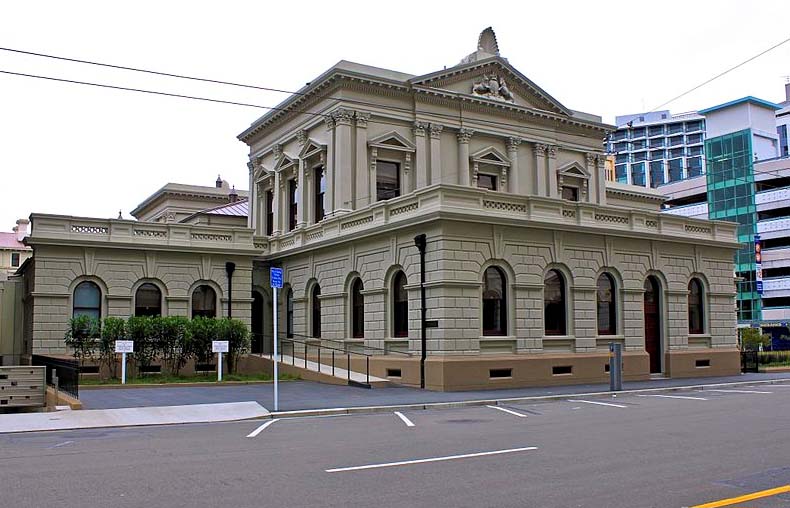
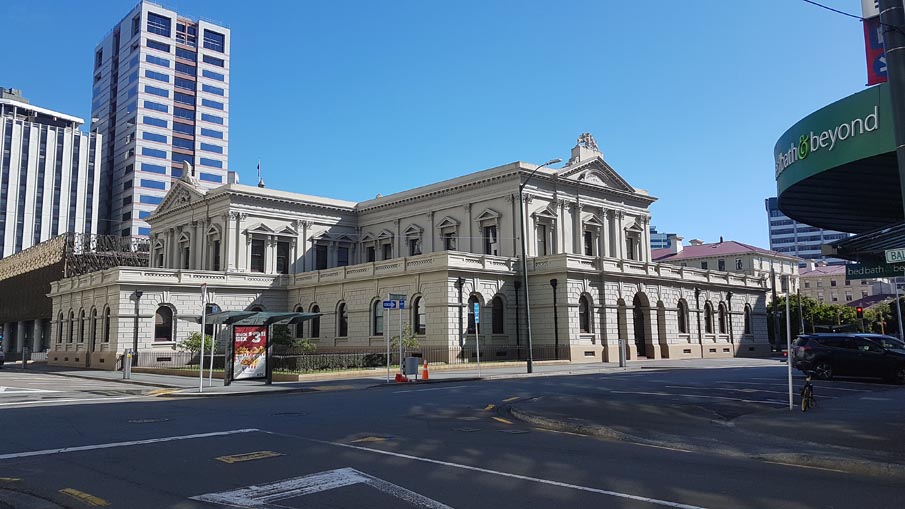
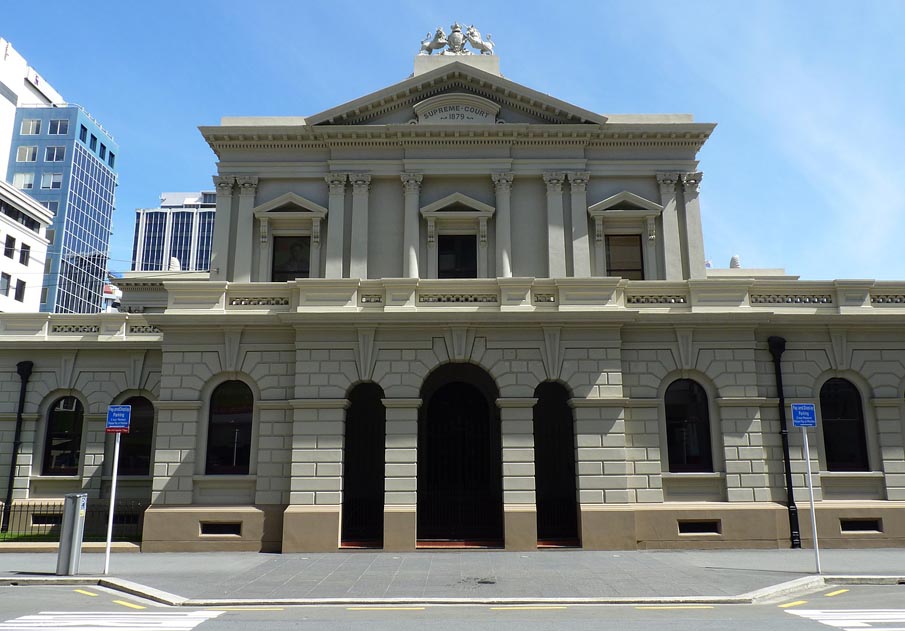
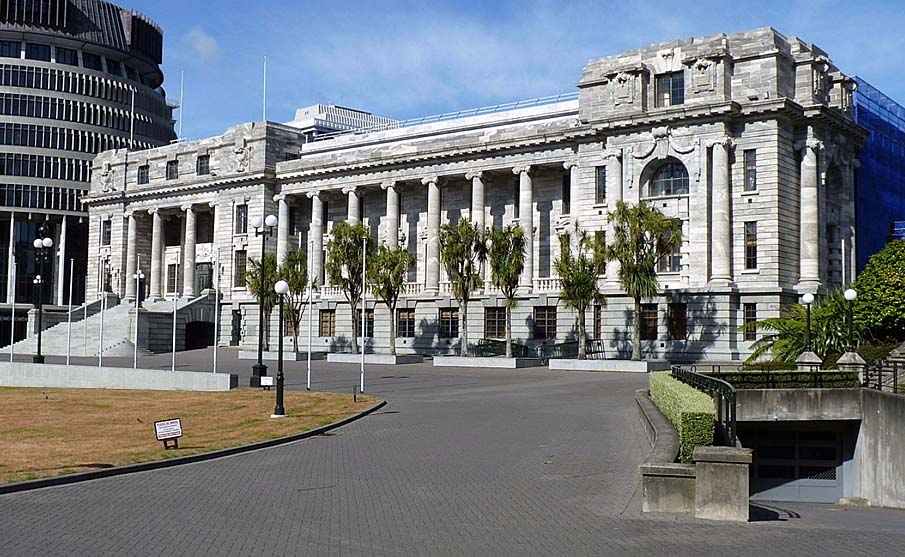
The neo-Classical Old High Court building, Wellington was constructed in 1879 to 1881 to house the High Court, which used to be known as the Supreme Court. It is of historic, architectural, aesthetic, social and technological heritage significance, and is an important element in Wellington’s Government Centre Historic Area. Designed by Pierre Finch Martineau Burrows, it was the first major public building in Wellington to be constructed in masonry. Home to the High Court in Wellington from 1881 to 1993 and central in a precinct historically associated with justice, the building is strongly associated with the social and legal heritage of New Zealand, and is connected with many important cases in the country’s legal history. Furthermore, the building has features of high aesthetic value, including the main courtroom.
Wellington’s first Supreme Court building was opened in Lambton Quay in 1861 but when the seat of government was moved from Auckland to Wellington four years later, a new and more appropriate building was planned. The new building was designed in 1878 by P. F. M. Burrows, Chief Draughtsman in the Public Works Department, who was inspired by English court buildings. Burrows took over the duties of the Colonial Architect after WH Clayton died in 1877 but never received that title. The Old High Court is one of his most important buildings. The foundation stone was laid on 1 December 1879, an event that drew a crowd of 2000 people. James Barry and William McDowall were awarded the £24,785 contract to construct the building. Their subcontractors included plasterer Edmund Platt.
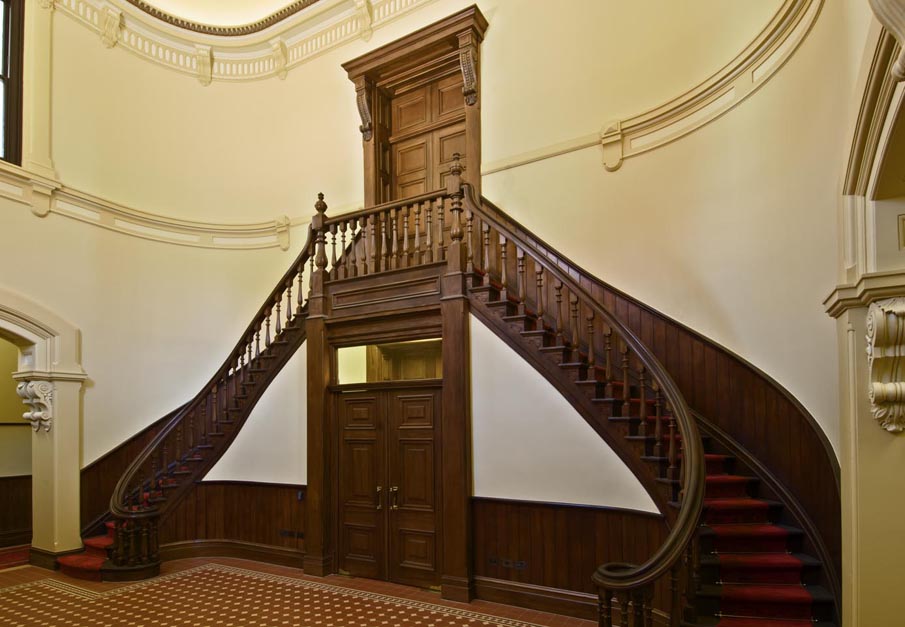
The site was on reclaimed land and concrete piles were driven into the bedrock. The T-shaped building was opened in 1881 and its main entrance was on Stout Street. The ground floor included a vestibule, main No 1 Courtroom, a smaller courtroom, a library, jury rooms, and offices. An arbitration court and apartment were on the first floor, and the basement contained five cells and a staircase leading directly up to the dock in the main courtroom. One of the building’s key features is the main courtroom, which is lined with kauri panelling and includes a canopied bench and a curved staircase leading from the vestibule to the public gallery. The exterior features a rusticated ground floor, round-headed windows, and triangular pediments.
The Court of Appeal, Magistrates Court and Arbitration Court also shared the building over the years. By the early 1900s, lack of space became an issue and Government Architect John Campbell designed major additions in 1907 and 1913 that followed the style of the original structure. Further alterations were made in the 1940s and 1956, then in 1981 a third major addition was completed, two years after the Supreme Court was renamed the High Court. In 1993 the building was left vacant and fell into disrepair, after the High Court was relocated to a new building in Molesworth Street, Wellington. In 2004, the Supreme Court was established as New Zealand’s highest tribunal, and alongside the construction of a new building, the former High Court was restored at a cost of $37.3 million. The restoration involved demolition of some additions, base isolation seismic strengthening, and the repair and restoration of decorative mouldings and key interior features.
The two adjoining buildings were completed in 2009 and the Supreme Court complex was opened the following year. The new Supreme Court was designed to mirror key elements of the old building. In 2010, the Ministry of Justice won an Encore Award in the Historic Heritage category for the restoration of the Old High Court. The building has retained its authenticity in terms of design, materiality, craftsmanship and setting, and is currently used for ceremonial occasions.
Wellington’s first Supreme Court building was opened in Lambton Quay in 1861 but when the seat of government was moved from Auckland to Wellington four years later, a new and more appropriate building was planned. The new building was designed in 1878 by P. F. M. Burrows, Chief Draughtsman in the Public Works Department, who was inspired by English court buildings. Burrows took over the duties of the Colonial Architect after WH Clayton died in 1877 but never received that title. The Old High Court is one of his most important buildings. The foundation stone was laid on 1 December 1879, an event that drew a crowd of 2000 people. James Barry and William McDowall were awarded the £24,785 contract to construct the building. Their subcontractors included plasterer Edmund Platt.
The site was on reclaimed land and concrete piles were driven into the bedrock. The T-shaped building was opened in 1881 and its main entrance was on Stout Street. The ground floor included a vestibule, main No 1 Courtroom, a smaller courtroom, a library, jury rooms, and offices. An arbitration court and apartment were on the first floor, and the basement contained five cells and a staircase leading directly up to the dock in the main courtroom. One of the building’s key features is the main courtroom, which is lined with kauri panelling and includes a canopied bench and a curved staircase leading from the vestibule to the public gallery. The exterior features a rusticated ground floor, round-headed windows, and triangular pediments.
The Court of Appeal, Magistrates Court and Arbitration Court also shared the building over the years. By the early 1900s, lack of space became an issue and Government Architect John Campbell designed major additions in 1907 and 1913 that followed the style of the original structure. Further alterations were made in the 1940s and 1956, then in 1981 a third major addition was completed, two years after the Supreme Court was renamed the High Court. In 1993 the building was left vacant and fell into disrepair, after the High Court was relocated to a new building in Molesworth Street, Wellington. In 2004, the Supreme Court was established as New Zealand’s highest tribunal, and alongside the construction of a new building, the former High Court was restored at a cost of $37.3 million. The restoration involved demolition of some additions, base isolation seismic strengthening, and the repair and restoration of decorative mouldings and key interior features.
The two adjoining buildings were completed in 2009 and the Supreme Court complex was opened the following year. The new Supreme Court was designed to mirror key elements of the old building. In 2010, the Ministry of Justice won an Encore Award in the Historic Heritage category for the restoration of the Old High Court. The building has retained its authenticity in terms of design, materiality, craftsmanship and setting, and is currently used for ceremonial occasions.