

William Reeves (1823-91) was a businessman and politician who came to New Zealand in 1857, and rose to prominence as managing director and editor of the Lyttelton Times, a Christchurch newspaper that he had turned by the 1880s into 'the country's leading advocate of liberal political ideas'. In his capacity as a leading newspaper man, Reeves founded and served as first chairman of the United Press Association. Politically Reeves filled various local offices, and served both in the House of Representatives and the Legislative Council, where he demonstrated particular interest in educational issues.
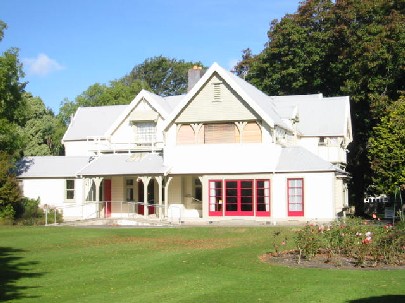
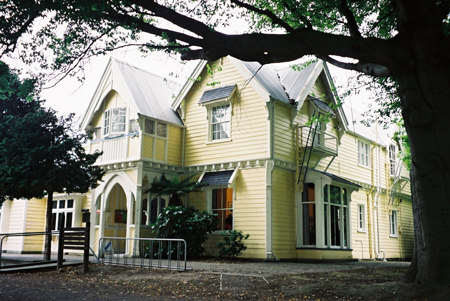
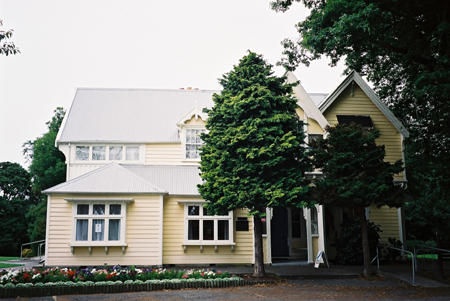
After purchasing his new Opawa property, Reeves raised £1,800 in mortgages, and commissioned the prominent architectural practise of Mountfort and Bury to design a house he was to call Risingholme, after the slight rise on which it was built. Principal designer Benjamin Mountfort was preoccupied during this period with the design and building of the Canterbury Provincial Council Buildings, and thus relied on partner Maxwell Bury to carry out the on-going work of the practice. Risingholme displays elements considered characteristic of the design of Bury, such as the fussy forms and forty-five degree roof pitch. Large by contemporary Christchurch standards, the timber house cost £1,392. Reeves also developed the extensive grounds from this time.
Maxwell Bury (1825-1912) was born in Nottinghamshire and trained as an engineer at an ironworks near Derby. After a period as an engineer officer in the merchant service, Bury married in 1853 and emigrated to Melbourne the following year. After a few months the couple moved on to Nelson where Bury set up as an engineer and land agent. Whilst in the province he designed several buildings, including the Nelson Provincial Government Buildings. Bury was actively involved in the Anglican Church in Nelson, and after he moved to Christchurch in 1863, this involvement continued. It was unsurprising therefore that he gained the commission to design the first stone Anglican church in the city, St John the Baptist in Latimer Square (1864, Cat. II). The partnership with Benjamin Mountfort commenced in July 1864 and lasted for twenty months, during which time several churches were designed - including St James, Cust and St Josephs, Lyttelton (both Category II). The relationship ceased in March 1866 when the Bury family returned to England. Bury had returned alone to Nelson by 1870, where he resumed his architectural career. In 1877 he won the competition for the University of Otago and Professorial Houses (all Category I), and subsequently moved to Dunedin. Architectural jobs were scarce however, and Bury moved between Dunedin, Christchurch and Nelson until c1890 when he settled in Sydney. In 1908 he returned to England, where he died in 1912.
Risingholme was the Reeves family home for twenty-six years, and was thus the childhood home of William's famous eldest son; the politician, poet and historian William Pember Reeves (1857-1932). Like his father, William Pember came to prominence as editor of the Lyttelton Times and the Canterbury Times. Raised on liberal politics at his father's knee, Reeves entered parliament in 1887, and soon became principal intellectual and ideologist of what would be the Liberal Party. With the ascendancy to power of the Liberals under John Ballance in 1891, he became Minister of Education and Justice. In 1892 he was also appointed Minister of Labour. In this role he secured the passage of the Industrial Arbitration and Conciliation Act (1894), which provided for compulsory arbitration in industrial disputes. This landmark legislation directed industrial relations in New Zealand for 79 years. Reeves was also responsible for other significant labour legislation, such as the Factories Act and the Shops and Shop Assistants Act (both also 1894), which together gave New Zealand the most extensive system of labour regulations in the world. In 1896 he left for England to become New Zealand's Agent General, the position that was later to become that of High Commissioner. He was successful in this role, but resigned under pressure from the new Ward administration in 1908. Reeves then became a director of the National Bank of New Zealand, and the director of the London School of Economics and Political Science. Whilst in London he wrote The Land of the Long White Cloud - Ao Tea Roa (1898), which became the standard liberal history of New Zealand until the 1950s.
On the death of William Reeves Snr. in 1891, the family discovered that he was heavily in debt. This necessitated the sale of Risingholme, which was bought jointly by brothers Leonard and George Harper, and Thomas Maude. Leonard, a barrister, and George were sons of J. C. Harper, the first bishop of the Christchurch diocese. Leonard's law firm, Harper and Co, infamously collapsed in 1892 due to financial mismanagement. He fled to Europe to escape his creditors, but was eventually traced to Germany in 1895 and escorted back to Christchurch to face trial. It was probably as a consequence of these escapades that Risingholme was conveyed by the Supreme Court to mortgager the Union Bank of Australia in 1894. The bank subsequently sold the property to Eliza White in 1896.
Eliza White (1841-1909) was the wealthy widow of successful merchant Alfred Joseph White, who had established a popular high quality furnishing store on the High/Tuam Street corner in the 1860s. By the turn of the century, A. J. White's employed 80 people in the shop and adjacent furniture factory. After Alfred's death in 1895, Eliza continued to run the business herself. Devoutly Catholic, she donated large sums to good causes, including the building of the Cathedral of the Blessed Sacrament (1905, Category I). Although she had extensive property interests, it is possible that Eliza lived at Risingholme, as she is recorded as living at Opawa through the period. After her death Eliza left an estate worth £70,000, £40,000 of which was left to be administered by a charitable trust. Risingholme itself passed in 1910 to her daughters Maud, Rose and Beatrice, her solicitor Henry Loughnan and her accountant Arthur Read (or Reed). The following year the house was bought by Cashel Street draper William Burns. Burns was declared bankrupt in 1918, and the official assignee sold the house to Mary Anderson.
Mary Anderson was the wife of Frederick William Anderson (d 1944), a son of John Anderson, founder of the once nationally prominent engineering firm, Andersons'. Frederick was trained as an engineer at workshops in Britain and the US, and joined the family company on his return in 1889. Although older brothers John and Andrew headed up the business, Frederick was responsible from the mid 1890s for operations at the firm's Lyttelton workshop, the centre of its extensive contracting business. He also served as a director of the company from 1903-43. Frederick and Mary retained Risingholme for twenty-four years, extensively altering its west and south elevations in 1919 at a cost of £860. The major feature added at this time was the distinctive deep two-level porch projecting from the western elevation. Daughter Margaret (1902-97) was art mistress at Rangi Ruru Girls' School, and Ngaio Marsh, Evelyn Page and Olivia Spencer Bower were all family friends. After Margaret married Austrian-born plant geneticist Dr Otto Frankel in 1939, a portion of the Risingholme estate was subdivided in 1940 for the couple to build a new home. This house (9 Ford Road), designed by noted New Zealand/Austrian architect Ernst Plishke, is a Category II Historic Place.
After Mary Anderson's death in 1942, Risingholme was transmitted to trustee of the Anderson estate Albert Freeman. The following year the property was sold to the Christchurch City Council for £3,000. This purchase was funded by John (later Sir John) McKenzie, the managing director of the extensive McKenzies department store chain, and a noted philanthropist. By the time of his death McKenzie was one of New Zealand's wealthiest men, and had contributed more than £1million to charity. Risingholme was gifted to the city for 'the health, amusement and instruction of the public' . Local residents petitioned the council for the house to become a community centre for Opawa and surrounding suburbs. The Risingholme Community Centre opened in 1944 as one of the first community centres in the country, and quickly became known for the quality and diversity of its programmes. These included pottery classes conducted by artist Doris Lusk. Some alterations were carried out by architect G. T. Lucas to adapt the building for its new use. These included the installation of bi-fold doors to fully enclose the ground floor of the deep western porch, and the extension of the south-western corner to provide for a new director's office. Today the house is still well utilised as a community facility, supplemented by two halls on the eastern side of the property.
The roof was replaced in 1992. In 1998 alterations were carried out by architect Tim Field to reconfigure the custodian's flat. A new meeting room was constructed from the former kitchen and two other rooms on the ground floor, whilst a new kitchen and bathroom were inserted on the first floor. These alterations necessitated the removal of some internal walls, the insertion of new walls, and the removal of a fireplace and chimney dating from the 1919 alterations. During early 2005 extensive repairs were carried out prior to painting.
List Entry Information
Status
Listed
List Entry Status
Historic Place Category 2
Access
Private/No Public Access
List Number
3131
Date Entered
24th June 2005
Date of Effect
24th June 2005
City/District Council
Christchurch City
Region
Canterbury Region
Extent of List Entry
Registration includes the house, its fixtures and fittings, and the land on RT7D/524. (Note the Risingholme reserve boundary indicated on aerial photo, page 10 of registration report.) Only the house itself is included in the registration; other buildings and structures are excluded.
Legal description
Lot 1 DP 3482, Lot 2 DP 26076, Pt Lots 3 and 6-7 DP 3482 (RT CB7D/524), Canterbury Land District
Status
Listed
List Entry Status
Historic Place Category 2
Access
Private/No Public Access
List Number
3131
Date Entered
24th June 2005
Date of Effect
24th June 2005
City/District Council
Christchurch City
Region
Canterbury Region
Extent of List Entry
Registration includes the house, its fixtures and fittings, and the land on RT7D/524. (Note the Risingholme reserve boundary indicated on aerial photo, page 10 of registration report.) Only the house itself is included in the registration; other buildings and structures are excluded.
Legal description
Lot 1 DP 3482, Lot 2 DP 26076, Pt Lots 3 and 6-7 DP 3482 (RT CB7D/524), Canterbury Land District
Why is this place significant?
Cultural Significance
Social significance as the base for the Risingholme Community Centre, a particularly early (and now long-lived) example of the community centre concept of public education and recreation. In light of the Reeves' liberal/ socialist convictions and interest in education, this was an apposite use for the house.
Historic Significance
Historical Significance or Value Hstorical significance as the former home of prominent New Zealand liberal politician and educationalist William Pember Reeves, and Christchurch notables editor William Reeves, lawyer Leonard Harper, businesswoman and philanthropist Eliza White, engineer Frederick Anderson and philanthropist Sir John McKenzie.
Physical Significance
Architectural significance as a rare example of the domestic work of architect Maxwell Bury. The only other registered dwellings known to have been designed (at least in part) by Bury are Chippenham Lodge in Christchurch (Cat. II), and the Professorial Houses at Otago University (Cat. I).
Why is this place Category 1 / Category 2?
Detail Of Assessed Criteria
(b) its association with a number of prominent Christchurch persons, including members of the Reeves, Harper, White and Anderson families; and its position as an early example of the community centre concept. (e) its long-standing community associations, having served as a community centre for eastern Christchurch since 1944.
Why is this place significant?
Cultural Significance
Social significance as the base for the Risingholme Community Centre, a particularly early (and now long-lived) example of the community centre concept of public education and recreation. In light of the Reeves' liberal/ socialist convictions and interest in education, this was an apposite use for the house.
Historic Significance
Historical Significance or Value Hstorical significance as the former home of prominent New Zealand liberal politician and educationalist William Pember Reeves, and Christchurch notables editor William Reeves, lawyer Leonard Harper, businesswoman and philanthropist Eliza White, engineer Frederick Anderson and philanthropist Sir John McKenzie.
Physical Significance
Architectural significance as a rare example of the domestic work of architect Maxwell Bury. The only other registered dwellings known to have been designed (at least in part) by Bury are Chippenham Lodge in Christchurch (Cat. II), and the Professorial Houses at Otago University (Cat. I).
Why is this place Category 1 / Category 2?
Detail Of Assessed Criteria
(b) its association with a number of prominent Christchurch persons, including members of the Reeves, Harper, White and Anderson families; and its position as an early example of the community centre concept. (e) its long-standing community associations, having served as a community centre for eastern Christchurch since 1944.
Construction Professional
Name
Bury, Maxwell
Type
Architect
Biography
Maxwell Bury (1825-1912) was born at East Retford, Nottinghamshire and was the son of an Anglican minister. He had training in architecture, civil and steam engineering and ship design, and it appears that some of his training was undertaken at Butterley Ironworks. He subsequently went to sea as an engineer officer. In 1853 he married Eleanor Sarah Deighton (known as Ellen) and the following year they travelled to Australia. They found, when they arrived, that Melbourne was suffering from a post-goldrush depression, and consequently the Burys moved to New Zealand. They arrived in Lyttelton in 1854 from Melbourne and settled in Nelson soon after. Bury established himself as an engineer, and became the chairman of the first Nelson Board of Works. He also became involved in various mining ventures and was churchwarden. By 1858 Bury decided to change professions, and took up architecture again. He was responsible for the first Masonic Hall in Nelson, the 1858 enlargement of Frederick Thatcher's Christ Church, and the Nelson Institute. His design for the Nelson Provincial Buildings did not win the 1858 competition but was successful none the less, as his was the only design that could be built for the specified price. None of these timber buildings now survive. The area's wealth, which enabled Bury to gain these commissions, was based on mining. When this boom slackened, the Burys moved, arriving in Christchurch in 1863. Their involvement in the church led to further commissions for Bury, including an orphanage in Addington, the Riccarton Parsonage and the Church of St John the Baptist in Latimer Square. He entered into partnership with Benjamin Woolfield Mountfort (1825-1898) in 1864. The partnership only lasted two years, but in that time Mountfort and Bury were responsible for a number of churches: St James-on-the-Cust, St Mark's at Opawa, St Joseph's at Lyttelton and St Patrick's at Akaroa and a few houses including Risingholme and Chippenham Lodge. Bury and his family then left for London in 1866. Although it seems he intended to return to New Zealand, various problems delayed this. His marriage appears to have broken up and family tradition has it that Bury went back to sea. Around 1870 Bury did make it back to New Zealand, settling by himself in Nelson. He designed the Chapel of the Holy Evangelists for Bishopdale in Nelson (1875-1876) By 1876 Bury was based in Dunedin and won the competition for the design of Otago University, Dunedin, in 1877. Unfortunately costs on this building overran to such an extent that a Commission of Enquiry into the matter was held in 1879. Thereafter Bury found his commissions dropping off. He did undertake further work for the University from 1883-1885. Some time after 1885 he returned to Nelson, and then to Sydney, where he set up office as a civil engineer in 1890. He retired in Sydney six years later, and in 1908 finally returned to England where he died in 1912. (Anne Marchant, 'Maxwell Bury of 'Bury and Mountfort', in Bulletin of New Zealand Art History, 19, 1998, pp.3-15)
Name
Field, Tim
Type
Architect
Biography
No biography is currently available for this construction professional
Name
Walker, R. S
Type
Architect
Biography
No biography is currently available for this construction professional
Name
Lucas, G.T
Type
Architect
Biography
No biography is currently available for this construction professional
Construction Details
Start Year
1864
Type
Original Construction
Start Year
1919
Type
Modification
Description
Extensive alterations, mainly to west elevation.
Start Year
1944
Type
Modification
Description
Alterations for community centre, including enclosure of ground floor porch and extension of south-western corner.
Start Year
1998
Type
Modification
Description
Alterations for new ground floor meeting room and first floor custodian's flat.
Construction Materials
Timber with a corrugated iron roof.
Construction Professional
Name
Bury, Maxwell
Type
Architect
Biography
Maxwell Bury (1825-1912) was born at East Retford, Nottinghamshire and was the son of an Anglican minister. He had training in architecture, civil and steam engineering and ship design, and it appears that some of his training was undertaken at Butterley Ironworks. He subsequently went to sea as an engineer officer. In 1853 he married Eleanor Sarah Deighton (known as Ellen) and the following year they travelled to Australia. They found, when they arrived, that Melbourne was suffering from a post-goldrush depression, and consequently the Burys moved to New Zealand. They arrived in Lyttelton in 1854 from Melbourne and settled in Nelson soon after. Bury established himself as an engineer, and became the chairman of the first Nelson Board of Works. He also became involved in various mining ventures and was churchwarden. By 1858 Bury decided to change professions, and took up architecture again. He was responsible for the first Masonic Hall in Nelson, the 1858 enlargement of Frederick Thatcher's Christ Church, and the Nelson Institute. His design for the Nelson Provincial Buildings did not win the 1858 competition but was successful none the less, as his was the only design that could be built for the specified price. None of these timber buildings now survive. The area's wealth, which enabled Bury to gain these commissions, was based on mining. When this boom slackened, the Burys moved, arriving in Christchurch in 1863. Their involvement in the church led to further commissions for Bury, including an orphanage in Addington, the Riccarton Parsonage and the Church of St John the Baptist in Latimer Square. He entered into partnership with Benjamin Woolfield Mountfort (1825-1898) in 1864. The partnership only lasted two years, but in that time Mountfort and Bury were responsible for a number of churches: St James-on-the-Cust, St Mark's at Opawa, St Joseph's at Lyttelton and St Patrick's at Akaroa and a few houses including Risingholme and Chippenham Lodge. Bury and his family then left for London in 1866. Although it seems he intended to return to New Zealand, various problems delayed this. His marriage appears to have broken up and family tradition has it that Bury went back to sea. Around 1870 Bury did make it back to New Zealand, settling by himself in Nelson. He designed the Chapel of the Holy Evangelists for Bishopdale in Nelson (1875-1876) By 1876 Bury was based in Dunedin and won the competition for the design of Otago University, Dunedin, in 1877. Unfortunately costs on this building overran to such an extent that a Commission of Enquiry into the matter was held in 1879. Thereafter Bury found his commissions dropping off. He did undertake further work for the University from 1883-1885. Some time after 1885 he returned to Nelson, and then to Sydney, where he set up office as a civil engineer in 1890. He retired in Sydney six years later, and in 1908 finally returned to England where he died in 1912. (Anne Marchant, 'Maxwell Bury of 'Bury and Mountfort', in Bulletin of New Zealand Art History, 19, 1998, pp.3-15)
Name
Field, Tim
Type
Architect
Biography
No biography is currently available for this construction professional
Name
Walker, R. S
Type
Architect
Biography
No biography is currently available for this construction professional
Name
Lucas, G.T
Type
Architect
Biography
No biography is currently available for this construction professional
Construction Details
Start Year
1864
Type
Original Construction
Start Year
1919
Type
Modification
Description
Extensive alterations, mainly to west elevation.
Start Year
1944
Type
Modification
Description
Alterations for community centre, including enclosure of ground floor porch and extension of south-western corner.
Start Year
1998
Type
Modification
Description
Alterations for new ground floor meeting room and first floor custodian's flat.
Construction Materials
Timber with a corrugated iron roof.
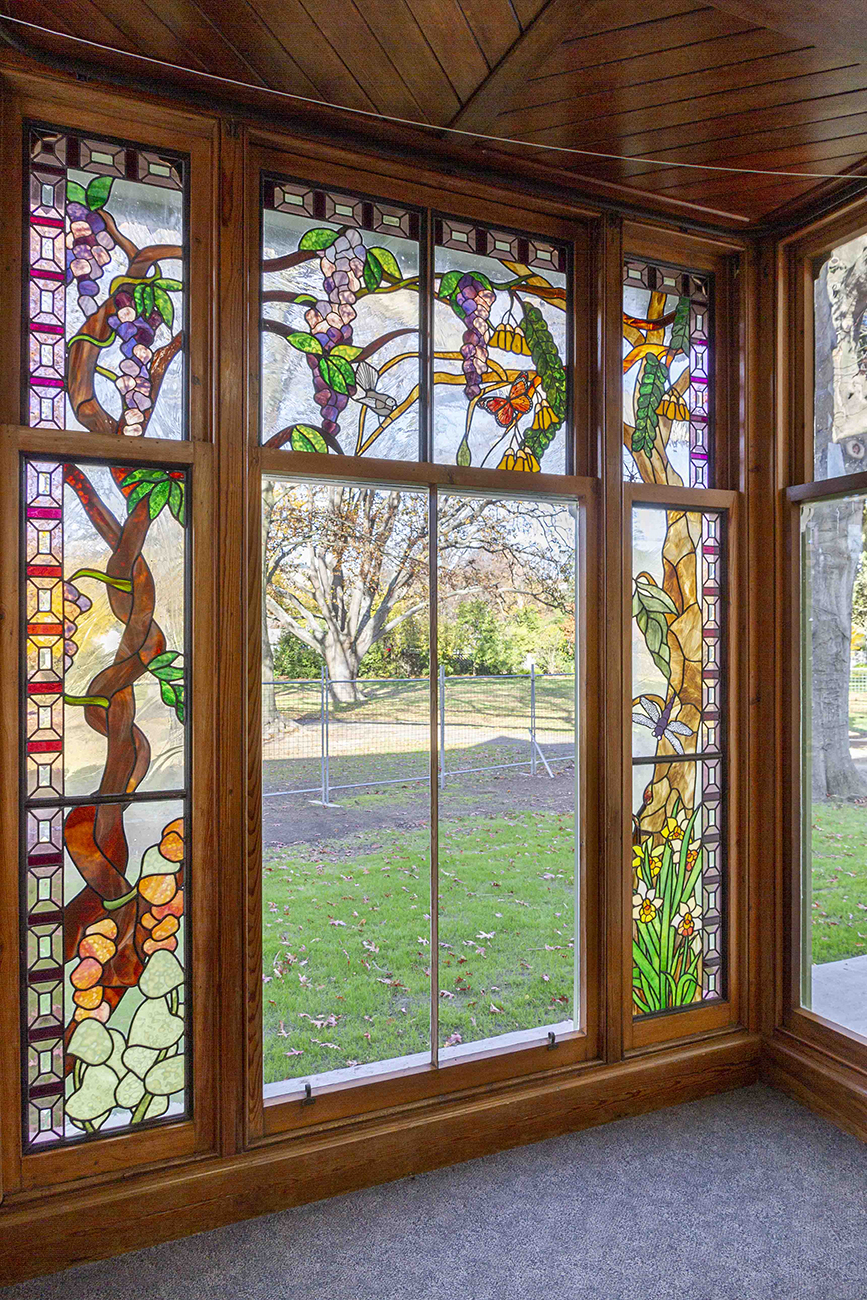
A colonial vernacular house with Gothic Revival features, such as fretted barges and a partly jettied upper storey, substantially (but not inappropriately) modified in the Arts and Crafts style in 1919 with a largely new western elevation. The house is entered from a gothic-detailed porch on the south elevation. Public rooms lead off either side of a long dark hall. A steep stair at the far end provides access to the bedrooms on the first floor. A significant proportion of Risingholme's original garden survives intact, and 26 of its trees are listed as heritage/notable trees with the Christchurch City Council.
A colonial vernacular house with Gothic Revival features, such as fretted barges and a partly jettied upper storey, substantially (but not inappropriately) modified in the Arts and Crafts style in 1919 with a largely new western elevation. The house is entered from a gothic-detailed porch on the south elevation. Public rooms lead off either side of a long dark hall. A steep stair at the far end provides access to the bedrooms on the first floor. A significant proportion of Risingholme's original garden survives intact, and 26 of its trees are listed as heritage/notable trees with the Christchurch City Council.
Historical and Associated Iwi / Hapū / Whānau
Completion Date
29th August 2001
Report Written By
Melanie Lovell-Smith
Information Sources
Andersons, 1950
100 Years: Being an Account of the Founding, Development and Progress of Andersons 1850-1950, Christchurch: Caxton Press, 1950.
Archives New Zealand (Chch)
Archives New Zealand (Christchurch)
Christchurch City Council
Christchurch City Council
Dictionary of New Zealand Biography
Dictionary of New Zealand Biography
Fletcher, 2002
J. Fletcher, Faithful to their Trust: The Eliza White Trust Board of Management 1909-2002 Eliza White Trust Board of Management, 2002.
Hendry, 1968
J.A. Hendry (text) and A.J. Mair (drawings), Homes of the Pioneers, Christchurch, 1968.
Lochhead, 1999
Ian Lochhead, A Dream of Spires: Benjamin Mountfort and the Gothic Revival, Christchurch, 1999
New Zealand Historic Places Trust (NZHPT)
New Zealand Historic Places Trust
Risingholme Community Centre, 1994
Risingholme Community Centre, Risingholme, 1944-94.
Royal Society of New Zealand
The Royal Society of New Zealand
Other Information
A fully referenced version of this report is available from the NZHPT Southern Region Office. Please note that entry on the New Zealand Heritage List/Rarangi Korero identifies only the heritage values of the property concerned, and should not be construed as advice on the state of the property, or as a comment of its soundness or safety, including in regard to earthquake risk, safety in the event of fire, or insanitary conditions.
Historical and Associated Iwi / Hapū / Whānau
Completion Date
29th August 2001
Report Written By
Melanie Lovell-Smith
Information Sources
Andersons, 1950
100 Years: Being an Account of the Founding, Development and Progress of Andersons 1850-1950, Christchurch: Caxton Press, 1950.
Archives New Zealand (Chch)
Archives New Zealand (Christchurch)
Christchurch City Council
Christchurch City Council
Dictionary of New Zealand Biography
Dictionary of New Zealand Biography
Fletcher, 2002
J. Fletcher, Faithful to their Trust: The Eliza White Trust Board of Management 1909-2002 Eliza White Trust Board of Management, 2002.
Hendry, 1968
J.A. Hendry (text) and A.J. Mair (drawings), Homes of the Pioneers, Christchurch, 1968.
Lochhead, 1999
Ian Lochhead, A Dream of Spires: Benjamin Mountfort and the Gothic Revival, Christchurch, 1999
New Zealand Historic Places Trust (NZHPT)
New Zealand Historic Places Trust
Risingholme Community Centre, 1994
Risingholme Community Centre, Risingholme, 1944-94.
Royal Society of New Zealand
The Royal Society of New Zealand
Other Information
A fully referenced version of this report is available from the NZHPT Southern Region Office. Please note that entry on the New Zealand Heritage List/Rarangi Korero identifies only the heritage values of the property concerned, and should not be construed as advice on the state of the property, or as a comment of its soundness or safety, including in regard to earthquake risk, safety in the event of fire, or insanitary conditions.
Current Usages
Uses: Civic Facilities
Specific Usage: Community centre
Former Usages
General Usage: Accommodation
Specific Usage: House
Current Usages
Uses: Civic Facilities
Specific Usage: Community centre
Former Usages
General Usage: Accommodation
Specific Usage: House
Location
Sign up to hear more
Get the latest heritage news, features and events delivered
straight to your inbox.
