

In 1881 the property was leased to South Dunedin man Jesse Millington, at an annual rent of £120, for a period of 25 years. The lease discusses Millington's responsibility to maintain the buildings, and the plumbing, and pay taxes and rates. Millington took out a mortgage with the New Zealand Mortgage and Investment Association in 1881 for some £3000. Millington disappeared in 1887 and the lease was vested in the New Zealand Mortgage and Investment Association.
The first tenants were apparently from the lower middle class and the working class, there were painters, bootmakers, carpenters, butchers, bakers and a storeman.
Charles Allen, a substantial property owner, died in 1888. His real estate became the property of his brother James Allen, including Sections 41 and 60 Block XXXIII on which the Terrace Houses stand. The property seems to have been maintained as a rental property while Allen and later his wife Mary Allen owned it. Mrs Allen sold the property to retired mercer Robinson Bentham in March 1924.
Bentham had the property surveyed. In 1925 the property was subdivided into lots (Deeds Plan 402). The following year the terrace houses were sold on individual titles.
In recent years the terraced houses have been landmark rental properties, well known to students, and an important element in the townscape of the North Dunedin student area.
List Entry Information
Status
Listed
List Entry Status
Historic Place Category 2
Access
Private/No Public Access
List Number
3189
Date Entered
14th April 2005
Date of Effect
14th April 2005
City/District Council
Dunedin City
Region
Otago Region
Extent of List Entry
Registration includes the land in certificates of title OT271/238, OT17A/73, OT271/228, OT271/223. OT17A/74, OT17A/77, OT271/237, OT271/225, OT271/226, OT17A/75, OT271/227, OT17A/76 and OT271/232 and the buildings, fixtures and fittings thereon.
Legal description
LOT 4 Deed Plan 402 (RT OT271/238); LOT 5 Deed Plan 402 (RT OT17A/73); LOT 6 Deed Plan 402 (RT OT271/228); LOT 7 Deed Plan 402 (RT OT17A/74), LOT 8 Deed Plan 402 (RT OT271/223); LOT 9 Deed Plan 402 (RT OT17A/77); LOT 10 Deed Plan 402 (RT OT271/237); LOT 11 Deed Plan 402 (RT OT271/225); LOT 12 Deed Plan 402 (RT OT271/226); LOT 13 Deed Plan 402 (RT OT17A/75); LOT 14 Deed Plan 402 (RT OT271/227); LOT 15 Deed Plan 402 (RT OT17A/76); LOT 16 Deed Plan 402 (RT OT271/232); all Otago Land District
Status
Listed
List Entry Status
Historic Place Category 2
Access
Private/No Public Access
List Number
3189
Date Entered
14th April 2005
Date of Effect
14th April 2005
City/District Council
Dunedin City
Region
Otago Region
Extent of List Entry
Registration includes the land in certificates of title OT271/238, OT17A/73, OT271/228, OT271/223. OT17A/74, OT17A/77, OT271/237, OT271/225, OT271/226, OT17A/75, OT271/227, OT17A/76 and OT271/232 and the buildings, fixtures and fittings thereon.
Legal description
LOT 4 Deed Plan 402 (RT OT271/238); LOT 5 Deed Plan 402 (RT OT17A/73); LOT 6 Deed Plan 402 (RT OT271/228); LOT 7 Deed Plan 402 (RT OT17A/74), LOT 8 Deed Plan 402 (RT OT271/223); LOT 9 Deed Plan 402 (RT OT17A/77); LOT 10 Deed Plan 402 (RT OT271/237); LOT 11 Deed Plan 402 (RT OT271/225); LOT 12 Deed Plan 402 (RT OT271/226); LOT 13 Deed Plan 402 (RT OT17A/75); LOT 14 Deed Plan 402 (RT OT271/227); LOT 15 Deed Plan 402 (RT OT17A/76); LOT 16 Deed Plan 402 (RT OT271/232); all Otago Land District
Why is this place significant?
Historic Significance
Historical Significance or Value The Terrace Houses have historical significance. As noted above they are representative of one of the types of working class housing that developed in the nineteenth century. They are also an example of investment housing, built for rental accommodation and largely used as such for their first forty years, and now again largely rental housing for the student market.
Physical Significance
The Dundas Street Terrace Houses have architectural significance. They are a relatively rare example of terraced houses, which were not a common building type in New Zealand. They are representative of the architectural styling of working class housing in England, transferred to a colonial society. The urban crowding was not a quality that settlers wished to emulate, and terraced housing remained uncommon.
Why is this place Category 1 / Category 2?
Detail Of Assessed Criteria
The Terrace Houses represent the development of nineteenth century working class housing in Dunedin, an important aspect of New Zealand history, and which in their history of ownership reveal a history of rental investment property, to individual ownership, and again in the current market as rental property. The property has an association with brothers James and Charles Allen, prominent members of nineteenth century Dunedin society. Together they owned the property for ten years, and James Allen or his family owned it until 1924 - a period of forty years, as part of a much larger estate. James Allen had substantial business interests in coal and gold mining, and was later a Minister of Defence as part of Massey's Reform ministry in the early twentieth century. The design of the Terrace Houses is interesting in its repetition of English terraced housing in a colonial context. The houses are recognised as an important and relatively rare example of this building type.
Why is this place significant?
Historic Significance
Historical Significance or Value The Terrace Houses have historical significance. As noted above they are representative of one of the types of working class housing that developed in the nineteenth century. They are also an example of investment housing, built for rental accommodation and largely used as such for their first forty years, and now again largely rental housing for the student market.
Physical Significance
The Dundas Street Terrace Houses have architectural significance. They are a relatively rare example of terraced houses, which were not a common building type in New Zealand. They are representative of the architectural styling of working class housing in England, transferred to a colonial society. The urban crowding was not a quality that settlers wished to emulate, and terraced housing remained uncommon.
Why is this place Category 1 / Category 2?
Detail Of Assessed Criteria
The Terrace Houses represent the development of nineteenth century working class housing in Dunedin, an important aspect of New Zealand history, and which in their history of ownership reveal a history of rental investment property, to individual ownership, and again in the current market as rental property. The property has an association with brothers James and Charles Allen, prominent members of nineteenth century Dunedin society. Together they owned the property for ten years, and James Allen or his family owned it until 1924 - a period of forty years, as part of a much larger estate. James Allen had substantial business interests in coal and gold mining, and was later a Minister of Defence as part of Massey's Reform ministry in the early twentieth century. The design of the Terrace Houses is interesting in its repetition of English terraced housing in a colonial context. The houses are recognised as an important and relatively rare example of this building type.
Construction Materials
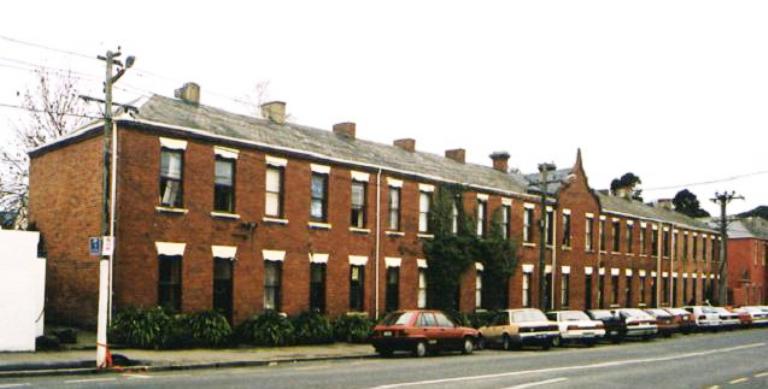
The Stafford Terraces are two-storied brick houses with a hipped slate roof.
Construction Materials
The Stafford Terraces are two-storied brick houses with a hipped slate roof.
The Terraces are a group of thirteen two-storied terrace houses. The elevation to Dundas Street is symmetrical with the centre terrace topped by a shaped gable. The kitchens are housed in a single-storey lean-to at the rear of each house. The elevation to Dundas Street has contrasting lintels. A long narrow hallway leads into the back living room and to the foot of the stairs. A back door, gives access to small backyards.
The Terraces are a group of thirteen two-storied terrace houses. The elevation to Dundas Street is symmetrical with the centre terrace topped by a shaped gable. The kitchens are housed in a single-storey lean-to at the rear of each house. The elevation to Dundas Street has contrasting lintels. A long narrow hallway leads into the back living room and to the foot of the stairs. A back door, gives access to small backyards.
Historical and Associated Iwi / Hapū / Whānau
Information Sources
Cyclopedia of New Zealand, 1905
Cyclopedia Company, Industrial, descriptive, historical, biographical facts, figures, illustrations, Wellington, N.Z, 1897-1908, Vol. 4 Otago and Southland, Cyclopedia Company, Christchurch, 1905
Dictionary of New Zealand Biography
Dictionary of New Zealand Biography
Wises Post Office Directories
Wises Post Office Directories
Knight, H. & N. Wales, 1988
Hardwicke Knight and Niel Wales, Buildings of Dunedin: An Illustrated Architectural Guide to New Zealand's Victorian City, John McIndoe, Dunedin, 1988
Muthesius, 1982
S. Muthesius, The English terraced house, Yale University Press, New Haven, 1982
Shaw, 1997 (2003)
Peter Shaw, A History of New Zealand Architecture, Auckland, 1997
Porter, 1983
Frances Porter (ed), Historic Buildings of Dunedin, South Island, Methuen, Auckland, 1983.
Other Information
A fully referenced version of this report is available from the NZHPT Otago/Southland Area Office Please note that entry on the New Zealand Heritage List/Rarangi Korero identifies only the heritage values of the property concerned, and should not be construed as advice on the state of the property, or as a comment of its soundness or safety, including in regard to earthquake risk, safety in the event of fire, or insanitary conditions.
Historical and Associated Iwi / Hapū / Whānau
Information Sources
Cyclopedia of New Zealand, 1905
Cyclopedia Company, Industrial, descriptive, historical, biographical facts, figures, illustrations, Wellington, N.Z, 1897-1908, Vol. 4 Otago and Southland, Cyclopedia Company, Christchurch, 1905
Dictionary of New Zealand Biography
Dictionary of New Zealand Biography
Wises Post Office Directories
Wises Post Office Directories
Knight, H. & N. Wales, 1988
Hardwicke Knight and Niel Wales, Buildings of Dunedin: An Illustrated Architectural Guide to New Zealand's Victorian City, John McIndoe, Dunedin, 1988
Muthesius, 1982
S. Muthesius, The English terraced house, Yale University Press, New Haven, 1982
Shaw, 1997 (2003)
Peter Shaw, A History of New Zealand Architecture, Auckland, 1997
Porter, 1983
Frances Porter (ed), Historic Buildings of Dunedin, South Island, Methuen, Auckland, 1983.
Other Information
A fully referenced version of this report is available from the NZHPT Otago/Southland Area Office Please note that entry on the New Zealand Heritage List/Rarangi Korero identifies only the heritage values of the property concerned, and should not be construed as advice on the state of the property, or as a comment of its soundness or safety, including in regard to earthquake risk, safety in the event of fire, or insanitary conditions.
Current Usages
Uses: Accommodation
Specific Usage: Terrace/ cojoined houses
Former Usages
General Usage: Accommodation
Specific Usage: Terrace/ cojoined houses
Current Usages
Uses: Accommodation
Specific Usage: Terrace/ cojoined houses
Former Usages
General Usage: Accommodation
Specific Usage: Terrace/ cojoined houses
