

Matakohe is located in Kaipara near the mouth of the Arapaoa River system. The area is within a complex landscape with overlapping footprints of multiple iwi and hapū including Ngāti Whātua, Te Roroa, Te Uri o Hau, and Ngāpuhi. The Arapaoa River, upper reaches of the Kaipara Harbour, and finger peninsulas were significant resource gathering areas and travel routes, and have many archaeological sites, wāhi tapu, and wāhi tūpuna located around them. The future site of Post Office (Former) lay along the eastern edge of the 68,000-acre Matakohe Block, which the Crown purchased from Te Uri o Hau for £2000 in 1858. The area was densely forested with some agricultural land near the river, and was not anticipated to be occupied by settlers for some time. In 1862 the Albertland special settlement, one of the last such settlements to take place in Northland, was established on 20,000 acres of Matakohe and neighbouring land blocks. Matakohe developed as a gum and timber settlement from the mid-1860s, with a number of gum stores. In the late nineteenth century it was considered to be a main centre of Otamatea County, and by 1902 the population consisted of approximately 548 people mostly employed in cattle farming, gum digging, or bush-felling. With few roads and limited rail access, early transport remained heavily reliant on the waterways, including for mail delivery. A post office, initially housed in a private home and later a local store, began operating in 1864. During 1900-14 there was a nationwide governmental post office building boom. At Matakohe, due to low revenues at the existing post office, the government required the settlers seeking a purpose-built building to also provide the land. In March 1908 a tender was advertised and a contract issued to Auckland builders Radcliffe and Burton for £749, with construction of the new building underway by June the same year.
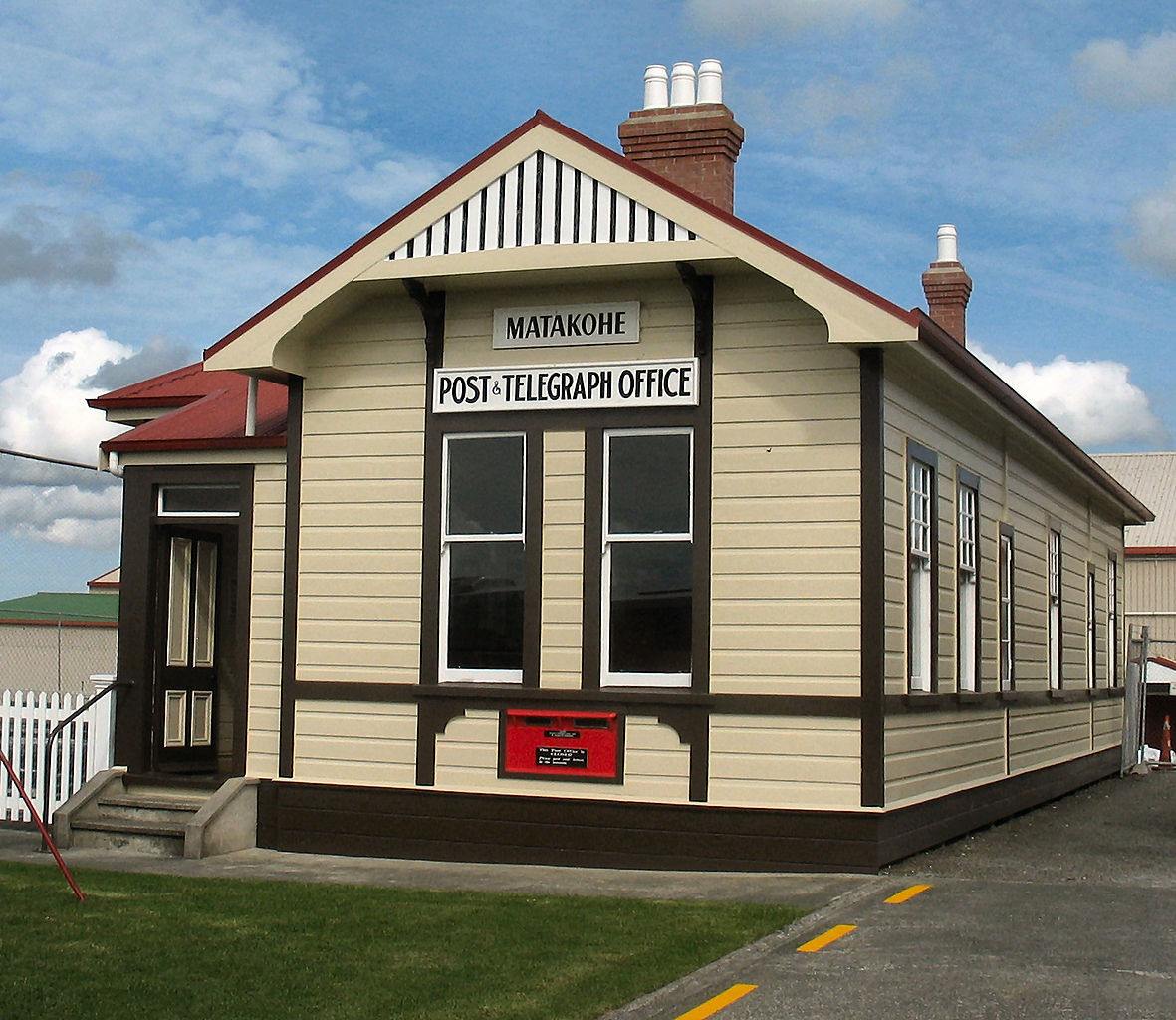
Constructed from local kauri, the post office was described as being of the most up-to-date style, and is an example of a small combined post office and residence design created during the tenure of John Campbell, the government’s head Public Works Department architect. It had the appearance of a bay villa with rusticated weatherboards, a prominent gable with simple timber fretwork, an externally accessed post box, and timber detailing around the windows, as well as a ‘POST OFFICE’ sign. The front of the building was accessed by a covered porch beside the bay, which led to the public room and mail room, separated by a spacious counter, and a telegraph exchange room. The rear of the building, with separate external access, provided accommodation for the postmaster with two bedrooms, a parlour, kitchen, bathroom and outbuildings. Until local road improvements later in the century, mail continued to be delivered to the wharf and conveyed by horse to the post office. In addition to offering mail and telephone services for eight decades, Post Office (Former) was a centre for the Matakohe community and was used for additional government functions, such as post office banking and issuing marriage licences, and was also a polling booth at times.
In 1988, Post Office (Former) was one of 432 small post offices closed by New Zealand Post – a move which was widely opposed by many rural communities. Two decades earlier, after the loss of several important local buildings to fires, the Matakohe community created a local museum, presently known as the Kauri Museum, on reserve land to preserve their history including Matakohe School (Former), List No. 470, Category 1 historic place. With the support of the local community, the closed post office was purchased by the museum and re-sited to the reserve in July 1992. A small number of changes have been made, such as the removal of the internal fireplace and repairs and maintenance, and a small art gallery occupies the former accommodation rooms. The place remains significant for its ongoing educational use for over 35 years, with displays –including original equipment – related to its historic function and local history for museum visitors.

List Entry Information
Status
Listed
List Entry Status
Historic Place Category 2
Access
Able to Visit
List Number
3911
Date Entered
6th September 1984
Date of Effect
6th September 1984
City/District Council
Kaipara District
Region
Northland Region
Extent of List Entry
Extent includes part of the land described as Lot 1 DP 180723 (RT NA111D/489), North Auckland Land District, and the building known as Post Office (Former) thereon. The extent aligns with the parcel boundary on the north and south sides and extends 1.5m east and west of the building.
Legal description
Lot 1 DP 180723 (RT NA111D/489), North Auckland Land District
Status
Listed
List Entry Status
Historic Place Category 2
Access
Able to Visit
List Number
3911
Date Entered
6th September 1984
Date of Effect
6th September 1984
City/District Council
Kaipara District
Region
Northland Region
Extent of List Entry
Extent includes part of the land described as Lot 1 DP 180723 (RT NA111D/489), North Auckland Land District, and the building known as Post Office (Former) thereon. The extent aligns with the parcel boundary on the north and south sides and extends 1.5m east and west of the building.
Legal description
Lot 1 DP 180723 (RT NA111D/489), North Auckland Land District
Construction Professional
Name
Campbell, John
Type
Architect
Biography
Queenstown builder
Name
Radcliffe and Burton
Type
Builder
Biography
No biography is currently available for this construction professional
Construction Details
Start Year
1908
Type
Original Construction
Description
Construction of Post Office (Former) in original location
Type
Modification
Description
Internal fireplace removed; new signage added above bay window
Period
Post-1989
Start Year
1992
Type
Relocation
Description
Relocation of building to the Kauri Museum, Matakohe
Type
Maintenance/repairs
Description
Roof replaced
Period
Pre-2026
Construction Professional
Name
Campbell, John
Type
Architect
Biography
Queenstown builder
Name
Radcliffe and Burton
Type
Builder
Biography
No biography is currently available for this construction professional
Construction Details
Start Year
1908
Type
Original Construction
Description
Construction of Post Office (Former) in original location
Type
Modification
Description
Internal fireplace removed; new signage added above bay window
Period
Post-1989
Start Year
1992
Type
Relocation
Description
Relocation of building to the Kauri Museum, Matakohe
Type
Maintenance/repairs
Description
Roof replaced
Period
Pre-2026
Historical and Associated Iwi / Hapū / Whānau
Completion Date
30th June 2026
Report Written By
Alexandra Foster
Information Sources
Paparoa, Matakohe and Districts Centennial Association, 1962
Paparoa, Matakohe and Districts Centennial Association, Paparoa – Matakohe 1862-1962, Paparoa, 1962
Richardson, 1993
Richardson, Peter, ‘Campbell, John’, Dictionary of New Zealand Biography, first published in 1993, Te Ara – the Encyclopedia of New Zealand, https://teara.govt.nz/en/biographies/2c3/campbell-john
Robertson and Brown, 2007
Robertson, G.I. and E. Brown, Post and Telephone Offices of Northland, Auckland, 2007
Other Information
A fully referenced copy of the Upgrade Report is available upon request from the Northern Regional Office of Heritage New Zealand Pouhere Taonga. Disclaimer Please note that entry on the New Zealand Heritage List/Rārangi Kōrero identifies only the heritage values of the property concerned, and should not be construed as advice on the state of the property, or as a comment of its soundness or safety, including in regard to earthquake risk, safety in the event of fire, or insanitary conditions. Archaeological sites are protected by the Heritage New Zealand Pouhere Taonga Act 2014, regardless of whether they are entered on the New Zealand Heritage List/Rārangi Kōrero or not. Archaeological sites include ‘places associated with pre-1900 human activity, where there may be evidence relating to the history of New Zealand’. This List entry report should not be read as a statement on whether or not the archaeological provisions of the Act apply to the property(s) concerned. Please contact your local Heritage New Zealand office for archaeological advice.
Historical and Associated Iwi / Hapū / Whānau
Completion Date
30th June 2026
Report Written By
Alexandra Foster
Information Sources
Paparoa, Matakohe and Districts Centennial Association, 1962
Paparoa, Matakohe and Districts Centennial Association, Paparoa – Matakohe 1862-1962, Paparoa, 1962
Richardson, 1993
Richardson, Peter, ‘Campbell, John’, Dictionary of New Zealand Biography, first published in 1993, Te Ara – the Encyclopedia of New Zealand, https://teara.govt.nz/en/biographies/2c3/campbell-john
Robertson and Brown, 2007
Robertson, G.I. and E. Brown, Post and Telephone Offices of Northland, Auckland, 2007
Other Information
A fully referenced copy of the Upgrade Report is available upon request from the Northern Regional Office of Heritage New Zealand Pouhere Taonga. Disclaimer Please note that entry on the New Zealand Heritage List/Rārangi Kōrero identifies only the heritage values of the property concerned, and should not be construed as advice on the state of the property, or as a comment of its soundness or safety, including in regard to earthquake risk, safety in the event of fire, or insanitary conditions. Archaeological sites are protected by the Heritage New Zealand Pouhere Taonga Act 2014, regardless of whether they are entered on the New Zealand Heritage List/Rārangi Kōrero or not. Archaeological sites include ‘places associated with pre-1900 human activity, where there may be evidence relating to the history of New Zealand’. This List entry report should not be read as a statement on whether or not the archaeological provisions of the Act apply to the property(s) concerned. Please contact your local Heritage New Zealand office for archaeological advice.
Current Usages
Uses: Civic Facilities
Specific Usage: Museum
Former Usages
General Usage: Accommodation
Specific Usage: House
General Usage: Communication
Specific Usage: Post Office
General Usage: Communication
Specific Usage: Postal & Telecommunications - Other
Current Usages
Uses: Civic Facilities
Specific Usage: Museum
Former Usages
General Usage: Accommodation
Specific Usage: House
General Usage: Communication
Specific Usage: Post Office
General Usage: Communication
Specific Usage: Postal & Telecommunications - Other
Sign up to hear more
Get the latest heritage news, features and events delivered
straight to your inbox.
