

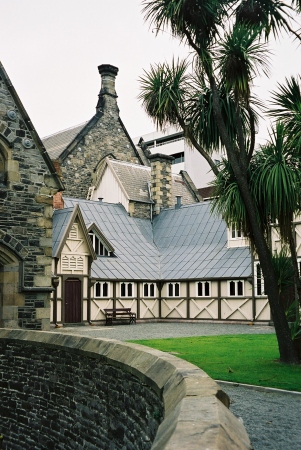
The Canterbury Provincial Council Buildings were designed by Benjamin Woolfield Mountfort. and built in three stages. Mountfort was one of the foremost architects in Victorian New Zealand and, according to architectural historian Ian Lochhead, 'did most to shape the architectural character of nineteenth-century Christchurch.' In 1854 Mountfort prepared his initial plans for the Provincial Council buildings, which were to consist of a two-storeyed timber complex surrounding an enclosed courtyard. The complex was to be Gothic in style; Mountfort being, as Lochhead argues, a champion of the Gothic style and conscious of Sir Charles Barry and A.W.N. Pugin's Gothic design for the Houses of Parliament, London, formally opened in 1852. This proposed complex never eventuated but remnants of this first proposal, both in style and in plan, can be seen in the Provincial Council buildings of today.
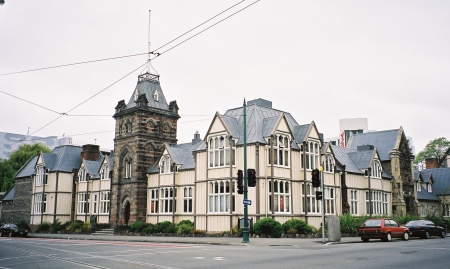
Tenders were called for the first part of the Provincial Council buildings in 1857 and the foundation stone was laid in January of the following year. This first section was L-shaped in plan and relatively plain in style. The timber Council Chamber, modelled on fourteenth and fifteenth century English manorial halls, formed the heart of the complex. This section of the building was first used in September 1859. By the time it opened, however, tenders for an extension had already been called for. This extension increased the western frontage along Durham Street and added a north wing that fronted onto Armagh Street. This was more elaborately detailed than the first, featuring foliated windows and a tower in the centre of the north wing. The tower was made from alternate courses of red and grey stone, a distinctive feature of High Victorian architecture known as constructional polychromy, a way of achieving colour through the process of construction by combining different types of building materials.
The third part of the Chambers was erected because of the significant growth in Canterbury's population and a corresponding growth in the number of elected representatives. In 1861 the membership of the Provincial Council was increased from 26 to 35. Canterbury's economy was also rapidly on the rise and the Provincial Council had both the money and the incentive to build a further addition to their chambers in stone rather than timber.
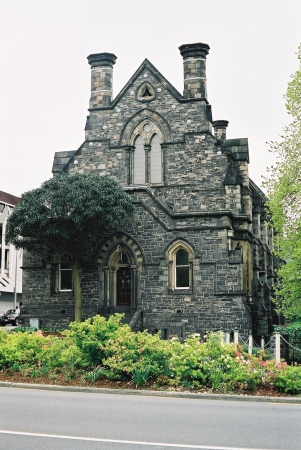
Again designed by Mountfort, the stone chamber, built in 1864-1865, was attached to the southern end of the existing building on Durham Street. From the exterior the stone chamber is a massive block of dark grey stone, solidly buttressed. Mountfort dealt with the potentially awkward transition between the stone chamber and the much lower wooden building with a gable, which sits midway between the heights of the buildings on either side. From the outside the staircase in this gable is marked by a group of windows stepped up the side of the building. The entrance to the stone chamber on Durham Street is set within a grand arch.
The interior of the stone chamber is one of Mountfort's most impressive achievements. The floor and lower walls are decorated with encaustic tiles arranged in geometric patterns. Above the lower wall panels, light-coloured sandstone walls rise, banded with dark string courses and divided by dark columns. The stained glass windows set in the walls were presumably designed by Mountfort and executed by the London firm of Lavers and Barraud. They have been described as the 'most important set of High Victorian secular stained glass windows' in New Zealand, and their 'jewel-like' light makes a major contribution to Mountfort's richly coloured interior. The ridge-and-furrow ceiling was stencilled by the painter John Calcott St Quentin in 1867. Predominantly gold, red and dark blue, the ceiling is decorated with bands of stars on the furrows and stylised plant forms on the ridges. Again the overwhelming effect is of glowing colour and drama.
The refreshment rooms Mountfort designed at the same time as the stone chamber were built onto the eastern end of the earlier timber chamber. (This involved relocating the secretary's room and an octagonal tower to the south-east end of the north wing.) Mountfort provided a dining room on the ground floor and a smoking room on the first floor for the comfort of the Provincial Council members. Here the arrangement of the interior spaces dictated the asymmetrical appearance of the exterior, in a direct reflection of the Gothic revival ideal.
After the demise of the provincial councils in 1876 the building came under central government ownership and was used by various government departments. In 1928, under the Canterbury Provincial Vesting Act, the timber Council Chamber and the stone buildings were returned to local control to be maintained as a memorial, the first time that the New Zealand government had passed legislation to protect an historic building. It was not until 1971, however, that the remaining timber buildings were brought under the control of the local board.
The Canterbury Provincial Council buildings are a superb example of Mountfort's work and his stone chamber is a particularly fine example of Victorian Gothic Revival architecture. The Canterbury Provincial Council Buildings are the only surviving purpose-built Provincial Council chambers in New Zealand. As Lochhead points out 'Within an international context [the buildings] occupy an honourable place in the nineteenth-century tradition of Gothic legislative buildings deriving from Barry and Pugin's Houses of Parliament' (Lochhead, 1999: 116). The three distinct stages of the building show the history and growth of the province of Canterbury from its small beginnings in the 1850s through to its wealth and success of the 1860s and 1870s and they form a distinct and notable part of the townscape. Within the history of historic preservation in New Zealand the Provincial Chambers also occupy a significant place as one of the earliest buildings to be protected.
List Entry Information
Status
Listed
List Entry Status
Historic Place Category 1
Access
Private/No Public Access
List Number
45
Date Entered
7th April 1983
Date of Effect
7th April 1983
City/District Council
Christchurch City
Region
Canterbury Region
Extent of List Entry
Extent of Registration is the land described as Pt Res 11 Sec 1 SO 19339, Canterbury Land District and the building known as Canterbury Provincial Government Buildings thereon.
Legal description
Pt Res 11 Sec 1 SO 19339, Canterbury Land District
Location Description
Multiple views of the complex are possible from Oxford Terrace, Gloucester, Durham and Armagh Streets, the River Avon and the cloistered courtyard at the centre of the complex.
Status
Listed
List Entry Status
Historic Place Category 1
Access
Private/No Public Access
List Number
45
Date Entered
7th April 1983
Date of Effect
7th April 1983
City/District Council
Christchurch City
Region
Canterbury Region
Extent of List Entry
Extent of Registration is the land described as Pt Res 11 Sec 1 SO 19339, Canterbury Land District and the building known as Canterbury Provincial Government Buildings thereon.
Legal description
Pt Res 11 Sec 1 SO 19339, Canterbury Land District
Location Description
Multiple views of the complex are possible from Oxford Terrace, Gloucester, Durham and Armagh Streets, the River Avon and the cloistered courtyard at the centre of the complex.
Construction Professional
Name
Mountfort, Benjamin Woolfield
Type
Architect
Biography
Benjamin Woolfield Mountfort (1825-98) trained as an architect in England, in the office of Richard Cromwell Carpenter, a member of the Cambridge Camden Society (later the Ecclesiological Society). He arrived in Canterbury in 1850. Mountfort was New Zealand's pre-eminent Gothic Revival architect and, according to architectural historian Ian Lochhead, 'did most to shape the architectural character of nineteenth-century Christchurch.' The buildings he designed were almost exclusively in the Gothic Revival style. During his career he designed many churches and additions to churches; those still standing include the Trinity Congregational Church in Christchurch (1874), St Mary's Church in Parnell, Auckland and the Church of the Good Shepherd in Phillipstown, Christchurch (1884). In 1857 he became the first architect to the province of Canterbury. He designed the Canterbury Provincial Council Buildings in three stages from 1858 to 1865. The stone chamber of this building can be considered the greatest accomplishment of his career. He was involved in many important commissions from the 1870s, including the Canterbury Museum (1869-82) and the Clock-tower Block on the Canterbury College campus (1876-77). He was also involved in the construction of Christchurch's Cathedral and made several major modifications to the original design. Mountfort introduced a number of High Victorian elements to New Zealand architecture, such as the use of constructional polychromy, probably first used in New Zealand in the stone tower of the Canterbury Provincial Government Buildings (1859). Overall, his oeuvre reveals a consistent and virtually unerring application of Puginian principles including a commitment to the Gothic style, honest use of materials and picturesque utility. The result was the construction of inventive and impressive buildings of outstanding quality. He died in Christchurch in 1898. A belfry at the Church of the Good Shepherd in Phillipstown, the church he attended for the last ten years of his life, was erected in his honour.
Construction Details
Start Year
1857
Finish Year
1859
Type
Original Construction
Description
First building including the timber chamber
Start Year
1859
Finish Year
1861
Type
Addition
Description
Second building - addition to western frontage and north wing
Start Year
1864
Finish Year
1865
Type
Addition
Description
Stone chamber and refreshment rooms
Start Year
1864
Finish Year
1865
Type
Relocation
Description
Secretary's room and octagonal tower moved to south east end of north wing
Construction Professional
Name
Mountfort, Benjamin Woolfield
Type
Architect
Biography
Benjamin Woolfield Mountfort (1825-98) trained as an architect in England, in the office of Richard Cromwell Carpenter, a member of the Cambridge Camden Society (later the Ecclesiological Society). He arrived in Canterbury in 1850. Mountfort was New Zealand's pre-eminent Gothic Revival architect and, according to architectural historian Ian Lochhead, 'did most to shape the architectural character of nineteenth-century Christchurch.' The buildings he designed were almost exclusively in the Gothic Revival style. During his career he designed many churches and additions to churches; those still standing include the Trinity Congregational Church in Christchurch (1874), St Mary's Church in Parnell, Auckland and the Church of the Good Shepherd in Phillipstown, Christchurch (1884). In 1857 he became the first architect to the province of Canterbury. He designed the Canterbury Provincial Council Buildings in three stages from 1858 to 1865. The stone chamber of this building can be considered the greatest accomplishment of his career. He was involved in many important commissions from the 1870s, including the Canterbury Museum (1869-82) and the Clock-tower Block on the Canterbury College campus (1876-77). He was also involved in the construction of Christchurch's Cathedral and made several major modifications to the original design. Mountfort introduced a number of High Victorian elements to New Zealand architecture, such as the use of constructional polychromy, probably first used in New Zealand in the stone tower of the Canterbury Provincial Government Buildings (1859). Overall, his oeuvre reveals a consistent and virtually unerring application of Puginian principles including a commitment to the Gothic style, honest use of materials and picturesque utility. The result was the construction of inventive and impressive buildings of outstanding quality. He died in Christchurch in 1898. A belfry at the Church of the Good Shepherd in Phillipstown, the church he attended for the last ten years of his life, was erected in his honour.
Construction Details
Start Year
1857
Finish Year
1859
Type
Original Construction
Description
First building including the timber chamber
Start Year
1859
Finish Year
1861
Type
Addition
Description
Second building - addition to western frontage and north wing
Start Year
1864
Finish Year
1865
Type
Addition
Description
Stone chamber and refreshment rooms
Start Year
1864
Finish Year
1865
Type
Relocation
Description
Secretary's room and octagonal tower moved to south east end of north wing
Historical and Associated Iwi / Hapū / Whānau
Completion Date
11th December 2001
Report Written By
Melanie Lovell-Smith
Information Sources
Ciaran, 1998
Fiona Ciaran, Stained Glass Windows of Canterbury, New Zealand. A Catalogue Raisonne, Dunedin, 1998
Wilson, 1991
John Wilson, The Canterbury Provincial Council Buildings, Christchurch, 1991
Lochhead, 1999
Ian Lochhead, A Dream of Spires: Benjamin Mountfort and the Gothic Revival, Christchurch, 1999
Strongman, 1994
Thelma Strongman, 'The Heritage Values of the Canterbury Provincial Council Buildings and their Surrounds : report prepared for the Parks and Properties Unit, Christchurch City Council', Christchurch, 1994
Trapeznik, 2000
A. Trapeznik (ed.), Common Ground? Heritage and Public Places in New Zealand, Wellington, 2000
Historic Places in New Zealand
Historic Places in New Zealand
Other Information
This place was identified as significant under previous legislation with different information requirements. It remains significant under the current legislation. There is opportunity under our legislation and policies to add to this information. Further information about this place may be available from the Southern Regional Office of Heritage New Zealand Pouhere Taonga. Please note that entry on the New Zealand Heritage List/Rarangi Korero identifies only the heritage values of the property concerned, and should not be construed as advice on the state of the property, or as a comment of its soundness or safety, including in regard to earthquake risk, safety in the event of fire, or insanitary conditions.
Historical and Associated Iwi / Hapū / Whānau
Completion Date
11th December 2001
Report Written By
Melanie Lovell-Smith
Information Sources
Ciaran, 1998
Fiona Ciaran, Stained Glass Windows of Canterbury, New Zealand. A Catalogue Raisonne, Dunedin, 1998
Wilson, 1991
John Wilson, The Canterbury Provincial Council Buildings, Christchurch, 1991
Lochhead, 1999
Ian Lochhead, A Dream of Spires: Benjamin Mountfort and the Gothic Revival, Christchurch, 1999
Strongman, 1994
Thelma Strongman, 'The Heritage Values of the Canterbury Provincial Council Buildings and their Surrounds : report prepared for the Parks and Properties Unit, Christchurch City Council', Christchurch, 1994
Trapeznik, 2000
A. Trapeznik (ed.), Common Ground? Heritage and Public Places in New Zealand, Wellington, 2000
Historic Places in New Zealand
Historic Places in New Zealand
Other Information
This place was identified as significant under previous legislation with different information requirements. It remains significant under the current legislation. There is opportunity under our legislation and policies to add to this information. Further information about this place may be available from the Southern Regional Office of Heritage New Zealand Pouhere Taonga. Please note that entry on the New Zealand Heritage List/Rarangi Korero identifies only the heritage values of the property concerned, and should not be construed as advice on the state of the property, or as a comment of its soundness or safety, including in regard to earthquake risk, safety in the event of fire, or insanitary conditions.
Current Usages
Uses: Civic Facilities
Specific Usage: Historic Property
Uses: Trade
Specific Usage: Office building/Offices
Former Usages
General Usage: Law Enforcement
Specific Usage: Courthouse
Themes
Women's Suffrage
Current Usages
Uses: Civic Facilities
Specific Usage: Historic Property
Uses: Trade
Specific Usage: Office building/Offices
Former Usages
General Usage: Law Enforcement
Specific Usage: Courthouse
Themes
Women's Suffrage
Sign up to hear more
Get the latest heritage news, features and events delivered
straight to your inbox.
