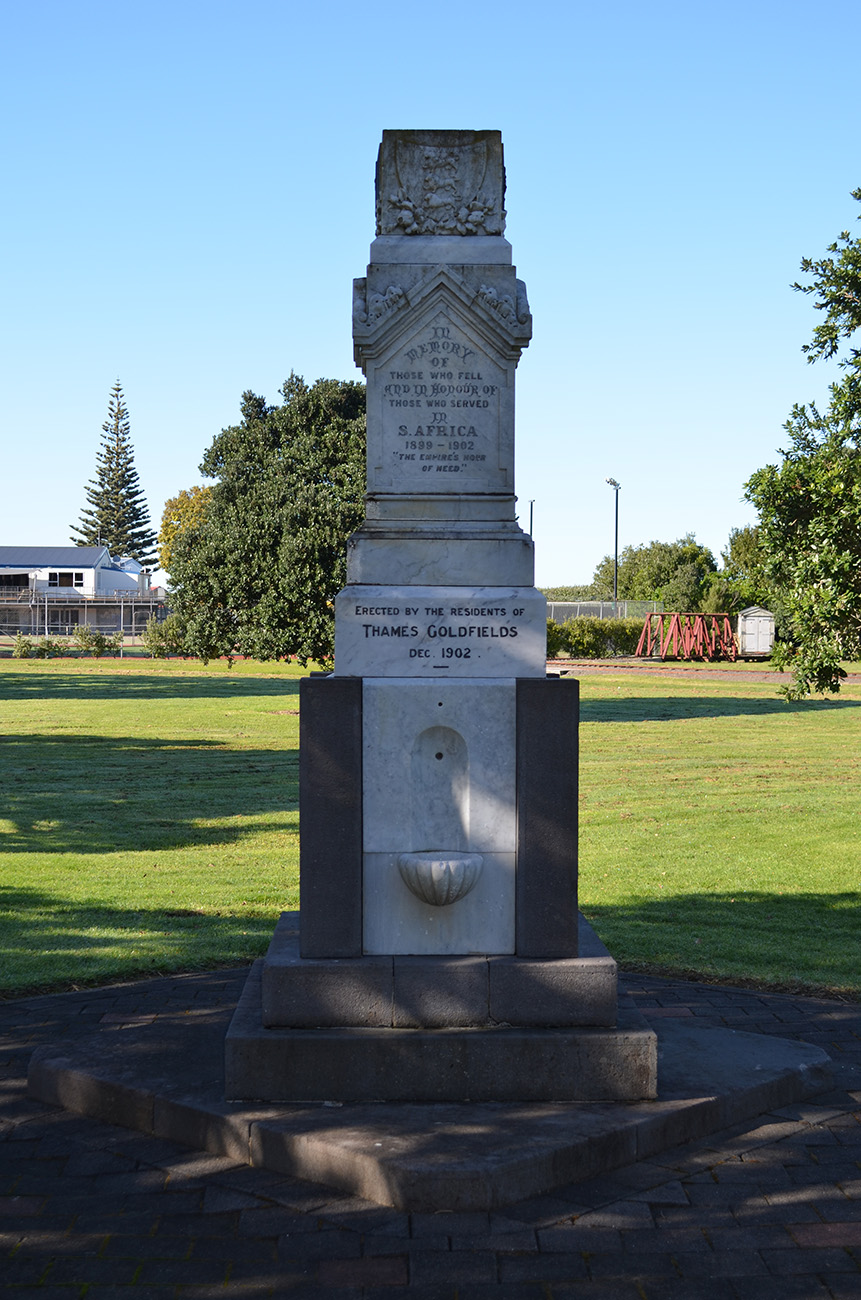
The South African War Memorial commemorates individuals from Thames who served and fell in the first overseas conflict involving New Zealand troops. Presently located in Victoria Park, the stone monument was initially unveiled in late 1902 - shortly after the war ended - on Pollen Street, the town’s main commercial thoroughfare. Funded by public subscription, the memorial reflects the importance to many New Zealanders of being part of Britain’s imperial commonwealth at the turn of the nineteenth century. The imperial associations of the monument were reinforced when it was relocated before early 1921 to Victoria Park, named after the British monarch Queen Victoria who reigned when the South African War (1899-1902) took place. Prominently situated in the park, the memorial has since continued to be a place of commemoration.
Te Kauaeranga was initially settled by Ngāti Huarere prior to conquest by Marutūahu iwi during the sixteenth century. Flat plains by the shoreline were generally cultivated and protected by defensive pā. Prior to European arrival, the Thames foreshore - later largely infilled for Victoria Park and other purposes - was divided into numerous customary interests enabling hapū from throughout Hauraki to access pātiki (flatfish) in associated fishing grounds. The area that subsequently became Grahamstown was known as Tarakonaiti after a large pā situated by the Karaka Stream. After the discovery of gold in 1867, a mining settlement known as Shortland was initially established by the mouth of the Kauaeranga River before civic development for the rapidly growing township moved further north to Grahamstown. The Grahamstown Railway station was built by the Thames foreshore, and a reclamation project to create park grounds at the station entrance underway by 1901.
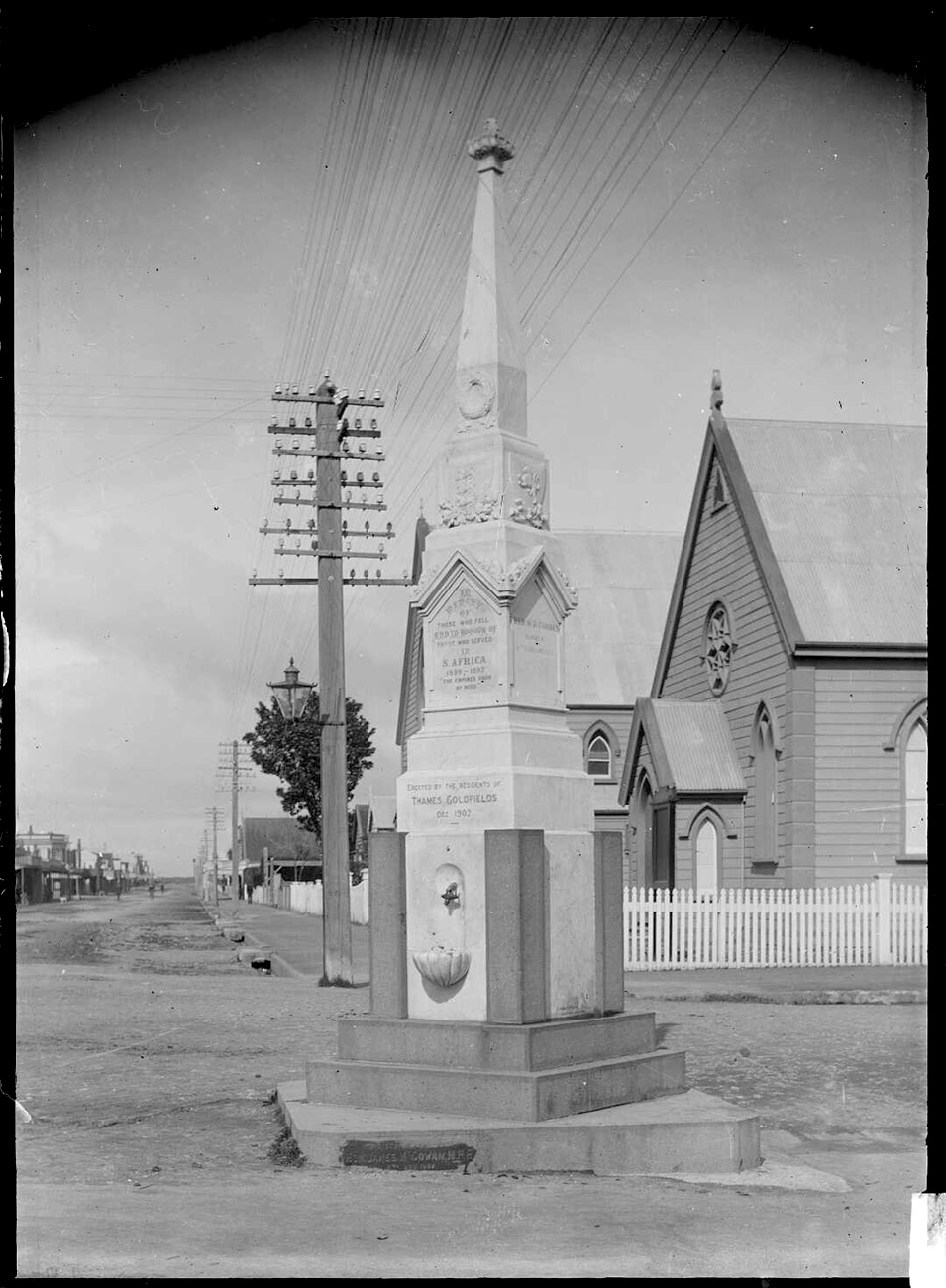
At the turn of the century, a substantial contingent of men from Thames volunteered to join New Zealand troops travelling to South Africa, in patriotic support of imperial rule in another British colony. One of the Boer republics over which control was being contested, Transvaal, held extensive mineral resources, similarly to Thames. Although the troops gained a high reputation while serving abroad, no national memorials were created in New Zealand to acknowledge their contribution after the conflict ended in May 1902. However, many local communities erected their own monuments, including in major provincial centres. In Thames, planning led by a memorial committee was soon underway and, following a public poll, a prominent town centre location at the corner of Pollen and Mary Streets selected in preference to an alternative site in the newly-created Victoria Park. A foundation stone for the monument was laid on King Edward VII’s birthday in November 1902, the same day that Victoria Park was officially opened. The completed structure was formally unveiled on 18 December 1902 at a well-attended ceremony.
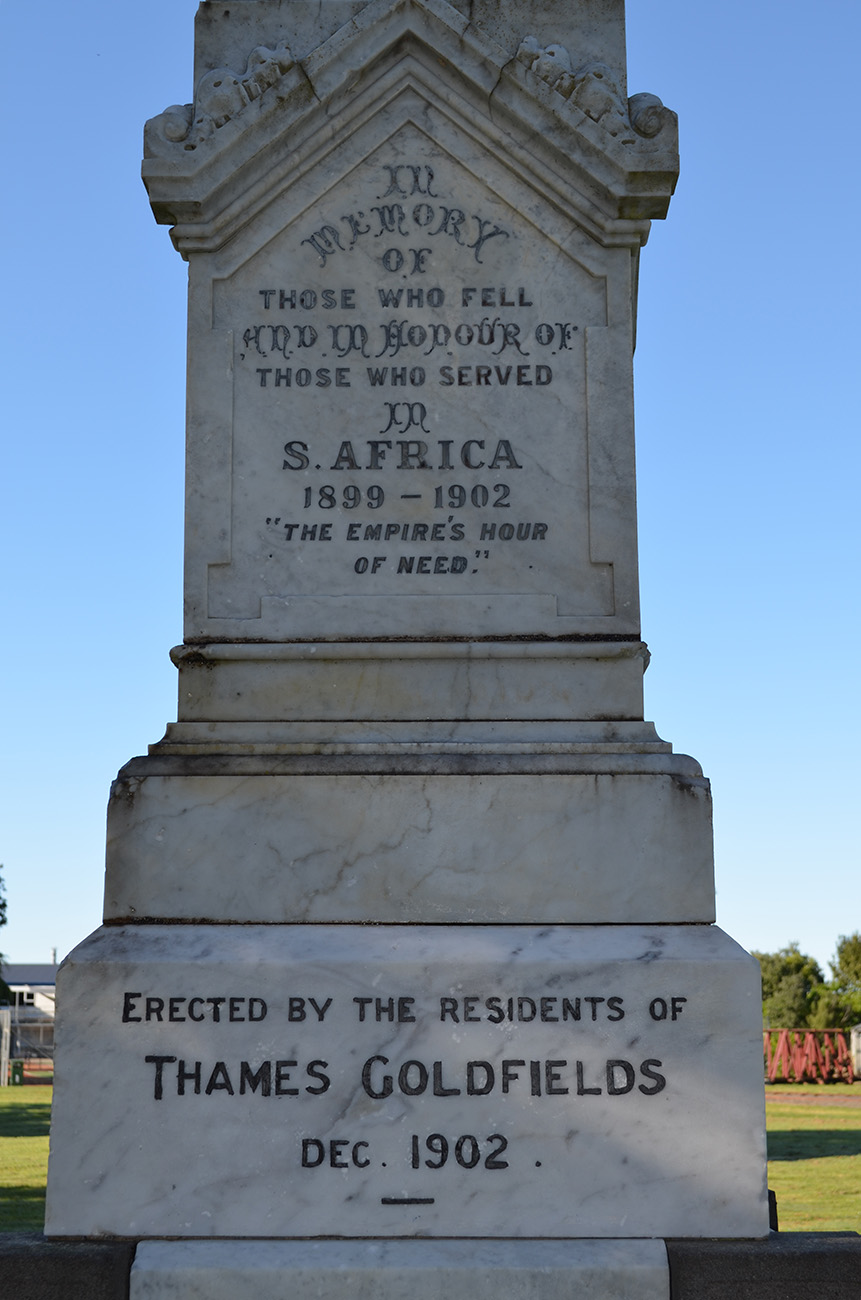
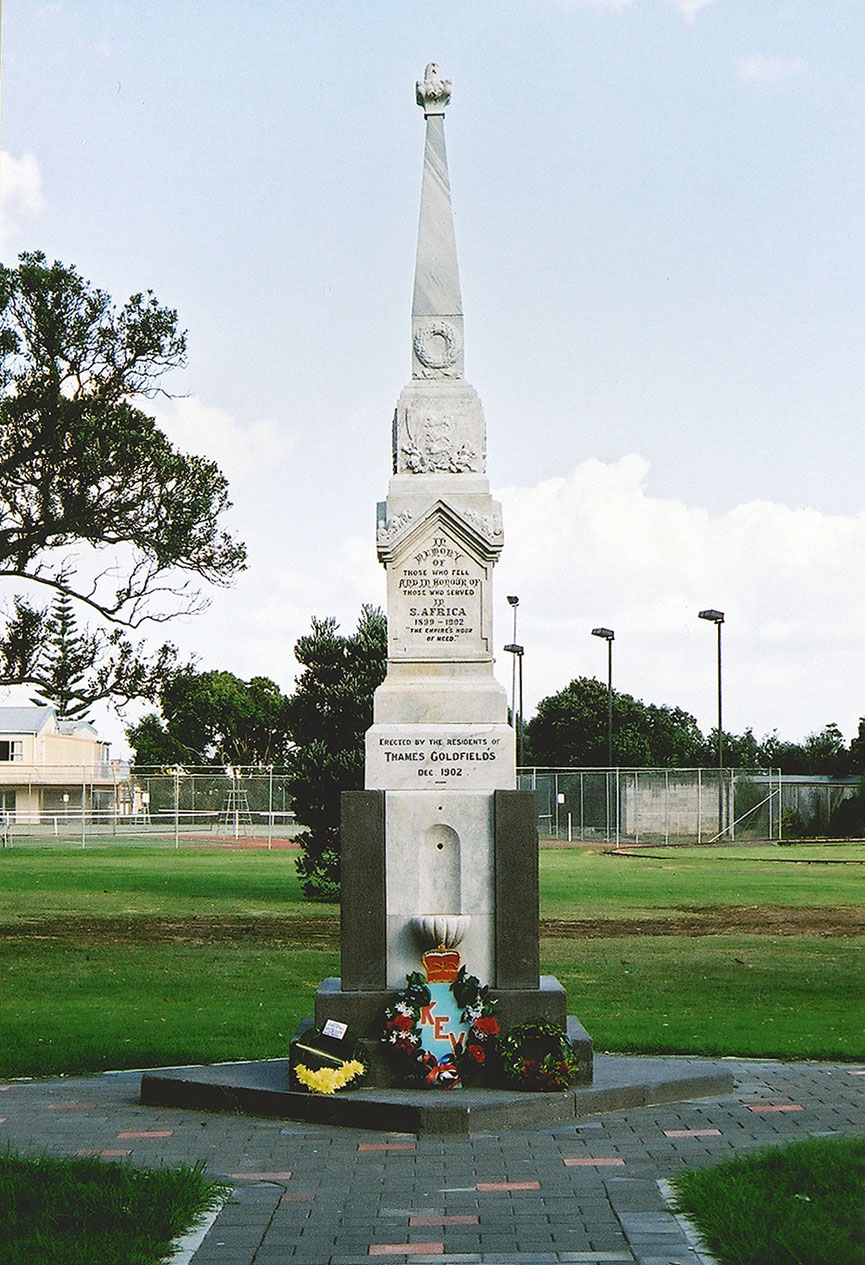
Created by an Auckland firm of monumental masons, McNab and Mason, the memorial consisted of a stone obelisk with Sicilian marble panels and a Malmesbury bluestone base. Its ornate design incorporated a stepped column bearing symbols representing England, Scotland, Ireland and New Zealand, and was surmounted by a tapering spire topped by a crown. Laurel wreaths on the spire symbolised victory, reinforcing imperial connections. As well as a water tap with scalloped bowl on its front face, the design also featured a general inscription commemorating those who served and fell, and the names of three individual troopers who died. Costing £140, the monument was funded by the residents of Thames through public subscription
With an increasing use of motor vehicles as the twentieth century progressed, the memorial was later deemed a traffic hazard and re-sited to Victoria Park by early 1921. Although the importance of the South African conflict was eclipsed by the scale of the First World War (1914-18), early ANZAC Day commemorations included leaving tributes at the memorial in its new position. During celebrations for the coronation of King George VI in 1937, the monument also formed part of the setting for official events with processions and a firework display being held beside it. Half a century later, its functional use as a water fountain had evidently ceased. In 2002, however, the memorial was formally rededicated in its centennial year by Padre Harvey Dalton of the Returned Services Association. After the upper part of the monument containing its crown symbol was deliberately damaged in 2021, the spire was taken down. At some stage, paving connecting the memorial with nearby Albert Street was also laid.
Te Kauaeranga was initially settled by Ngāti Huarere prior to conquest by Marutūahu iwi during the sixteenth century. Flat plains by the shoreline were generally cultivated and protected by defensive pā. Prior to European arrival, the Thames foreshore - later largely infilled for Victoria Park and other purposes - was divided into numerous customary interests enabling hapū from throughout Hauraki to access pātiki (flatfish) in associated fishing grounds. The area that subsequently became Grahamstown was known as Tarakonaiti after a large pā situated by the Karaka Stream. After the discovery of gold in 1867, a mining settlement known as Shortland was initially established by the mouth of the Kauaeranga River before civic development for the rapidly growing township moved further north to Grahamstown. The Grahamstown Railway station was built by the Thames foreshore, and a reclamation project to create park grounds at the station entrance underway by 1901.
At the turn of the century, a substantial contingent of men from Thames volunteered to join New Zealand troops travelling to South Africa, in patriotic support of imperial rule in another British colony. One of the Boer republics over which control was being contested, Transvaal, held extensive mineral resources, similarly to Thames. Although the troops gained a high reputation while serving abroad, no national memorials were created in New Zealand to acknowledge their contribution after the conflict ended in May 1902. However, many local communities erected their own monuments, including in major provincial centres. In Thames, planning led by a memorial committee was soon underway and, following a public poll, a prominent town centre location at the corner of Pollen and Mary Streets selected in preference to an alternative site in the newly-created Victoria Park. A foundation stone for the monument was laid on King Edward VII’s birthday in November 1902, the same day that Victoria Park was officially opened. The completed structure was formally unveiled on 18 December 1902 at a well-attended ceremony.
Created by an Auckland firm of monumental masons, McNab and Mason, the memorial consisted of a stone obelisk with Sicilian marble panels and a Malmesbury bluestone base. Its ornate design incorporated a stepped column bearing symbols representing England, Scotland, Ireland and New Zealand, and was surmounted by a tapering spire topped by a crown. Laurel wreaths on the spire symbolised victory, reinforcing imperial connections. As well as a water tap with scalloped bowl on its front face, the design also featured a general inscription commemorating those who served and fell, and the names of three individual troopers who died. Costing £140, the monument was funded by the residents of Thames through public subscription
With an increasing use of motor vehicles as the twentieth century progressed, the memorial was later deemed a traffic hazard and re-sited to Victoria Park by early 1921. Although the importance of the South African conflict was eclipsed by the scale of the First World War (1914-18), early ANZAC Day commemorations included leaving tributes at the memorial in its new position. During celebrations for the coronation of King George VI in 1937, the monument also formed part of the setting for official events with processions and a firework display being held beside it. Half a century later, its functional use as a water fountain had evidently ceased. In 2002, however, the memorial was formally rededicated in its centennial year by Padre Harvey Dalton of the Returned Services Association. After the upper part of the monument containing its crown symbol was deliberately damaged in 2021, the spire was taken down. At some stage, paving connecting the memorial with nearby Albert Street was also laid.