Situated at the intersection of St Andrew Street and George Street, Penrose’s Department Store at 205 George Street was built in 1909 for William Penrose. It was extensively remodelled in 1914 by Salmond and Vanes, one of Otago’s leading architectural firms. This section has seen a mix of domestic and commercial occupation over the decades. The building has architectural and historical significance as a classical department store of the Edwardian era with notable interior and exterior features. It is also notable through its association with the Penrose’s Company and its iconic 1920s Lamson money system, which became an institution in Dunedin.
Both iwi history and archaeological evidence show Māori occupation in the Ōtākou / Otago region since the 12th century. Today, Kāi Tahu mana whenua is recognised over a large part of Te Wai Pounamu. Kāti Māmoe and Waitaha shared occupation are always acknowledged. The hapū Kai Te Pahi, Kāti Moki, and Kāti Taoka still maintain their presence and responsibility as kaitiaki in this region. While there were no permanent settlements around George Street, the area near the Toitū Tauraka waka (List No. 9774) was known as Ōtepoti.
The sites originally legal description was Section 72, Block XX, Town of Dunedin. The site was first owned by John Curle from 1857-1861 and had a house occupied by David Hutchinson on site by 1857. William Penrose (1872-1926) purchased the section from Bendix Hallenstein Estate (of Hallensteins Clothing Company) in 1906. The department store was designed by Walden and Barton and built by Simpson and Company for William Penrose, which opened in May 1909. The Otago Witness reported the opening and described it as, ’a revelation in store architecture ‘. Some of the significant features are the main rimu staircase, mahogany window frames and mosaic tiled entrance.
William Penrose worked for Drummond & Glasson, one of Timaru’s largest drapery firms. In 1890 he took over the store, which became known as Penrose’s Drapery Establishment. In 1907, Penrose bought out the drapery store of Fyfe & Cumming in Dunedin, and re-opened it in 1909 as Penrose & Co. At that point, he sold the Timaru store and moved to Dunedin. When Penrose died in 1926, the Dunedin store stayed open and eventually became Penrose’s Department Store.
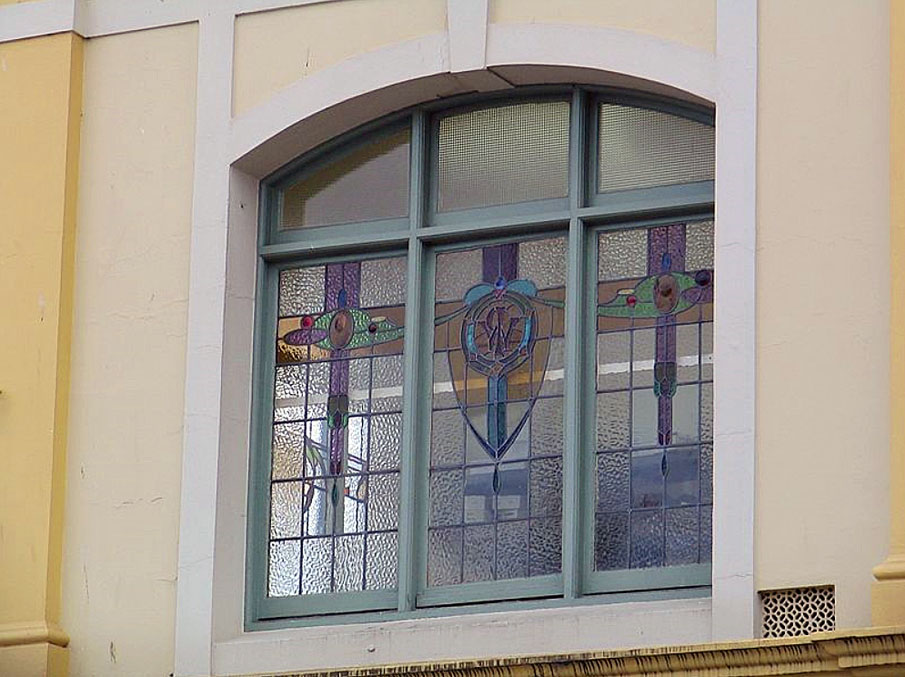
In 1914 the Penrose’s Department Store was altered and extended to the North and West and these plans were drawn by Salmond and Vanes. Penrose’s reported that, ’the whole of the frontage on St Andrew Street is to be remodelled and we are scrapheaping [sic] the whole of our present windows in George Street as well as remodelling the interior of the shop’. The Art Nouveau windows which have become an important feature of the building were added at this time.
One of the distinctive parts of the Penrose’s shopping experience was the money transfer system used in store. The money system within Penrose’s became an institution and tourist attraction with many people remembering the "fast and loud `whoosh' of the Lamson system of pneumatic brass canisters". The cannisters held money, which used to whizz overhead at Penrose's department store. Thousands of these Lamson pneumatic money systems were installed across New Zealand. The one in Penrose’s was installed in the 1920s replacing the original gravity-fed system which was in place from 1909. It was used right up until Penrose’s’ closure in 1995 where it was gifted to the Toitū Otago Settlers Museum.
After Penrose’s death, Ernest Henry Hodge took over the running of the business in 1932. In 1940 a part of the building was sold to Woolworths, and it lost part of its George Street frontage. The Hodge family continued to manage the store, finally purchasing it from Penrose’s in 1959, on the understanding that they continue to use the name. The business closed in 1995 and has had various other tenants in the space such as Starbucks and travel agents. The building is an important presence in the George Street Commercial Registered Historic Area.