

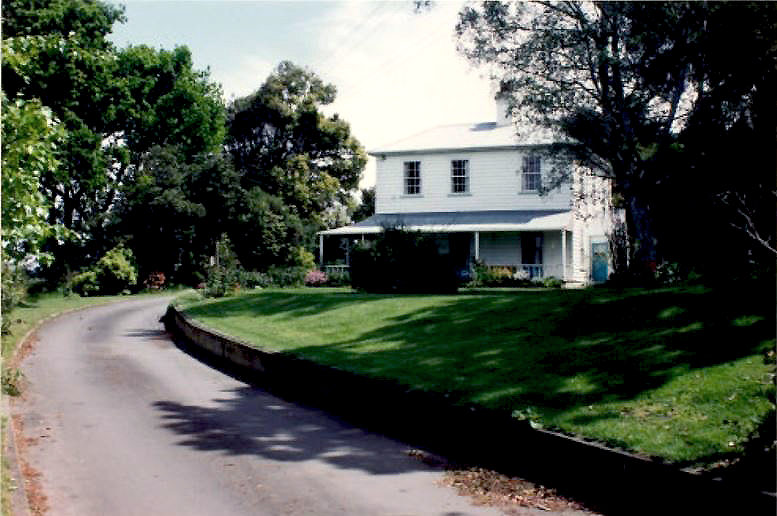
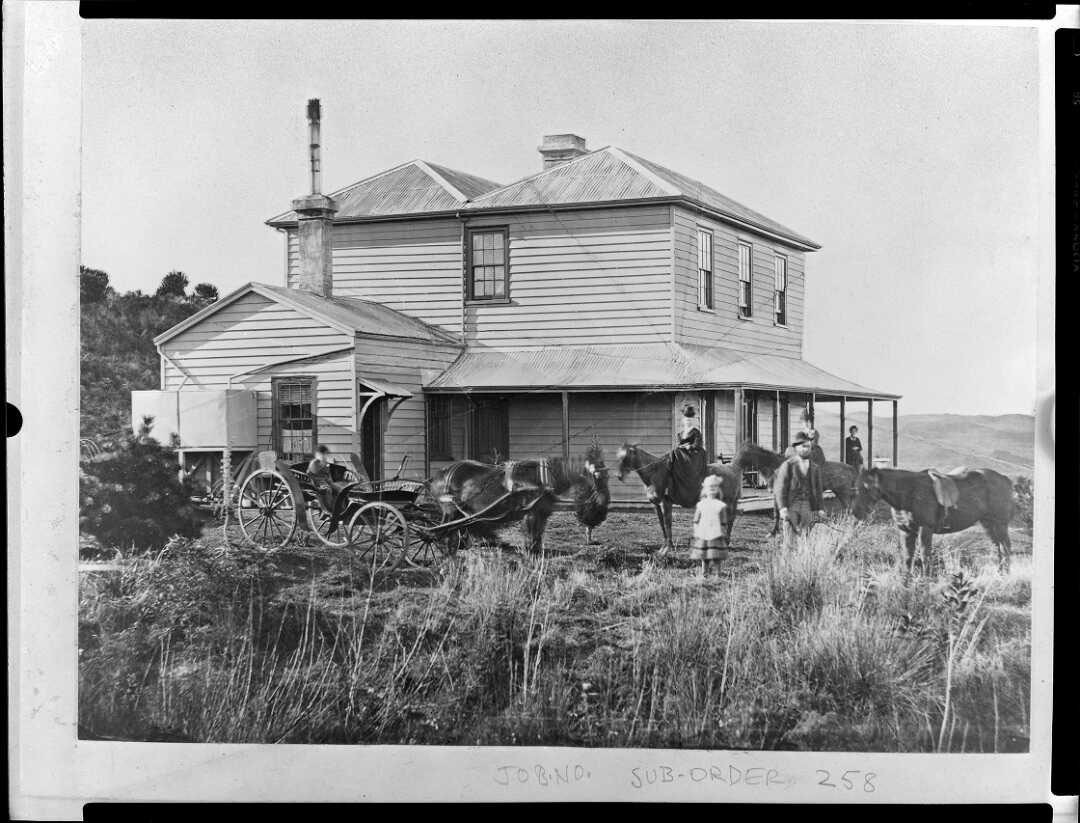
Set on an elevated site amidst a garden of mature trees and overlooking Wanganui Golf Course, Belmont is a distinguished example of a Victorian country homestead. Built in 1860 by Thomas Ballardie Taylor, a senior partner with the mercantile firm Taylor and Watt, the house is constructed of native rimu and mataī timber. Belmont holds architectural significance as an excellent example of an early New Zealand country residence. It features the characteristic symmetrical design, rectangular form, timber framing, weather cladding, and hipped roof typical of the Georgian/Regency style. Of local historical significance for its connection to Thomas Ballardie Taylor and his role in the development of Whanganui as an important port town in the mid-nineteenth century, the house stands as a testament to Victorian entrepreneurial success.
The Whanganui rohe lies between Mount Ruapehu and the Tasman Sea, a landscape carved by rivers and streams, with the Whanganui River at its heart. Māori have lived in the region for generations, tracing their whakapapa to one of three waka - the Aotea, the Kurahaupō and the Tākitimu - together becoming known as Te Āti Haunui-a-Pāpārangi. The densely forested inland slopes of the Whanganui River valley provided an ideal conditions for settlement, with abundant food resources and large trees to build waka that enabled trade and communication further afield. Te Āti Haunui-a-Pāpārangi were known for their skill in managing the river environment, and for their exceptional canoeing abilities They built pā strategically above river bends and developed sheltered terraces for māra kūmara (kūmara gardens).
In the 1820s, migration and raiding parties from the north resulted in a changed tribal dynamic during the turbulent period associated with the advent of European muskets. Following a raid led by Te Rauparaha of Ngāti Toa in 1829, Ngāti Tūwharetoa and Ngāti Raukawa settled in the rohe. Nonetheless, Te Āti Haunui-a-Pāpārangi remain mana whenua.
Further changes came with the arrival of European settlers, who followed hard on the heels of the missionaries in the 1840s. Land sales created an atmosphere of distrust amongst Māori as the terms of land sales were disputed. The town of Whanganui was established in 1841, but unease persisted throughout the 1840s, with conflicts erupting between Māori and settlers ending in the battle of St John’s Wood in 1847. In 1848, the government repurchased the Whanganui Block, through a deed signed by 207 Māori, leading to a period of consolidation as the town grew. However, conflict continued into the 1860s, with fighting between Māori and colonial forces, and between groups of Māori. It was not until 1870, with the departure of the last British regiment, that Whanganui entered a period of rapid growth, becoming the second-most important port in the North Island.
The port’s success created opportunities for two young Scotsmen, Thomas Ballardie Taylor and William Hogg Watt, who established an importing and merchant firm during the 1860s. Their commerical success enabled the purchase of land in Whanganui and in outlying areas such as Westmere and Tayforth, where they developed profitable farms. Taylor’s two-storeyed country house, Belmont, was constructed in the Georgian/Regency style, expressed in its rectangular plan and symmetrical arrangement of double-hung sash windows with glazing bars. The main entrance is flanked by French doors - an English feature that allowed residents to enjoy close contact with nature, particularly fitting to the New Zealand context of integrating house and garden. This connection continues with the wide verandas, providing much-needed shade for the warm climate. The entrance hallway leads into a central corridor with reception and service rooms on the ground floor and bedrooms upstairs.
Taylor died in 1871, drowned after being swept overboard during a voyage. His son, Thomas Chalmers Taylor, continued the business and assumed management of Belmont for his widowed mother. After his death in 1907, the Belmont estate was sold to the Wanganui Golf Club, though the homestead remained in private ownership. While the interior has been renovated over time, the house has not undergone major structural changes and a retains much of its historical integrity. Today, Belmont remains a private residence.
List Entry Information
Status
Listed
List Entry Status
Historic Place Category 2
Access
Private/No Public Access
List Number
5474
Date Entered
1st July 1993
Date of Effect
1st July 1993
City/District Council
Whanganui District
Region
Horizons (Manawatū-Whanganui) Region
Extent of List Entry
Extent includes part of the land described as Lot 1 DP 547876 (RT 947748), Wellington Land District and the building known as Belmont thereon. The extent does not include the garage or the swimming pool.
Legal description
Lot 1 DP 547876 (RT 947748) Wellington Land District
Status
Listed
List Entry Status
Historic Place Category 2
Access
Private/No Public Access
List Number
5474
Date Entered
1st July 1993
Date of Effect
1st July 1993
City/District Council
Whanganui District
Region
Horizons (Manawatū-Whanganui) Region
Extent of List Entry
Extent includes part of the land described as Lot 1 DP 547876 (RT 947748), Wellington Land District and the building known as Belmont thereon. The extent does not include the garage or the swimming pool.
Legal description
Lot 1 DP 547876 (RT 947748) Wellington Land District
Construction Professional
Name
Unknown
Type
Architect
Biography
No biography is currently available for this construction professional
Construction Details
Start Year
1860
startYearCirca
Type
Original Construction
Description
Georgian/Regency style
Start Year
1981
Type
Addition
Description
Renovations to laundry and lounge; addition of veranda
Type
Maintenance/repairs
Description
Repiling
Period
Pre-1992
Start Year
1993
Type
Maintenance/repairs
Description
Repainting
Start Year
2006
Type
Modification
Description
Installation of solid fuel heater
Start Year
2007
Type
Modification
Description
Installation of kitchen window; plumbing works
Start Year
2008
Type
Modification
Description
Installation of woodburner
Construction Professional
Name
Unknown
Type
Architect
Biography
No biography is currently available for this construction professional
Construction Details
Start Year
1860
startYearCirca
Type
Original Construction
Description
Georgian/Regency style
Start Year
1981
Type
Addition
Description
Renovations to laundry and lounge; addition of veranda
Type
Maintenance/repairs
Description
Repiling
Period
Pre-1992
Start Year
1993
Type
Maintenance/repairs
Description
Repainting
Start Year
2006
Type
Modification
Description
Installation of solid fuel heater
Start Year
2007
Type
Modification
Description
Installation of kitchen window; plumbing works
Start Year
2008
Type
Modification
Description
Installation of woodburner
Historical and Associated Iwi / Hapū / Whānau
Completion Date
12th May 2025
Report Written By
Anna Renton-Green
Information Sources
Bowman and Cable, 2012
Ian Bowman and Nick Cable, Belmont (Dwelling), Built Heritage Inventory, Whanganui District Council, 2012.
Other Information
A fully referenced copy of the Summary Upgrade Report is available upon request from the Central Regional Office of Heritage New Zealand Pouhere Taonga Disclaimer Please note that entry on the New Zealand Heritage List/Rārangi Kōrero identifies only the heritage values of the property concerned, and should not be construed as advice on the state of the property, or as a comment of its soundness or safety, including in regard to earthquake risk, safety in the event of fire, or insanitary conditions. Archaeological sites are protected by the Heritage New Zealand Pouhere Taonga Act 2014, regardless of whether they are entered on the New Zealand Heritage List/Rārangi Kōrero or not. Archaeological sites include ‘places associated with pre-1900 human activity, where there may be evidence relating to the history of New Zealand’. This List entry report should not be read as a statement on whether or not the archaeological provisions of the Act apply to the property (s) concerned. Please contact your local Heritage New Zealand office for archaeological advice This place was identified as significant under previous legislation with different information requirements. It remains significant under the current legislation. There is opportunity under our legislation and policies to add to this information. Further information about this place may be available from the Central Regional Office of Heritage New Zealand Pouhere Taonga. A copy of the original report is available from the NZHPT Central region office Please note that entry on the New Zealand Heritage List/Rarangi Korero identifies only the heritage values of the property concerned, and should not be construed as advice on the state of the property, or as a comment of its soundness or safety, including in regard to earthquake risk, safety in the event of fire, or insanitary conditions.
Historical and Associated Iwi / Hapū / Whānau
Completion Date
12th May 2025
Report Written By
Anna Renton-Green
Information Sources
Bowman and Cable, 2012
Ian Bowman and Nick Cable, Belmont (Dwelling), Built Heritage Inventory, Whanganui District Council, 2012.
Other Information
A fully referenced copy of the Summary Upgrade Report is available upon request from the Central Regional Office of Heritage New Zealand Pouhere Taonga Disclaimer Please note that entry on the New Zealand Heritage List/Rārangi Kōrero identifies only the heritage values of the property concerned, and should not be construed as advice on the state of the property, or as a comment of its soundness or safety, including in regard to earthquake risk, safety in the event of fire, or insanitary conditions. Archaeological sites are protected by the Heritage New Zealand Pouhere Taonga Act 2014, regardless of whether they are entered on the New Zealand Heritage List/Rārangi Kōrero or not. Archaeological sites include ‘places associated with pre-1900 human activity, where there may be evidence relating to the history of New Zealand’. This List entry report should not be read as a statement on whether or not the archaeological provisions of the Act apply to the property (s) concerned. Please contact your local Heritage New Zealand office for archaeological advice This place was identified as significant under previous legislation with different information requirements. It remains significant under the current legislation. There is opportunity under our legislation and policies to add to this information. Further information about this place may be available from the Central Regional Office of Heritage New Zealand Pouhere Taonga. A copy of the original report is available from the NZHPT Central region office Please note that entry on the New Zealand Heritage List/Rarangi Korero identifies only the heritage values of the property concerned, and should not be construed as advice on the state of the property, or as a comment of its soundness or safety, including in regard to earthquake risk, safety in the event of fire, or insanitary conditions.
Current Usages
Uses: Accommodation
Specific Usage: House
Former Usages
General Usage: Accommodation
Specific Usage: House
Current Usages
Uses: Accommodation
Specific Usage: House
Former Usages
General Usage: Accommodation
Specific Usage: House
Location
Sign up to hear more
Get the latest heritage news, features and events delivered
straight to your inbox.
