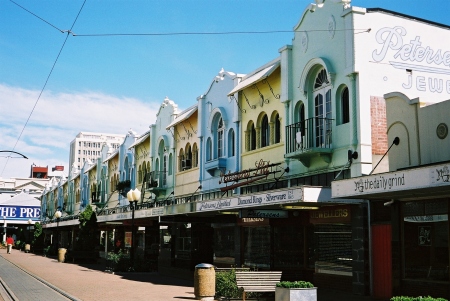
The New Regent area sits on the site of what was once a very large hall known as the "Colosseum". This huge building, erected in 1888, covered the whole length of the present street and the flanking rows of shops on either side. At various times the Colosseum contained O'Brien's Boot Factory, a skating rink and a silent movie theatre. In 1929 the Colosseum was demolished and the property purchased by a development company known as "Regent Street Ltd".
Two years later a shopping complex known as New Regent Street was opened by the Mayor, Mr D.G. Sullivan. Christchurch architect Mr H.F. Willis undertook the design of this unique group of shops. His plan for the New Regent Street development was for a narrow private road lined on each side by twenty small, two storey shops. The street was conceived in the "Spanish Mission" style popular at the time.
The street was erected during the Depression and was one of the only substantial building projects undertaken in the South Island during the period. When the forty shops were offered up for lease in 1931, only three were let because of the bad economic situation. The Company responded by leasing the remainder rent free until the were established and then charging a nominal rent. Over the years some units were amalgamated to make larger shops and eventually all passed into individual ownership. Following World War II, New Regent Street was declared a public road. In the early 1990's it was closed to traffic with only pedestrian access allowed in preparation for installation of a new tramway due to open in 1995.
List Entry Information
Status
Listed
List Entry Status
Historic Area
Access
Able to Visit
List Number
7057
Date Entered
27th October 1994
Date of Effect
27th October 1994
City/District Council
Christchurch City
Region
Canterbury Region
Extent of List Entry
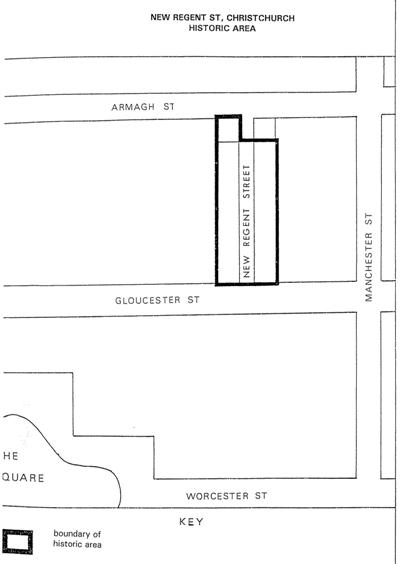
The area comprises all buildings on New Regent Street between Gloucester and Armagh Streets except the ANZ bank on the eastern corner with Armagh Street.
Status
Listed
List Entry Status
Historic Area
Access
Able to Visit
List Number
7057
Date Entered
27th October 1994
Date of Effect
27th October 1994
City/District Council
Christchurch City
Region
Canterbury Region
Extent of List Entry
The area comprises all buildings on New Regent Street between Gloucester and Armagh Streets except the ANZ bank on the eastern corner with Armagh Street.
Why is this place significant?
Cultural Significance
Cultural/Social: The idea of a whole street of small specialist shops leased out as part of a single, comprehensive development was very advanced for its time. In the 1930's, shopping complexes were a comparatively new concept here and overseas. New Regent Street, erected in 1931 was a forerunner of present day shopping malls in New Zealand.
Historic Significance
Historical Significance or Value Historical: The site for New Regent St, which once housed the "Colosseum", is significant in the history of Christchurch retail. The subsequent development of the site into a private road lined with twenty architecturally designed, specialist shops did not diminish its position in the retail life of the city. The time at which the complex was built (1930's) and the subsequent economic problems faced also highlights the effect of the Depression on New Zealand society. The New Regent Street area, designed in the "Spanish Mission" style, is visually unique to Christchurch and New Zealand. Still with many of its original features, the area is significant in terms of the city's retail history and streetscape appeal.
Physical Significance
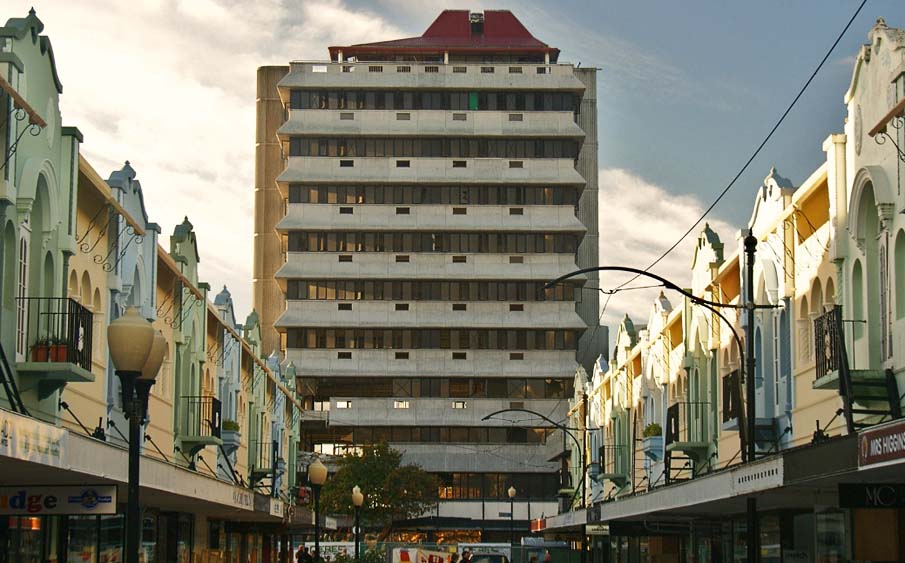
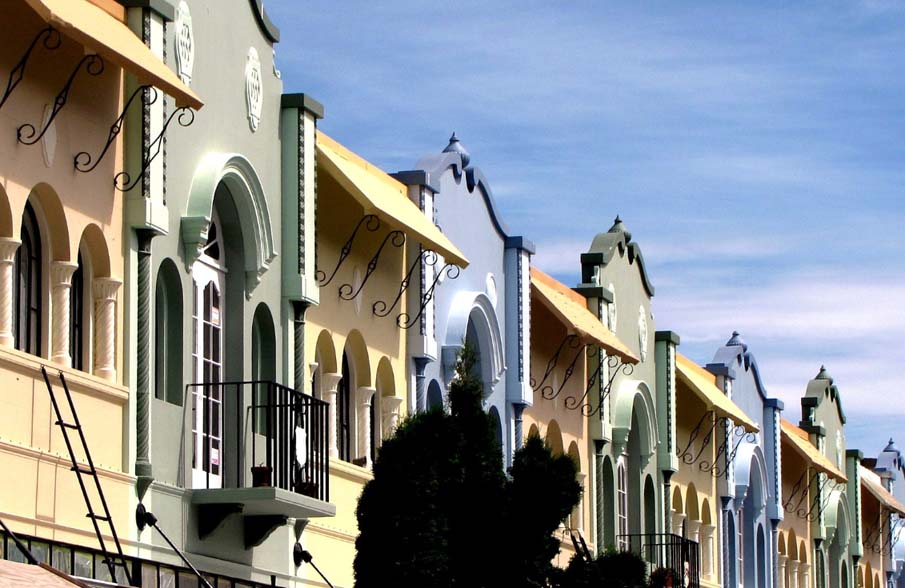
Architectural: New Regent St was designed by Christchurch architect, Mr H.F. Willis. Willis designed a number of significant buildings in the city including the State Picture Theatre (1935) in the Art Deco style. He chose another popular style of the 1930's for New Regent St, the "Spanish Mission" style. New Regent St has considerable streetscape quality because of its unity of style and use of colour to highlight facade variations. Another Spanish style building designed by Willis was originally on the eastern corner of Armagh St but this was demolished in 1967. Aesthetic: The street is visually unique in Christchurch and New Zealand and adds much to the character of the central city area. The fact that virtually the whole street was designed as a single united complex in scale, style and function gives it a considerable aesthetic value. This streetscape quality is enhanced by the rhythmic colour pattern emphasising the variations in style of the different coloured sections. Willis' design was a forerunner to the modern shopping mall.
Why is this place significant?
Cultural Significance
Cultural/Social: The idea of a whole street of small specialist shops leased out as part of a single, comprehensive development was very advanced for its time. In the 1930's, shopping complexes were a comparatively new concept here and overseas. New Regent Street, erected in 1931 was a forerunner of present day shopping malls in New Zealand.
Historic Significance
Historical Significance or Value Historical: The site for New Regent St, which once housed the "Colosseum", is significant in the history of Christchurch retail. The subsequent development of the site into a private road lined with twenty architecturally designed, specialist shops did not diminish its position in the retail life of the city. The time at which the complex was built (1930's) and the subsequent economic problems faced also highlights the effect of the Depression on New Zealand society. The New Regent Street area, designed in the "Spanish Mission" style, is visually unique to Christchurch and New Zealand. Still with many of its original features, the area is significant in terms of the city's retail history and streetscape appeal.
Physical Significance
Architectural: New Regent St was designed by Christchurch architect, Mr H.F. Willis. Willis designed a number of significant buildings in the city including the State Picture Theatre (1935) in the Art Deco style. He chose another popular style of the 1930's for New Regent St, the "Spanish Mission" style. New Regent St has considerable streetscape quality because of its unity of style and use of colour to highlight facade variations. Another Spanish style building designed by Willis was originally on the eastern corner of Armagh St but this was demolished in 1967. Aesthetic: The street is visually unique in Christchurch and New Zealand and adds much to the character of the central city area. The fact that virtually the whole street was designed as a single united complex in scale, style and function gives it a considerable aesthetic value. This streetscape quality is enhanced by the rhythmic colour pattern emphasising the variations in style of the different coloured sections. Willis' design was a forerunner to the modern shopping mall.
DESCRIPTION OF BOUNDARY: All buildings on New Regent Street between Gloucester and Armagh Streets except the ANZ bank on the eastern corner with Armagh Street. LIST OF ITEMS: New Regent Street shops (All included in one Category I registration). A single storey building containing two shops on the western corner of Armagh St has been included because it is similar in scale and style to the character of the rest of the area. STRUCTURES: New Regent St (Category I) Mr H.F. Willis designed the street in the "Spanish Mission" style. On its upper storey, its design features three different sections varying somewhat in style and expressed in a repeating pattern. Every second section shows three round headed windows supported by small columns showing a spiral motif. They have no parapet but an awning extends out above the windows. The other sections are of two similar styles and alternate in the remaining spaces. Both feature a Spanish style parapet. The main difference between them is that one section has a centrally placed double casement window, while the other type has French windows leading onto a small balcony. The central windows of both versions are surmounted by a projecting arched moulding over a small arched window with panes arranged in sunburst form. At street level the shops feature large display windows originally surrounded by coloured tiles, many of which still remain. There have been a number of modifications to the area, for example upper story windows have been blocked in and some shop fronts altered, but these are minor in nature. Many of the shops still show the original 1930's tiles around the windows of their street facades and remain unaltered on their distinctive upper storey also. The sites on either corner of the intersection of New Regent St and Armagh St were not owned by Regent St Ltd and are not part of the same development. The building containing two shops on the western corner has been included in the historic area because although it is single story it is similar in scale and style to the character of the area. The eastern corner has not been included. It formerly contained another Willis designed Spanish Style building, which was demolished in 1967 to make way for the present ANZ building.
DESCRIPTION OF BOUNDARY: All buildings on New Regent Street between Gloucester and Armagh Streets except the ANZ bank on the eastern corner with Armagh Street. LIST OF ITEMS: New Regent Street shops (All included in one Category I registration). A single storey building containing two shops on the western corner of Armagh St has been included because it is similar in scale and style to the character of the rest of the area. STRUCTURES: New Regent St (Category I) Mr H.F. Willis designed the street in the "Spanish Mission" style. On its upper storey, its design features three different sections varying somewhat in style and expressed in a repeating pattern. Every second section shows three round headed windows supported by small columns showing a spiral motif. They have no parapet but an awning extends out above the windows. The other sections are of two similar styles and alternate in the remaining spaces. Both feature a Spanish style parapet. The main difference between them is that one section has a centrally placed double casement window, while the other type has French windows leading onto a small balcony. The central windows of both versions are surmounted by a projecting arched moulding over a small arched window with panes arranged in sunburst form. At street level the shops feature large display windows originally surrounded by coloured tiles, many of which still remain. There have been a number of modifications to the area, for example upper story windows have been blocked in and some shop fronts altered, but these are minor in nature. Many of the shops still show the original 1930's tiles around the windows of their street facades and remain unaltered on their distinctive upper storey also. The sites on either corner of the intersection of New Regent St and Armagh St were not owned by Regent St Ltd and are not part of the same development. The building containing two shops on the western corner has been included in the historic area because although it is single story it is similar in scale and style to the character of the area. The eastern corner has not been included. It formerly contained another Willis designed Spanish Style building, which was demolished in 1967 to make way for the present ANZ building.
Historical and Associated Iwi / Hapū / Whānau
Information Sources
McKenzie, 1984 (4)
James McKenzie, New Regent Street Precinct, Historic Places Trust, 1984.
Other Information
This historic place was registered under the Historic Places Act 1993. This report includes text from the original Proposal for Registration considered by the NZHPT Board at the time of registration. Please note that entry on the New Zealand Heritage List/Rarangi Korero identifies only the heritage values of the property concerned, and should not be construed as advice on the state of the property, or as a comment of its soundness or safety, including in regard to earthquake risk, safety in the event of fire, or insanitary conditions.
Historical and Associated Iwi / Hapū / Whānau
Information Sources
McKenzie, 1984 (4)
James McKenzie, New Regent Street Precinct, Historic Places Trust, 1984.
Other Information
This historic place was registered under the Historic Places Act 1993. This report includes text from the original Proposal for Registration considered by the NZHPT Board at the time of registration. Please note that entry on the New Zealand Heritage List/Rarangi Korero identifies only the heritage values of the property concerned, and should not be construed as advice on the state of the property, or as a comment of its soundness or safety, including in regard to earthquake risk, safety in the event of fire, or insanitary conditions.