

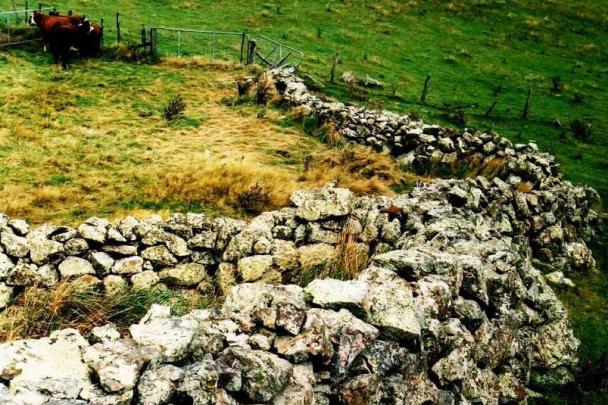
Dry stone walling is a construction technique whereby stones are not fixed by means of a mortar. This dry stone wall is an excellent example of the technique using readily available greywacke. It is thought to be some 120 metres long. Being mostly sand and swamp country, Manawatu has no great stone working tradition and the dry stone wall is a rare, if not unique, example of this technique in Manawatu. A date of 1922 has been suggested.
List Entry Information
Status
Listed
List Entry Status
Historic Place Category 2
Access
Private/No Public Access
List Number
7118
Date Entered
17th December 1993
Date of Effect
17th December 1993
City/District Council
Palmerston North City
Region
Horizons (Manawatū-Whanganui) Region
Extent of List Entry
Extent includes part of the land described as Lot 5 DP 91000 ( RT WN58C/933), Wellington Land District and the structure known as Stone Wall thereon, which extends for c. 120 metres along the eastern boundary of the land parcel.
Legal description
Lot 5 DP 91000 (RT WN58C/933), Wellington Land District;
Status
Listed
List Entry Status
Historic Place Category 2
Access
Private/No Public Access
List Number
7118
Date Entered
17th December 1993
Date of Effect
17th December 1993
City/District Council
Palmerston North City
Region
Horizons (Manawatū-Whanganui) Region
Extent of List Entry
Extent includes part of the land described as Lot 5 DP 91000 ( RT WN58C/933), Wellington Land District and the structure known as Stone Wall thereon, which extends for c. 120 metres along the eastern boundary of the land parcel.
Legal description
Lot 5 DP 91000 (RT WN58C/933), Wellington Land District;
Construction Details
Start Year
1922
Type
Original Construction
Construction Details
Start Year
1922
Type
Original Construction
Historical and Associated Iwi / Hapū / Whānau
Other Information
This place was identified as significant under previous legislation with different information requirements. It remains significant under the current legislation. There is opportunity under our legislation and policies to add to this information. Further information about this place may be available from the Central Regional Office of Heritage New Zealand Pouhere Taonga. A copy of the original report is available from the NZHPT Central region office Please note that entry on the New Zealand Heritage List/Rarangi Korero identifies only the heritage values of the property concerned, and should not be construed as advice on the state of the property, or as a comment of its soundness or safety, including in regard to earthquake risk, safety in the event of fire, or insanitary conditions.
Historical and Associated Iwi / Hapū / Whānau
Other Information
This place was identified as significant under previous legislation with different information requirements. It remains significant under the current legislation. There is opportunity under our legislation and policies to add to this information. Further information about this place may be available from the Central Regional Office of Heritage New Zealand Pouhere Taonga. A copy of the original report is available from the NZHPT Central region office Please note that entry on the New Zealand Heritage List/Rarangi Korero identifies only the heritage values of the property concerned, and should not be construed as advice on the state of the property, or as a comment of its soundness or safety, including in regard to earthquake risk, safety in the event of fire, or insanitary conditions.
Former Usages
General Usage: Civic Facilities
Specific Usage: Wall/Fence
Former Usages
General Usage: Civic Facilities
Specific Usage: Wall/Fence
Location
Stay up to date with Heritage this month
