

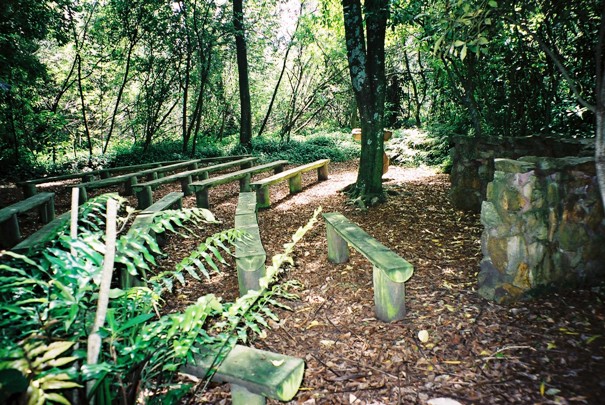
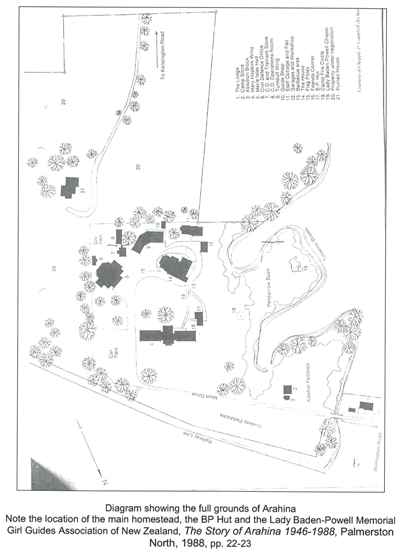
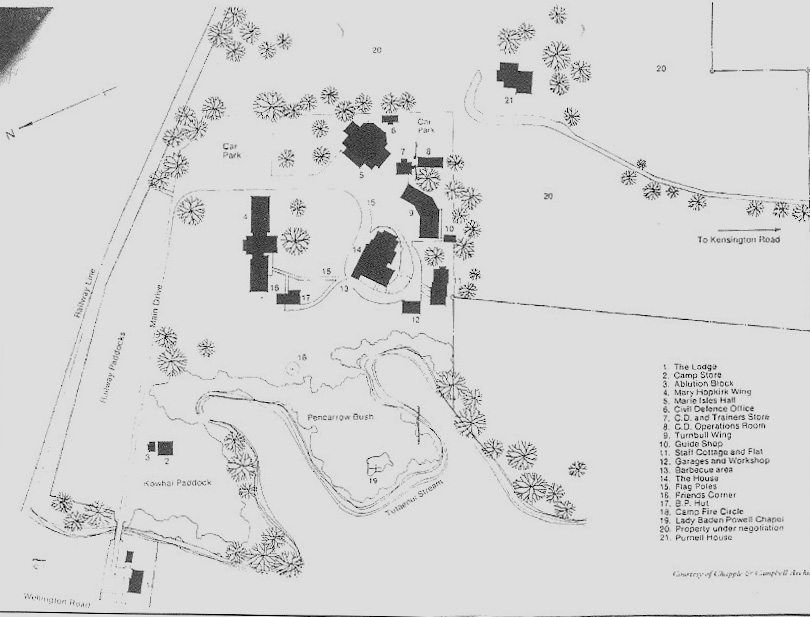
The land, first purchased by Jane Duthie Crooke in 1911, was bought by the Girl Guides Association (New Zealand Branch) Incorporated (Girl Guides) in 1946. The area contains a range of facilities used by, or built for, the Girl Guides. The main house, named 'Astolat' by the Crookes and constructed in 1919, dominates the complex. Its importance in the setting is emphasised by an expanse of grass situated at the front, which allows an unimpeded view of the building. The surrounds include a camping ground and campfire circle, an outdoor bush chapel, gardens, accommodation blocks, huts and halls.
Arahina is historically and culturally significant for its association with the Girl Guide movement in New Zealand. The Girl Guide movement has had a major impact on the lives of many young New Zealand women. At Arahina, thousands of guides and leaders were trained, and went on to provide leadership to generations of New Zealand girl guides. The area also has aesthetic and architectural value. The homestead is a fine example of the English Domestic Revival style, and is carefully detailed and well handled. The homestead is set among well-kept and carefully laid out gardens and outbuildings that illustrate the importance the NZ Girl Guides placed on outdoor recreation and training.
List Entry Information
Status
Listed
List Entry Status
Historic Area
Access
Private/No Public Access
List Number
7627
Date Entered
24th June 2005
Date of Effect
24th June 2005
City/District Council
Rangitīkei District
Region
Horizons (Manawatū-Whanganui) Region
Extent of List Entry
The Registration includes the land comprised in Certificate of Title 42D/142, Wellington Registry as marked on Extent of Registration Map; and the buildings and their fittings and fixtures and the individual items are marked on the Extent of Registration Map (see Appendix 4 in the registration proposal).. The Arahina Historic Area contains a range of facilities used by, or built for, the Girl Guides. Included in the area are: the main house 'Astolat', Lady Baden-Powell Memorial Chapel, Girl Guides' Campfire Circle, Mary Hopkirk Wing, a sun-dial and flagpole, the BP Hut (originally known as 'Mine Haven'), Marie Isles Hall, the Turnbull Wing, various outbuildings and garages, and the staff cottage and flat.
Legal description
Lot 1 DP 75470, Pt Blk VII Rangitikei District, Pt Blk VII Rangitikei District, Pt Lot 2 on Deeds Plan 284, Pt Lots 1 and 2 on DP 18830, Pt Lot 1 Deeds Plan 430 and Lots 1 and 2 on DP 45023 (RT WN 42D/142), Wellington Land District
Status
Listed
List Entry Status
Historic Area
Access
Private/No Public Access
List Number
7627
Date Entered
24th June 2005
Date of Effect
24th June 2005
City/District Council
Rangitīkei District
Region
Horizons (Manawatū-Whanganui) Region
Extent of List Entry
The Registration includes the land comprised in Certificate of Title 42D/142, Wellington Registry as marked on Extent of Registration Map; and the buildings and their fittings and fixtures and the individual items are marked on the Extent of Registration Map (see Appendix 4 in the registration proposal).. The Arahina Historic Area contains a range of facilities used by, or built for, the Girl Guides. Included in the area are: the main house 'Astolat', Lady Baden-Powell Memorial Chapel, Girl Guides' Campfire Circle, Mary Hopkirk Wing, a sun-dial and flagpole, the BP Hut (originally known as 'Mine Haven'), Marie Isles Hall, the Turnbull Wing, various outbuildings and garages, and the staff cottage and flat.
Legal description
Lot 1 DP 75470, Pt Blk VII Rangitikei District, Pt Blk VII Rangitikei District, Pt Lot 2 on Deeds Plan 284, Pt Lots 1 and 2 on DP 18830, Pt Lot 1 Deeds Plan 430 and Lots 1 and 2 on DP 45023 (RT WN 42D/142), Wellington Land District
Why is this place significant?
Cultural Significance
The cultural value of the Arahina Training Centre can be found in the strong links that many guides have with the area, and the importance that guiding has had for the women and girls of New Zealand. The Arahina Training Centre is held in high esteem by the local community as a key element on the local landscape.
Historic Significance
Historical Significance or Value The Arahina Training Centre has historical significance for two principal reasons; its association with the Girl Guides Association in New Zealand, and with the original owners of the property, Alfred Crooke and Jane (Jean) Duthie Smith. The Girl Guides Association has had a major impact on the lives of many young New Zealand women and this building had a big role in that history. Thousands of guides and leaders were trained at the centre and many went on to provide leadership to generations of New Zealand girl guides. Alfred and Jane (Jean) Crooke are of minor historical interest. Alfred Crooke was a stipendiary magistrate, a position of some public status in early twentieth century New Zealand. They were responsible for the construction of 'Astolat', a fine house that adds much to the broader Marton landscape. It was their vision and work that shaped the Arahina's physical and historical nature.
Physical Significance
The Crooke homestead, 'Astolat' is architecturally significant. It is a good example of the English Domestic Revival style. Designed by Clifford Newton Hood, a Wanganui based architect, the house is carefully detailed and well handled. The aesthetic value of the Arahina Training Centre can be found in the combination of the fine main house and its well kept and carefully laid-out gardens. The broader area illustrates the importance that guiding placed on outdoor recreation and training.
Why is this place significant?
Cultural Significance
The cultural value of the Arahina Training Centre can be found in the strong links that many guides have with the area, and the importance that guiding has had for the women and girls of New Zealand. The Arahina Training Centre is held in high esteem by the local community as a key element on the local landscape.
Historic Significance
Historical Significance or Value The Arahina Training Centre has historical significance for two principal reasons; its association with the Girl Guides Association in New Zealand, and with the original owners of the property, Alfred Crooke and Jane (Jean) Duthie Smith. The Girl Guides Association has had a major impact on the lives of many young New Zealand women and this building had a big role in that history. Thousands of guides and leaders were trained at the centre and many went on to provide leadership to generations of New Zealand girl guides. Alfred and Jane (Jean) Crooke are of minor historical interest. Alfred Crooke was a stipendiary magistrate, a position of some public status in early twentieth century New Zealand. They were responsible for the construction of 'Astolat', a fine house that adds much to the broader Marton landscape. It was their vision and work that shaped the Arahina's physical and historical nature.
Physical Significance
The Crooke homestead, 'Astolat' is architecturally significant. It is a good example of the English Domestic Revival style. Designed by Clifford Newton Hood, a Wanganui based architect, the house is carefully detailed and well handled. The aesthetic value of the Arahina Training Centre can be found in the combination of the fine main house and its well kept and carefully laid-out gardens. The broader area illustrates the importance that guiding placed on outdoor recreation and training.
The Arahina Training Centre served as the national training centre for the Girl Guides Association between 1946 and 1999. Prior to that it was the property of Alfred Crooke and his wife Jane (Jean) Duthie Smith, who were responsible for the construction of the main house in 1919, and who resided in the house until the early 1940s. 'Astolat' In 1911, Jane (Jean) Duthie Crooke (nee Smith) purchased land near the Tutaenui Stream in Marton. The land, originally part of Section VII of the Rangitikei Block, was part of 5000 acres first acquired by Sir William Fox (1812?-1893) in 1849 and conferred by Crown Grant in 1858. Fox, a noted politician, artist, and social advocate, built his homestead Westoe (Category I; Record Number 156) on part of the estate and lived there until 1887. Fox subdivided part of his estate for the proposed town of Marsden, but the settlement proved unpopular due to Fox's stipulation that liquor should not be sold from any of the buildings erected there. The early Pakeha settlers eventually selected a site further north at what is now the town of Marton. The land on Fox's estate was subsequently sold to farmers and appears to have been used for farming for much of the remainder of the nineteenth century. Jane (Jean) Crooke purchased her land from sheep-farmer Edward Newman of Dunisnane, and Janet Henderson and William Morrison of Fern Flats. On 4 December 1919, Jane (Jean) Crooke sold the land for £1200 to her husband Alfred Crooke. Jane (Jean) Crooke was born in Milton, Otago, in 1864 to James Chapman Smith of Greenfield and Margaret (nee Martin). Alfred Crooke was born in Guildford, Surrey, in 1854. After qualifying as a barrister and solicitor he set up practice in Lawrence, Otago. He and Jean married in 1890. After serving as a stipendiary magistrate in Greymouth, Alfred transferred with his wife and four daughters to New Plymouth in 1912. When Alfred Crooke retired in 1919, the Crooke family moved to Marton with their four daughters. The Crookes commissioned Wanganui architect Clifford Newton Hood (1891-1971) to design the house. Hood trained under architect Thomas Harvey James, and served as a draughtsman and then architect to the Wanganui Education Board. He went into private practice in 1918, and the Crookes' project was one of his first commissions as an independent architect. The house was completed later that same year. The Crookes named it 'Astolat' after the name bestowed on the town of Guildford by Sir Thomas Malory, who also identified the Arthurian 'Camelot' as Winchester. The couple also landscaped the gardens and added several outbuildings, which served various functions, and included a writing room for Jane (Jean) Crooke known as 'The Haven', a large garage, a workshop, milking shed, and hen-house. Astolat was a large house. Its size was required to comfortably accommodate the Crookes, three of their four children, and later, their grandchildren. Jane (Jean) Crooke died in 1940 and Alfred Crooke in 1941. The property was left to their two unmarried daughters, Frances Magdalene (Betty), and Helen Iris Crooke (1895-1985). It was during the Second World War and Betty Crooke, a member of the WAAC, was stationed at Fort Dorset. Helen Iris Crooke was Director-General of the VAD (Transport Divison) in New Zealand, and later travelled to Europe to work with refugees for the UNRRA. Between 1943 and 1946 the Crookes' second daughter, Winifred Forester, moved into the house with her family in a care-taking capacity. At the end of the war the property was placed on the market. It was advertised in April 1946 at a price of £8,500 'some thousands of pounds below cost' as a 'lovely home or...hospital or convalescent home'. It attracted the interest of the Girl Guides Association. The Girl Guides Association The first Girl Guides in New Zealand were known as Peace Scouts, a group conceived of in 1909 by Colonel Cosgrove. Cosgrove, a New Zealander, had served in the South African War with the founder of the Boy Scouts, Robert Baden-Powell. At this time there were no comparable programmes available to girls in either New Zealand or England, and Cosgrove established the Peace Scouts as a female alternative to the Scouts. The Peace Scouts were envisaged as a community initiative that would assist girls to acquire a range of skills and encourage them to meet their personal and professional aspirations. Girls, aged between seven and ten years, were able to join a group named the 'Fairy Scouts' (now known as the 'Brownies'). In 1923 the Peace Scout Movement changed its name to the Girl Guides Association (New Zealand Branch) Incorporated, and affiliated itself with the World Guides. The affiliation prompted a change in Movement, prompting a less military, more domestic focus. This change was symbolised by the change in uniform from one of khaki with bugler and staves to the plain blue uniform of the Guides. The Guides aim was to 'train girls through a series of healthy, happy activities, while delighting them'. Despite this change, World War II was a busy time for the New Zealand guiding movement. Guides assisted with the war effort by undertaking farm work, collecting materials, sewing, knitting, and using their knotting skills to make camouflage nets. The Guides also launched the Baden-Powell Memorial Fund and collected £2165 towards the war effort. After the end of the war, total national membership stood at 9450 girls. However, a large number of adult Guide leaders had volunteered for services during the war, or had taken up work in essential industries, and there had been little time or funding for the training of leaders. If the Movement was to continue in peacetime, more trained Guide leaders would be required. The Association's Annual Report for 1946 indicated a decrease in Guiders that year and noted that: it is, of course, only natural that, after the strenuous years of war many feel in need of more leisure time and are disinclined to tie themselves to a voluntary group which demands much of them...but if the six years of hard work and sacrifices are not to have been in vain, much must be done NOW to help our young people to live through the uncertain years that lie ahead'. The need for more Guide leaders was recognised at government level. As New Zealand was one of the few Guiding countries without training facilities, the Dominion Executive granted approval to the movement to establish a national guide-training centre. Arahina Marton was considered an ideal location for the new training centre, primarily because it was a bus and train junction, and could therefore be easily accessed by Guides throughout New Zealand. In November 1946, the Girl Guides Association purchased the Crooke family property for £8,000. The Guides named the property 'Arahina', a Maori name that translates as 'to lead' or 'to guide'. The next two years were spent preparing the property for its official opening as a training centre. Miss Enid Simes of Christchurch was part of the 1947 efforts to prepare the house. She remembered her experience: When we arrived it was a completely empty house - no furniture, no curtains, bare boards in most rooms and the creeper peering in the windows making strange patterns in the evening light. It was the time of food rationing when coupons were exchanged for meat, tea, sugar and butter. We were really in a plight having nothing, but managed to persuade the Department concerned to give us one 75 pound bag of sugar. With this we bottled plums, apples and pears from the orchard. In an issue of Te Rama, the Guide magazine, it was noted that 'Because Arahina is ours, we will want to be proud of it as a home, and no home can be well-run without the right things'. Through hard work, gifts, and donations, the Arahina Training Centre was prepared for opening. In the Annual Report for the 1948 financial year it was noted that 'the establishing of the Training Centre has been a long, slow and oftimes disappointing task but we can confidently say that it should now go forward, becoming more and more a part of our Movement'. The 'Dominion Training Centre' was officially opened on 31 October 1948 Barbara Freyberg (née Jekyll), wife of the then Governor-General of New Zealand. The training programmes held at Arahina were then based on the English Girl Guides' Training Scheme, and, at the time of the opening, New Zealand only had two Guiders qualified to teach the Training Scheme, a Miss Burgin and an Elizabeth Robertson. However, with the assistance of Guiders from overseas, and numerous training sessions at Arahina and around the country, the number of Trainers was gradually increased. The first training at the new centre had taken place prior to its opening in May 1947, and by 1967 the facilities had accommodated approximately 13,000 Guides. In 1956, the Guides first full time trainer, Jean Elliot, was appointed, and the following year New Zealand's own training scheme and Guide Diploma was launched. During this period Arahina had developed into a fully functioning, well-equipped centre. When it first opened, free of debt, in 1948, a number of schemes were tested to raise funds for its maintenance. The 1948 Annual Report noted that: To produce vegetables, harvest small fruits and to have our own milk and eggs will help considerably with our expenses. A further source of income will be the letting of Arahina to other organisations when not required by the Guides. An attempt was made to grow market vegetables in the railway line paddocks but the soil proved unsuitable. Smaller gardens were later developed on another portion of the property. The letting of the facilities to other organisations was more successful, and by 1967 they had been used by approximately 8,000 people from other organisations. Another means of raising funds was the sale of land not required by the Guides. A number of sections were sold by the Guides in the 1950s, although some were re-purchased in the 1970s. By the mid to late 1950s, the financial situation had stabilised. However, by 1967, the year the Girl Guide movement had almost tripled in size to 44,125 girls. As the needs and numbers of the Guides increased, so did the demands on the facilities at Arahina. In response, Arahina experienced two spates of building. In 1956 a trading block, and a new accommodation block were constructed, providing 32 extra beds. That same year a new wing with a dining room and bedroom area was added to the original homestead. In the 1960s, a new conference centre, the Marie Iles Hall, was designed and constructed on land gifted to the Guides by the company M.S.D. Spiers. In addition, a new garage and storeroom was constructed, and the homestead was renovated. Later History By the late 1980s the number of Girl Guides trainees began to decrease. This was partly a result of a reduced rail service through Marton, which made the Arahina Training Centre less accessible. Difficulties in keeping staff and maintaining operation costs arose and, to combat this, an effort was made to increase the occupancy of private users. One of these private users was the Ministry of Civil Defence, which opened Arahina as New Zealand's National Civil Defence School on 24 May 1983. The Mary Hopkirk Wing was completed in 1985 to assist with the complex's new purpose. The Ministry used Arahina for the School for 15 weeks of the year until 1993. Despite this, the problems persisted. To help resolve them, the concept of taking training sessions to the districts was developed. It proved successful, resulting in a marked increase in Girl Guide training attendance. This placed Arahina's future as a national training centre under threat. Eventually, the decision was made to sell the property. Although a conference centre was mooted for the site, in March 2001 Arahina was sold to The Institute in Basic Life Principles, a non-denominational Christian organisation that aims to provide alternative education for young people on a full-time or temporary basis.
The Arahina Training Centre served as the national training centre for the Girl Guides Association between 1946 and 1999. Prior to that it was the property of Alfred Crooke and his wife Jane (Jean) Duthie Smith, who were responsible for the construction of the main house in 1919, and who resided in the house until the early 1940s. 'Astolat' In 1911, Jane (Jean) Duthie Crooke (nee Smith) purchased land near the Tutaenui Stream in Marton. The land, originally part of Section VII of the Rangitikei Block, was part of 5000 acres first acquired by Sir William Fox (1812?-1893) in 1849 and conferred by Crown Grant in 1858. Fox, a noted politician, artist, and social advocate, built his homestead Westoe (Category I; Record Number 156) on part of the estate and lived there until 1887. Fox subdivided part of his estate for the proposed town of Marsden, but the settlement proved unpopular due to Fox's stipulation that liquor should not be sold from any of the buildings erected there. The early Pakeha settlers eventually selected a site further north at what is now the town of Marton. The land on Fox's estate was subsequently sold to farmers and appears to have been used for farming for much of the remainder of the nineteenth century. Jane (Jean) Crooke purchased her land from sheep-farmer Edward Newman of Dunisnane, and Janet Henderson and William Morrison of Fern Flats. On 4 December 1919, Jane (Jean) Crooke sold the land for £1200 to her husband Alfred Crooke. Jane (Jean) Crooke was born in Milton, Otago, in 1864 to James Chapman Smith of Greenfield and Margaret (nee Martin). Alfred Crooke was born in Guildford, Surrey, in 1854. After qualifying as a barrister and solicitor he set up practice in Lawrence, Otago. He and Jean married in 1890. After serving as a stipendiary magistrate in Greymouth, Alfred transferred with his wife and four daughters to New Plymouth in 1912. When Alfred Crooke retired in 1919, the Crooke family moved to Marton with their four daughters. The Crookes commissioned Wanganui architect Clifford Newton Hood (1891-1971) to design the house. Hood trained under architect Thomas Harvey James, and served as a draughtsman and then architect to the Wanganui Education Board. He went into private practice in 1918, and the Crookes' project was one of his first commissions as an independent architect. The house was completed later that same year. The Crookes named it 'Astolat' after the name bestowed on the town of Guildford by Sir Thomas Malory, who also identified the Arthurian 'Camelot' as Winchester. The couple also landscaped the gardens and added several outbuildings, which served various functions, and included a writing room for Jane (Jean) Crooke known as 'The Haven', a large garage, a workshop, milking shed, and hen-house. Astolat was a large house. Its size was required to comfortably accommodate the Crookes, three of their four children, and later, their grandchildren. Jane (Jean) Crooke died in 1940 and Alfred Crooke in 1941. The property was left to their two unmarried daughters, Frances Magdalene (Betty), and Helen Iris Crooke (1895-1985). It was during the Second World War and Betty Crooke, a member of the WAAC, was stationed at Fort Dorset. Helen Iris Crooke was Director-General of the VAD (Transport Divison) in New Zealand, and later travelled to Europe to work with refugees for the UNRRA. Between 1943 and 1946 the Crookes' second daughter, Winifred Forester, moved into the house with her family in a care-taking capacity. At the end of the war the property was placed on the market. It was advertised in April 1946 at a price of £8,500 'some thousands of pounds below cost' as a 'lovely home or...hospital or convalescent home'. It attracted the interest of the Girl Guides Association. The Girl Guides Association The first Girl Guides in New Zealand were known as Peace Scouts, a group conceived of in 1909 by Colonel Cosgrove. Cosgrove, a New Zealander, had served in the South African War with the founder of the Boy Scouts, Robert Baden-Powell. At this time there were no comparable programmes available to girls in either New Zealand or England, and Cosgrove established the Peace Scouts as a female alternative to the Scouts. The Peace Scouts were envisaged as a community initiative that would assist girls to acquire a range of skills and encourage them to meet their personal and professional aspirations. Girls, aged between seven and ten years, were able to join a group named the 'Fairy Scouts' (now known as the 'Brownies'). In 1923 the Peace Scout Movement changed its name to the Girl Guides Association (New Zealand Branch) Incorporated, and affiliated itself with the World Guides. The affiliation prompted a change in Movement, prompting a less military, more domestic focus. This change was symbolised by the change in uniform from one of khaki with bugler and staves to the plain blue uniform of the Guides. The Guides aim was to 'train girls through a series of healthy, happy activities, while delighting them'. Despite this change, World War II was a busy time for the New Zealand guiding movement. Guides assisted with the war effort by undertaking farm work, collecting materials, sewing, knitting, and using their knotting skills to make camouflage nets. The Guides also launched the Baden-Powell Memorial Fund and collected £2165 towards the war effort. After the end of the war, total national membership stood at 9450 girls. However, a large number of adult Guide leaders had volunteered for services during the war, or had taken up work in essential industries, and there had been little time or funding for the training of leaders. If the Movement was to continue in peacetime, more trained Guide leaders would be required. The Association's Annual Report for 1946 indicated a decrease in Guiders that year and noted that: it is, of course, only natural that, after the strenuous years of war many feel in need of more leisure time and are disinclined to tie themselves to a voluntary group which demands much of them...but if the six years of hard work and sacrifices are not to have been in vain, much must be done NOW to help our young people to live through the uncertain years that lie ahead'. The need for more Guide leaders was recognised at government level. As New Zealand was one of the few Guiding countries without training facilities, the Dominion Executive granted approval to the movement to establish a national guide-training centre. Arahina Marton was considered an ideal location for the new training centre, primarily because it was a bus and train junction, and could therefore be easily accessed by Guides throughout New Zealand. In November 1946, the Girl Guides Association purchased the Crooke family property for £8,000. The Guides named the property 'Arahina', a Maori name that translates as 'to lead' or 'to guide'. The next two years were spent preparing the property for its official opening as a training centre. Miss Enid Simes of Christchurch was part of the 1947 efforts to prepare the house. She remembered her experience: When we arrived it was a completely empty house - no furniture, no curtains, bare boards in most rooms and the creeper peering in the windows making strange patterns in the evening light. It was the time of food rationing when coupons were exchanged for meat, tea, sugar and butter. We were really in a plight having nothing, but managed to persuade the Department concerned to give us one 75 pound bag of sugar. With this we bottled plums, apples and pears from the orchard. In an issue of Te Rama, the Guide magazine, it was noted that 'Because Arahina is ours, we will want to be proud of it as a home, and no home can be well-run without the right things'. Through hard work, gifts, and donations, the Arahina Training Centre was prepared for opening. In the Annual Report for the 1948 financial year it was noted that 'the establishing of the Training Centre has been a long, slow and oftimes disappointing task but we can confidently say that it should now go forward, becoming more and more a part of our Movement'. The 'Dominion Training Centre' was officially opened on 31 October 1948 Barbara Freyberg (née Jekyll), wife of the then Governor-General of New Zealand. The training programmes held at Arahina were then based on the English Girl Guides' Training Scheme, and, at the time of the opening, New Zealand only had two Guiders qualified to teach the Training Scheme, a Miss Burgin and an Elizabeth Robertson. However, with the assistance of Guiders from overseas, and numerous training sessions at Arahina and around the country, the number of Trainers was gradually increased. The first training at the new centre had taken place prior to its opening in May 1947, and by 1967 the facilities had accommodated approximately 13,000 Guides. In 1956, the Guides first full time trainer, Jean Elliot, was appointed, and the following year New Zealand's own training scheme and Guide Diploma was launched. During this period Arahina had developed into a fully functioning, well-equipped centre. When it first opened, free of debt, in 1948, a number of schemes were tested to raise funds for its maintenance. The 1948 Annual Report noted that: To produce vegetables, harvest small fruits and to have our own milk and eggs will help considerably with our expenses. A further source of income will be the letting of Arahina to other organisations when not required by the Guides. An attempt was made to grow market vegetables in the railway line paddocks but the soil proved unsuitable. Smaller gardens were later developed on another portion of the property. The letting of the facilities to other organisations was more successful, and by 1967 they had been used by approximately 8,000 people from other organisations. Another means of raising funds was the sale of land not required by the Guides. A number of sections were sold by the Guides in the 1950s, although some were re-purchased in the 1970s. By the mid to late 1950s, the financial situation had stabilised. However, by 1967, the year the Girl Guide movement had almost tripled in size to 44,125 girls. As the needs and numbers of the Guides increased, so did the demands on the facilities at Arahina. In response, Arahina experienced two spates of building. In 1956 a trading block, and a new accommodation block were constructed, providing 32 extra beds. That same year a new wing with a dining room and bedroom area was added to the original homestead. In the 1960s, a new conference centre, the Marie Iles Hall, was designed and constructed on land gifted to the Guides by the company M.S.D. Spiers. In addition, a new garage and storeroom was constructed, and the homestead was renovated. Later History By the late 1980s the number of Girl Guides trainees began to decrease. This was partly a result of a reduced rail service through Marton, which made the Arahina Training Centre less accessible. Difficulties in keeping staff and maintaining operation costs arose and, to combat this, an effort was made to increase the occupancy of private users. One of these private users was the Ministry of Civil Defence, which opened Arahina as New Zealand's National Civil Defence School on 24 May 1983. The Mary Hopkirk Wing was completed in 1985 to assist with the complex's new purpose. The Ministry used Arahina for the School for 15 weeks of the year until 1993. Despite this, the problems persisted. To help resolve them, the concept of taking training sessions to the districts was developed. It proved successful, resulting in a marked increase in Girl Guide training attendance. This placed Arahina's future as a national training centre under threat. Eventually, the decision was made to sell the property. Although a conference centre was mooted for the site, in March 2001 Arahina was sold to The Institute in Basic Life Principles, a non-denominational Christian organisation that aims to provide alternative education for young people on a full-time or temporary basis.
Historical and Associated Iwi / Hapū / Whānau
Completion Date
11th February 2005
Report Written By
L. Burbury, M. Kelly
Information Sources
Alexander Turnbull Library
Alexander Turnbull Library, Wellington
Girl Guides Association of NZ, 1988
Girl Guides Association of New Zealand, The Story of Arahina 1946-1988, Palmerston North, 1988 (Stylex Print)
Iles, 1953
M. Iles, Thirty years of Guiding in New Zealand 1923-1953, Whitcombe & Tombs, Wellington, 1953
Iles, 1976
M. Iles, 65 Years of Guiding 1908-1973: The official history of the girl guides association of NZ (Inc), The Girl Guides Association of New Zealand, Christchurch, 1976
Melody, 1979
P. Melody, They called it Marton: the life and times of Marton 1866-1979, Palmerston North, 1979 (PH Print)
Other Information
A fully referenced registration report (which includes a physical description of the area) is available from the NZHPT Central Region Office. Please note that entry on the New Zealand Heritage List/Rarangi Korero identifies only the heritage values of the property concerned, and should not be construed as advice on the state of the property, or as a comment of its soundness or safety, including in regard to earthquake risk, safety in the event of fire, or insanitary conditions.
Historical and Associated Iwi / Hapū / Whānau
Completion Date
11th February 2005
Report Written By
L. Burbury, M. Kelly
Information Sources
Alexander Turnbull Library
Alexander Turnbull Library, Wellington
Girl Guides Association of NZ, 1988
Girl Guides Association of New Zealand, The Story of Arahina 1946-1988, Palmerston North, 1988 (Stylex Print)
Iles, 1953
M. Iles, Thirty years of Guiding in New Zealand 1923-1953, Whitcombe & Tombs, Wellington, 1953
Iles, 1976
M. Iles, 65 Years of Guiding 1908-1973: The official history of the girl guides association of NZ (Inc), The Girl Guides Association of New Zealand, Christchurch, 1976
Melody, 1979
P. Melody, They called it Marton: the life and times of Marton 1866-1979, Palmerston North, 1979 (PH Print)
Other Information
A fully referenced registration report (which includes a physical description of the area) is available from the NZHPT Central Region Office. Please note that entry on the New Zealand Heritage List/Rarangi Korero identifies only the heritage values of the property concerned, and should not be construed as advice on the state of the property, or as a comment of its soundness or safety, including in regard to earthquake risk, safety in the event of fire, or insanitary conditions.
Current Usages
Uses: Accommodation
Specific Usage: House
Uses: Education
Specific Usage: Special education school/centre
Former Usages
General Usage: Accommodation
Specific Usage: House
General Usage: Civic Facilities
Specific Usage: Hall, Girl Guide/ Scout
General Usage: Education
Specific Usage: Adult Education/training
General Usage: Education
Specific Usage: Education - other
General Usage: Government
Specific Usage: Flagpole
Current Usages
Uses: Accommodation
Specific Usage: House
Uses: Education
Specific Usage: Special education school/centre
Former Usages
General Usage: Accommodation
Specific Usage: House
General Usage: Civic Facilities
Specific Usage: Hall, Girl Guide/ Scout
General Usage: Education
Specific Usage: Adult Education/training
General Usage: Education
Specific Usage: Education - other
General Usage: Government
Specific Usage: Flagpole
