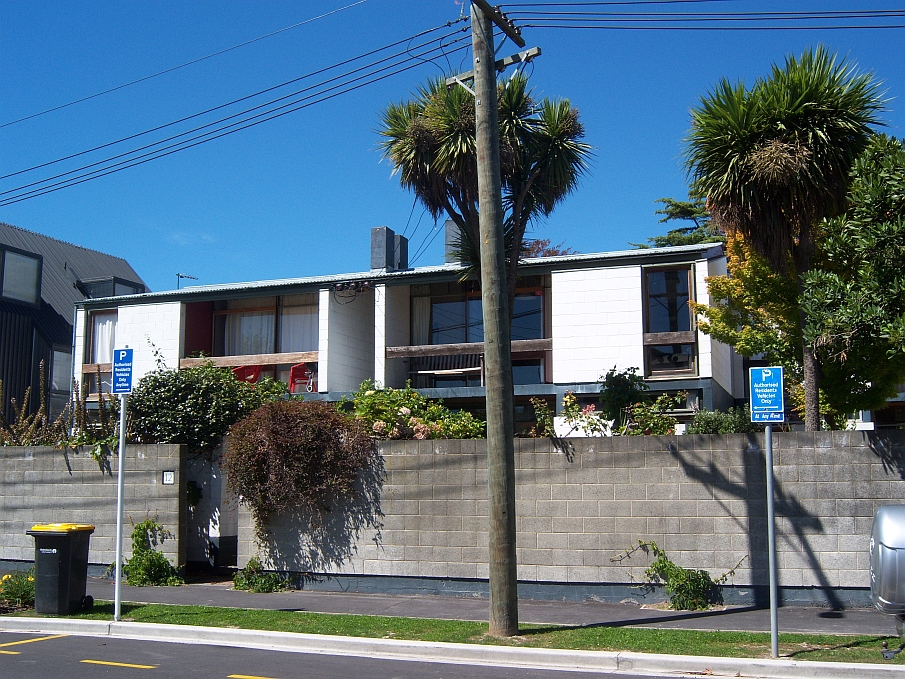
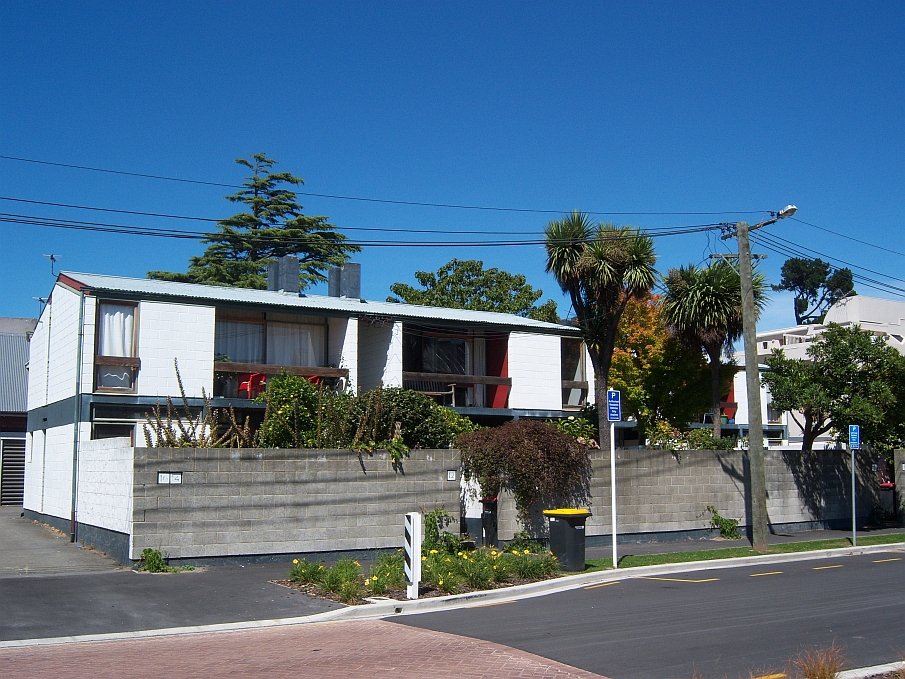
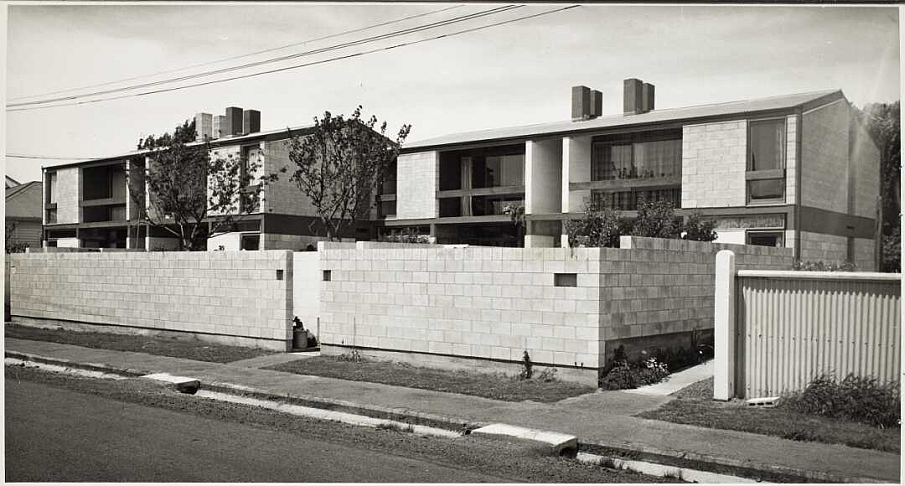
The Dorset Street Flats were designed and built between 1956 and 1957 and are amongst the most important domestic buildings constructed in New Zealand in the second half of the twentieth century. Miles Warren (b.1929, later Sir Miles Warren) designed them as a young architect and with these flats he launched an architectural vocabulary that would come to distinguish the 'Christchurch School' of post-war architecture and also helped to shape modernist architectural design nationally for over two decades. They remain a key influence in the practice of New Zealand architectural design.
In 1955 Warren returned to his hometown of Christchurch from two years working and travelling in Europe and started his own private practice, the first notable commission being a house for family friends in Timaru, Mervyn and Brenda Raymond. The Dorset Street Flats was one of the first fully independent designs Warren undertook. Unlike the Raymond House he had the advantage of a completely free hand over the design and was effectively his own client. In 1956 Warren and two of his friends decided to build a block of flats for their own occupation, with extra flats to let as income, and they formed a registered company, Dorset Estates Limited for this purpose. Having the freedom to pursue his own particular vision, Warren, 'brimful of a year and a half in London, [was] determined to make a building stuffed full of everything he knew'.
Primary in Warren's thinking at the time were his encounters with modernist British architecture, especially the recent explosion of New Brutalism and his first-hand experience of continental European architecture, such as contemporary Danish architects in and around Copenhagen and the work of Le Corbusier in France. His education at the Auckland School of Architecture (Warren graduated in 1950) and his ideas about a suitable local modernist architectural expression for Christchurch also informed his thinking. One shared concept amongst all the international influences but distinct from established local ideas of modernist architecture was the value and nature of masonry construction. 'Like most young New Zealand architects coming to Europe for the first time, I discovered a sense of the solidity of masonry walls - their weight, their load-bearing capacity, their sense of enclosure, all in marked contrast to our thin 4 x 2 inch partition walls'. Although, Warren agreed with Auckland modernist architects The Group architects' 1946 manifesto that, 'New Zealand must have its own architecture, its own sense of what is beautiful and appropriate to our climate and conditions,' he considered the light, timber-framed construction favoured by like The Group inappropriate for the climate, conditions and local traditions in Christchurch and the South Island in general.
In London, Warren witnessed firsthand the emergence of New Brutalism, the movement which endeavoured to return modernist architecture to first principles: truth to function, truth to structure and truth to materials. 'I was London at the LCC [London County Council architects], extraordinarily fortunate to be sitting right in the middle of the birth of Brutalism. I went over the Hunstanton School with the Smithsons and Ove Arup... I went to the great debate at the AA about the Leeds housing competition, lapped up the Corbusian influence of the LCC led by Bill Howell, Killick, Amis, Partridge etc...' While Alison and Peter Smithson's famous Hunstanton School was a Miesian exercise in steel and brick, the Smithsons and other London architects were just as interested in the ideas of Le Corbusier, and in particular his use of beton brut, literally 'raw concrete', also known as fair-faced or exposed concrete. The unequivocal expression of materials was rationalised by Le Corbusier in his influential statement that 'architecture is the construction of emotional relationships out of brute materials'. In 1955, Warren visited Le Corbusier's most famous post-war building, the Unite d'Habitation in Marseilles, a tour-de-force multi-unit housing project in reinforced fair-faced concrete with bright accents of block colours.
In an earlier continental jaunt Warren had travelled through Scandinavia to visit key modernist buildings by Norwegian and Danish architects, amongst these was the work of Finn Juhl, an architect better known for his furniture design. Juhl's own house at Charlottelund, north of Copenhagen, designed and built in 1941-42, was a straightforward arrangement of pure forms: two basic horizontal blocks under shallow pitched roofs with no eaves, joined by a flat-roofed entry block with tall chimneys providing a vertical counterpoint. Built in brick plastered to a grey-white finish, Warren must have absorbed the way in which the openings for doors and windows appeared as though simply punctured or cut through the brickwork, revealing the solidity and construction of the load-bearing walls. The house established an open relationship with its setting and the woodland beyond, with generous sliding doors opening to the garden.
Another important influence upon Warren's ideas on modern living were the South Hill Flats, a terrace of six houses designed by Bill and Gillian Howell and Stanley Amis for themselves and some friends in Hampstead Heath at the time Warren worked with them at the LCC housing division. This flat-roofed, reinforced concrete terrace with its banks of large south-facing windows and balconies not only gave each of the families involved a house of their own but a separate flat to lease. Interior finishes included white painted brick and blockwork with timber. In the Dorset Street Flats, all these ideas would merge with Warren's own particular aesthetic and concepts for modern living.
The Flats reflect the changing social needs for housing in the post-war period, as young, single professionals sought to live in small city flats that met their requirements for low-maintenance minimal urban living. Christchurch's domestic buildings, including those within the inner-city area, were almost all detached single-unit dwellings on independent sections. The Dorset Street area was formerly occupied by large dwellings and grounds such as the adjacent Johnstone residence and Cecil Wood's Bishopscourt, the former residence of the Anglican Bishop of Christchurch, located adjacent to the southern boundary of Lot 2 DP 18797. Smaller residences were also located in the area and a number of nineteenth century cottages remain on the north side of Dorset Street. However, multi-unit dwellings were built during the inter-war period and many of these developments were located in the vicinity of Dorset Street in the area around Victoria Street and Cranmer Square, bordered by Bealey Avenue and between Montreal Street and Park Terrace. Notable early multi-unit residences include Victoria Mansions (NZHPT record no. 3142) designed by Heathcote Helmore and constructed circa 1935 on the corner of Victoria and Montreal Streets and Helmore and Cotterill's maisonettes (NZHPT record no. 3724) built from 1939 to 1941 on the corner of Bealey Avenue and Dublin Street. Other apartment block developments were erected in Salisbury Street and further south at the intersection of Montreal and Hereford Streets West Avon and St Elmo Courts were constructed in 1930. This concentration of higher density residential developments was recognised in the 1962 Christchurch City Planning Scheme that provided for higher-density living in this area.
The site purchased by Dorset Estates Limited on 8 August 1956 was a lot recently divided from an original Town Reserve section (TR 25), previously owned by prominent solicitor and Canterbury property owner Harry Bell Johnstone. Town Reserve 25 faced Park Terrace, a fashionable street of mainly larger dwellings situated opposite Hagley Park and the Avon River/Otakaro. Meandering its way from a spring source in Avonhead through Christchurch city and out to sea via the estuary, Avon River/Otakaro was a popular recreational river among Christchurch's European settlers and highly regarded as a seasonal mahinga kai by Waitaha, Ngati Mamoe and Ngai Tahu. Fresh kai included Patiki (flounder) were speared, eels (tuna), ducks, whitebait (inaka) and native trout. The Canterbury Museum holds some important Maori taonga that have been recovered from Otakaro, including a canoe paddle made of manuka.
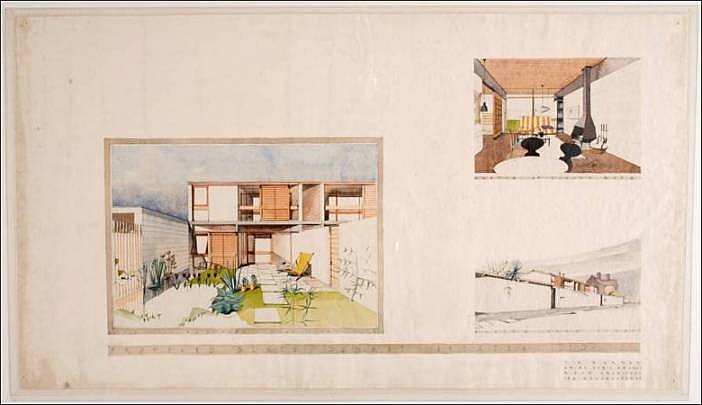
In 1902, Johnstone's widow, Isabella, built a large house for herself on the corner of Park Terrace and what was then Park Street (it was renamed Dorset Street in 1904). Designed by Collins & Harman, the Old English style house with its picturesque, jumbled roofline of multiple gabled forms and prominent chimneys, had half-timbered upper storeys placed on a ground floor of brick and pebble-dash. The house was converted into flats in 1935 and was still standing in early 1956 when Warren began the design work for Dorset Street Flats. It is depicted in broad terms as a simplified silhouette in the background of a watercolour perspective of the Dorset Street Flats produced by Warren. Collins & Harman also designed a separate stable for the wealthy Mrs Johnstone to house her horses, carriages and stablehands: 'Built in brick, it accommodated four horses, with a coach house and harness room on the groundfloor and upstairs a boy's room and a storage area for straw and feed. Two downstairs windows were added later, as well as two small dormer windows on either side of the central dormer.' In the subdivision of Pt TR 25 in 1956 the stable was included within Lot 2 of DP 18797, purchased by Dorset Estate Limited for the new flats.
Instead of demolishing the stables, Warren incorporated them into the new development: they were converted into four garages (each assigned to one of the ground floor flats) and a shared laundry for all residents. The presence of the stables helped determine the layout of the eight flats on the site: two identical two storey blocks with four flats in each (two up, two down), with the two blocks partially overlapping as the eastern-most block was pushed north, towards the street, to allow for the retention of the stable/garages behind.
These flats marked the emergence of a new kind of residential living in New Zealand: a small-scale group of purpose-designed, modern, modest-sized one-bedroom city flats for minimal living. As Douglas Lloyd Jenkins has noted, in the New Zealand context they 'provided one of the first attempts... at a unit suitable for urban living, built around the needs of a single person not reliant on the state for housing.' It was a type of housing, the noted architectural historian Nikolaus Pevsner observed in 1958, New Zealand was in need of: 'Flats, everybody here expects me to say something against flats. Well - the truth is I can't. I think you are building too few flats... because... According to your 1951 census 32 per cent of your 'permanent private dwellings'... consist of two persons or less... don't you think... 10 per cent would prefer a flat to a house if they could get one?'
The Dorset Street Flats established an alternative form of multi-unit dwelling to large apartment blocks, semi-detached housing and the division of larger houses into flats. These particular flats were designed for three young bachelor owner-occupiers: Simon Wood and Michael Weston, both lawyers, and Miles Warren himself. It was intended that each would occupy a ground floor flat, with the first-floor flats let to tenants to provide Dorset Estates Limited with an income. In consideration of their youth and the fact that most of the units were designated for tenancy, the building was designed to be 'as simple and economic as possible with a minimum of maintenance and upkeep' and this was part of the reason for constructing the flats in concrete block. However, Warren selected concrete block principally because: he considered masonry construction more suited to the local climate and conditions; he had a keen appreciation of the phenomenological qualities of substance, enclosure and load-bearing capacity provided by masonry; it was a quintessentially local and modern material that allowed an alternative means of masonry construction to brick which carried with it associations of traditional use; and he found particular aesthetic pleasure in the texture and pattern of well-laid blockwork.
To allow for this aesthetic experience and to conform to New Brutalism's principle of truth to materials, surfaces in the building expressed the value of their materials: the concrete block walls were left unplastered and supported what were originally fair-faced concrete beams, with both block and reinforced concrete exposed on the exterior and interior surfaces, although the blocks were painted white. Likewise, timber was clear-varnished or oiled. The thickness and load-bearing quality of the concrete block walls was expressed by the recession and detailing of the doors and windows, as well as the set-back roof, which, without projecting eaves and with well set-back bargeboards, allowed the structural integrity of the walls to be plainly read.
The integrity of the structural expression was not, however, as the architect desired, as the Christchurch City Council engineers did not share Warren's enthusiasm and confidence in the load-bearing capacity of concrete block masonry. Despite the best efforts of the building's young structural engineer, Lyall Holmes (c.1923-1970), the Council refused to accept that the exterior walls of two skins of double concrete block and interior walls of single skin block were structurally sound and insisted on the introduction of a number of reinforced concrete columns within the walls. The Dorset Street Flats, however, would prove a good testing ground for the team of young architect and engineer, as after this experiment the pair's future buildings in reinforced concrete block were approved by the City Council.
New Brutalism (as it was at this point in time, before it was abbreviated to 'Brutalism') was not just about structural, material and functional truth. Several of the Smithsons' early designs, including the Hunstanton School visited by Warren, emphasised what was called 'formal legibility of plan'. At Hunstanton, this legibility resulted from an axial and symmetrical plan, two devices used to good effect by Warren in the planning of the Dorset Street Flats. The Flats are organised according to two parallel axes, one in each block, with every pair of flats bisected by an external stair that gives access to the flats on the first floor. A long, narrow path walled by the tall concrete block courtyard fences of the ground floor flats on either side, connects the stairs to the street and gives full expression to the axial planning. On either side of the axis, the internal planning of the flats are mirror images of each other, with the large living area on the inside, closest to the stair, and the three 'boxes' of kitchen, bath and bedroom on the exterior edge. The axial external stair not only logically orders the plan but also serves to separate the flats from each other vertically, allowing for soundproofing.
In true modernist fashion, Warren considered the flats in abstract terms:
'...each flat was designed as a spatial unity, that is, not a collection of box-like small rooms but as planes and solids within the large space. Living room and bedroom [in the ground floor flats] are divided by a broad sliding door and when that is open the two rooms are visually and practically one. The w.c., shower etc are contained in a clearly defined 'box' within the total space. To assist this sense of unity, walls and ceiling finishes both colour and textures are the same throughout all rooms. The apparent size of the living room is greatly increased by a completely glazed north wall with ceiling and wall finishes and brightly coloured panels extending 4ft beyond the glass and further with garden walls on the same plane... the Ground floors are concrete slabs... lying hard on the ground enabling the brick garden terraces to finish level with the floors and to continue the extension of wall and ceiling planes.'
Warren took a total design approach to the Dorset Street Flats by designing built-in furniture and fittings for all of the flats. This not only satisfied his architectural ideals but also provided practical solutions for young men living independently with few possessions or furniture. The living rooms were given a wall or half a wall of built in shelving, the ground floor flats' shelving including a fold-down writing desk and a drinks cabinet. Kitchen cabinets included an in-built dish drying rack above the sink, the bathroom cabinets a sliding mirror door and the bedrooms all featured an in-built wardrobe and drawers; two kinds of handles were used on sliding and hinged cupboard doors, whether they were in the bathroom, bedroom or kitchen. Unlike many later post-war buildings using the same architectural language, the Dorset Street Flats incorporated bright colours of paint applied to non load-bearing wall surfaces, an influence gleaned from Le Corbusier's Unite d'Habitation. Warren also specifically designed exterior fittings, including the louvered gates (since replaced) and the metal letterboxes.
The flats were built by Cecil & R Davenport & Sons. All three of the owners became occupiers of the flats on their completion in 1957. Simon Wood lived in number 2 Dorset Street Miles Warren lived in number 4 and Michael Weston in number 16. The names of all original occupiers remain on embossed metal tags attached to the meter boxes of all the flats, except numbers 2 and 6, whose tags are missing. As listed on the meter boxes, the original tenants included noted local restaurateur John Leon Langley in number 8, G. E. Moir in number 10, G. F. Dillon, a farmer, in number 12 and Michael Davis, a surveyor who was a good friend and fellow Christ's College 'old boy' to Wood, Warren and Weston, in number 14. Kay or Kathy Ryan, who ran a coffee shop in Bedford Row, was an original tenant of number 6. Peter Hollings, a company manager, was resident in number 2 in 1959 but later moved to number 10. Warren remained in residence at number 4 until the first stage of his new architectural offices and flat at 65 Cambridge Terrace was completed in 1965. Later tenants included architect Allan Mitchener, who would go on to teach architecture at the University of Auckland and who lived at number 14 from circa 1962 to 1966. Jonty Rout, who as a young architect got his first job out of university with Warren & Mahoney, lived in number 8 with his wife Morrin in 1973; Rout would go on to establish the prominent Christchurch architectural practice Sheppard & Rout. Other architects who lived in the Dorset Street Flats included Nicholas Kennedy (number 4, 1968) and Gordon Cullinan (number 8, circa 1968 to 1972). Another member of Warren & Mahoney, practice manager William Fox, lived in number 4 from around 1970 to 1972. In around 1976 to 1977, Miles Warren used number 4 as over-flow office space when working on a large (and ultimately unrealised) project in Iran. More recent tenants have included artist Peter Robinson, who lived there when teaching at Christ's College in the late 1990s.
Michael Weston eventually bought out the other partners of Dorset Estates Limited and by 1978, owned the whole property outright. His wife inherited it on his death in 1993 and as she passed away shortly after, her three children inherited the flats in 1994. They sold the flats in 1995 in two stages, although one flat still remains in the possession of one of Weston's stepchildren. Since then the Dorset Street Flats have attracted owners and tenants who have been fascinated by their history and architecture.
On their completion and subsequent publication, the Dorset Street Flats acquired notoriety with the general public and became greatly admired in architectural circles. They were soon dubbed ‘Fort Dorset' for their substantial and uncompromising expression of concrete block and it is widely accepted that tour buses would drive via Dorset Street to ogle what were reputed to be the ugliest buildings in the city. Architects, however, viewed them entirely differently. Within a decade, Warren's Christchurch counterpart, architect Peter Beaven, wrote in the journal of the Royal Institute of British Architects, 'The shattering first view of these flats, their statement of private urban living and their frank use of materials, was a revelation to New Zealand architects. We could see the future.'
That future was the establishment of a distinct, widely-recognised Canterbury or Christchurch architectural modernist lexicon based on the territory explored in the Dorset Street Flats: load-bearing white-painted or exposed reinforced concrete block combined with fair-faced concrete, a refined use of timber and negative detailing, all realised with the highest craftsmanship. Warren entered into partnership with Maurice Mahoney (b. 1929) in 1958 and with the consultation of Lyall Holmes, Warren & Mahoney fully explored the expressive Brutalist potential of this architectural vocabulary, reaching a climax in their design of Christchurch College, the Anglican halls of residence at the University of Canterbury (1964-67). Before that, however, Warren went on to design further flats along the same lines as investment properties for himself and his friend Michael Weston. In Carlton Mill Road they built a block of four flats, in Andover Street blocks of six and eight flats and in Clissold Street a further eight units. In addition to the use of the same material language, they were designed on similar lines to the Dorset Street flats: axial and symmetrical planning, north facing with generous openings onto gardens or balconies. The combination of concrete block, fair-faced concrete and high quality timber finishes not only became part of the accepted vocabulary of the practice of Warren & Mahoney but was also widely adopted by architects in Christchurch and beyond.
The Dorset Street Flats were swiftly recognised as a notable contribution to New Zealand architecture. An early illustration of the building in a 1958 article by Nikolaus Pevsner in the international publication, The Listener, is an important moment in the history of the Dorset Street Flats. They were also published in Home & Building twice in 1959, the second time making the cover and that same year were included in the New Zealand section of the first in a series of issues of The Architectural Review dedicated to reviewing architecture throughout the Commonwealth. Since then their canonical status has been acknowledged by nearly every major publication on New Zealand architecture and not only in volumes on the modern movement in New Zealand. The section on architecture in the 'Cultural Aspects' of the seminal title A History of Canterbury, states, 'If a watershed is sought in Canterbury architecture, it probably lies somewhere in the middle 1950s. On his return in 1955 from further studies in England, F.M. Warren broke new ground with a block of flats (1957) in Dorset Street, Christchurch...' It is now widely accepted that not only are the Dorset Street Flats 'one of the best known New Zealand buildings of the 50s' but that they 'made an impact out of all proportion to their size and commonplace materials.'