

The survival of the delicately contrived structure (expressly as the main decorative feature for the second royal visit to Rotorua) is extraordinary, as is the uniqueness of its design; no other such archway is known in New Zealand. Built of totara in a latticework pattern the arches were decorated with greenery and illuminated with electric lights with the design resembling a royal crown. It was an ambitious design, particularly given that electricity had only been switched on in Rotorua just week's prior. Botanically interesting, it was festooned with strong green foliage species, some native; nikau, kiokio, fern and pine. Following the visit in June 1901, of the Duke and Duchess of Cornwall and York (later King George V and Queen Mary) the structure was relocated to the Arawa Street entrance of the Gardens, where part of it still stands.
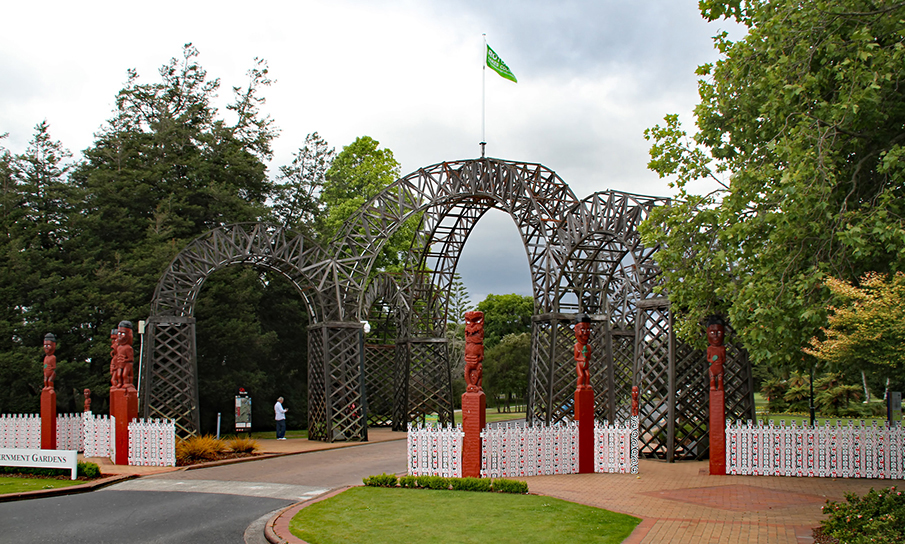
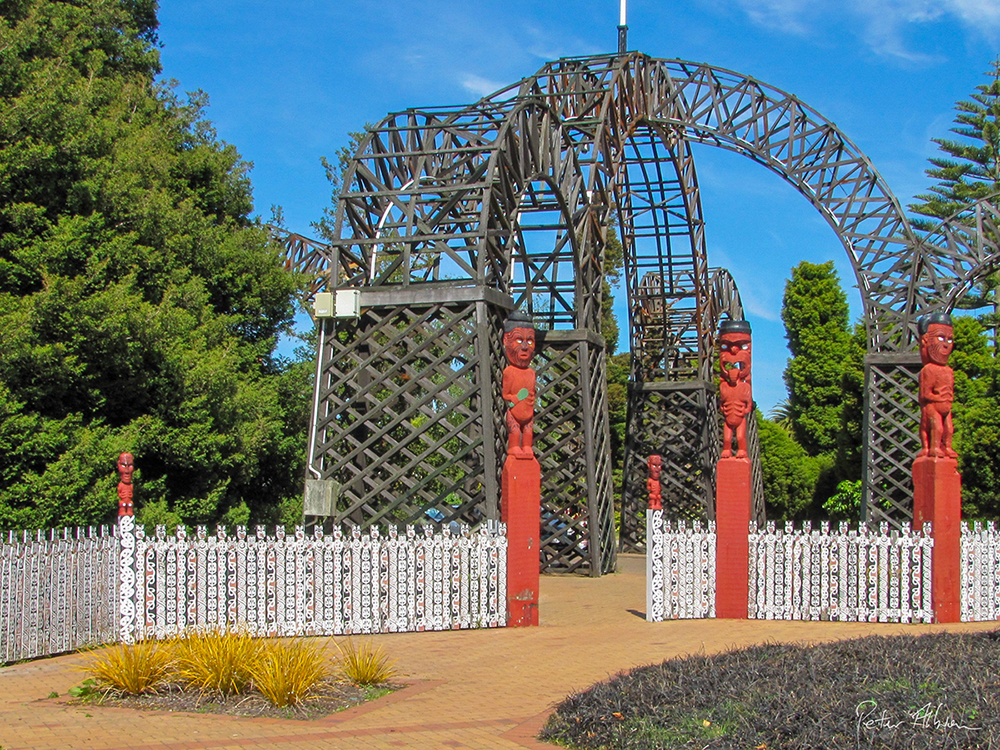
Designed by Captain A.C. Turner and believed to have been built by Alfred Patchett Warbrick, the Arch is approached from Arawa and Haupapa Streets, straddling the Queens Drive entrance to the Rotorua Government Gardens at a 45 degree angle. There are eight timber columns or piers with diagonal lattice work supporting timber arches. The central arches are higher than the outer arches. Each arch has an upper and lower timber chord built of three layers of laminated timber to enable the arch to be curved. They are secured by cross ties and diagonal trusses. Where the timber has delaminated or spread, stainless steel nail plates and screws now hold the structure intact. The original timber consisted of totara, kauri, and rimu. Some pieces of trellis are damaged/missing and it is not known how much original timber remains given the impact of cumulative repairs required in this harsh environment.
Technically outstanding, the Archway is one of the earliest New Zealand examples of outdoor illumination using electricity and the design contrivance to achieve a seemingly delicate structure of such dimensions, innovative. As it once did for royalty, the Archway now forms an unusual, bold and unique entranceway to the Rotorua Government Gardens, making a strong contribution to the overall aesthetic values of the Gardens. Historically it is a reminder of New Zealand’s ties with Great Britain, and royal visits that held a strong significance to both Europeans and Maori, with more than 5,000 Maori gathering for the occasion.
The Gateway
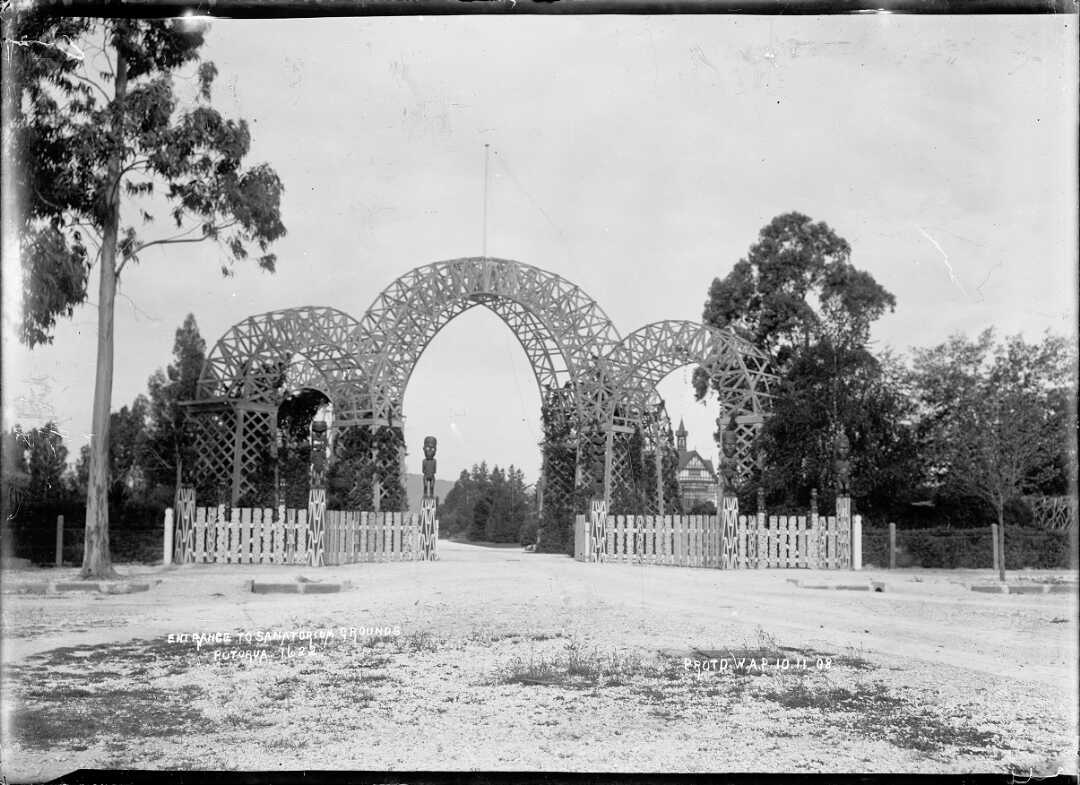
The Gateway is a significant aspect of the entranceway. Located in front of the Prince’s Archway on the Queens Drive entrance, early photos of the gateway from around 1909 show it in its complete form: carved figures with painted bases, patterned palings and gateways.
The carving of the gateways was directed by Tene Waitere (1853/1854-1931) a master carver ‘…of Ngati Tarawhai, who were kin to Ngati Pikiao and Tuhourangi of Te Arawa of Rotorua.’ Waitere is considered the most innovative Maori carver of his time; his works reached global audiences decades before the globalisation of culture became a fashionable topic.’ He was trained ‘by Wero Taroi, the master carver of the Ngati Tarawhai school. Although he may have worked on some of the last big carved canoes, he established his reputation by working with Wero, Anaha Te Rahui and Neke Kapua on several new meeting houses around Rotorua and Taupo.’ ‘Tene’s carvings show greater diversity than those of his contemporaries.‘ He worked on many significant carvings including, ‘Te Tiki-o-Tamamutu, Kearoa, Rauru, Tuhoromatakaka, Uenukukopako, Tiki and Hinemihi.’ Waitere is considered the most prolific carver of his time in the Rotorua area. His work was steeped in tradition, and preserved its integrity when faced with the commercial demands of European tourists and collectors.’ Completed in 1907 the gateways are carved from single pieces of totara; there are adze marks visible on the bases. On some of the larger pieces the buttocks are added with the timber dowelled into position.
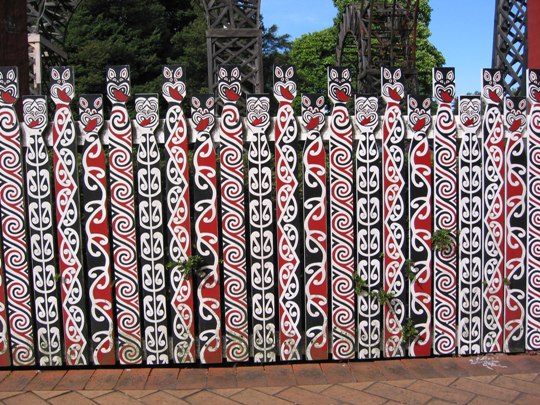
Kowhaiwhai patterns on the figure bases are in the tri colour of red, black and white. Black or red in these patterns is the background colour, while white is used to define the pattern. The palings reverse this by using white as a background colour with red and black used to define the pattern. All figures are painted dark red with the hair pieces a lighter tone.
A photograph of the time indicates that two lamp posts were added sometime in the 1930s to 1940s. All figures have been repainted in red with a darker hair piece. The two centre figures appear to be painted in a lighter red to the others. A second photograph from this period shows the figures and bases painted in dark red. A third photograph from this period shows many changes to the gateway. All the palings have been removed from the fence line and the gates. The two smaller gateways have been completely removed from the structure. Fence rails remain. The gate has had the fence palings replaced and the gateway currently has kerbing, gardens, signage and a tar sealed road; the figures are painted red.
List Entry Information
Status
Listed
List Entry Status
Historic Place Category 2
Access
Able to Visit
List Number
787
Date Entered
7th April 1983
Date of Effect
7th April 1983
City/District Council
Rotorua District
Region
Bay of Plenty Region
Legal description
Pt Lot 3 DPS 15998 (RT SA34C/324) Recreation Reserve (NZ Gazette 1984 p.2272), South Auckland Land District
Location Description
Sited at Queens Drive Entrance at intersection of Arawa Street and Hinemaru Street.
Status
Listed
List Entry Status
Historic Place Category 2
Access
Able to Visit
List Number
787
Date Entered
7th April 1983
Date of Effect
7th April 1983
City/District Council
Rotorua District
Region
Bay of Plenty Region
Legal description
Pt Lot 3 DPS 15998 (RT SA34C/324) Recreation Reserve (NZ Gazette 1984 p.2272), South Auckland Land District
Location Description
Sited at Queens Drive Entrance at intersection of Arawa Street and Hinemaru Street.
Construction Professional
Name
Waitere, Tene
Type
Carver
Biography
Tene Waitere (1853-1931). Was trained as a carver by Wero Taroi a master carver of the Ngati Tarawhai school.
Name
Warbrick, Alfred Patchett
Type
Builder
Biography
Alfred Patchett Warbrick (circa 1860-1940). Builder of the Princes Gate Archway at the Rotorua Government Gardens. Boat builder and tour guide in Rotorua.
Name
Turner, Archibald Campbell
Type
Architect
Biography
Captain Archibald Campbell Turner was responsible for the Princes Gate Archway at the Rotorua Government Gardens. He was also a Captain in the Army, and District Road Surveyor from 1900. He was responsible for much of the road building in the Rotorua area.
Construction Details
Start Year
1901
Type
Original Construction
Description
Princes Gate Arch erected at junction of Fenton and Hinemoa Streets, then relocated to Queens Drive entrance.
Start Year
1907
Type
Original Construction
Description
Prince's Gate completed
Construction Professional
Name
Waitere, Tene
Type
Carver
Biography
Tene Waitere (1853-1931). Was trained as a carver by Wero Taroi a master carver of the Ngati Tarawhai school.
Name
Warbrick, Alfred Patchett
Type
Builder
Biography
Alfred Patchett Warbrick (circa 1860-1940). Builder of the Princes Gate Archway at the Rotorua Government Gardens. Boat builder and tour guide in Rotorua.
Name
Turner, Archibald Campbell
Type
Architect
Biography
Captain Archibald Campbell Turner was responsible for the Princes Gate Archway at the Rotorua Government Gardens. He was also a Captain in the Army, and District Road Surveyor from 1900. He was responsible for much of the road building in the Rotorua area.
Construction Details
Start Year
1901
Type
Original Construction
Description
Princes Gate Arch erected at junction of Fenton and Hinemoa Streets, then relocated to Queens Drive entrance.
Start Year
1907
Type
Original Construction
Description
Prince's Gate completed
Historical and Associated Iwi / Hapū / Whānau
Completion Date
7th November 2011
Report Written By
G. Henry, J. Schuster, T. Ngata, L. Pattison
Other Information
This place was identified as significant under previous legislation with different information requirements. It remains significant under the current legislation. There is opportunity under our legislation and policies to add to this information. Further information about this place may be available from the Lower Northern Office of Heritage New Zealand Pouhere Taonga. Information in this report is from the registration report for the Rotorua Government Gardens Historic Area (Register no. 7015). A fully referenced copy of this report is available from the Lower Northern Office of the NZHPT. Please note that entry on the New Zealand Heritage List/Rarangi Korero identifies only the heritage values of the property concerned, and should not be construed as advice on the state of the property, or as a comment of its soundness or safety, including in regard to earthquake risk, safety in the event of fire, or insanitary conditions.
Historical and Associated Iwi / Hapū / Whānau
Completion Date
7th November 2011
Report Written By
G. Henry, J. Schuster, T. Ngata, L. Pattison
Other Information
This place was identified as significant under previous legislation with different information requirements. It remains significant under the current legislation. There is opportunity under our legislation and policies to add to this information. Further information about this place may be available from the Lower Northern Office of Heritage New Zealand Pouhere Taonga. Information in this report is from the registration report for the Rotorua Government Gardens Historic Area (Register no. 7015). A fully referenced copy of this report is available from the Lower Northern Office of the NZHPT. Please note that entry on the New Zealand Heritage List/Rarangi Korero identifies only the heritage values of the property concerned, and should not be construed as advice on the state of the property, or as a comment of its soundness or safety, including in regard to earthquake risk, safety in the event of fire, or insanitary conditions.
Current Usages
Uses: Civic Facilities
Specific Usage: Archway
Uses: Civic Facilities
Specific Usage: Gate
Former Usages
General Usage: Civic Facilities
Specific Usage: Archway
General Usage: Civic Facilities
Specific Usage: Gate
Themes
Of Significance to Maori
Current Usages
Uses: Civic Facilities
Specific Usage: Archway
Uses: Civic Facilities
Specific Usage: Gate
Former Usages
General Usage: Civic Facilities
Specific Usage: Archway
General Usage: Civic Facilities
Specific Usage: Gate
Themes
Of Significance to Maori
Location
Related listings
Sign up to hear more
Get the latest heritage news, features and events delivered
straight to your inbox.
