

The first Bank of New South Wales opened in Tyne Street, close to the bustling harbour precinct in the mid-1870s, and by the early 1880s had negotiated for a new and prominent site in Thames Street, adjoining Lawson’s earlier architectural masterpiece, the National Bank (1870). Designed with the commercial operation on the ground floor, with an additional basement level, and manager’s level on the first floor, the Bank of New South Wales operated in these premises until closure in 1979. The bank building found new life as the Forrester Gallery, named after prominent architect John Meggett Forrester who had bequeathed a generous amount to establish an art gallery in his home town. The Forrester Gallery opened in May 1983.
The bank was designed by Dunedin architect R.A. Lawson, who was renowned for his church architecture but who also completed substantial commercial commissions as well, including the Bank of Otago, next door to the Bank of New South Wales site. The contractors were Philpot and Matheson of Dunedin, while the stone carving was probably by one of Dunedin’s renowned Godfrey brothers.
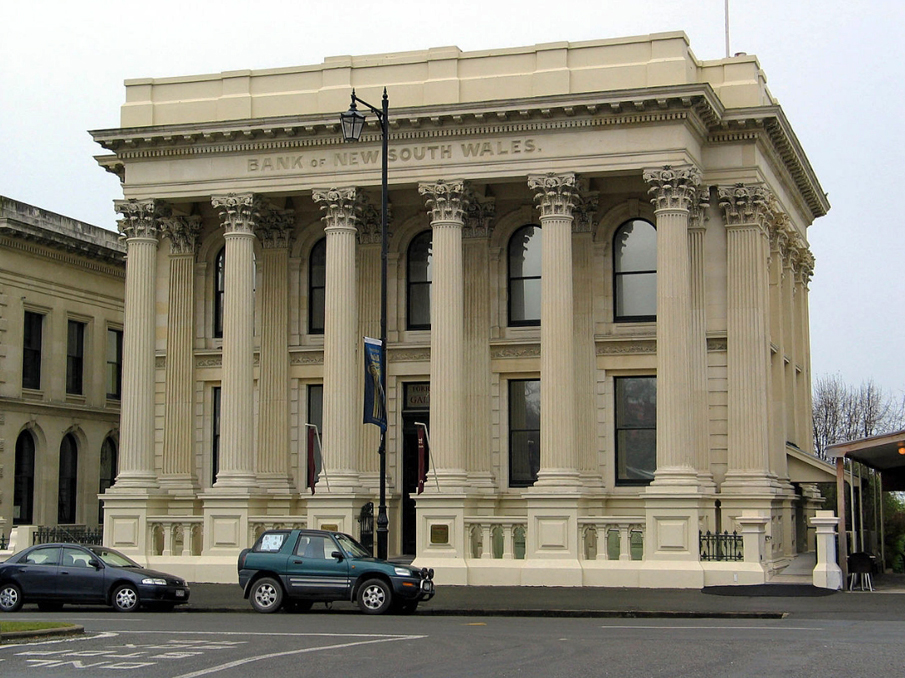
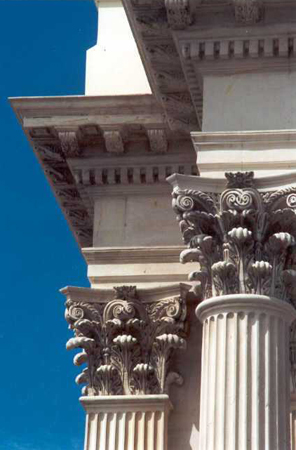
The Bank is designed in Neo-classical style with a hexastyle portico originally surmounted with a balustraded parapet, now replaced by a more solid structure. The ground floor windows are square headed and those on the first floor are semi-circular. A floriated band of carved stonework marks the level of the first floor. The side elevations are treated in the same manner as the front with fluted pilasters with carved capitals. The rear elevation is plain with a small timber-framed extension to the ground floor. The beautiful exterior ornamentation and the interior ornamentation and fittings make this a special building.
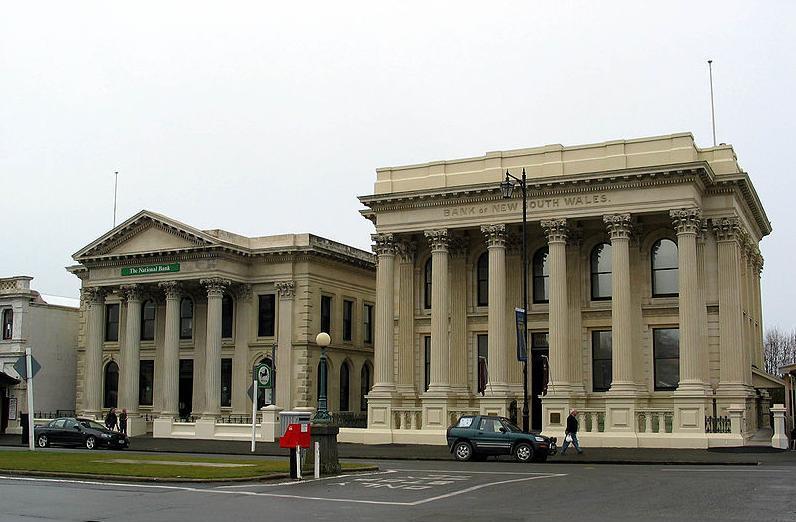
The Bank of New South Wales (Former) is one of Oamaru’s most distinguished buildings, sitting alongside the National Bank, also designed by R.A. Lawson. It is a key building in the history of New Zealand bank architecture by an architect of national importance. Historically it was constructed at a time when Oamaru was expanding and illustrates the importance of banking within the commercial life of the town. The building is an essential component in the impressive array of Oamaru stone public and commercial buildings in Thames Street.
The Gallery’s twenty-fifth year of operation was celebrated in 2008 with an exhibition from the collection by Colin Wheeler and Colin McCahon, and closed with an exhibition focused on the with the exhibition Future present, past- Lawson architectural drawings (of the building) and drawings of the proposed Dunedin architects McCoy Wixon architectural concept for a new addition to the east of the building.
In 2012 the former Bank of New South Wales in its reincarnation as the Forrester Gallery ‘overarches’ the collection and ‘acts as a linchpin and magnet’ for visitors to Oamaru, a landmark building in this town notable for its Victorian townscape.
List Entry Information
Status
Listed
List Entry Status
Historic Place Category 1
Access
Private/No Public Access
List Number
355
Date Entered
2nd July 1987
Date of Effect
2nd July 1987
City/District Council
Waitaki District
Region
Otago Region
Extent of List Entry
Extent includes part of the land described as Town Sec 1 Blk IV Town of Oamaru (RT OT27/269), Otago Land District and the 1882 building known as the Bank of New South Wales (Former), thereon.
Legal description
Town Sec 1 Blk IV Town of Oamaru (RT OT27/269), Otago Land District
Status
Listed
List Entry Status
Historic Place Category 1
Access
Private/No Public Access
List Number
355
Date Entered
2nd July 1987
Date of Effect
2nd July 1987
City/District Council
Waitaki District
Region
Otago Region
Extent of List Entry
Extent includes part of the land described as Town Sec 1 Blk IV Town of Oamaru (RT OT27/269), Otago Land District and the 1882 building known as the Bank of New South Wales (Former), thereon.
Legal description
Town Sec 1 Blk IV Town of Oamaru (RT OT27/269), Otago Land District
Why is this place significant?
Historic Significance
Historical Significance or Value This building was constructed when Oamaru was undergoing a period of rapid expansion. Its imposing appearance illustrates the importance of the Bank of New South Wales in the commercial life of the town. The building was taken over by the Oamaru Borough Council and converted to an art gallery and cultural centre in 1981.
Physical Significance
ARCHITECTURAL SIGNIFICANCE One of Oamaru's most distinguished buildings it stands alongside the Neo-classical National Bank also designed by Lawson. An imposing dignified structure it is a key building in the history of New Zealand bank architecture by an architect of national importance. TOWNSCAPE/LANDMARK SIGNIFICANCE The Forrester Gallery forms a pair of 19th century Neo-classical bank buildings with the National Bank and is an essential component in the impressive array of Oamaru Stone public and commercial buildings in Thames Street. SPECIAL FEATURES The beautifully carved exterior ornamentation and interior fittings and ornamentation in the former banking chamber.
Why is this place significant?
Historic Significance
Historical Significance or Value This building was constructed when Oamaru was undergoing a period of rapid expansion. Its imposing appearance illustrates the importance of the Bank of New South Wales in the commercial life of the town. The building was taken over by the Oamaru Borough Council and converted to an art gallery and cultural centre in 1981.
Physical Significance
ARCHITECTURAL SIGNIFICANCE One of Oamaru's most distinguished buildings it stands alongside the Neo-classical National Bank also designed by Lawson. An imposing dignified structure it is a key building in the history of New Zealand bank architecture by an architect of national importance. TOWNSCAPE/LANDMARK SIGNIFICANCE The Forrester Gallery forms a pair of 19th century Neo-classical bank buildings with the National Bank and is an essential component in the impressive array of Oamaru Stone public and commercial buildings in Thames Street. SPECIAL FEATURES The beautifully carved exterior ornamentation and interior fittings and ornamentation in the former banking chamber.
Construction Professional
Name
Fleming, Bruce
Type
Architect
Biography
No biography is currently available for this construction professional
Name
Philpot and Matheson
Type
Builder
Biography
No biography is currently available for this construction professional
Name
Lawson, Robert Arthur
Type
Architect
Biography
Born in Scotland, Lawson (1833-1902) began his professional career in Perth. At the age of 25 he moved to Melbourne and was engaged in goldmining and journalism before resuming architectural practice. In 1862 Lawson sailed for Dunedin, where his sketch plans had won the competition for the design of First Church. This was built 1867-73. Lawson went on to become one of the most important architects in New Zealand. First Church is regarded as his masterpiece and one of the finest nineteenth century churches in New Zealand. He was also responsible for the design of the Trinity Church (now Fortune Theatre), Dunedin (1869-70), the East Taieri Presbyterian Church (1870), and Knox Church, Dunedin (1874). He designed Park's School (1864) and the ANZ Bank (originally Union Bank, 1874). In Oamaru he designed the Bank of Otago (later National Bank building, 1870) and the adjoining Bank of New South Wales (now Forrester Gallery, 1881). See also: Ledgerwood, Norman, 2013. 'R.A. Lawson: Victorian Architect of Dunedin'. Historic Cemeteries Conservation NZ.
Construction Details
Start Year
1883
Type
Original Construction
Start Year
2014
Type
Restoration
Description
Restoration of the original polished floor boards in the street level galleries, reception and stairway
Start Year
1950
Type
Modification
Description
Wall removed to the right of the main entrance doors
Start Year
1953
Type
Modification
Description
Portico added to the entrance to the manager’s residence
Start Year
1956
Type
Modification
Description
Alterations to Kitchen, bathroom etc in manager’s residence
Start Year
1965
Type
Modification
Description
Fire escape erected
Start Year
1979
Type
Other
Description
Bank closed
Start Year
1983
Type
Modification
Description
Conversion to Art Gallery (Bruce Fleming, Mason and Wales, structural engineers Brickell and Moss)
Start Year
2004
Type
Modification
Description
Alteration to entrance foyer and reception, wheelchair access ramp
Construction Materials
Oamaru stone
Construction Professional
Name
Fleming, Bruce
Type
Architect
Biography
No biography is currently available for this construction professional
Name
Philpot and Matheson
Type
Builder
Biography
No biography is currently available for this construction professional
Name
Lawson, Robert Arthur
Type
Architect
Biography
Born in Scotland, Lawson (1833-1902) began his professional career in Perth. At the age of 25 he moved to Melbourne and was engaged in goldmining and journalism before resuming architectural practice. In 1862 Lawson sailed for Dunedin, where his sketch plans had won the competition for the design of First Church. This was built 1867-73. Lawson went on to become one of the most important architects in New Zealand. First Church is regarded as his masterpiece and one of the finest nineteenth century churches in New Zealand. He was also responsible for the design of the Trinity Church (now Fortune Theatre), Dunedin (1869-70), the East Taieri Presbyterian Church (1870), and Knox Church, Dunedin (1874). He designed Park's School (1864) and the ANZ Bank (originally Union Bank, 1874). In Oamaru he designed the Bank of Otago (later National Bank building, 1870) and the adjoining Bank of New South Wales (now Forrester Gallery, 1881). See also: Ledgerwood, Norman, 2013. 'R.A. Lawson: Victorian Architect of Dunedin'. Historic Cemeteries Conservation NZ.
Construction Details
Start Year
1883
Type
Original Construction
Start Year
2014
Type
Restoration
Description
Restoration of the original polished floor boards in the street level galleries, reception and stairway
Start Year
1950
Type
Modification
Description
Wall removed to the right of the main entrance doors
Start Year
1953
Type
Modification
Description
Portico added to the entrance to the manager’s residence
Start Year
1956
Type
Modification
Description
Alterations to Kitchen, bathroom etc in manager’s residence
Start Year
1965
Type
Modification
Description
Fire escape erected
Start Year
1979
Type
Other
Description
Bank closed
Start Year
1983
Type
Modification
Description
Conversion to Art Gallery (Bruce Fleming, Mason and Wales, structural engineers Brickell and Moss)
Start Year
2004
Type
Modification
Description
Alteration to entrance foyer and reception, wheelchair access ramp
Construction Materials
Oamaru stone
The first bank to open in Oamaru was the Bank of New Zealand, opening a branch in Tyne Street in 1862. The first Bank of New South Wales opened in New Zealand in the wake of the gold rushes in Central Otago, opening seven branches throughout the country. In North Otago the first branch opened in 1876 in wooden premises on Tyne Street, the last of the trading banks to open in the North Otago town. In 1882 authority was given to the Bank of New South Wales’ inspector to purchase a quarter acre building site adjacent to the National Bank. The site had been occupied by timber merchant Henry Aitken In early 1883 architect Robert Arthur Lawson advertised for the ‘ERECTION of OFFICES’ in Thames Street. Lawson, one of New Zealand’s pre-eminent nineteenth century architects, was well known for his church designs, but also undertook significant commercial work. His commercial buildings included banks, offices, shops and warehouses. His notable bank buildings included the Bank of Otago in Oamaru (1870 - later the National Bank building, Record No. 363, Category I) and the Union Bank of Australasia in Dunedin (1874, later the ANZ Bank, Record No. 2138, Category II). In August 1883 the North Otago Times reported that the tender of Messrs Philpot and Matheson of Dunedin had been accepted at a cost of something over £5,000. Philpot and Matheson were active in Dunedin in the early 1880s, and in 1884 were the successful tenderers for the construction of the Southland Meat Company’s Freezing Works at Bluff. Little else is known of their work. The site was immediately to the south of the National Bank with a 62 foot (18.9 metre) street frontage. The paper reported that the plans showed ‘’an exceedingly handsome building in the full Corinthian order of architecture, the beauty of which will be enhanced, as in the National Bank, by a piazza, having a parapet and balustrade,, supported by six projected fluted Corinthian columns.’ The bank had three levels - ground and first floors with a basement level - 43 feet (13.1 metres) above the street line, 13 (4.0 metres) proud feet higher than the National Bank. The principal elevation was divided into five bays separated by columns. The depth was 50 feet (15.2 metres). The public entrance was through the porch into the banking hall, a generous room of 29 foot by 22 foot (8.8 metres by 6.7 metres), with a height of 17 foot (5.2 metres). The ceiling was panelled in ’12 divisions with enriched cornices and centre flowers.’ The waiting room and manager’s room were to the south of the entrance. Off the hall were a strong room and lavatory and other service areas. The upper storey housed the manager’s residence, though the dining room was on the ground floor. The basement provided space for kitchen and offices. The private entrance was on the south frontage, ‘approached from the street by a stone causeway.’ The result, the paper enthused, was a ‘graceful while massive building, and one which will be second to none in the town.’ The intricate carving is thought to be the work of one of the Godfrey brothers. One of the Godfrey brothers had worked with Lawson on the Bank of Otago (National Bank) next door. The bank opened on 19 September 1884. The Bank of New South Wales traded on this site for the next 95 years. By the 1970s the building no longer suited the needs of the Bank of New South Wales and the head office approached the Oamaru Borough Council with the view of exchanging the Borough’s leasehold land nearby for the bank’s freehold land and building. The bank was conscious of the ‘architectural and historic value’ of the building and hoped it might be used in a manner beneficial to Oamaru. The mayor noted that architect J.M. Forrester who on his death in 1965 had bequeathed over $70,000 to the borough to form the basis of an art gallery, and that the offer of the bank at that time was ‘fortuitous.’ In 1981 plans were prepared by architect B.R. Fleming of Dunedin architectural partnership Mason and Wales to redevelop the building which included earthquake strengthening and interior alterations. Approval in principle to the first stage of development was agreed in June 1981 – internal alterations, with a second stage planned for an addition to the rear of the building (though this was seen as some distance in the future if it was to happen at all). The new Forrester Gallery, named after John Meggatt Forrester, was officially opened in May 1983. The venture was praised as a ‘community and team effort’ and one which remembered one of Oamaru’s ‘most distinguished citizens.’ The centenary of the building was marked in 1984. Celebrations included a selection of architectural drawings depicting North Otago by Forrester and an exhibition of paintings by Oamaru-born Colin McCahon. In 2012 the former Bank of New South Wales in its reincarnation as the Forrester Gallery ‘overarches’ the collection and ‘acts as a linchpin and magnet’ for visitors to Oamaru, a landmark building in this town notable for its Victorian townscape.
The first bank to open in Oamaru was the Bank of New Zealand, opening a branch in Tyne Street in 1862. The first Bank of New South Wales opened in New Zealand in the wake of the gold rushes in Central Otago, opening seven branches throughout the country. In North Otago the first branch opened in 1876 in wooden premises on Tyne Street, the last of the trading banks to open in the North Otago town. In 1882 authority was given to the Bank of New South Wales’ inspector to purchase a quarter acre building site adjacent to the National Bank. The site had been occupied by timber merchant Henry Aitken In early 1883 architect Robert Arthur Lawson advertised for the ‘ERECTION of OFFICES’ in Thames Street. Lawson, one of New Zealand’s pre-eminent nineteenth century architects, was well known for his church designs, but also undertook significant commercial work. His commercial buildings included banks, offices, shops and warehouses. His notable bank buildings included the Bank of Otago in Oamaru (1870 - later the National Bank building, Record No. 363, Category I) and the Union Bank of Australasia in Dunedin (1874, later the ANZ Bank, Record No. 2138, Category II). In August 1883 the North Otago Times reported that the tender of Messrs Philpot and Matheson of Dunedin had been accepted at a cost of something over £5,000. Philpot and Matheson were active in Dunedin in the early 1880s, and in 1884 were the successful tenderers for the construction of the Southland Meat Company’s Freezing Works at Bluff. Little else is known of their work. The site was immediately to the south of the National Bank with a 62 foot (18.9 metre) street frontage. The paper reported that the plans showed ‘’an exceedingly handsome building in the full Corinthian order of architecture, the beauty of which will be enhanced, as in the National Bank, by a piazza, having a parapet and balustrade,, supported by six projected fluted Corinthian columns.’ The bank had three levels - ground and first floors with a basement level - 43 feet (13.1 metres) above the street line, 13 (4.0 metres) proud feet higher than the National Bank. The principal elevation was divided into five bays separated by columns. The depth was 50 feet (15.2 metres). The public entrance was through the porch into the banking hall, a generous room of 29 foot by 22 foot (8.8 metres by 6.7 metres), with a height of 17 foot (5.2 metres). The ceiling was panelled in ’12 divisions with enriched cornices and centre flowers.’ The waiting room and manager’s room were to the south of the entrance. Off the hall were a strong room and lavatory and other service areas. The upper storey housed the manager’s residence, though the dining room was on the ground floor. The basement provided space for kitchen and offices. The private entrance was on the south frontage, ‘approached from the street by a stone causeway.’ The result, the paper enthused, was a ‘graceful while massive building, and one which will be second to none in the town.’ The intricate carving is thought to be the work of one of the Godfrey brothers. One of the Godfrey brothers had worked with Lawson on the Bank of Otago (National Bank) next door. The bank opened on 19 September 1884. The Bank of New South Wales traded on this site for the next 95 years. By the 1970s the building no longer suited the needs of the Bank of New South Wales and the head office approached the Oamaru Borough Council with the view of exchanging the Borough’s leasehold land nearby for the bank’s freehold land and building. The bank was conscious of the ‘architectural and historic value’ of the building and hoped it might be used in a manner beneficial to Oamaru. The mayor noted that architect J.M. Forrester who on his death in 1965 had bequeathed over $70,000 to the borough to form the basis of an art gallery, and that the offer of the bank at that time was ‘fortuitous.’ In 1981 plans were prepared by architect B.R. Fleming of Dunedin architectural partnership Mason and Wales to redevelop the building which included earthquake strengthening and interior alterations. Approval in principle to the first stage of development was agreed in June 1981 – internal alterations, with a second stage planned for an addition to the rear of the building (though this was seen as some distance in the future if it was to happen at all). The new Forrester Gallery, named after John Meggatt Forrester, was officially opened in May 1983. The venture was praised as a ‘community and team effort’ and one which remembered one of Oamaru’s ‘most distinguished citizens.’ The centenary of the building was marked in 1984. Celebrations included a selection of architectural drawings depicting North Otago by Forrester and an exhibition of paintings by Oamaru-born Colin McCahon. In 2012 the former Bank of New South Wales in its reincarnation as the Forrester Gallery ‘overarches’ the collection and ‘acts as a linchpin and magnet’ for visitors to Oamaru, a landmark building in this town notable for its Victorian townscape.
ARCHITECTURAL DESCRIPTION (STYLE) Neo-classical building with a hexastyle portico originally surmounted by a balustraded parapet. Columns and pilasters set on high pedestals are of the Corinthian Order. MODIFICATIONS The original parapet has been replaced by a more solid structure in Oamaru stone and interior changes were made with the conservation of the building into a gallery.
ARCHITECTURAL DESCRIPTION (STYLE) Neo-classical building with a hexastyle portico originally surmounted by a balustraded parapet. Columns and pilasters set on high pedestals are of the Corinthian Order. MODIFICATIONS The original parapet has been replaced by a more solid structure in Oamaru stone and interior changes were made with the conservation of the building into a gallery.
Historical and Associated Iwi / Hapū / Whānau
Public NZAA Number
J41/289
Completion Date
7th May 2012
Report Written By
Heather Bauchop
Information Sources
McDonald, 1962
K C McDonald, 'White Stone Country', Oamaru, 1962
McIndoe, 1979
John McIndoe, Oamaru, Dunedin, 1979
North Otago Times
North Otago Times
Stacpoole, 1976
John Stacpoole, Colonial Architecture in New Zealand, Wellington, 1976
Cochran, 1997
Chris Cochran, ‘Forrester Gallery Thames Street, Oamaru, Conservation Report’ prepared for the Waitaki District Council, 19 September 1997
Muirhead, 1990
Syd Muirhead, Historic North Otago, Oamaru Mail, 1990
Other Information
A fully referenced Upgrade Report is available from the Otago/Southland Area office of NZHPT. This historic place was registered under the Historic Places Act 1980. This report includes the text from the original Building Classification Committee report considered by the NZHPT Board at the time of registration. Please note that entry on the New Zealand Heritage List/Rarangi Korero identifies only the heritage values of the property concerned, and should not be construed as advice on the state of the property, or as a comment of its soundness or safety, including in regard to earthquake risk, safety in the event of fire, or insanitary conditions.
Historical and Associated Iwi / Hapū / Whānau
Public NZAA Number
J41/289
Completion Date
7th May 2012
Report Written By
Heather Bauchop
Information Sources
McDonald, 1962
K C McDonald, 'White Stone Country', Oamaru, 1962
McIndoe, 1979
John McIndoe, Oamaru, Dunedin, 1979
North Otago Times
North Otago Times
Stacpoole, 1976
John Stacpoole, Colonial Architecture in New Zealand, Wellington, 1976
Cochran, 1997
Chris Cochran, ‘Forrester Gallery Thames Street, Oamaru, Conservation Report’ prepared for the Waitaki District Council, 19 September 1997
Muirhead, 1990
Syd Muirhead, Historic North Otago, Oamaru Mail, 1990
Other Information
A fully referenced Upgrade Report is available from the Otago/Southland Area office of NZHPT. This historic place was registered under the Historic Places Act 1980. This report includes the text from the original Building Classification Committee report considered by the NZHPT Board at the time of registration. Please note that entry on the New Zealand Heritage List/Rarangi Korero identifies only the heritage values of the property concerned, and should not be construed as advice on the state of the property, or as a comment of its soundness or safety, including in regard to earthquake risk, safety in the event of fire, or insanitary conditions.
Current Usages
Uses: Civic Facilities
Specific Usage: Art Gallery
Former Usages
General Usage: Finance
Specific Usage: Bank
Current Usages
Uses: Civic Facilities
Specific Usage: Art Gallery
Former Usages
General Usage: Finance
Specific Usage: Bank
Location
Stay up to date with Heritage this month
