The Town Hall is a prominent civic landmark in the heart of commercial Auckland. It was constructed in 1909-1911 to a design by J. J. and E. J. Clark of Melbourne, who were responsible for numerous public buildings in Australia. Its grand architectural style is Imperial Baroque, the exterior combining stone and early reinforced concrete. The building has a distinctive clock tower, and is unusual in that it occupies a triangular site.
Before the construction of the Town Hall, council business in Auckland was carried out in a succession of other buildings, including the city library. Monumental town halls as an emblem of local government were common in nineteenth-century Europe, and were adopted in colonial New Zealand. The Auckland Town Hall was partly modelled on overseas examples, including Lambeth Town Hall in London and, like them, combined council administration and public entertainment. It was divided internally between offices - including the council debating chamber - at the front of the building, and two large public halls at the rear. Although council offices were moved into a separate building in the 1960s, the Town Hall has remained at the heart of political developments in the city with its ongoing use for debates. It is also still used as a public meeting place, having been the venue for a variety of gatherings from the reception of Gallipoli survivors in 1915 to boxing matches and classical music recitals in more recent times.
The Auckland Town Hall has national significance as one of the major town halls in the country, and is the most intact of those built in the early twentieth century. It demonstrates the raised profile of civic government during New Zealand's progress from colony to Dominion, being the first purpose-built town hall erected in Auckland. The building has been at the centre of the city's political and cultural life since its construction and has hosted events and figures of national importance. Its well-preserved interior includes a number of unusual features, such as a semi-circular council chamber and an organ, notable for being the largest in the country when installed. The building was - and remains - an important symbol of civic pride, having recently been restored to ensure its continued use. Its value is enhanced by its proximity to other historic buildings of early twentieth-century date, including the St James Theatre.
Before the construction of the Town Hall, council business in Auckland was carried out in a succession of other buildings, including the city library. Monumental town halls as an emblem of local government were common in nineteenth-century Europe, and were adopted in colonial New Zealand. The Auckland Town Hall was partly modelled on overseas examples, including Lambeth Town Hall in London and, like them, combined council administration and public entertainment. It was divided internally between offices - including the council debating chamber - at the front of the building, and two large public halls at the rear. Although council offices were moved into a separate building in the 1960s, the Town Hall has remained at the heart of political developments in the city with its ongoing use for debates. It is also still used as a public meeting place, having been the venue for a variety of gatherings from the reception of Gallipoli survivors in 1915 to boxing matches and classical music recitals in more recent times.
The Auckland Town Hall has national significance as one of the major town halls in the country, and is the most intact of those built in the early twentieth century. It demonstrates the raised profile of civic government during New Zealand's progress from colony to Dominion, being the first purpose-built town hall erected in Auckland. The building has been at the centre of the city's political and cultural life since its construction and has hosted events and figures of national importance. Its well-preserved interior includes a number of unusual features, such as a semi-circular council chamber and an organ, notable for being the largest in the country when installed. The building was - and remains - an important symbol of civic pride, having recently been restored to ensure its continued use. Its value is enhanced by its proximity to other historic buildings of early twentieth-century date, including the St James Theatre.
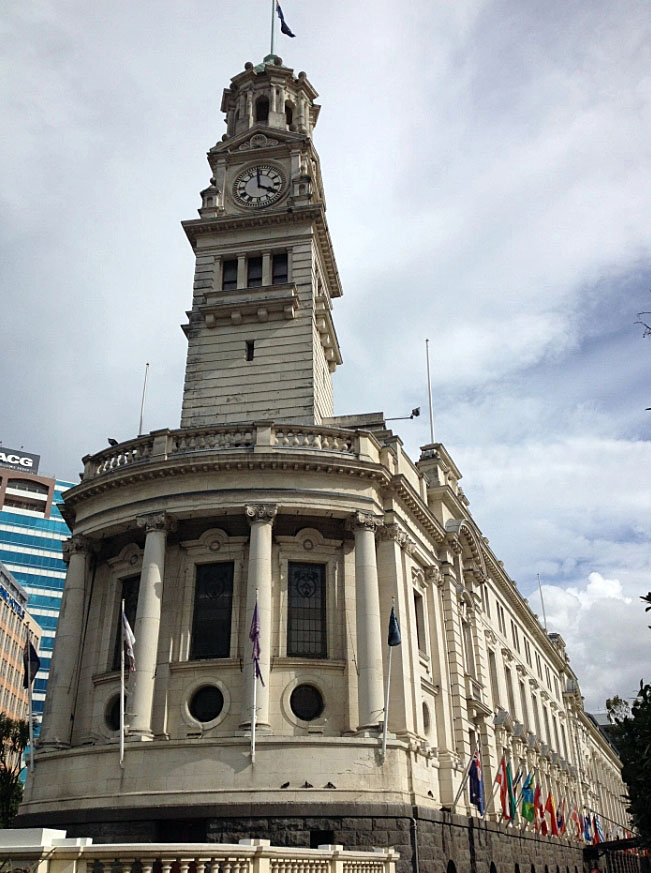
Auckland Town Hall. July 2015. Image courtesy of www.jontynz.com | Jonty Crane | Jonty Crane
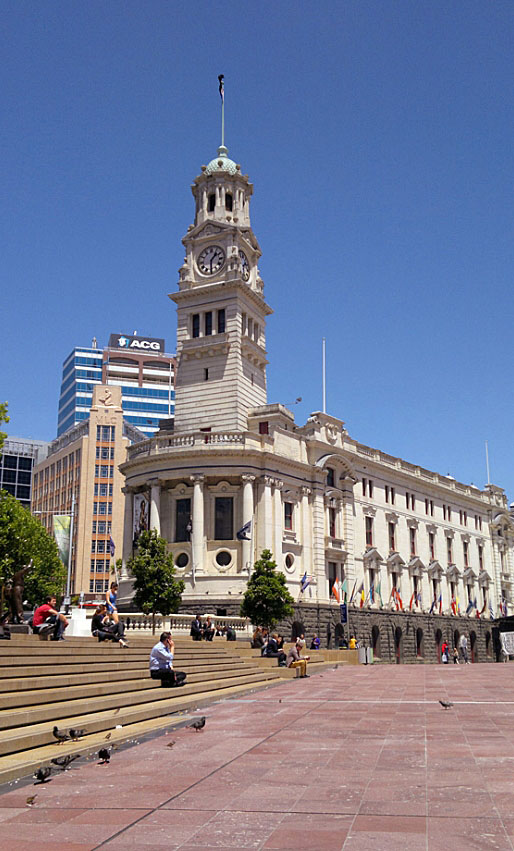
Auckland Town Hall. Image courtesy of commons.wikimedia.org | ChewyPineapple | 16/11/2011 | ChewyPineapple - Wikimedia Commons
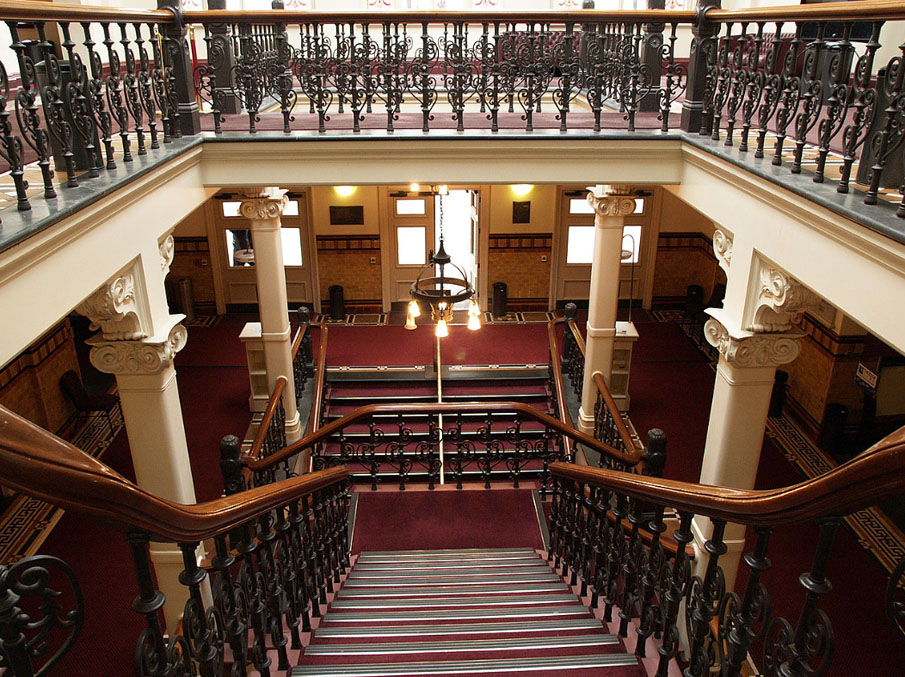
Auckland Town Hall. Stairways and Entrance. CC Licence 3.0. Image courtesy of commons.wikimedia.org | Ulrich Lange, Bochum, Germany | 05/11/2004 | Ulrich Lange - Wikimedia Commons
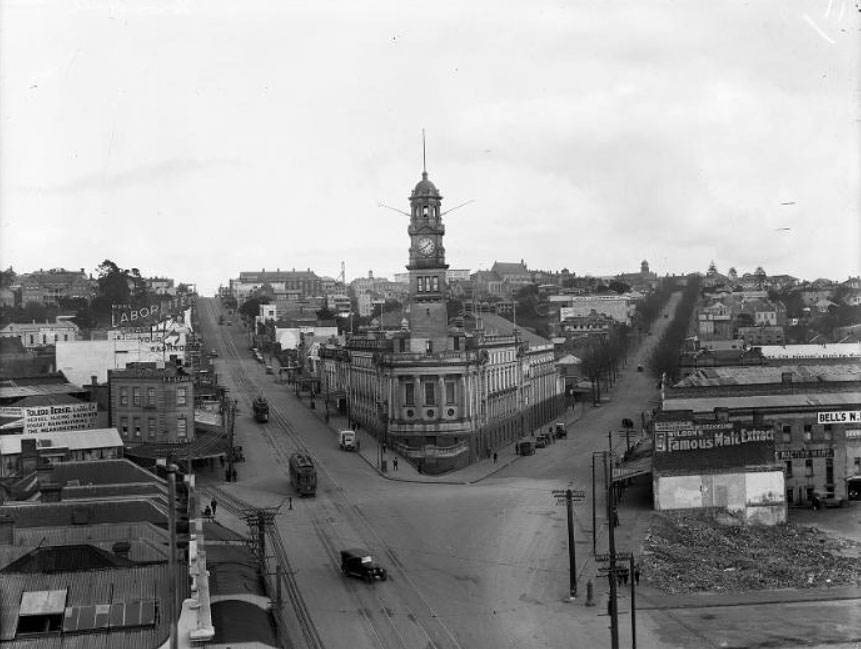
Auckland Town Hall. c.1920. 'Looking along Queen Street and Greys Avenue, Auckland, showing the Town Hall'. Permission of the Alexander Turnbull Library, National Library of New Zealand Te Puna Matauranga o Aotearoa, must be obtained before any re-use. Ref no. 1/1-008196 | Alexander Turnbull Library, Wellington, N.Z.
Auckland Town Hall. July 2015. Image courtesy of www.jontynz.com | Jonty Crane | Jonty Crane
Auckland Town Hall. Image courtesy of commons.wikimedia.org | ChewyPineapple | 16/11/2011 | ChewyPineapple - Wikimedia Commons
Auckland Town Hall. Stairways and Entrance. CC Licence 3.0. Image courtesy of commons.wikimedia.org | Ulrich Lange, Bochum, Germany | 05/11/2004 | Ulrich Lange - Wikimedia Commons
Auckland Town Hall. c.1920. 'Looking along Queen Street and Greys Avenue, Auckland, showing the Town Hall'. Permission of the Alexander Turnbull Library, National Library of New Zealand Te Puna Matauranga o Aotearoa, must be obtained before any re-use. Ref no. 1/1-008196 | Alexander Turnbull Library, Wellington, N.Z.