Descended from the Takitimu canoe through Tamatea Arikinui’s grandson, Ngati Kahungunu ki Heretaunga is Hawke’s Bay’s predominant iwi. Ngati Kahungungu’s dominance began to be asserted around the sixteenth century, but Maori are first thought to have settled in the province about 1300. Heretaunga was rich in resources and Maori settlements were mostly around the coast or situated along the area’s numerous waterways. Hastings is located between two key rivers, the Ngaruroro and Tukituki, and their tributary streams. There are consequently many recorded archaeological sites indicating Maori settlement in the immediate vicinity, including pa, pits and terraces, and urupa.
By the late 1850s Wairarapa’s European pastoralists were moving further north and the Government purchased large tracts of land from Ngati Kahungunu to meet this demand for land. Now one of Hawke’s Bay’s main cities, Hastings was established later than other main towns in the province. Thomas Tanner (1830-1918), a Central Hawke’s Bay runholder, and his consortium illegally leased a large portion of the Heretaunga Plains from Maori in the 1860s. The lease was formalised in 1867, and the entire block was purchased by Tanner’s syndicate, nicknamed the Apostles, in 1870 and divided among them. Although officially cleared of fraud, underhand methods and intimidation are known to have been employed if reluctance to sell was encountered.
Within a few years Hastings had been laid out and the fledgling town was quickly given a boost when the railway went through in 1874. Soon key features such as the racecourse and showground were established and businesses blossomed, particularly those to do with meat and wool processing. For example, Tomoana freezing works was established in 1884. By the turn of the twentieth century fruit growers were important to the local economy too, and enterprises such as the Frimley Canning Factory opened, soon followed by cool storage facilities.
With business came people and between 1901, when Cornwall Park was established, and 1911, when the King George V Coronation Drinking Fountain was built, the population of Hastings almost doubled. Therefore, civic amenities were increasingly being considered, such as larger municipal buildings and theatre, a public library, and recreational facilities. Cornwall Park was Hastings’ first park. Although not formally gifted to the town until 1901, James Nelson Williams (1837-1915), owner of Frimley Estate, had set aside the land for the park in 1898. While Victoria Square was public land in 1897 it was leased for crops and grazing until 1906. In contrast, top-dressing and planting had been undertaken at Cornwall Park, and a cycle track is known to have been established, by November 1905, soon followed by tennis courts, and cricket pitches. For decades it remained Hastings’ main sports ground and recreational park, and remains one of the city’s ‘premier parks,’ featuring many historic trees.
James Williams was the cousin and brother-in-law of Archdeacon Samuel Williams (1822-1907). Both James’ father William (1800-1878), and Samuel’s father Henry Williams (1792-1867), were important missionaries and Henry translated the Treaty of Waitangi into Maori. Cornwall Park, formerly part of Frimley estate, was presented to the people of Hastings in 1901 by Samuel’s daughters: Anna Lydia Williams (1854-1938) and Lucy Frances Warren (1868-1925). Frimley was the result of Samuel securing James some of the Heretaunga Block as part of Tanner’s venture in 1864. From the 1870s James was said to be ‘a shareholder in and director of practically every scheme to advance the progress and welfare of the province.’ Later, the Williams family donated the remainder of Frimley to Hastings for parkland after the homestead was destroyed by fire in 1951.
Cornwall Park was presented and named in honour of Prince George (1865-1936), at that time the Duke of Cornwall and York, who toured New Zealand that year along with the Duchess. This was a momentous occasion because no members of the royal family had visited since Prince Alfred (1844-1900) in 1869 and 1870. Coming only five months after the death of New Zealand’s first monarch, Queen Victoria, the 1901 tour was especially important to New Zealanders because it gave them a direct way of displaying their continued support for the monarchy and admiration for the late Queen, the Duke’s grandmother. There were many events to mark the tour including John Logan Campbell (1817-1912) donating a substantially larger piece of land in Auckland, also known as Cornwall Park. However, a difference was that that gift was acknowledged in person – Hastings not being on the royal couple’s itinerary.
Ten years after the tour which cemented the Hastings land’s future as Cornwall Park, the drinking fountain was constructed to commemorate the Duke succeeding his father to the throne, becoming King George V. To mark the coronation the Government offered to grant a subsidy of up to £250 towards public buildings and structures. Conditions applied, such as no subsidy would be given on borrowed money and applications were due by Coronation Day, 22 June 1911. A public meeting was held in early June to decide the form of Hastings’ commemorative gesture. Ideas ‘ranged from the erection of a municipal theatre to the construction of a two-mile boulevard from Hastings to Havelock North. Ultimately it was decided to erect a drinking fountain in Cornwall Park.’ This seems to have been because it was both affordable and could be constructed in a timely fashion, as well as having a symbolic link to the new king because of its location.
These kinds of meetings were happening all around New Zealand at the time because communities were keen to create ‘expressions of loyalty.’ The extent of interest in the scheme was underestimated by the Government, with the Minister of Internal Affairs noting in October that ‘…the applications had greatly exceeded the amount anticipated – it was really about double….’ Examples of what other communities built include the Waiau Coronation Library and Hall and the Warkworth Town Hall and the King George Hall in Bay View, Napier. Along with band rotundas and swimming baths like Queenstown’s Coronation Bath House, halls were among the most common form of commemorative structures because the grants were specifically targeted towards them. However, there were at least three other fountains constructed in public parks commemorating the coronation - in Hawera, Christchurch, and Temuka. It is unclear whether these were drinking or ornamental fountains, but they were funded by private donations. The Hastings drinking fountain received the government subsidy for half of the 212 pounds and 17 shillings construction cost.
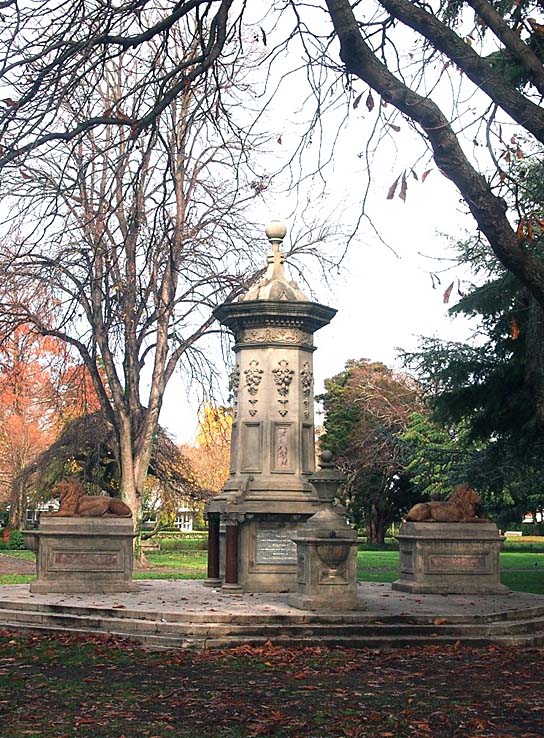
A design competition for the Cornwall Park structure was quickly organised, with the Borough Council’s draughtsman and assistant engineer, Victor Ernest Larcomb (1888-1961), being the successful entrant. Larcomb’s plans for the King George V Coronation Drinking Fountain date from August 1911. Built by E & W Platt of Wellington, the design included a tall central section, replete with moulded garlands and explanatory plaques. The perimeter pedestals each feature a drinking fountain. One pair of pedestals was topped with urns, while the other had lions modelled on the recently established Wellington Zoo’s famous attraction, King Dick.
Further cementing ties to the family, King George’s son Prince Albert, the Duke of York (1895-1952), was welcomed to Hastings in Cornwall Park during his 1927 tour. He later became King George VI in 1936 after his elder brother’s abdication. The Duke and Duchess’ tour was more comprehensive than previous ones, because they ‘visited most of the larger North Island towns’ before continuing onto the South Island. A few years before the Duke and Duchess’ tour, Cornwall Park was described as:
‘less beautiful than the one in Auckland, but certainly a happy hunting ground for explorers of five and six years old…It isn’t a monotonous stretch of lawns and garden, but there are unexpected walks and arbours and glimpses between the trees, all of which make it a pleasant place….’
This pleasant place played a key role in Hastings’ first experience of royalty, hosting the Duke and Duchess there on 4 March 1927. It was reported that Hastings ‘made no secret of the fact that it expected the visitors, all the countryside appeared to have come to town to augment the local people, and not only [at] Cornwall…but the streets leading to it were all filled.’
On subsequent royal occasions the public reception was held elsewhere. For example the Duke of Gloucester’s welcome during the 1934-1935 tour was staged at Hastings Racecourse, which would have accommodated a larger crowd. It may also have been because Cornwall Park was being developed during this period, with the creation of its ponds and limestone bridges and seating. A few decades later the newly crowned Queen Elizabeth II was welcomed at the Civic Centre in early January 1954, but subsequently in 1963 she only made a ‘brief stop’ in the town. Other events hosted at Cornwall Park included the official welcome for the Governor General and his wife, Lord and Lady Bledisloe, in 1930. Lord Bledisloe returned to Cornwall Park the following year to lead a memorial service a few days after the Hawke’s Bay earthquake, expressing sympathy on behalf of the King.
Cornwall Park, with the drinking fountain as its focal point, is still used for community events. For example, there is an annual International Cultures Day festival, and it is the home of the Cornwall Cricket Club. With three rest homes nearby the park is a popular place for elderly people to take a walk, and young families also frequent it regularly. In particular, playing and having photographs taken on the drinking fountain’s lions has been a rite of passage for children visiting the park, as well as some adults. Indeed, in 2001 an exhibition called ‘Laying it on the Lion’ was held at the Hawke’s Bay Exhibition Centre celebrating people’s personal photographs of interaction with the lions. One of the lions is a hero image on the Park’s interpretation signage and the entire structure is often referred to as the Lion Monument.