DonateMembershipVisit Heritage
  • Tūrangawaewae
    Places
  • Tira Māori
    Māori Heritage
  • Poutairangahia
    Archaeology
  • Rauemi
    Resources
  • Mō Tātou
    About Us
  • New Zealand Heritage List
  • Nominate and submit
  • Explore the List
  • National Historic Landmarks
  • Plaques
  • Rainbow List Project
  • Lost heritage
  • Visit Heritage
  • Our properties
  • Turnbull House Project
  • Collections
  • Shop
  • Tohu Whenua
  • Tira Māori
  • Conserving Māori heritage
  • Marae built heritage
  • Māori heritage on the List
  • Hinemihi—Te Hokinga Mai
  • What is archaeology?
  • Is there a site on my property?
  • What are my legal requirements?
  • Affecting an archaeological site
  • Declaring an archaeological site
  • Archaeology FAQs
  • Archaeology Digital Library
  • Archaeology guidelines and templates
  • Resources
  • Funding
  • Publications
  • Sustainable management guides
  • Disaster recovery
  • Podcasts & digital resources
  • Education Hub
  • Conservation plans
  • About
  • Board
  • Māori Heritage Council
  • Senior Staff
  • Offices
  • Contact us
  • Careers
  • Covenants
  • Fast-track
  • Corporate documents
  • Currently consulting on
  • Our submissions
  • News
  • Covid-19 response
Quick links
Rārangi Kōrero | The List
Explore the List
National Historic Landmarks
Ngā Manawhenua o Aotearoa me ōna Kōrero Tūturu
Quick links
Tapuwae
A Vision for Places of Māori Heritage
Funding for Māori Heritage
Resources
Quick links
Archaeological Authority Portal
Applying for an archaeological authority
Archaeology FAQs
Browse the most frequently asked questions about archaeological authorities and the archaeological process.
Quick links
Quick links
News
News Keep up to date with Heritage New Zealand Pouhere Taonga
Membership
Membership Find out more and sign up today
DonateMembershipVisit Heritage
  • Tūrangawaewae
    Places
  • Tira Māori
    Māori Heritage
  • Poutairangahia
    Archaeology
  • Rauemi
    Resources
  • Mō Tātou
    About Us
  • New Zealand Heritage List
  • Nominate and submit
  • Explore the List
  • National Historic Landmarks
  • Plaques
  • Rainbow List Project
  • Lost heritage
  • Visit Heritage
  • Our properties
  • Turnbull House Project
  • Collections
  • Shop
  • Tohu Whenua
  • Tira Māori
  • Conserving Māori heritage
  • Marae built heritage
  • Māori heritage on the List
  • Hinemihi—Te Hokinga Mai
  • What is archaeology?
  • Is there a site on my property?
  • What are my legal requirements?
  • Affecting an archaeological site
  • Declaring an archaeological site
  • Archaeology FAQs
  • Archaeology Digital Library
  • Archaeology guidelines and templates
  • Resources
  • Funding
  • Publications
  • Sustainable management guides
  • Disaster recovery
  • Podcasts & digital resources
  • Education Hub
  • Conservation plans
  • About
  • Board
  • Māori Heritage Council
  • Senior Staff
  • Offices
  • Contact us
  • Careers
  • Covenants
  • Fast-track
  • Corporate documents
  • Currently consulting on
  • Our submissions
  • News
  • Covid-19 response
Quick links
Rārangi Kōrero | The List
Explore the List
National Historic Landmarks
Ngā Manawhenua o Aotearoa me ōna Kōrero Tūturu
Quick links
Tapuwae
A Vision for Places of Māori Heritage
Funding for Māori Heritage
Resources
Quick links
Archaeological Authority Portal
Applying for an archaeological authority
Archaeology FAQs
Browse the most frequently asked questions about archaeological authorities and the archaeological process.
Quick links
Quick links
News
News Keep up to date with Heritage New Zealand Pouhere Taonga
Membership
Membership Find out more and sign up today
  • Places
  • Nominate and submit
  • National Historic Landmarks
  • Places
  • Nominate and submit
  • National Historic Landmarks
  • Tira Māori
  • Conserving Māori heritage
  • Marae built heritage
  • Tira Māori
  • Conserving Māori heritage
  • Marae built heritage
  • Archaeological authorities
  • Archaeology Digital Library
  • Archaeological authorities
  • Archaeology Digital Library
  • All resources
  • Publications
  • Funding
  • All resources
  • Publications
  • Funding
  • FAQs
  • FAQs
Follow us on:
Places
  • Places
  • Nominate and submit
  • National Historic Landmarks
Tira Māori
  • Tira Māori
  • Conserving Māori heritage
  • Marae built heritage
Archaeology
  • Archaeological authorities
  • Archaeology Digital Library
Resources
  • All resources
  • Publications
  • Funding
FAQs
  • FAQs
Follow us on
HomePrivacyTerms and conditionsAbout this site
© Heritage New Zealand Pouhere Taonga 2026.
 
Post Box (Former)

207 Lyndon Road East, HASTINGS

Public

Historic Place Category 2

List No. 1099

Quick links:
List GalleryLocationDetails
Thought to have been installed in central Hastings in 1903, Post Box (Former) is a rare remaining example of a New Zealand-manufactured cast iron pillar box using a popular British Penfold design.

Until the mid twentieth century, Victorian and Edwardian pillar boxes or ‘letter receivers’ were common along the streets of New Zealand urban centres. However, examples such as Post Box (Former) are now rare and have historic and social significance. Post Box (Former) also has importance because of its association with leading British architect and surveyor, John Wornham Penfold, and the well-known manufacturer, P & D Duncan Limited. This place also has commemorative value as plaques on the structure celebrate the centenary of Hastings becoming a town district in 1884.

Hastings was established later than other towns in Hawke’s Bay, and the gradual increase of postal services available there was an indicator of its coming of age in the late nineteenth and early twentieth centuries. Hastings’ first letter receivers were installed in 1903. The introduction of streetside pillar boxes and other receivers in New Zealand coincided with the beginnings of stamp usage in the late 1850s. When penny post came into effect in 1901 this usage increased exponentially. Pillar boxes were generally found in larger towns and cities, so the installation of Post Box (Former) is likely to have been recognition by the Post Office Department of Hastings’ rapidly increasing population and the corresponding increased demand for services.

Manufactured by P & D Duncan of Christchurch using the well-known Penfold 1872 hexagonal British pillar box design, Post Box (Former) is a characteristic example of a late Victorian New Zealand letter receiver. This pillar box bears a VR insignia, which indicates it was manufactured prior to Queen Victoria’s death in 1901. In 1986 it was relocated from its original position on the corner of Heretaunga Street East and Hastings Street South to the Hastings District Council offices. Still painted traditional ‘pillar box red,’ Post Box (Former) was closed for service in 1993 and its aperture blocked to no longer take mail. In 2011 it was moved a few metres to the north corner of the Council property, where it remains as a monument.
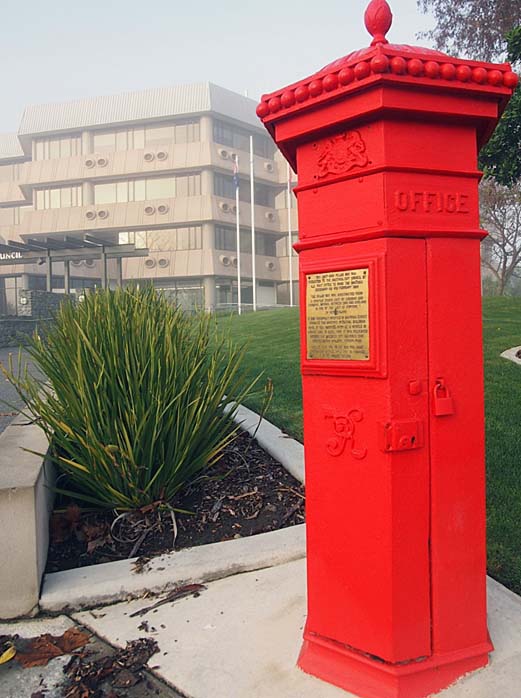
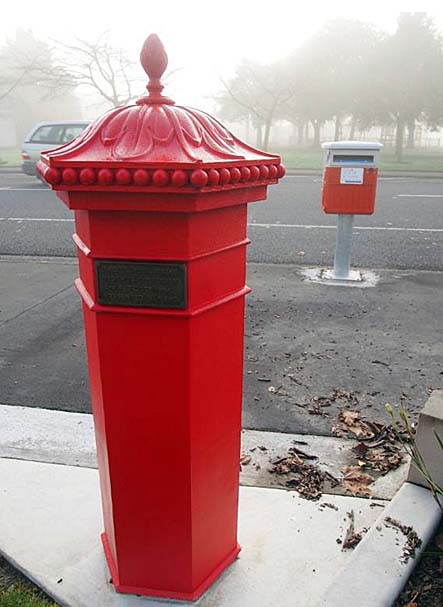
Post Box (Former) | Karen Astwood | 13/06/2013 | Heritage New Zealand
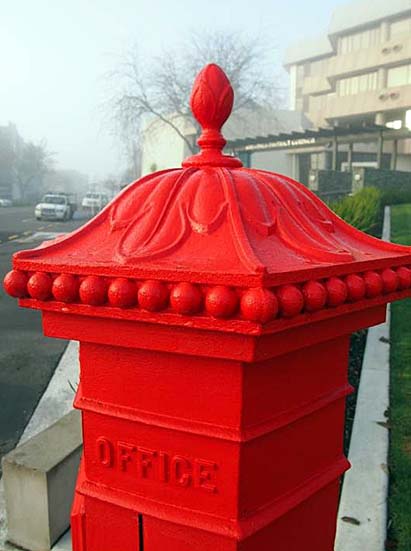
Post Box (Former). West side | Karen Astwwod | 13/06/2014 | Heritage New Zealand
Post Box (Former). Cap and upper shelf | Karen Astwood | 13/06/2014 | Heritage New Zealand
Post Box (Former) | Karen Astwood | 13/06/2013 | Heritage New Zealand
Post Box (Former). West side | Karen Astwwod | 13/06/2014 | Heritage New Zealand
Post Box (Former). Cap and upper shelf | Karen Astwood | 13/06/2014 | Heritage New Zealand

List Entry Information

Overview

Status
Listed

List Entry Status
Historic Place Category 2

Access
Able to Visit

List Number
1099

Date Entered
1st May 2014

Date of Effect
1st May 2014

City/District Council
Hastings District

Region
Hawke's Bay Region

Extent of List Entry

Extent includes part of the land described as Lot 2 DP 6381 (RT HB111/19), Hawkes Bay Land District and the structure known as Post Box (Former) thereon, including a 2 metre square curtilage along the parcel's east boundary, with Post Box (Former) at its centre. (Refer to map in Appendix 1 of the registration report for further information).

Legal description

Lot 2 DP 6381 (RT HB111/19), Hawkes Bay Land District

Location Description

Post Box (Former) is located in central Hastings on the footpath edge of the Hastings District Council building’s property. This is approximately mid-way along the Lyndon Road East block, between Karamu Road South and Warren Street South. A modern post box is nearby.

Detailed List Entry
Significance

Cultural Significance

Social Significance or Value Dating from an age when the post was the main means of distance communication, Post Box (Former) has social significance because it was introduced as a community convenience, saving people the time it would take to travel to a post office. It remained in service for most of the twentieth century and now has some local social value as a commemorative structure. The continued existence of Post Box (Former) can be attributed to community advocacy, meaning it has social value. The 1950s saw pillar boxes begin to be removed by the Post Office Department. However some, like Post Box (Former) were retained in communities where they were already esteemed for their heritage values.

Historic Significance

Historical Significance or Value Using a standardised British design by important architect and surveyor John Wornham Penfold, well-known and longstanding Christchurch firm P & D Duncan manufactured numerous pillar boxes for the New Zealand Post Office Department. These were once a common sight in urban centres. Post Box (Former) is a rare remaining example of this type of letter receiver and therefore has historical value. As New Zealand settlements, towns and cities developed their available postal services and facilities correspondingly increased. Post Box (Former) has historical significance as a marker of the notable increase in Hastings’ population and status in the late nineteenth and early twentieth centuries. The creation and installation of Post Box (Former) was also contemporary with the introduction of universal penny post in New Zealand. As such, Post Box (Former) is indicative of the dramatic increase in letter writing this produced, and the coinciding necessity for greater public access to letter receivers in the early twentieth century.

Physical Significance

Aesthetic Significance or Value Post Box (Former) has aesthetic value because it is a point of interest in its streetscape - its bold red colour and ornate Victorian features contribute to its visual interest.

Detail Of Assessed Criteria

(a) The extent to which the place reflects important or representative aspects of New Zealand history Aspects of Post Box (Former) demonstrate the close administrative ties between New Zealand and Britain in the late nineteenth and early twentieth century. The adoption of standardised British designs for New Zealand pillar boxes, such as Penfold’s 1872 type, is indicative of this, as is the inclusion of the British coat of arms and the VR insignia, in reference to Queen Victoria. (e) The community association with, or public esteem for the place When in service, Post Box (Former) was an important public facility essential to Hastings people as a means of communication, particularly in the early twentieth century. When Victorian and Edwardian pillar boxes were systematically removed from the 1950s a small portion, including Post Box (Former), were retained for their locally recognised historic value. This community esteem was reinforced when the Hastings District Council accepted ownership of Post Box (Former). On behalf of residents the Council has ensured Post Box (Former) remains publically accessible and well maintained. (g) The technical accomplishment or value, or design of the place Post Box (Former) is an example of architect John Wornham Penfold’s celebrated pillar box designs for the British Post Office, which were then also adopted in New Zealand and other colonies. (h) The symbolic or commemorative value of the place Post Box (Former)’s overt primarily function is a commemorative piece of street furniture, because of its plaque celebrating the centenary of Hastings becoming a town district in 1884. As a distinctly Victorian structure, Post Box (Former) also tacitly commemorates this bygone age when post was the main means of communication. (j) The importance of identifying rare types of historic places Once numbering in their hundreds around the country, Penfold hexagonal pillar boxes, like Post Box (Former), are now acknowledges as rare, with only a handful remaining on street sides in New Zealand.

Construction Professional

Name

Penfold, John Wornham (1828-1909)

Type

Designer

Biography

Penfold was an English surveyor and architect famous for his British Post Office Department pillar box designs. There were three types of Penfold boxes produced in the 1860s and 1870s. Penfold boxes were subsequently adopted for pillar boxes manufactured in various British colonies, such as New Zealand. Although he was best known for his pillar box design Penfold was also a leading figure in his respective professional fields, becoming the President of the Architectural Association as well as being a founding member and longstanding honorary secretary of the Royal Institute of Chartered Surveyors. Source: Registration Report for Post Box (Former), Karen Astwood, 2013

Name

P & D Duncan Limited

Type

Engineer

Biography

The Duncan brothers, Peter (1838-1907) and David (1832-1897), emigrated from Scotland, arriving in Lyttelton in 1863 and 1867 respectively. They each had solid work experience in smithing and fitting by this time. The company was based in Christchurch, with a branch later opening in Ashburton. Despite going into partnership in 1870 it was not until 1874 that they adopted the name P & D Duncan. In 1894 P & D Duncan became a limited liability company. In the same year the company began manufacturing pillar boxes for the Post Office Department. However, the main focus of the business from its earliest period, and what it was most well-known for, was the repair, development and manufacture of farm machinery. Their farm implements and machines were distributed all around New Zealand by the early twentieth century. Peter retired from the company four years after his elder brother’s death, at which time the business was continued by people who were mostly relatives. Source: Registration Report for Post Box (Former), Karen Astwood, Sep 2013.

Construction Details

Start Year

1901

Type

Original Construction

Description

Date of manufacture

Start Year

1903

Type

Original Construction

Description

Installed on corner of Heretaunga Street East and Hastings Street South

Start Year

1984

Type

Addition

Description

Hastings centenary plaque added

Start Year

1985

Type

Damaged

Description

Pillar box hit by a vehicle

Start Year

1986

Type

Relocation

Description

Relocated to Lyndon Street East outside Hastings District Council building

Start Year

1993

Type

Addition

Description

Interpretation plaque added

Start Year

2011

Type

Relocation

Description

Relocated to north corner of Hastings District Council building’s property

Construction Materials

Cast iron

Historical Narrative

Descended from the Takitimu canoe through Tamatea Arikinui’s grandson, Ngati Kahungunu ki Heretaunga is Hawke’s Bay’s predominant iwi. Ngati Kahungungu’s dominance began to be asserted around the sixteenth century, but Maori are first thought to have settled in the province about 1300. Heretaunga was rich in resources and Maori settlements were mostly around the coast or situated along the area’s numerous waterways. Hastings is located between two key rivers, the Ngaruroro and Tukituki, and their tributary streams. There are consequently many recorded archaeological sites indicating Maori settlement in the immediate vicinity, including pa, pits and terraces, and urupa. By the late 1850s Wairarapa’s European pastoralists were moving further north and the Government purchased large tracts of land from Ngati Kahungunu to meet this demand for land. Now one of Hawke’s Bay’s two largest cities, Hastings was established later than other main towns in the province. Thomas Tanner (1830-1918), a Central Hawke’s Bay runholder, and his consortium illegally leased a large portion of the Heretaunga Plains from Maori in the 1860s. The lease was formalised in 1867, and the entire block was purchased by Tanner’s syndicate, nicknamed the Apostles, in 1870 and divided among them. Although officially cleared of fraud, underhand methods and intimidation are known to have been employed if reluctance to sell was encountered. Within a few years Hastings had been laid out and the fledgling town was quickly given a boost when the railway went through in 1874. Over the next few years key features such as the racecourse and showground were established and businesses blossomed, particularly those to do with meat and wool processing. For example, Tomoana freezing works was established in 1884. By the turn of the twentieth century, fruit growers were important to the local economy too and enterprises such as the large Frimley Canning Factory opened, soon followed by cool storage facilities. With business came people, and between 1901 and 1911, the population of Hastings almost doubled. As was typical elsewhere nationally, milestones in the development of local postal services were indicative of Hastings’ growth during the late nineteenth and early twentieth centuries. The first post office in the embryonic township opened in 1872 in a store, under the name Karamu. The first Hawke’s Bay post office had been established in Ahuriri/Napier in the 1850s. Prior to the establishment of the Karamu Post Office, local residents relied on postal facilities in Havelock North or Clive. After the railway arrived the post office was incorporated into the railway station and renamed Hastings Post Office. As the population grew services and facilities were added, with letter carrier deliveries beginning in 1887 and a purpose built post office constructed in 1896, with an even larger one opened in 1910 to cater to the expanding population. Earlier, in 1903, Hastings’ first three pillar letter receivers were installed. Prior to 1862, when stamps became compulsory for national post, New Zealanders had to go to a post office for their items to be marked with the correct postage cost. While street post boxes were installed in Wellington and Auckland in 1859 for international post, it was only after 1864 that the Post Office Department (later the Post and Telegraph Department) increasingly installed a variety of different styles of post box, more commonly known at the time as letter receiving boxes, or receivers. For example, in 1885 the department’s annual reports note the total number of pillar, wall, and lamp-post receivers in New Zealand was 227. With the introduction and popularity of stamps these types of receivers were ‘the obvious complement to their usefulness’, completely side-stepping the need for people to travel into the post office, and being accessible at any time. The boxes were predominantly installed to meet the demands of large towns and cities. Post Box (Former) was manufactured by the Christchurch firm of P & D Duncan Limited. Their manufacturing mark was revealed after the pillar box was hit by a vehicle in the mid 1980s. Up until 1879 New Zealand’s street pillar boxes had been imported from Australia. The Duncan brothers, Peter (1838-1907) and David (1832-1897), had emigrated from Scotland, arriving in Lyttelton in 1863 and 1867 respectively. They each had solid work experience in smithing and fitting by this time. Despite going into partnership in 1870 it was not until 1874 that they adopted the name P & D Duncan, and in 1894 it became a limited liability company. In the same year the company began manufacturing pillar boxes for the Post Office Department. The company’s contract for letter receivers is thought to have ended in 1901, although it has been posited that they continued to create pillar boxes into the Edwardian period. The design used was the same as the British receivers designed by John Wornham Penfold (1828-1909), and named after him. Britain first introduced letter receivers in the early 1850s. In 1865 Penfold, an architect and surveyor, was invited to design a new standard pillar box. There were several Penfold box variations, and the style of Post Box (Former) shows it to be one of the last implemented in Britain, dating from around 1872. The British Postal Museum and Archive states that the 1872-79 version of the Penfold pillar box is ‘very rare.’ In the 1870s Britain reverted to a cylindrical pillar box as standard. However, Penfold boxes continued to be manufactured in New Zealand into the Edwardian period. Post Box (Former) has the insignia VR (Victoria Regina) on it, which places its period of manufacture before the death of Queen Victoria in 1901. The NZHPT Buildings Classification Committee dated it circa 1885. However, in 1986 Robin Startup, then editor of the Postal History Society’s journal, noted the Hastings box was not recorded in a Post Office list in 1902 but was in a 1910 list. He therefore suggested it was probably cast in 1901 and installed post-1902, most likely 1903. A search of the Post and Telegraph Department annual reports from 1883 to 1903 found the earliest reference to letter receivers being installed in Hastings was a group of three in 1903. Therefore, it is highly probable that Post Box (Former) was amongst this first group of Hastings post receivers. A debate was played out in several issues of Historic Places magazine during 1985 and 1986 regarding the disparate attributed manufacturing and installation dates for Post Box (Former). However, based on evidence from government records, Startup’s 1903 installation date seems most likely. The Post Office’s expansion of services in Hastings was relatively late compared with Napier, which had letter receivers since the 1880s. The only remaining pillar box in Napier is Post Box, Category 2 historic place (Register No. 4829). Based on the apparent continued installation of VR type boxes until at least 1903, as seen with the Hastings receiver, it is likely that the Napier pillar box was installed after this period since it bears the mark of the subsequent monarch, King Edward VII. Indeed, Startup dates the Napier receiver to 1905. As well as being indicative of the growth in Hastings’ population, the installation of these boxes may also have been motivated by a broader national communications trend at the time. On 1 January 1901 New Zealand introduced universal penny post, significantly cutting the cost for posting letters nationally and internationally. This is said to have had an ‘electrifying effect. Almost everyone seemed to take to letter writing.’ The government had anticipated that penny postage would ‘prove an epoch in the history of the colony. New Zealand will by this reform be placed in the forefront of the civilised countries of the world.’ Therefore, it seems likely that the anticipated greater demand led to the pre-ordering of post boxes. Indeed, penny post did prove ‘an estimable boon,’ with the statistics for the first year of its implementation showing letter volume was up by 13 million pieces. However, there is also a possibility that Post Box (Former) may have been one that the Post Office Department had closed elsewhere and then re-used in Hastings. Post Box (Former) was first installed outside Hasting’s Methodist Church, on the corner of Heretaunga Street East and Hastings Street South. In the early 1950s the New Zealand Post Office Association began a campaign to replace the cast iron pillar boxes with hutch-like wooden letter boxes mounted on posts. Considered unsanitary, leaky, and difficult to clear, most boxes were sold to museums and private collectors or turned into scrap metal. However, some were retained ‘in those districts where they were of historical interest.’ Presumably Hastings residents successfully advocated for their post box’s retention on those grounds. In 1984 the Post Office Department presented Post Box (Former) to the Hastings District Council to mark Hastings’ centenary of becoming a town district. In 1986 the Council relocated it to outside their offices on Lyndon Road East. The previous year it had been hit by a car, revealing the manufacturer’s marks below street level. It was not until 1992 that Post Box (Former) was permanently closed. The reasoning behind its closure was there was no provision for keeping standard and fast post separate, and also the colour of the box did not comply with New Zealand Post corporate branding. Therefore, a new letter receiver was installed further north along the road and a sign placed on Post Box (Former) directing customers to it. In 2011 Post Box was moved approximately 15 metres to the north corner of the Council’s property as part of a landscaping project which created a new entrance for the Council buildings. Therefore, it is now directly opposite a contemporary letter receiver which is on the road side of the footpath.

Physical Description

Current Description Post Box (Former) is located in the northwest corner of the Hastings District Council property on Lyndon Road East, site of the Hastings District Council offices. The stout Victorian form of Post Box (Former) creates a nice contrast to the modern, post mounted, hutch style New Zealand Post letter receiver located opposite it on Lyndon Road East. Both retain the traditional red associated with post boxes and therefore draw the viewer’s attention from some distance along the street. Post Box (Former) is all the more striking because its red colour also forms a contrast to the green mounded lawn immediately behind. Therefore, despite its size, Post Box (Former) has definite streetscape presence. Of a list of remaining pillar boxes compiled in 1966 the majority of boxes were Penfold type. In 1975 there were said to be only 15 pillar boxes remaining on streets. There are currently (2013) seven pillar boxes on the NZHPT Register: three examples in Thames (VR types), as well as one each in Hawera (VR type), Napier (ER type), Nelson (VR type), and Wairoa (ER type). Of these, the Hawera, Napier and Wairoa examples are all Penfold pillar boxes, while the others are circular receivers. As a VR type, Post Box (Former) is the oldest of the group of Hawke’s Bay pillar boxes, and is akin to the Hawera example. Post Box (Former) is a standard 1872 model Penfold cast iron pillar box, seemingly in excellent condition. . The pillar box is approximately 1.5 metres high and was cast in three parts: the main shaft, its door, and the cap decorated with acanthus leaf motifs and encircled with small spheres. The structure’s decorative features are concentrated on the cap, and combine with the other features of the box to create a distinctly Victorian appearance. The main shaft is hexagonal, with the door being shaped to be one side wide and extend almost halfway along the flanking sides. The door begins close to ground level and makes up the bulk of the shaft’s height. At its current location the door faces northeast. The door features the VR insignia denoting its Victorian period manufacture, although belying its probable Edwardian installation in 1903. The door also has a rectangular metal interpretation plaque above its VR insignia. Dating from around 1993, the plaque mentions an earlier estimated construction period of 1880-85, the gifting of the structure to the Council in 1984, the original location of Post Box (Former) on the corner of Heretaunga Street East and Hastings Street South, as well as the 1985 relocation to its current area, and the 1992 closure of the box. Because it has no function the pillar box is now a piece of attractive and interesting street furniture – a curiosity with some commemorative features. Above the door section of Post Box (Former) the remainder of the shaft is divided in two by moulded cornices. Directly above the door the aperture, through which mail was formerly deposited, has been sealed with a metal plate. On each flanking side are the words ‘Post’ and ‘Office’ respectively. To the rear is another, smaller, metal plaque from 1984 commemorating Hastings becoming a town district a century earlier. The top of the shaft has only one feature which is the British coat of arms, on the door side of the pillar box.

Reference

Completion Date

19th September 2013

Report Written By

Karen Astwood

Information Sources

Boyd, 1984

Mary Boyd, City of the Plains, A History of Hastings, Wellington, 1984

Farrugia, 1969

Farrugia, Jean Young, The Letter Box: A history of the post office pillar and wall boxes, Sussex, Centaur, 1969

Robinson, 1964

Howard Robinson, A History of the Post Office in New Zealand, RE Owen, Government Printer, Wellington, 1964

Marshall and Startup, 1984

Marshall, Bruce, and Robin Startup, From the Bay to the Bush: The People, Post Offices and Postmarks of Hawkes Bay, Jubilee ’84 Committee, Hawke’s Bay Philatelic Society, 1984

Report Written By

A fully referenced registration report is available on request from the Central Region Office of the NZHPT Please note that entry on the New Zealand Heritage List/Rarangi Korero identifies only the heritage values of the property concerned, and should not be construed as advice on the state of the property, or as a comment of its soundness or safety, including in regard to earthquake risk, safety in the event of fire, or insanitary conditions.

Further Information

Current Usages

Uses: Commemoration

Specific Usage: Monuments, memorial, site of particular event - other

Uses: Miscellaneous

Specific Usage: Street furniture

Former Usages

General Usage:: Communication

Specific Usage: Post Box

Themes

Web Links

Overview

Status

Listed

List Entry Status

Historic Place Category 2

Access

Able to Visit

List Number

1099

Date Entered

1st May 2014

Date of Effect

1st May 2014

City/District Council

Hastings District

Region

Hawke's Bay Region

Extent of List Entry

Extent includes part of the land described as Lot 2 DP 6381 (RT HB111/19), Hawkes Bay Land District and the structure known as Post Box (Former) thereon, including a 2 metre square curtilage along the parcel's east boundary, with Post Box (Former) at its centre. (Refer to map in Appendix 1 of the registration report for further information).

Legal description

Lot 2 DP 6381 (RT HB111/19), Hawkes Bay Land District

Location Description

Post Box (Former) is located in central Hastings on the footpath edge of the Hastings District Council building’s property. This is approximately mid-way along the Lyndon Road East block, between Karamu Road South and Warren Street South. A modern post box is nearby.

Status

Listed

List Entry Status

Historic Place Category 2

Access

Able to Visit

List Number

1099

Date Entered

1st May 2014

Date of Effect

1st May 2014

City/District Council

Hastings District

Region

Hawke's Bay Region

Extent of List Entry

Extent includes part of the land described as Lot 2 DP 6381 (RT HB111/19), Hawkes Bay Land District and the structure known as Post Box (Former) thereon, including a 2 metre square curtilage along the parcel's east boundary, with Post Box (Former) at its centre. (Refer to map in Appendix 1 of the registration report for further information).

Legal description

Lot 2 DP 6381 (RT HB111/19), Hawkes Bay Land District

Location Description

Post Box (Former) is located in central Hastings on the footpath edge of the Hastings District Council building’s property. This is approximately mid-way along the Lyndon Road East block, between Karamu Road South and Warren Street South. A modern post box is nearby.

Significance

Why is this place significant?

Cultural Significance

Social Significance or Value Dating from an age when the post was the main means of distance communication, Post Box (Former) has social significance because it was introduced as a community convenience, saving people the time it would take to travel to a post office. It remained in service for most of the twentieth century and now has some local social value as a commemorative structure. The continued existence of Post Box (Former) can be attributed to community advocacy, meaning it has social value. The 1950s saw pillar boxes begin to be removed by the Post Office Department. However some, like Post Box (Former) were retained in communities where they were already esteemed for their heritage values.

Historic Significance

Historical Significance or Value Using a standardised British design by important architect and surveyor John Wornham Penfold, well-known and longstanding Christchurch firm P & D Duncan manufactured numerous pillar boxes for the New Zealand Post Office Department. These were once a common sight in urban centres. Post Box (Former) is a rare remaining example of this type of letter receiver and therefore has historical value. As New Zealand settlements, towns and cities developed their available postal services and facilities correspondingly increased. Post Box (Former) has historical significance as a marker of the notable increase in Hastings’ population and status in the late nineteenth and early twentieth centuries. The creation and installation of Post Box (Former) was also contemporary with the introduction of universal penny post in New Zealand. As such, Post Box (Former) is indicative of the dramatic increase in letter writing this produced, and the coinciding necessity for greater public access to letter receivers in the early twentieth century.

Physical Significance

Aesthetic Significance or Value Post Box (Former) has aesthetic value because it is a point of interest in its streetscape - its bold red colour and ornate Victorian features contribute to its visual interest.

Why is this place Category 1 / Category 2?

Detail Of Assessed Criteria

(a) The extent to which the place reflects important or representative aspects of New Zealand history Aspects of Post Box (Former) demonstrate the close administrative ties between New Zealand and Britain in the late nineteenth and early twentieth century. The adoption of standardised British designs for New Zealand pillar boxes, such as Penfold’s 1872 type, is indicative of this, as is the inclusion of the British coat of arms and the VR insignia, in reference to Queen Victoria. (e) The community association with, or public esteem for the place When in service, Post Box (Former) was an important public facility essential to Hastings people as a means of communication, particularly in the early twentieth century. When Victorian and Edwardian pillar boxes were systematically removed from the 1950s a small portion, including Post Box (Former), were retained for their locally recognised historic value. This community esteem was reinforced when the Hastings District Council accepted ownership of Post Box (Former). On behalf of residents the Council has ensured Post Box (Former) remains publically accessible and well maintained. (g) The technical accomplishment or value, or design of the place Post Box (Former) is an example of architect John Wornham Penfold’s celebrated pillar box designs for the British Post Office, which were then also adopted in New Zealand and other colonies. (h) The symbolic or commemorative value of the place Post Box (Former)’s overt primarily function is a commemorative piece of street furniture, because of its plaque celebrating the centenary of Hastings becoming a town district in 1884. As a distinctly Victorian structure, Post Box (Former) also tacitly commemorates this bygone age when post was the main means of communication. (j) The importance of identifying rare types of historic places Once numbering in their hundreds around the country, Penfold hexagonal pillar boxes, like Post Box (Former), are now acknowledges as rare, with only a handful remaining on street sides in New Zealand.

Why is this place significant?

Cultural Significance

Social Significance or Value Dating from an age when the post was the main means of distance communication, Post Box (Former) has social significance because it was introduced as a community convenience, saving people the time it would take to travel to a post office. It remained in service for most of the twentieth century and now has some local social value as a commemorative structure. The continued existence of Post Box (Former) can be attributed to community advocacy, meaning it has social value. The 1950s saw pillar boxes begin to be removed by the Post Office Department. However some, like Post Box (Former) were retained in communities where they were already esteemed for their heritage values.

Historic Significance

Historical Significance or Value Using a standardised British design by important architect and surveyor John Wornham Penfold, well-known and longstanding Christchurch firm P & D Duncan manufactured numerous pillar boxes for the New Zealand Post Office Department. These were once a common sight in urban centres. Post Box (Former) is a rare remaining example of this type of letter receiver and therefore has historical value. As New Zealand settlements, towns and cities developed their available postal services and facilities correspondingly increased. Post Box (Former) has historical significance as a marker of the notable increase in Hastings’ population and status in the late nineteenth and early twentieth centuries. The creation and installation of Post Box (Former) was also contemporary with the introduction of universal penny post in New Zealand. As such, Post Box (Former) is indicative of the dramatic increase in letter writing this produced, and the coinciding necessity for greater public access to letter receivers in the early twentieth century.

Physical Significance

Aesthetic Significance or Value Post Box (Former) has aesthetic value because it is a point of interest in its streetscape - its bold red colour and ornate Victorian features contribute to its visual interest.

Why is this place Category 1 / Category 2?

Detail Of Assessed Criteria

(a) The extent to which the place reflects important or representative aspects of New Zealand history Aspects of Post Box (Former) demonstrate the close administrative ties between New Zealand and Britain in the late nineteenth and early twentieth century. The adoption of standardised British designs for New Zealand pillar boxes, such as Penfold’s 1872 type, is indicative of this, as is the inclusion of the British coat of arms and the VR insignia, in reference to Queen Victoria. (e) The community association with, or public esteem for the place When in service, Post Box (Former) was an important public facility essential to Hastings people as a means of communication, particularly in the early twentieth century. When Victorian and Edwardian pillar boxes were systematically removed from the 1950s a small portion, including Post Box (Former), were retained for their locally recognised historic value. This community esteem was reinforced when the Hastings District Council accepted ownership of Post Box (Former). On behalf of residents the Council has ensured Post Box (Former) remains publically accessible and well maintained. (g) The technical accomplishment or value, or design of the place Post Box (Former) is an example of architect John Wornham Penfold’s celebrated pillar box designs for the British Post Office, which were then also adopted in New Zealand and other colonies. (h) The symbolic or commemorative value of the place Post Box (Former)’s overt primarily function is a commemorative piece of street furniture, because of its plaque celebrating the centenary of Hastings becoming a town district in 1884. As a distinctly Victorian structure, Post Box (Former) also tacitly commemorates this bygone age when post was the main means of communication. (j) The importance of identifying rare types of historic places Once numbering in their hundreds around the country, Penfold hexagonal pillar boxes, like Post Box (Former), are now acknowledges as rare, with only a handful remaining on street sides in New Zealand.

Construction Information

Construction Professional

Name

Penfold, John Wornham (1828-1909)

Type

Designer

Biography

Penfold was an English surveyor and architect famous for his British Post Office Department pillar box designs. There were three types of Penfold boxes produced in the 1860s and 1870s. Penfold boxes were subsequently adopted for pillar boxes manufactured in various British colonies, such as New Zealand. Although he was best known for his pillar box design Penfold was also a leading figure in his respective professional fields, becoming the President of the Architectural Association as well as being a founding member and longstanding honorary secretary of the Royal Institute of Chartered Surveyors. Source: Registration Report for Post Box (Former), Karen Astwood, 2013

Name

P & D Duncan Limited

Type

Engineer

Biography

The Duncan brothers, Peter (1838-1907) and David (1832-1897), emigrated from Scotland, arriving in Lyttelton in 1863 and 1867 respectively. They each had solid work experience in smithing and fitting by this time. The company was based in Christchurch, with a branch later opening in Ashburton. Despite going into partnership in 1870 it was not until 1874 that they adopted the name P & D Duncan. In 1894 P & D Duncan became a limited liability company. In the same year the company began manufacturing pillar boxes for the Post Office Department. However, the main focus of the business from its earliest period, and what it was most well-known for, was the repair, development and manufacture of farm machinery. Their farm implements and machines were distributed all around New Zealand by the early twentieth century. Peter retired from the company four years after his elder brother’s death, at which time the business was continued by people who were mostly relatives. Source: Registration Report for Post Box (Former), Karen Astwood, Sep 2013.

Construction Details

Start Year

1901

startYearCirca

Type

Original Construction

Description

Date of manufacture

Start Year

1903

Type

Original Construction

Description

Installed on corner of Heretaunga Street East and Hastings Street South

Start Year

1984

Type

Addition

Description

Hastings centenary plaque added

Start Year

1985

Type

Damaged

Description

Pillar box hit by a vehicle

Start Year

1986

Type

Relocation

Description

Relocated to Lyndon Street East outside Hastings District Council building

Start Year

1993

startYearCirca

Type

Addition

Description

Interpretation plaque added

Start Year

2011

Type

Relocation

Description

Relocated to north corner of Hastings District Council building’s property

Construction Materials

Cast iron

Construction Professional

Name

Penfold, John Wornham (1828-1909)

Type

Designer

Biography

Penfold was an English surveyor and architect famous for his British Post Office Department pillar box designs. There were three types of Penfold boxes produced in the 1860s and 1870s. Penfold boxes were subsequently adopted for pillar boxes manufactured in various British colonies, such as New Zealand. Although he was best known for his pillar box design Penfold was also a leading figure in his respective professional fields, becoming the President of the Architectural Association as well as being a founding member and longstanding honorary secretary of the Royal Institute of Chartered Surveyors. Source: Registration Report for Post Box (Former), Karen Astwood, 2013

Name

P & D Duncan Limited

Type

Engineer

Biography

The Duncan brothers, Peter (1838-1907) and David (1832-1897), emigrated from Scotland, arriving in Lyttelton in 1863 and 1867 respectively. They each had solid work experience in smithing and fitting by this time. The company was based in Christchurch, with a branch later opening in Ashburton. Despite going into partnership in 1870 it was not until 1874 that they adopted the name P & D Duncan. In 1894 P & D Duncan became a limited liability company. In the same year the company began manufacturing pillar boxes for the Post Office Department. However, the main focus of the business from its earliest period, and what it was most well-known for, was the repair, development and manufacture of farm machinery. Their farm implements and machines were distributed all around New Zealand by the early twentieth century. Peter retired from the company four years after his elder brother’s death, at which time the business was continued by people who were mostly relatives. Source: Registration Report for Post Box (Former), Karen Astwood, Sep 2013.

Construction Details

Start Year

1901

startYearCirca

Type

Original Construction

Description

Date of manufacture

Start Year

1903

Type

Original Construction

Description

Installed on corner of Heretaunga Street East and Hastings Street South

Start Year

1984

Type

Addition

Description

Hastings centenary plaque added

Start Year

1985

Type

Damaged

Description

Pillar box hit by a vehicle

Start Year

1986

Type

Relocation

Description

Relocated to Lyndon Street East outside Hastings District Council building

Start Year

1993

startYearCirca

Type

Addition

Description

Interpretation plaque added

Start Year

2011

Type

Relocation

Description

Relocated to north corner of Hastings District Council building’s property

Construction Materials

Cast iron

Historical Narrative

Descended from the Takitimu canoe through Tamatea Arikinui’s grandson, Ngati Kahungunu ki Heretaunga is Hawke’s Bay’s predominant iwi. Ngati Kahungungu’s dominance began to be asserted around the sixteenth century, but Maori are first thought to have settled in the province about 1300. Heretaunga was rich in resources and Maori settlements were mostly around the coast or situated along the area’s numerous waterways. Hastings is located between two key rivers, the Ngaruroro and Tukituki, and their tributary streams. There are consequently many recorded archaeological sites indicating Maori settlement in the immediate vicinity, including pa, pits and terraces, and urupa. By the late 1850s Wairarapa’s European pastoralists were moving further north and the Government purchased large tracts of land from Ngati Kahungunu to meet this demand for land. Now one of Hawke’s Bay’s two largest cities, Hastings was established later than other main towns in the province. Thomas Tanner (1830-1918), a Central Hawke’s Bay runholder, and his consortium illegally leased a large portion of the Heretaunga Plains from Maori in the 1860s. The lease was formalised in 1867, and the entire block was purchased by Tanner’s syndicate, nicknamed the Apostles, in 1870 and divided among them. Although officially cleared of fraud, underhand methods and intimidation are known to have been employed if reluctance to sell was encountered. Within a few years Hastings had been laid out and the fledgling town was quickly given a boost when the railway went through in 1874. Over the next few years key features such as the racecourse and showground were established and businesses blossomed, particularly those to do with meat and wool processing. For example, Tomoana freezing works was established in 1884. By the turn of the twentieth century, fruit growers were important to the local economy too and enterprises such as the large Frimley Canning Factory opened, soon followed by cool storage facilities. With business came people, and between 1901 and 1911, the population of Hastings almost doubled. As was typical elsewhere nationally, milestones in the development of local postal services were indicative of Hastings’ growth during the late nineteenth and early twentieth centuries. The first post office in the embryonic township opened in 1872 in a store, under the name Karamu. The first Hawke’s Bay post office had been established in Ahuriri/Napier in the 1850s. Prior to the establishment of the Karamu Post Office, local residents relied on postal facilities in Havelock North or Clive. After the railway arrived the post office was incorporated into the railway station and renamed Hastings Post Office. As the population grew services and facilities were added, with letter carrier deliveries beginning in 1887 and a purpose built post office constructed in 1896, with an even larger one opened in 1910 to cater to the expanding population. Earlier, in 1903, Hastings’ first three pillar letter receivers were installed. Prior to 1862, when stamps became compulsory for national post, New Zealanders had to go to a post office for their items to be marked with the correct postage cost. While street post boxes were installed in Wellington and Auckland in 1859 for international post, it was only after 1864 that the Post Office Department (later the Post and Telegraph Department) increasingly installed a variety of different styles of post box, more commonly known at the time as letter receiving boxes, or receivers. For example, in 1885 the department’s annual reports note the total number of pillar, wall, and lamp-post receivers in New Zealand was 227. With the introduction and popularity of stamps these types of receivers were ‘the obvious complement to their usefulness’, completely side-stepping the need for people to travel into the post office, and being accessible at any time. The boxes were predominantly installed to meet the demands of large towns and cities. Post Box (Former) was manufactured by the Christchurch firm of P & D Duncan Limited. Their manufacturing mark was revealed after the pillar box was hit by a vehicle in the mid 1980s. Up until 1879 New Zealand’s street pillar boxes had been imported from Australia. The Duncan brothers, Peter (1838-1907) and David (1832-1897), had emigrated from Scotland, arriving in Lyttelton in 1863 and 1867 respectively. They each had solid work experience in smithing and fitting by this time. Despite going into partnership in 1870 it was not until 1874 that they adopted the name P & D Duncan, and in 1894 it became a limited liability company. In the same year the company began manufacturing pillar boxes for the Post Office Department. The company’s contract for letter receivers is thought to have ended in 1901, although it has been posited that they continued to create pillar boxes into the Edwardian period. The design used was the same as the British receivers designed by John Wornham Penfold (1828-1909), and named after him. Britain first introduced letter receivers in the early 1850s. In 1865 Penfold, an architect and surveyor, was invited to design a new standard pillar box. There were several Penfold box variations, and the style of Post Box (Former) shows it to be one of the last implemented in Britain, dating from around 1872. The British Postal Museum and Archive states that the 1872-79 version of the Penfold pillar box is ‘very rare.’ In the 1870s Britain reverted to a cylindrical pillar box as standard. However, Penfold boxes continued to be manufactured in New Zealand into the Edwardian period. Post Box (Former) has the insignia VR (Victoria Regina) on it, which places its period of manufacture before the death of Queen Victoria in 1901. The NZHPT Buildings Classification Committee dated it circa 1885. However, in 1986 Robin Startup, then editor of the Postal History Society’s journal, noted the Hastings box was not recorded in a Post Office list in 1902 but was in a 1910 list. He therefore suggested it was probably cast in 1901 and installed post-1902, most likely 1903. A search of the Post and Telegraph Department annual reports from 1883 to 1903 found the earliest reference to letter receivers being installed in Hastings was a group of three in 1903. Therefore, it is highly probable that Post Box (Former) was amongst this first group of Hastings post receivers. A debate was played out in several issues of Historic Places magazine during 1985 and 1986 regarding the disparate attributed manufacturing and installation dates for Post Box (Former). However, based on evidence from government records, Startup’s 1903 installation date seems most likely. The Post Office’s expansion of services in Hastings was relatively late compared with Napier, which had letter receivers since the 1880s. The only remaining pillar box in Napier is Post Box, Category 2 historic place (Register No. 4829). Based on the apparent continued installation of VR type boxes until at least 1903, as seen with the Hastings receiver, it is likely that the Napier pillar box was installed after this period since it bears the mark of the subsequent monarch, King Edward VII. Indeed, Startup dates the Napier receiver to 1905. As well as being indicative of the growth in Hastings’ population, the installation of these boxes may also have been motivated by a broader national communications trend at the time. On 1 January 1901 New Zealand introduced universal penny post, significantly cutting the cost for posting letters nationally and internationally. This is said to have had an ‘electrifying effect. Almost everyone seemed to take to letter writing.’ The government had anticipated that penny postage would ‘prove an epoch in the history of the colony. New Zealand will by this reform be placed in the forefront of the civilised countries of the world.’ Therefore, it seems likely that the anticipated greater demand led to the pre-ordering of post boxes. Indeed, penny post did prove ‘an estimable boon,’ with the statistics for the first year of its implementation showing letter volume was up by 13 million pieces. However, there is also a possibility that Post Box (Former) may have been one that the Post Office Department had closed elsewhere and then re-used in Hastings. Post Box (Former) was first installed outside Hasting’s Methodist Church, on the corner of Heretaunga Street East and Hastings Street South. In the early 1950s the New Zealand Post Office Association began a campaign to replace the cast iron pillar boxes with hutch-like wooden letter boxes mounted on posts. Considered unsanitary, leaky, and difficult to clear, most boxes were sold to museums and private collectors or turned into scrap metal. However, some were retained ‘in those districts where they were of historical interest.’ Presumably Hastings residents successfully advocated for their post box’s retention on those grounds. In 1984 the Post Office Department presented Post Box (Former) to the Hastings District Council to mark Hastings’ centenary of becoming a town district. In 1986 the Council relocated it to outside their offices on Lyndon Road East. The previous year it had been hit by a car, revealing the manufacturer’s marks below street level. It was not until 1992 that Post Box (Former) was permanently closed. The reasoning behind its closure was there was no provision for keeping standard and fast post separate, and also the colour of the box did not comply with New Zealand Post corporate branding. Therefore, a new letter receiver was installed further north along the road and a sign placed on Post Box (Former) directing customers to it. In 2011 Post Box was moved approximately 15 metres to the north corner of the Council’s property as part of a landscaping project which created a new entrance for the Council buildings. Therefore, it is now directly opposite a contemporary letter receiver which is on the road side of the footpath.
Descended from the Takitimu canoe through Tamatea Arikinui’s grandson, Ngati Kahungunu ki Heretaunga is Hawke’s Bay’s predominant iwi. Ngati Kahungungu’s dominance began to be asserted around the sixteenth century, but Maori are first thought to have settled in the province about 1300. Heretaunga was rich in resources and Maori settlements were mostly around the coast or situated along the area’s numerous waterways. Hastings is located between two key rivers, the Ngaruroro and Tukituki, and their tributary streams. There are consequently many recorded archaeological sites indicating Maori settlement in the immediate vicinity, including pa, pits and terraces, and urupa. By the late 1850s Wairarapa’s European pastoralists were moving further north and the Government purchased large tracts of land from Ngati Kahungunu to meet this demand for land. Now one of Hawke’s Bay’s two largest cities, Hastings was established later than other main towns in the province. Thomas Tanner (1830-1918), a Central Hawke’s Bay runholder, and his consortium illegally leased a large portion of the Heretaunga Plains from Maori in the 1860s. The lease was formalised in 1867, and the entire block was purchased by Tanner’s syndicate, nicknamed the Apostles, in 1870 and divided among them. Although officially cleared of fraud, underhand methods and intimidation are known to have been employed if reluctance to sell was encountered. Within a few years Hastings had been laid out and the fledgling town was quickly given a boost when the railway went through in 1874. Over the next few years key features such as the racecourse and showground were established and businesses blossomed, particularly those to do with meat and wool processing. For example, Tomoana freezing works was established in 1884. By the turn of the twentieth century, fruit growers were important to the local economy too and enterprises such as the large Frimley Canning Factory opened, soon followed by cool storage facilities. With business came people, and between 1901 and 1911, the population of Hastings almost doubled. As was typical elsewhere nationally, milestones in the development of local postal services were indicative of Hastings’ growth during the late nineteenth and early twentieth centuries. The first post office in the embryonic township opened in 1872 in a store, under the name Karamu. The first Hawke’s Bay post office had been established in Ahuriri/Napier in the 1850s. Prior to the establishment of the Karamu Post Office, local residents relied on postal facilities in Havelock North or Clive. After the railway arrived the post office was incorporated into the railway station and renamed Hastings Post Office. As the population grew services and facilities were added, with letter carrier deliveries beginning in 1887 and a purpose built post office constructed in 1896, with an even larger one opened in 1910 to cater to the expanding population. Earlier, in 1903, Hastings’ first three pillar letter receivers were installed. Prior to 1862, when stamps became compulsory for national post, New Zealanders had to go to a post office for their items to be marked with the correct postage cost. While street post boxes were installed in Wellington and Auckland in 1859 for international post, it was only after 1864 that the Post Office Department (later the Post and Telegraph Department) increasingly installed a variety of different styles of post box, more commonly known at the time as letter receiving boxes, or receivers. For example, in 1885 the department’s annual reports note the total number of pillar, wall, and lamp-post receivers in New Zealand was 227. With the introduction and popularity of stamps these types of receivers were ‘the obvious complement to their usefulness’, completely side-stepping the need for people to travel into the post office, and being accessible at any time. The boxes were predominantly installed to meet the demands of large towns and cities. Post Box (Former) was manufactured by the Christchurch firm of P & D Duncan Limited. Their manufacturing mark was revealed after the pillar box was hit by a vehicle in the mid 1980s. Up until 1879 New Zealand’s street pillar boxes had been imported from Australia. The Duncan brothers, Peter (1838-1907) and David (1832-1897), had emigrated from Scotland, arriving in Lyttelton in 1863 and 1867 respectively. They each had solid work experience in smithing and fitting by this time. Despite going into partnership in 1870 it was not until 1874 that they adopted the name P & D Duncan, and in 1894 it became a limited liability company. In the same year the company began manufacturing pillar boxes for the Post Office Department. The company’s contract for letter receivers is thought to have ended in 1901, although it has been posited that they continued to create pillar boxes into the Edwardian period. The design used was the same as the British receivers designed by John Wornham Penfold (1828-1909), and named after him. Britain first introduced letter receivers in the early 1850s. In 1865 Penfold, an architect and surveyor, was invited to design a new standard pillar box. There were several Penfold box variations, and the style of Post Box (Former) shows it to be one of the last implemented in Britain, dating from around 1872. The British Postal Museum and Archive states that the 1872-79 version of the Penfold pillar box is ‘very rare.’ In the 1870s Britain reverted to a cylindrical pillar box as standard. However, Penfold boxes continued to be manufactured in New Zealand into the Edwardian period. Post Box (Former) has the insignia VR (Victoria Regina) on it, which places its period of manufacture before the death of Queen Victoria in 1901. The NZHPT Buildings Classification Committee dated it circa 1885. However, in 1986 Robin Startup, then editor of the Postal History Society’s journal, noted the Hastings box was not recorded in a Post Office list in 1902 but was in a 1910 list. He therefore suggested it was probably cast in 1901 and installed post-1902, most likely 1903. A search of the Post and Telegraph Department annual reports from 1883 to 1903 found the earliest reference to letter receivers being installed in Hastings was a group of three in 1903. Therefore, it is highly probable that Post Box (Former) was amongst this first group of Hastings post receivers. A debate was played out in several issues of Historic Places magazine during 1985 and 1986 regarding the disparate attributed manufacturing and installation dates for Post Box (Former). However, based on evidence from government records, Startup’s 1903 installation date seems most likely. The Post Office’s expansion of services in Hastings was relatively late compared with Napier, which had letter receivers since the 1880s. The only remaining pillar box in Napier is Post Box, Category 2 historic place (Register No. 4829). Based on the apparent continued installation of VR type boxes until at least 1903, as seen with the Hastings receiver, it is likely that the Napier pillar box was installed after this period since it bears the mark of the subsequent monarch, King Edward VII. Indeed, Startup dates the Napier receiver to 1905. As well as being indicative of the growth in Hastings’ population, the installation of these boxes may also have been motivated by a broader national communications trend at the time. On 1 January 1901 New Zealand introduced universal penny post, significantly cutting the cost for posting letters nationally and internationally. This is said to have had an ‘electrifying effect. Almost everyone seemed to take to letter writing.’ The government had anticipated that penny postage would ‘prove an epoch in the history of the colony. New Zealand will by this reform be placed in the forefront of the civilised countries of the world.’ Therefore, it seems likely that the anticipated greater demand led to the pre-ordering of post boxes. Indeed, penny post did prove ‘an estimable boon,’ with the statistics for the first year of its implementation showing letter volume was up by 13 million pieces. However, there is also a possibility that Post Box (Former) may have been one that the Post Office Department had closed elsewhere and then re-used in Hastings. Post Box (Former) was first installed outside Hasting’s Methodist Church, on the corner of Heretaunga Street East and Hastings Street South. In the early 1950s the New Zealand Post Office Association began a campaign to replace the cast iron pillar boxes with hutch-like wooden letter boxes mounted on posts. Considered unsanitary, leaky, and difficult to clear, most boxes were sold to museums and private collectors or turned into scrap metal. However, some were retained ‘in those districts where they were of historical interest.’ Presumably Hastings residents successfully advocated for their post box’s retention on those grounds. In 1984 the Post Office Department presented Post Box (Former) to the Hastings District Council to mark Hastings’ centenary of becoming a town district. In 1986 the Council relocated it to outside their offices on Lyndon Road East. The previous year it had been hit by a car, revealing the manufacturer’s marks below street level. It was not until 1992 that Post Box (Former) was permanently closed. The reasoning behind its closure was there was no provision for keeping standard and fast post separate, and also the colour of the box did not comply with New Zealand Post corporate branding. Therefore, a new letter receiver was installed further north along the road and a sign placed on Post Box (Former) directing customers to it. In 2011 Post Box was moved approximately 15 metres to the north corner of the Council’s property as part of a landscaping project which created a new entrance for the Council buildings. Therefore, it is now directly opposite a contemporary letter receiver which is on the road side of the footpath.
Physical Description

Current Description Post Box (Former) is located in the northwest corner of the Hastings District Council property on Lyndon Road East, site of the Hastings District Council offices. The stout Victorian form of Post Box (Former) creates a nice contrast to the modern, post mounted, hutch style New Zealand Post letter receiver located opposite it on Lyndon Road East. Both retain the traditional red associated with post boxes and therefore draw the viewer’s attention from some distance along the street. Post Box (Former) is all the more striking because its red colour also forms a contrast to the green mounded lawn immediately behind. Therefore, despite its size, Post Box (Former) has definite streetscape presence. Of a list of remaining pillar boxes compiled in 1966 the majority of boxes were Penfold type. In 1975 there were said to be only 15 pillar boxes remaining on streets. There are currently (2013) seven pillar boxes on the NZHPT Register: three examples in Thames (VR types), as well as one each in Hawera (VR type), Napier (ER type), Nelson (VR type), and Wairoa (ER type). Of these, the Hawera, Napier and Wairoa examples are all Penfold pillar boxes, while the others are circular receivers. As a VR type, Post Box (Former) is the oldest of the group of Hawke’s Bay pillar boxes, and is akin to the Hawera example. Post Box (Former) is a standard 1872 model Penfold cast iron pillar box, seemingly in excellent condition. . The pillar box is approximately 1.5 metres high and was cast in three parts: the main shaft, its door, and the cap decorated with acanthus leaf motifs and encircled with small spheres. The structure’s decorative features are concentrated on the cap, and combine with the other features of the box to create a distinctly Victorian appearance. The main shaft is hexagonal, with the door being shaped to be one side wide and extend almost halfway along the flanking sides. The door begins close to ground level and makes up the bulk of the shaft’s height. At its current location the door faces northeast. The door features the VR insignia denoting its Victorian period manufacture, although belying its probable Edwardian installation in 1903. The door also has a rectangular metal interpretation plaque above its VR insignia. Dating from around 1993, the plaque mentions an earlier estimated construction period of 1880-85, the gifting of the structure to the Council in 1984, the original location of Post Box (Former) on the corner of Heretaunga Street East and Hastings Street South, as well as the 1985 relocation to its current area, and the 1992 closure of the box. Because it has no function the pillar box is now a piece of attractive and interesting street furniture – a curiosity with some commemorative features. Above the door section of Post Box (Former) the remainder of the shaft is divided in two by moulded cornices. Directly above the door the aperture, through which mail was formerly deposited, has been sealed with a metal plate. On each flanking side are the words ‘Post’ and ‘Office’ respectively. To the rear is another, smaller, metal plaque from 1984 commemorating Hastings becoming a town district a century earlier. The top of the shaft has only one feature which is the British coat of arms, on the door side of the pillar box.

Current Description Post Box (Former) is located in the northwest corner of the Hastings District Council property on Lyndon Road East, site of the Hastings District Council offices. The stout Victorian form of Post Box (Former) creates a nice contrast to the modern, post mounted, hutch style New Zealand Post letter receiver located opposite it on Lyndon Road East. Both retain the traditional red associated with post boxes and therefore draw the viewer’s attention from some distance along the street. Post Box (Former) is all the more striking because its red colour also forms a contrast to the green mounded lawn immediately behind. Therefore, despite its size, Post Box (Former) has definite streetscape presence. Of a list of remaining pillar boxes compiled in 1966 the majority of boxes were Penfold type. In 1975 there were said to be only 15 pillar boxes remaining on streets. There are currently (2013) seven pillar boxes on the NZHPT Register: three examples in Thames (VR types), as well as one each in Hawera (VR type), Napier (ER type), Nelson (VR type), and Wairoa (ER type). Of these, the Hawera, Napier and Wairoa examples are all Penfold pillar boxes, while the others are circular receivers. As a VR type, Post Box (Former) is the oldest of the group of Hawke’s Bay pillar boxes, and is akin to the Hawera example. Post Box (Former) is a standard 1872 model Penfold cast iron pillar box, seemingly in excellent condition. . The pillar box is approximately 1.5 metres high and was cast in three parts: the main shaft, its door, and the cap decorated with acanthus leaf motifs and encircled with small spheres. The structure’s decorative features are concentrated on the cap, and combine with the other features of the box to create a distinctly Victorian appearance. The main shaft is hexagonal, with the door being shaped to be one side wide and extend almost halfway along the flanking sides. The door begins close to ground level and makes up the bulk of the shaft’s height. At its current location the door faces northeast. The door features the VR insignia denoting its Victorian period manufacture, although belying its probable Edwardian installation in 1903. The door also has a rectangular metal interpretation plaque above its VR insignia. Dating from around 1993, the plaque mentions an earlier estimated construction period of 1880-85, the gifting of the structure to the Council in 1984, the original location of Post Box (Former) on the corner of Heretaunga Street East and Hastings Street South, as well as the 1985 relocation to its current area, and the 1992 closure of the box. Because it has no function the pillar box is now a piece of attractive and interesting street furniture – a curiosity with some commemorative features. Above the door section of Post Box (Former) the remainder of the shaft is divided in two by moulded cornices. Directly above the door the aperture, through which mail was formerly deposited, has been sealed with a metal plate. On each flanking side are the words ‘Post’ and ‘Office’ respectively. To the rear is another, smaller, metal plaque from 1984 commemorating Hastings becoming a town district a century earlier. The top of the shaft has only one feature which is the British coat of arms, on the door side of the pillar box.

Reference

Historical and Associated Iwi / Hapū / Whānau

Completion Date

19th September 2013

Report Written By

Karen Astwood

Information Sources

Boyd, 1984

Mary Boyd, City of the Plains, A History of Hastings, Wellington, 1984

Farrugia, 1969

Farrugia, Jean Young, The Letter Box: A history of the post office pillar and wall boxes, Sussex, Centaur, 1969

Robinson, 1964

Howard Robinson, A History of the Post Office in New Zealand, RE Owen, Government Printer, Wellington, 1964

Marshall and Startup, 1984

Marshall, Bruce, and Robin Startup, From the Bay to the Bush: The People, Post Offices and Postmarks of Hawkes Bay, Jubilee ’84 Committee, Hawke’s Bay Philatelic Society, 1984

Other Information

A fully referenced registration report is available on request from the Central Region Office of the NZHPT Please note that entry on the New Zealand Heritage List/Rarangi Korero identifies only the heritage values of the property concerned, and should not be construed as advice on the state of the property, or as a comment of its soundness or safety, including in regard to earthquake risk, safety in the event of fire, or insanitary conditions.

Historical and Associated Iwi / Hapū / Whānau

Completion Date

19th September 2013

Report Written By

Karen Astwood

Information Sources

Boyd, 1984

Mary Boyd, City of the Plains, A History of Hastings, Wellington, 1984

Farrugia, 1969

Farrugia, Jean Young, The Letter Box: A history of the post office pillar and wall boxes, Sussex, Centaur, 1969

Robinson, 1964

Howard Robinson, A History of the Post Office in New Zealand, RE Owen, Government Printer, Wellington, 1964

Marshall and Startup, 1984

Marshall, Bruce, and Robin Startup, From the Bay to the Bush: The People, Post Offices and Postmarks of Hawkes Bay, Jubilee ’84 Committee, Hawke’s Bay Philatelic Society, 1984

Other Information

A fully referenced registration report is available on request from the Central Region Office of the NZHPT Please note that entry on the New Zealand Heritage List/Rarangi Korero identifies only the heritage values of the property concerned, and should not be construed as advice on the state of the property, or as a comment of its soundness or safety, including in regard to earthquake risk, safety in the event of fire, or insanitary conditions.

Further Information

Current Usages

Uses: Commemoration

Specific Usage: Monuments, memorial, site of particular event - other

Uses: Miscellaneous

Specific Usage: Street furniture

Former Usages

General Usage: Communication

Specific Usage: Post Box

Current Usages

Uses: Commemoration

Specific Usage: Monuments, memorial, site of particular event - other

Uses: Miscellaneous

Specific Usage: Street furniture

Former Usages

General Usage: Communication

Specific Usage: Post Box

Location

Loading
Stay up to date with Heritage this month