Descended from the Takitimu canoe through Tamatea Arikinui’s grandson, Ngati Kahungunu ki Heretaunga is Hawke’s Bay’s predominant iwi. Ngati Kahungungu’s dominance began to be asserted around the sixteenth century, but Maori are first thought to have settled in the province about 1300. Heretaunga was rich in resources and Maori settlements were mostly around the coast or situated along the area’s numerous waterways. Hastings is located between two key rivers, the Ngaruroro and Tukituki, and their tributary streams. There are consequently many recorded archaeological sites indicating Maori settlement in the immediate vicinity, including pa, pits and terraces, and urupa.
By the late 1850s Wairarapa’s European pastoralists were moving further north and the Government purchased large tracts of land from Ngati Kahungunu to meet this demand for land. Now one of Hawke’s Bay’s two largest cities, Hastings was established later than other main towns in the province. Thomas Tanner (1830-1918), a Central Hawke’s Bay runholder, and his consortium illegally leased a large portion of the Heretaunga Plains from Maori in the 1860s. The lease was formalised in 1867, and the entire block was purchased by Tanner’s syndicate, nicknamed the Apostles, in 1870 and divided among them. Although officially cleared of fraud, underhand methods and intimidation are known to have been employed if reluctance to sell was encountered.
Within a few years Hastings had been laid out and the fledgling town was quickly given a boost when the railway went through in 1874. Over the next few years key features such as the racecourse and showground were established and businesses blossomed, particularly those to do with meat and wool processing. For example, Tomoana freezing works was established in 1884. By the turn of the twentieth century, fruit growers were important to the local economy too and enterprises such as the large Frimley Canning Factory opened, soon followed by cool storage facilities. With business came people, and between 1901 and 1911, the population of Hastings almost doubled.
As was typical elsewhere nationally, milestones in the development of local postal services were indicative of Hastings’ growth during the late nineteenth and early twentieth centuries. The first post office in the embryonic township opened in 1872 in a store, under the name Karamu. The first Hawke’s Bay post office had been established in Ahuriri/Napier in the 1850s. Prior to the establishment of the Karamu Post Office, local residents relied on postal facilities in Havelock North or Clive. After the railway arrived the post office was incorporated into the railway station and renamed Hastings Post Office. As the population grew services and facilities were added, with letter carrier deliveries beginning in 1887 and a purpose built post office constructed in 1896, with an even larger one opened in 1910 to cater to the expanding population. Earlier, in 1903, Hastings’ first three pillar letter receivers were installed.
Prior to 1862, when stamps became compulsory for national post, New Zealanders had to go to a post office for their items to be marked with the correct postage cost. While street post boxes were installed in Wellington and Auckland in 1859 for international post, it was only after 1864 that the Post Office Department (later the Post and Telegraph Department) increasingly installed a variety of different styles of post box, more commonly known at the time as letter receiving boxes, or receivers. For example, in 1885 the department’s annual reports note the total number of pillar, wall, and lamp-post receivers in New Zealand was 227. With the introduction and popularity of stamps these types of receivers were ‘the obvious complement to their usefulness’, completely side-stepping the need for people to travel into the post office, and being accessible at any time. The boxes were predominantly installed to meet the demands of large towns and cities.
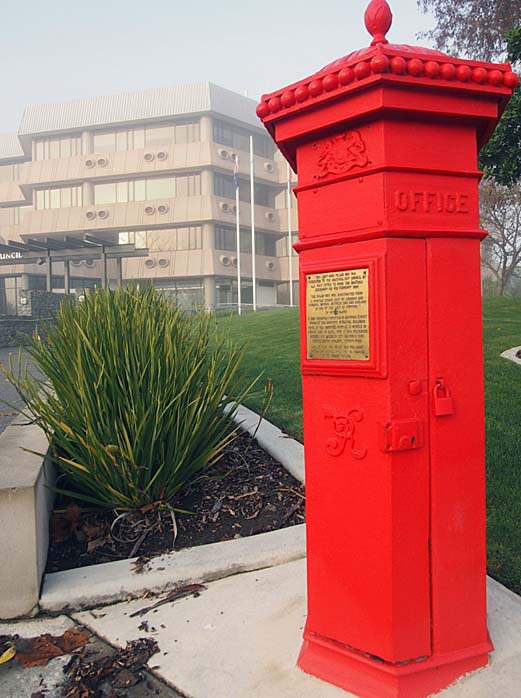
Post Box (Former) was manufactured by the Christchurch firm of P & D Duncan Limited. Their manufacturing mark was revealed after the pillar box was hit by a vehicle in the mid 1980s. Up until 1879 New Zealand’s street pillar boxes had been imported from Australia. The Duncan brothers, Peter (1838-1907) and David (1832-1897), had emigrated from Scotland, arriving in Lyttelton in 1863 and 1867 respectively. They each had solid work experience in smithing and fitting by this time. Despite going into partnership in 1870 it was not until 1874 that they adopted the name P & D Duncan, and in 1894 it became a limited liability company. In the same year the company began manufacturing pillar boxes for the Post Office Department. The company’s contract for letter receivers is thought to have ended in 1901, although it has been posited that they continued to create pillar boxes into the Edwardian period.
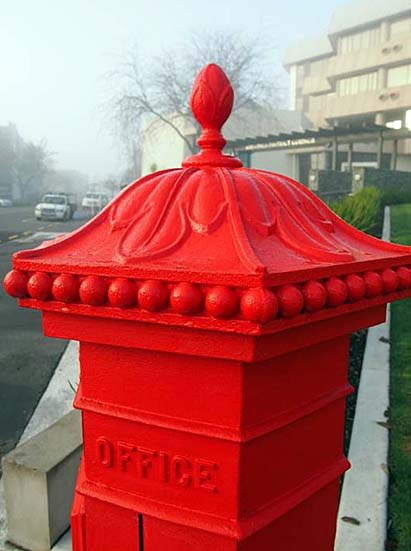
The design used was the same as the British receivers designed by John Wornham Penfold (1828-1909), and named after him. Britain first introduced letter receivers in the early 1850s. In 1865 Penfold, an architect and surveyor, was invited to design a new standard pillar box. There were several Penfold box variations, and the style of Post Box (Former) shows it to be one of the last implemented in Britain, dating from around 1872. The British Postal Museum and Archive states that the 1872-79 version of the Penfold pillar box is ‘very rare.’ In the 1870s Britain reverted to a cylindrical pillar box as standard. However, Penfold boxes continued to be manufactured in New Zealand into the Edwardian period.
Post Box (Former) has the insignia VR (Victoria Regina) on it, which places its period of manufacture before the death of Queen Victoria in 1901. The NZHPT Buildings Classification Committee dated it circa 1885. However, in 1986 Robin Startup, then editor of the Postal History Society’s journal, noted the Hastings box was not recorded in a Post Office list in 1902 but was in a 1910 list. He therefore suggested it was probably cast in 1901 and installed post-1902, most likely 1903. A search of the Post and Telegraph Department annual reports from 1883 to 1903 found the earliest reference to letter receivers being installed in Hastings was a group of three in 1903. Therefore, it is highly probable that Post Box (Former) was amongst this first group of Hastings post receivers. A debate was played out in several issues of Historic Places magazine during 1985 and 1986 regarding the disparate attributed manufacturing and installation dates for Post Box (Former). However, based on evidence from government records, Startup’s 1903 installation date seems most likely.
The Post Office’s expansion of services in Hastings was relatively late compared with Napier, which had letter receivers since the 1880s. The only remaining pillar box in Napier is Post Box, Category 2 historic place (Register No. 4829). Based on the apparent continued installation of VR type boxes until at least 1903, as seen with the Hastings receiver, it is likely that the Napier pillar box was installed after this period since it bears the mark of the subsequent monarch, King Edward VII. Indeed, Startup dates the Napier receiver to 1905.
As well as being indicative of the growth in Hastings’ population, the installation of these boxes may also have been motivated by a broader national communications trend at the time. On 1 January 1901 New Zealand introduced universal penny post, significantly cutting the cost for posting letters nationally and internationally. This is said to have had an ‘electrifying effect. Almost everyone seemed to take to letter writing.’ The government had anticipated that penny postage would ‘prove an epoch in the history of the colony. New Zealand will by this reform be placed in the forefront of the civilised countries of the world.’ Therefore, it seems likely that the anticipated greater demand led to the pre-ordering of post boxes. Indeed, penny post did prove ‘an estimable boon,’ with the statistics for the first year of its implementation showing letter volume was up by 13 million pieces. However, there is also a possibility that Post Box (Former) may have been one that the Post Office Department had closed elsewhere and then re-used in Hastings.
Post Box (Former) was first installed outside Hasting’s Methodist Church, on the corner of Heretaunga Street East and Hastings Street South. In the early 1950s the New Zealand Post Office Association began a campaign to replace the cast iron pillar boxes with hutch-like wooden letter boxes mounted on posts. Considered unsanitary, leaky, and difficult to clear, most boxes were sold to museums and private collectors or turned into scrap metal. However, some were retained ‘in those districts where they were of historical interest.’
Presumably Hastings residents successfully advocated for their post box’s retention on those grounds. In 1984 the Post Office Department presented Post Box (Former) to the Hastings District Council to mark Hastings’ centenary of becoming a town district. In 1986 the Council relocated it to outside their offices on Lyndon Road East. The previous year it had been hit by a car, revealing the manufacturer’s marks below street level.
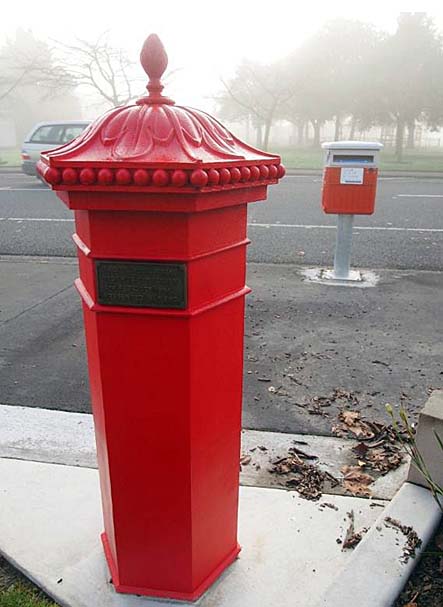
It was not until 1992 that Post Box (Former) was permanently closed. The reasoning behind its closure was there was no provision for keeping standard and fast post separate, and also the colour of the box did not comply with New Zealand Post corporate branding. Therefore, a new letter receiver was installed further north along the road and a sign placed on Post Box (Former) directing customers to it.
In 2011 Post Box was moved approximately 15 metres to the north corner of the Council’s property as part of a landscaping project which created a new entrance for the Council buildings. Therefore, it is now directly opposite a contemporary letter receiver which is on the road side of the footpath.