Clive Square was included as green space in the first town plan for Napier in 1855. Archaeological work has shown evidence of pre-European Māori occupation of the area. Clive Square was used for sporting and cultural activities from the 1860s. In 1884, after it lost its function as Napier’s main sportsground, William Robert Blythe wrote to the Municipal Council with a proposal to improve the southern portion of the Square. Born in Scotland in 1841, Blythe trained as a draper in England and arrived in Napier in 1870, starting his own drapery business in 1872. He was involved in a huge range of sporting clubs and was known to be a generous man and good employer. As well as initiating the beautification of Clive Square, he was instrumental in the formation of Napier’s Beautifying Association in 1900. He took an active interest in politics and was a friend of George Henry Swan, Mayor of Napier from 1885-1901. After he died in 1903 his friends formed a committee to raise money for a fountain in his memory, which was erected in 1904. The fountain survived the 1931 Hawke’s Bay earthquake but suffered damage to its upper half and the upper bowl was not restored until 1999.
Prior to 2015 the fountain had undergone little maintenance and was in serious disrepair. An extensive restoration project was undertaken by the Napier City Council which involved completely dismantling the fountain in order to treat and restore each portion, which renewed public appreciation for the fountain.


List Entry Information
Status
Listed
List Entry Status
Historic Place Category 2
Access
Able to Visit
List Number
1110
Date Entered
20th February 2020
Date of Effect
11th March 2020
City/District Council
Napier City
Region
Hawke's Bay Region
Extent of List Entry
Extent includes part of the land described as Legal Road and Lot 6 DP 22314 (NZ Gazette 1992 p. 3134; RT HBW2/674), Hawkes Bay Land District, and the structure known as Blythe Memorial Fountain thereon. Extent includes a curtilage extending 2 metres in all directions from the fountain’s base. (Refer to map in Appendix 1 of the List entry report for further information).
Legal description
Legal Road, Lot 6 DP 22314 (NZ Gazette 1992 p. 3134; RT HBW2/674), Hawkes Bay Land District
Location Description
Located on the Dickens Street side of Clive Square East at the intersection with Emerson Street, Napier.
Status
Listed
List Entry Status
Historic Place Category 2
Access
Able to Visit
List Number
1110
Date Entered
20th February 2020
Date of Effect
11th March 2020
City/District Council
Napier City
Region
Hawke's Bay Region
Extent of List Entry
Extent includes part of the land described as Legal Road and Lot 6 DP 22314 (NZ Gazette 1992 p. 3134; RT HBW2/674), Hawkes Bay Land District, and the structure known as Blythe Memorial Fountain thereon. Extent includes a curtilage extending 2 metres in all directions from the fountain’s base. (Refer to map in Appendix 1 of the List entry report for further information).
Legal description
Legal Road, Lot 6 DP 22314 (NZ Gazette 1992 p. 3134; RT HBW2/674), Hawkes Bay Land District
Location Description
Located on the Dickens Street side of Clive Square East at the intersection with Emerson Street, Napier.
Why is this place significant?
Cultural Significance
Social Significance or Value Clive Square has been a gathering space for the citizens of Napier since the 1860s, and this green space with established planting offers a valued respite from the busy streets surrounding it. The extensive publicly-funded 2015 restoration of the fountain indicates that it is valued by the community, and the positive feedback received after the restoration further illustrates appreciation for the fountain amongst the general public.
Historic Significance
Historical Significance or Value The Blythe Memorial Fountain is located within a key historic area in Napier, connected to pre-European Māori and colonial activity. The fountain represents the wide-ranging public service of William Robert Blythe, a Scottish immigrant who settled in Napier and became a prominent businessman and influential citizen. Blythe played a key role in the 1884-86 beautification of Clive Square and the formation of a Beautification Association, helping to shape the urban landscape of colonial Napier and encourage recreational activity in pleasant surroundings. This not only demonstrates the development of Napier as a town but also echoes the tradition of community involvement in the guardianship of urban green spaces that developed around New Zealand in the late nineteenth century.
Physical Significance
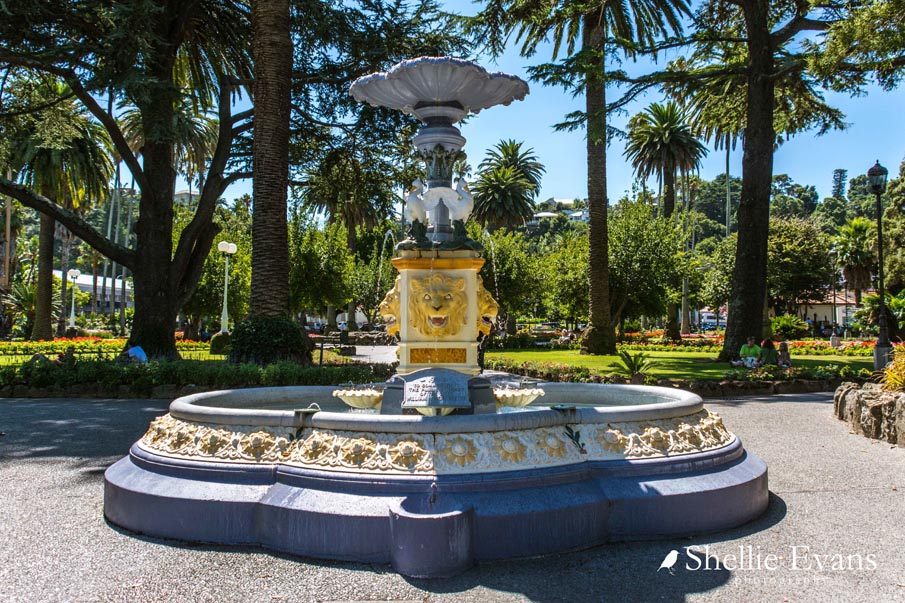
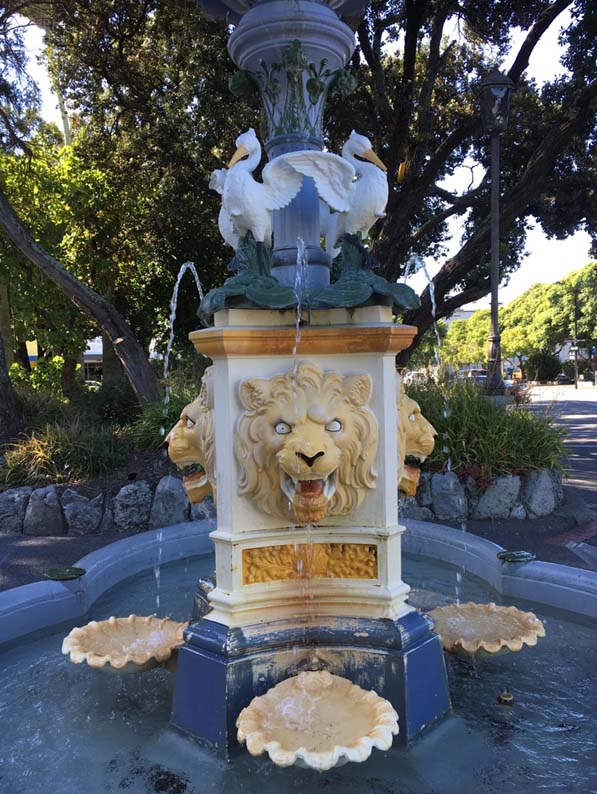
Aesthetic Significance or Value The Blythe Memorial Fountain makes an immediate visual impact with its highly decorative features of herons, lions, lily pads and patterned borders in combination with its striking colour palette, including different shades of blue and yellow as well as green, cream and white. Clive Square offers a restful green space in central Napier and the fountain acts as a gateway between the street and the park, drawing people in through the boldness of its ornamentation.
Why is this place Category 1 / Category 2?
Detail Of Assessed Criteria
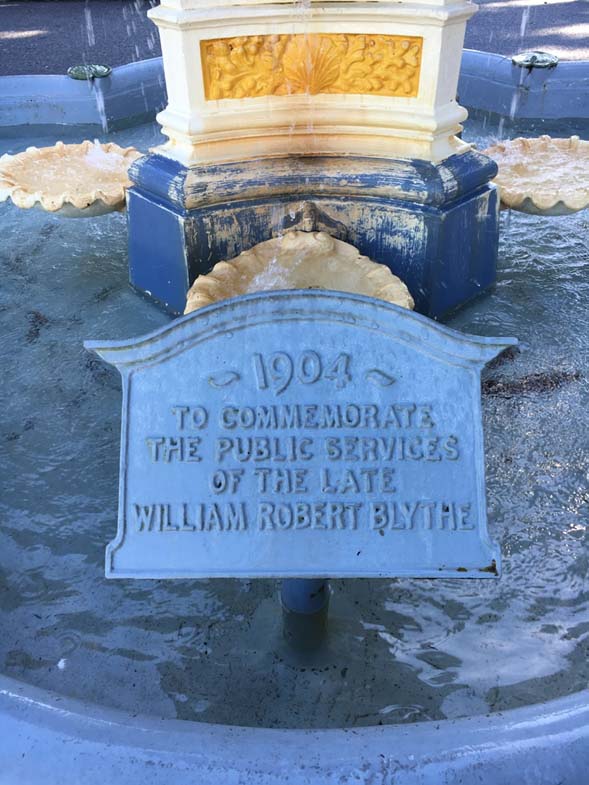
(a) The extent to which the place reflects important or representative aspects of New Zealand history The Blythe Memorial Fountain represents the level of influence immigrants to colonial New Zealand were able to have through their own initiative and the cultivating of public goodwill and political relationships. William Robert Blythe did not serve in either local or central government roles, but he had a strong impact on the Napier urban landscape through his beautifying efforts and on the community of Napier through his wide-ranging public service. The fountain’s plaque contributes to our understanding of Blythe’s significant public service and its decorative elements speak to Blythe’s personal interests and characteristics. The fountain, as a reminder of Blythe’s efforts to improve Napier’s urban environment, connects with the movement of community-led efforts to develop and protect New Zealand’s green spaces that is shown through the formation of beautification associations and scenery preservation groups around the country in the late nineteenth century. . (e) The community association with, or public esteem for the place The significant restoration of the Blythe Memorial Fountain undertaken in 2015 demonstrates that it is valued as a public monument by the Napier City Council and its rate paying citizens. Positive comments received by the Council and on websites maintained by private citizens following this restoration show public appreciation for the fountain. The fountain has occupied a prominent place in central Napier for over a century, surviving the catastrophic 1931 earthquake. As such, the public would undoubtedly experience a sense of loss if the fountain was to be removed from its longstanding home. (h) The symbolic or commemorative value of the place The Blythe Memorial Fountain commemorates William Robert Blythe and his public service for the benefit of Napier. This commemorative function is made explicit by a plaque naming William Robert Blythe and his public service. Decorative features on the fountain can be understood to symbolise aspects of Blythe’s personal interests and characteristics. The ornate fountain is itself indicative of the common visual language employed in commemorating civic-minded individuals, and remains a fitting symbol of Blythe’s work to beautify Napier’s urban environment. (k) The extent to which the place forms part of a wider historical and cultural area The Blythe Memorial Fountain is located in Clive Square. Clive Square falls within the Napier City Centre Historic Area (List No. 7022) and sits alongside Memorial Square which contains the Women’s Rest (Former) (List No. 1180) and the Napier Cenotaph (List No. 113). Both Clive Square and Memorial Square are well-maintained public green spaces with established planting. They are in close proximity to a range of historic buildings and structures in Napier as well as having their own historical importance dating back to Napier’s first town plan in 1855 and showing evidence of pre-European Māori occupation.
Why is this place significant?
Cultural Significance
Social Significance or Value Clive Square has been a gathering space for the citizens of Napier since the 1860s, and this green space with established planting offers a valued respite from the busy streets surrounding it. The extensive publicly-funded 2015 restoration of the fountain indicates that it is valued by the community, and the positive feedback received after the restoration further illustrates appreciation for the fountain amongst the general public.
Historic Significance
Historical Significance or Value The Blythe Memorial Fountain is located within a key historic area in Napier, connected to pre-European Māori and colonial activity. The fountain represents the wide-ranging public service of William Robert Blythe, a Scottish immigrant who settled in Napier and became a prominent businessman and influential citizen. Blythe played a key role in the 1884-86 beautification of Clive Square and the formation of a Beautification Association, helping to shape the urban landscape of colonial Napier and encourage recreational activity in pleasant surroundings. This not only demonstrates the development of Napier as a town but also echoes the tradition of community involvement in the guardianship of urban green spaces that developed around New Zealand in the late nineteenth century.
Physical Significance
Aesthetic Significance or Value The Blythe Memorial Fountain makes an immediate visual impact with its highly decorative features of herons, lions, lily pads and patterned borders in combination with its striking colour palette, including different shades of blue and yellow as well as green, cream and white. Clive Square offers a restful green space in central Napier and the fountain acts as a gateway between the street and the park, drawing people in through the boldness of its ornamentation.
Why is this place Category 1 / Category 2?
Detail Of Assessed Criteria
(a) The extent to which the place reflects important or representative aspects of New Zealand history The Blythe Memorial Fountain represents the level of influence immigrants to colonial New Zealand were able to have through their own initiative and the cultivating of public goodwill and political relationships. William Robert Blythe did not serve in either local or central government roles, but he had a strong impact on the Napier urban landscape through his beautifying efforts and on the community of Napier through his wide-ranging public service. The fountain’s plaque contributes to our understanding of Blythe’s significant public service and its decorative elements speak to Blythe’s personal interests and characteristics. The fountain, as a reminder of Blythe’s efforts to improve Napier’s urban environment, connects with the movement of community-led efforts to develop and protect New Zealand’s green spaces that is shown through the formation of beautification associations and scenery preservation groups around the country in the late nineteenth century. . (e) The community association with, or public esteem for the place The significant restoration of the Blythe Memorial Fountain undertaken in 2015 demonstrates that it is valued as a public monument by the Napier City Council and its rate paying citizens. Positive comments received by the Council and on websites maintained by private citizens following this restoration show public appreciation for the fountain. The fountain has occupied a prominent place in central Napier for over a century, surviving the catastrophic 1931 earthquake. As such, the public would undoubtedly experience a sense of loss if the fountain was to be removed from its longstanding home. (h) The symbolic or commemorative value of the place The Blythe Memorial Fountain commemorates William Robert Blythe and his public service for the benefit of Napier. This commemorative function is made explicit by a plaque naming William Robert Blythe and his public service. Decorative features on the fountain can be understood to symbolise aspects of Blythe’s personal interests and characteristics. The ornate fountain is itself indicative of the common visual language employed in commemorating civic-minded individuals, and remains a fitting symbol of Blythe’s work to beautify Napier’s urban environment. (k) The extent to which the place forms part of a wider historical and cultural area The Blythe Memorial Fountain is located in Clive Square. Clive Square falls within the Napier City Centre Historic Area (List No. 7022) and sits alongside Memorial Square which contains the Women’s Rest (Former) (List No. 1180) and the Napier Cenotaph (List No. 113). Both Clive Square and Memorial Square are well-maintained public green spaces with established planting. They are in close proximity to a range of historic buildings and structures in Napier as well as having their own historical importance dating back to Napier’s first town plan in 1855 and showing evidence of pre-European Māori occupation.
Construction Details
Start Year
1904
Type
Original Construction
Start Year
1920
Type
Modification
Description
Water supply cut off
Start Year
1931
Type
Demolished - Earthquake
Description
Upper section removed as a result of earthquake damage.
Start Year
1962
Type
Modification
Description
Water supply system restored
Start Year
1999
Type
Modification
Description
Upper bowl reinstalled
Start Year
2015
Type
Restoration
Description
Extensive restoration
Construction Materials
Concrete (base), cast iron
Construction Details
Start Year
1904
Type
Original Construction
Start Year
1920
Type
Modification
Description
Water supply cut off
Start Year
1931
Type
Demolished - Earthquake
Description
Upper section removed as a result of earthquake damage.
Start Year
1962
Type
Modification
Description
Water supply system restored
Start Year
1999
Type
Modification
Description
Upper bowl reinstalled
Start Year
2015
Type
Restoration
Description
Extensive restoration
Construction Materials
Concrete (base), cast iron
Early Napier The Ahuriri area’s rivers, wetlands, lagoons and fertile land produced important resources, making the area an attractive place to live. Settlement is thought to have begun in the twelfth or thirteenth century and Ngāti Kahungunu became the dominant iwi from the sixteenth century. There were several pā at what became Port Ahuriri and Napier. As a result of inter-tribal warfare, around the 1830s many local Ngāti Kahungunu sought refuge in Māhia. When missionaries and other Europeans began arriving in earnest after the signing of the Treaty of Waitangi, the exiles had returned and Te Koau, near Te Pakake, became the principal local pā. With the Ahuriri Purchase of 1851, the Crown acquired the lands between the Tutaekuri River and north to the Mohaka area, inclusive of Mataruahou and most of its surrounds. A few years later, in 1855, Napier was established by the government. The site was not promising because road access was difficult and future expansion would be challenging. However, Napier had a port, which was an important factor in Napier becoming Hawke’s Bay’s early administrative, commercial, and social centre. The population rose steadily: 343 in 1858; to 3,514 in 1874; and 8,774 in 1901. Napier’s geography limited its growth, until the 1931 Hawke’s Bay Earthquake lifted the ground level by as much as 2.7 metres in some places. In 1855 a town plan for Napier was produced by Alfred Domett (1811-1887), commissioner of Crown lands in Hawke’s Bay. The plan was ‘for a complete town, and laid down a pattern of roads and sections, with sites being reserved for public facilities.’ One of these public facilities was an area of land named Clive Square, envisaged as a recreation space or ‘village green’. Recent archaeological work has found evidence of pre-European Māori occupation of Clive Square. Clive Square was initially favoured as the town’s centre, but the rapid growth of businesses elsewhere in the town meant this never eventuated. When the Hawke’s Bay Provincial Council was abolished and replaced by the Napier Borough Council, the ‘Reserve known as Clive Square’ was included in the Napier Borough Endowments Act 1876 for the ‘use benefit and improvement of the Borough of Napier.’ From early on in Napier’s colonial history, the residents of Napier made good use of Clive Square for sporting and cultural activities and entertainment. In the 1860s an area of the Square was filled in and levelled for cricket and football matches. The Napier City Band (formed in 1868) gave recitals in the Square and it was the site of regular military inspection parades and of visiting entertainment such as circuses. Clive Square’s champion, William Blythe In 1884, the Recreation Ground took over as the town’s main sportsground and in June that year Mr W. R. Blythe wrote to the Napier Municipal Council with a proposal ‘for the improvement and adaptation of the southern portion’ of Clive Square. The proposal involved the erection of a ‘substantial and sightly fence’, a central concrete square with powerful gas lights installed on each corner, the creation of paths and planting and a band rotunda. Blythe explained that the cost of the gas lamps would be met by four local men and gave a personal undertaking to raise £100 towards the cost of the improvement work. By 1884, William Robert Blythe had lived in Napier for almost 14 years and had established himself as a successful businessman with an interest in civic matters. Born in 1841 in Scotland, Blythe learned his trade as a draper in Lancashire, England, then moved to St Helens in the same county and purchased an interest in a chemical manufacturing firm. He arrived in New Zealand in 1870, and settled in Napier, where he worked as a salesman for a general goods store with drapery before starting his own business, Blythe & Co. described as a ‘general drapers and outfitters’, in May 1872. He married Fanny Maria Robinson in 1874 and their first child was born the following year. They would go on to have a further five children together, three daughters and three sons in total. Blythe purchased rural and urban property in Napier and Hastings and the wider Hawke’s Bay region, building up a substantial property portfolio. One of his primary residences was a villa on Shakespeare Road, but in his later years he had residences on Sealy Road and Cobden Road. The family were comfortable enough to employ staff such as a nurse, housemaid and cook. Blythe was a founding member of the Napier Chamber of Commerce. Blythe took a strong interest in military and defence matters, serving as Captain Commanding of the Napier Rifle Volunteers in the 1880s. Through letters to local newspapers and participation in the Union Debating Society, he voiced his opinion on matters of defence and presented his ideas for the structure of New Zealand’s forces. Blythe’s son Girthon served in the South African war and Blythe was involved in organising Napier’s celebrations to mark the end of that war, described at the time as ‘a gentleman always to the fore in patriotic displays’. Blythe was also a member of the Napier Rifle Association and took a recreational interest in hunting game. He often served as a chairman, committee member or patron of a wide range of sporting teams, including swimming, athletics, cricket, football, racing and rowing. He also founded the Port Drum and Fife Band. Poultry raising and exotic birds and animals were also of interest to Blythe. At the 1893 Napier Poultry and Canary Association show, he exhibited ‘a number of newly imported fancy birds’ from 60 he had imported from Sydney, along with a pair of Russian guinea pigs and a monkey. Later that year he released a pair of Kookaburra in the hope that they would ‘thrive and breed.’ In 1900 he donated three bantam hens to each primary school in the district ‘with a view to encouraging the children to take an interest in poultry raising.’ Blythe was known as both a generous man and a good employer. He donated to various causes and liked to see credit given where he believed it was due. In 1896 the Hastings Fire Police acknowledged a letter of thanks and a cheque from Blythe, noting he was the only person to recognise the efforts of the Police in this way, despite the number of people they had assisted and the thousands of pounds worth of property they had saved since their formation. By 1897 he had 66 staff across his Napier and Hastings stores and he regularly held events such as dinners, balls and picnics to thank and reward them. Blythe’s prominent role in the community was already evident by 1881, when he was one of a small group presented to visiting Governor-General Sir Arthur Gordon. He was made a Justice of the Peace in 1885 and was a member of the 1897 Flood Relief Committee. He took an active role in politics, chairing a committee of John Davies Ormond’s supporters in the lead-up to the 1884 general election, at which Ormond won the Napier seat. Blythe was a friend of George Henry Swan, Napier’s Mayor from 1885 to 1901. Blythe’s active interest in public amenities and beautifying Napier was evident from 1881 when he wrote to the Napier Borough Council about tree planting, and the following year he was part of a group who sought permission to erect a fountain and drinking trough on Beach Road. Around New Zealand at this time, other like-minded citizens were also beginning to lead their communities to improve their environments, and the formation of various scenery preservation societies, conservation groups and beautifying societies from the 1880s onwards indicates that Blythe was at the forefront of this movement. Following Blythe’s proposal to the Council regarding improvements to southern Clive Square in June 1884, the Clive Square Improvement Committee was formed, of which Blythe was a member. Fundraising events including a concert at the Theatre Royal and a fair were held, but by February 1885 planting season was drawing near and only £18 had been raised after expenses. In a letter to the Daily Telegraph, Blythe announced a public subscription scheme to raise the remainder of the £100 contribution he had undertaken to provide towards the project. In addition, he noted that the Garrison Band had committed to performing in the Square each week during fair weather months if enough was raised to install a band rotunda at an extra cost of £50. On the first day of public subscriptions £46 was collected and by April 1885 Blythe had forwarded a £100 cheque to the Council and requested that the four gas lamps supplied by private citizens be erected immediately. In September 1886 paths were completed, grass sown, trees planted and the band rotunda constructed. The opening of the newly appointed Square on 29 November 1886 was a festive occasion, featuring a torchlight procession, music and fireworks. For the official part of the proceedings, Blythe joined Mayor Swan on the stage, who commended Blythe for his initiation of the work, adding that he ‘may be called the father of the work.’ The northern end of Clive Square was left undeveloped to serve as the playground for students of Napier Main School just across the road. Blythe’s efforts in beautifying Napier continued after this work on Clive Square. In a letter to the Daily Telegraph in 1900 he described Napier as a ‘perfect little Cinderella of a town’ and asked, ‘cannot we supply the new frock, slippers, bits of ribbon, etc., in the shape of a judicious revision and extension of our tree planting?’ Swan and Blythe were then involved in the setting up on a Beautifying Association for the city. Soon after, Blythe left on a trip to the United Kingdom, his first since leaving thirty years earlier. By this time his wife and all three of his daughters had died and he planned to visit two of his sons who were living there. The high esteem in which he was held is evidenced by gifts given to him by his peers and employees, a gathering in the Criterion Hotel presided over by Mayor Swan and the City Band ‘playing a number of selections on the wharf in his special honour’ as his ship departed. Blythe returned home in 1901 and in 1902 his sizeable Napier store was rebuilt in brick and extended from Emerson Street to Hastings Street. By May 1903 he sailed to Australia for his health; and although he had planned to return to Napier he died there on 7 December, aged 62. Blythe’s daughter Isabella had died in Sydney four years earlier and he was buried there with her. Commemoration In the month following Blythe’s death, a committee was formed to raise funds for a memorial fountain. The Hawke’s Bay Herald encouraged contributions, noting: ‘There are few citizens who in their time have exerted themselves more unselfishly for the good of their town than the late Mr W. R. Blythe. All who have been interested in the welfare of Napier can recall not only the energy with which he himself devised and promoted schemes for the benefit and advancement of the place, but also the sympathy and assistance which he rendered to the efforts of others’. On 10 June a meeting of subscribers to the Blythe Memorial Fund confirmed the committee’s selected design, described as ‘a cast-iron fountain, 10ft 8in high, chased and otherwise ornamented.’ In July the Napier Borough Council agreed to its placement in Clive Square, with the fund to meet all costs associated with the fountain’s installation and the Council to provide free water. The fountain was placed at the southern end of Clive Square and its plaque is dated 1904, but it is not known when the fountain’s installation was completed or if any kind of unveiling ceremony took place. The choice of a fountain reflects the common use of such installations, in that period, to commemorate civic-minded and philanthropic individuals. The fountain’s decorative features include herons, which are appropriate to Blythe’s interest in birds, and lions, a symbol of the British Empire and associated with the military and qualities such as strength, courage and loyalty. An early photograph of the fountain shows turnstiles on either side of it, but these were removed, probably in the 1910s, and replaced with planting. In advance of the Prince of Wales’ visit in 1920 another round of improvements to Clive Square was made. Under the direction of Charles Corner, Superintendent of Reserves, the Square’s picket fence was removed and replaced by a limestone surround. ‘Superfluous trees and shrubs’ were replaced by ‘palms, trees and shrubs of a sub-tropical nature.’ The water supply to the fountain was turned off in 1920 and photographs of the fountain after the 1931 Hawke’s Bay earthquake show it planted with greenery. In 1924 Napier’s war memorial Cenotaph (List No. 113) was erected in the northern portion of Clive Square, followed by the Napier Women’s Rest (List No. 1180) in 1926. During the official opening of the Women’s Rest, the northern part of the Square was officially renamed Memorial Square. Despite being used for many years as a road, it wasn’t until 1962 that a strip of land dividing Clive Square and Memorial Square gained the status of a legal road (Emerson Street). On the morning of 3 February 1931, a magnitude 7.8 earthquake killed at least 256 and injured thousands more in Hawke’s Bay. Buildings in Napier and Hastings crumbled and fire quickly tore through Napier’s central business district. The damage was catastrophic. The Blythe Memorial Fountain was damaged in the earthquake and photographs show the pedestal of the upper half of the fountain dislodged and leaning significantly to the west. This upper part of the fountain was removed and stored, and was not restored until 1999, when the upper basin was reinstated without the heron that had once stood in its centre. The band rotunda installed as result of Blythe’s efforts was also badly damaged in the 1931 earthquake and in 1934 it was replaced by a goldfish pond. In the weeks following the earthquake, the rebuilding of central city business premises was forbidden, to allow thoughtful planning of the town centre’s reconstruction. Instead, government funding was provided for the construction of temporary shops and offices in Clive and Memorial Squares, making these spaces integral to the city’s post-earthquake infrastructure. Water was restored to the fountain in 1962. Subsequently, despite descendants of Blythe keeping an eye on the fountain and making donations towards its upkeep, prior to 2015 the fountain had received little maintenance and ‘some pretty serious decay had set in on the panels, pipe work and fixing bolts’. In 2015 Napier City Council undertook a comprehensive restoration of the fountain, which involved completely dismantling it in order to treat and restore each portion, replacing its lead pipes, re-levelling its base, recasting several missing pieces which had been damaged or destroyed, and repainting it in what was considered ‘an appropriate Victorian colour scheme’. Since restoration, the fountain has become a favourite site within Napier for photobloggers; both local and those from further afield. Comments in response to posted photographs praised the restoration and lamented that it had not occurred earlier . In a May 2015 Council publication, Mayor Bill Dalton noted that many compliments had been received following the restoration of the fountain.
Current Description The Blythe Memorial Fountain is located at the southern central entrance of Clive Square, Napier, facing the intersection of Dickens and Munroe Street. The Blythe Memorial Fountain has a striking colour palette including different shades of blue and yellow as well as green, cream and white. It has a large blue base with four curved edges. A decorative cream-coloured border runs around the top of the base featuring yellow flowers. In the centre of the northern and southern exterior sides of the base is a small round protrusion, which serves no apparent purpose. A green lily pad sits on top of the four points where each of the curves of the base meet, and below each lily pad the shape of a potted plant appears in the decorative border. The central pedestal has four concave sides, each featuring an open-mouthed lion painted yellow with a black nose, white teeth and pink tongue. Below the lion is a decorative panel with a clam shell in the centre and a protruding basin with curved edges that resembles a blooming flower head. Above the lion heads, on each of the four corners of the central pedestal, a white heron bird stands amongst decorative greenery with its wings outstretched and yellow beak pointed down. On top of this central pedestal sits a thinner, tapered blue pedestal decorated with leaves. The pedestal widens out again towards the top, holding a blue basin with four curved edges that echoes the shape of the fountain’s base and resembles the blooming edges of the smaller protruding basins below the lions’ heads. Water shoots upwards out of a small pipe above each of the lion’s heads and out of each lion’s open mouth. A blue plaque is attached to a vertical stand at the inner edge of the base on the southern end of the fountain; it sits angled towards the viewer and reads: ‘1904 / To Commemorate / The Public Services / Of The Late / William Robert Blythe’. Around the fountain on its northern, eastern and western sides are established trees and gardens with rock borders. Looking past the fountain into the Square there are areas of lawn, flower beds, paths and a large raised pond made from dark grey stone featuring a central fountain, also made from dark grey stone.
Historical and Associated Iwi / Hapū / Whānau
Completion Date
26th October 2019
Report Written By
Cherie Jacobson and Elizabeth Cox
Information Sources
Campbell, 1975
M. D. N. Campbell, Story of Napier, 1874-1974; Footprints Along the Shore
Press
Press, 17 May 1915, p.9.
Te Ara - The Encyclopedia of New Zealand
www.TeAra.govt.nz
Te Ara - The Encyclopedia of New Zealand
www.TeAra.govt.nz
Te Ara - The Encyclopedia of New Zealand
www.TeAra.govt.nz
Hawke's Bay Herald
Hawke's Bay Herald
Hawke’s Bay Museum and Art Gallery
Other Information
A fully referenced proposal summary report is available on request from the Central Region Office of the NZHPT.
Historical and Associated Iwi / Hapū / Whānau
Completion Date
26th October 2019
Report Written By
Cherie Jacobson and Elizabeth Cox
Information Sources
Campbell, 1975
M. D. N. Campbell, Story of Napier, 1874-1974; Footprints Along the Shore
Press
Press, 17 May 1915, p.9.
Te Ara - The Encyclopedia of New Zealand
www.TeAra.govt.nz
Te Ara - The Encyclopedia of New Zealand
www.TeAra.govt.nz
Te Ara - The Encyclopedia of New Zealand
www.TeAra.govt.nz
Hawke's Bay Herald
Hawke's Bay Herald
Hawke’s Bay Museum and Art Gallery
Other Information
A fully referenced proposal summary report is available on request from the Central Region Office of the NZHPT.
Current Usages
Uses: Civic Facilities
Specific Usage: Fountain
Uses: Commemoration
Specific Usage: Memorial - Particular person or group
Former Usages
General Usage: Civic Facilities
Specific Usage: Fountain
General Usage: Commemoration
Specific Usage: Memorial - Particular person or group
Current Usages
Uses: Civic Facilities
Specific Usage: Fountain
Uses: Commemoration
Specific Usage: Memorial - Particular person or group
Former Usages
General Usage: Civic Facilities
Specific Usage: Fountain
General Usage: Commemoration
Specific Usage: Memorial - Particular person or group
Sign up to hear more
Get the latest heritage news, features and events delivered
straight to your inbox.