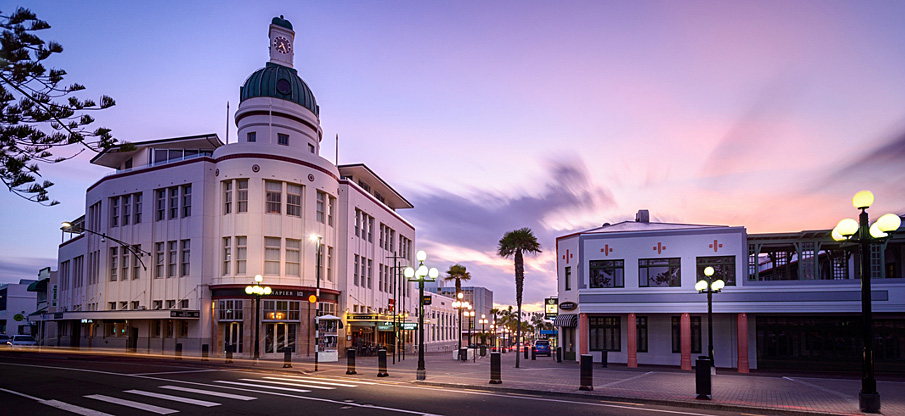
The Bank of New Zealand opened its Napier branch on 2 March 1862 in temporary premises in Emerson street. Later it was located in a permanent building on the corner of Hastings and Browning Streets. It did well from the outset, securing the important government contract which resulted in its supplying funds to the army commissariat during the New Zealand wars of the 1860s. Much later, in 1950-51, it was instrumental in financing the establishment by former shareholders of the important East Coast Fertilizer Company.
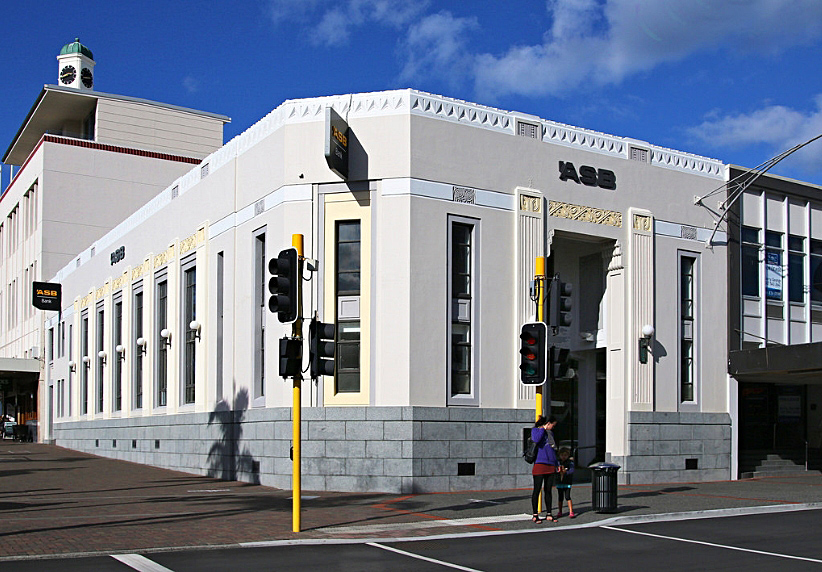
When the Hawkes Bay earthquake hit in 1931 the Bank's wooden premises were burnt down but in record time a "community bank" was built in a park and here six banks, including the Bank of New Zealand, operated under one roof until each acquired a new building. The BNZ's was opened on 5 November 1934 after more than a year's work. The contractor W M Angus Ltd and the subcontractors. Its apple green exterior was 'a mild sensation not only in Napier but in other places' according to the Daily Telegraph which praised its 'most pleasing colour scheme, which harmonises perfectly with the clean, free-lined type of architecture and adopted'.
The bank occupied the building until December 1989, extending it twice to gain more space. Since then it has been unoccupied and on the market. A plan for multiple uses centred round tourism is being canvassed.
List Entry Information
Status
Listed
List Entry Status
Historic Place Category 1
Access
Private/No Public Access
List Number
1112
Date Entered
12th December 1991
Date of Effect
12th December 1991
City/District Council
Napier City
Region
Hawke's Bay Region
Extent of List Entry
Extent includes part of the land described as Lot 1 DP 24894 (SRS HBV4/733), Hawkes Bay Land District, and the building known as Bank of New Zealand (Former) thereon. Refer to the map tabled at the Rārangi Kōrero Committee meeting on 30 January 2025.
Legal description
Lot 1 DP 24894 (SRS HBV4/733), Hawkes Bay Land District
Location Description
Included in the Napier City Centre Historic Area, Napier (Register no. 7022).
Status
Listed
List Entry Status
Historic Place Category 1
Access
Private/No Public Access
List Number
1112
Date Entered
12th December 1991
Date of Effect
12th December 1991
City/District Council
Napier City
Region
Hawke's Bay Region
Extent of List Entry
Extent includes part of the land described as Lot 1 DP 24894 (SRS HBV4/733), Hawkes Bay Land District, and the building known as Bank of New Zealand (Former) thereon. Refer to the map tabled at the Rārangi Kōrero Committee meeting on 30 January 2025.
Legal description
Lot 1 DP 24894 (SRS HBV4/733), Hawkes Bay Land District
Location Description
Included in the Napier City Centre Historic Area, Napier (Register no. 7022).
Why is this place significant?
Historic Significance
Historical Significance or Value The Bank of New Zealand building is significant as an element of a rebuilding programme which, due to the Hawkes Bay earthquake, was initiated by government at a time when financial constraints ensured very little building was being done elsewhere. As a contemporary newspaper claimed, it was proof of the bank's confidence in the prosperity and success of the new Napier.
Physical Significance
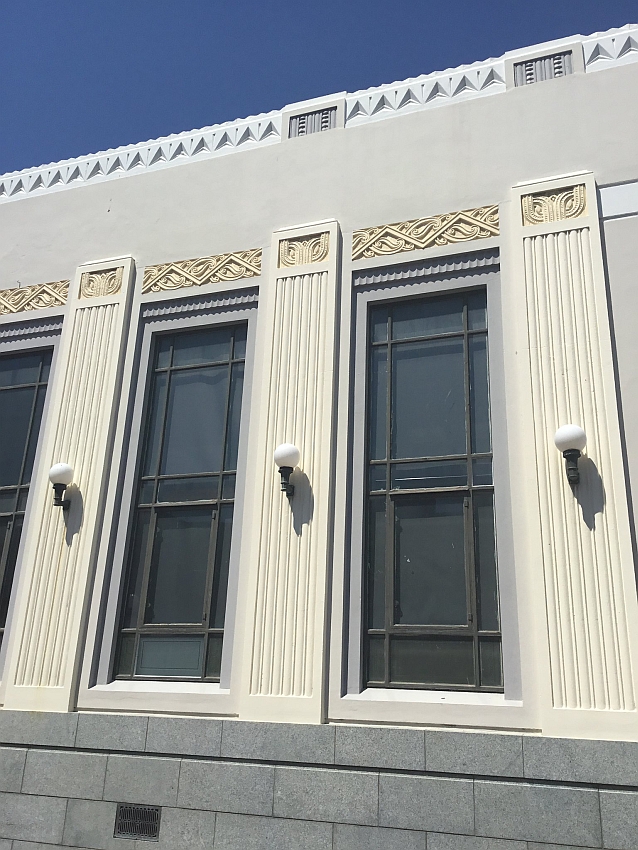
ARCHITECTURAL QUALITY: A graceful building in the New Zealand Art Deco idiom with many typical Art Deco features on its exterior. The designer has given it a place in New Zealand architecture which is almost unique by exploiting the similarity between Art Deco decorative patterns and traditional Maori Art. (Though it is not certain who was responsible for the Maori motifs, it was possibly Bill Couch, a draughtsman in the firm of Crichton, McKay and Haughton, who was an artist and stamp designer and may have acquired knowledge of Maori patterns through the Maori borders commonly seen on stamps of the period.) TOWNSCAPE/LANDMARK VALUE: The building is an important component of the Art Deco character of Napier, harmoniously complementing the T & G Building which stands beside it on the Emerson Street/Marine Parade corner.
Why is this place significant?
Historic Significance
Historical Significance or Value The Bank of New Zealand building is significant as an element of a rebuilding programme which, due to the Hawkes Bay earthquake, was initiated by government at a time when financial constraints ensured very little building was being done elsewhere. As a contemporary newspaper claimed, it was proof of the bank's confidence in the prosperity and success of the new Napier.
Physical Significance
ARCHITECTURAL QUALITY: A graceful building in the New Zealand Art Deco idiom with many typical Art Deco features on its exterior. The designer has given it a place in New Zealand architecture which is almost unique by exploiting the similarity between Art Deco decorative patterns and traditional Maori Art. (Though it is not certain who was responsible for the Maori motifs, it was possibly Bill Couch, a draughtsman in the firm of Crichton, McKay and Haughton, who was an artist and stamp designer and may have acquired knowledge of Maori patterns through the Maori borders commonly seen on stamps of the period.) TOWNSCAPE/LANDMARK VALUE: The building is an important component of the Art Deco character of Napier, harmoniously complementing the T & G Building which stands beside it on the Emerson Street/Marine Parade corner.
Construction Professional
Name
Crichton, McKay & Haughton
Type
Architectural Partnership
Biography
(William Crichton (1862-1928), James Hector McKay (d. 1944), Vivian Haughton (1891-1956)) William Crichton was born in England in 1862. He trained as an architect before immigrating to New Zealand in 1879. Upon his arrival he joined the Colonial Architects Office. In 1891 he established his own architectural firm and later, in 1901, joined with James Hector McKay to form the firm Crichton and McKay. (McKay had previously been in partnership with Robert Roy MacGregor from 1898-1901.) With the addition of Vivian Haughton in the 1920s the firm became Crichton, McKay & Haughton. In 1935 Haughton went into partnership with William McKeon (1896-1973). In 1952 Haughton established Haughton and Sons, which was later joined by Lindsay Mair, the son of the former government architect John Mair. Following Haughton's death in 1956, the firm became Haughton and Mair. Eventually, by the 1980s, it became Bulleyment Fortune architects. Crichton, McKay and Haughton were a prominent architectural firm in the 1920s and were responsible for a number of Wellington's commercial buildings such as the Huddart Parker Building (1923), the Dominion Building (1926-1927), as well as a number of domestic residences.
Construction Details
Start Year
1933
Finish Year
1934
Type
Original Construction
Start Year
1956
Type
Modification
Description
Extension to the rear ground floor to enlarge staff facilities; Haughton, Son and Mair, Wellington, Architects.
Start Year
1965
Type
Addition
Description
Removal of outer wall on south side and construction of two-storey (plus basement) addition. E A and L J Williams, Napier, Architects.
Start Year
1983
Type
Modification
Description
Addition of awning to exterior on Emerson and Hastings Streets.
Construction Materials
Reinforced concrete with some brick, stone (Coromandel granite) and metal work. Interior plasterwork and timber (Queensland maple). Flat Callender's roofing.
Construction Professional
Name
Crichton, McKay & Haughton
Type
Architectural Partnership
Biography
(William Crichton (1862-1928), James Hector McKay (d. 1944), Vivian Haughton (1891-1956)) William Crichton was born in England in 1862. He trained as an architect before immigrating to New Zealand in 1879. Upon his arrival he joined the Colonial Architects Office. In 1891 he established his own architectural firm and later, in 1901, joined with James Hector McKay to form the firm Crichton and McKay. (McKay had previously been in partnership with Robert Roy MacGregor from 1898-1901.) With the addition of Vivian Haughton in the 1920s the firm became Crichton, McKay & Haughton. In 1935 Haughton went into partnership with William McKeon (1896-1973). In 1952 Haughton established Haughton and Sons, which was later joined by Lindsay Mair, the son of the former government architect John Mair. Following Haughton's death in 1956, the firm became Haughton and Mair. Eventually, by the 1980s, it became Bulleyment Fortune architects. Crichton, McKay and Haughton were a prominent architectural firm in the 1920s and were responsible for a number of Wellington's commercial buildings such as the Huddart Parker Building (1923), the Dominion Building (1926-1927), as well as a number of domestic residences.
Construction Details
Start Year
1933
Finish Year
1934
Type
Original Construction
Start Year
1956
Type
Modification
Description
Extension to the rear ground floor to enlarge staff facilities; Haughton, Son and Mair, Wellington, Architects.
Start Year
1965
Type
Addition
Description
Removal of outer wall on south side and construction of two-storey (plus basement) addition. E A and L J Williams, Napier, Architects.
Start Year
1983
Type
Modification
Description
Addition of awning to exterior on Emerson and Hastings Streets.
Construction Materials
Reinforced concrete with some brick, stone (Coromandel granite) and metal work. Interior plasterwork and timber (Queensland maple). Flat Callender's roofing.
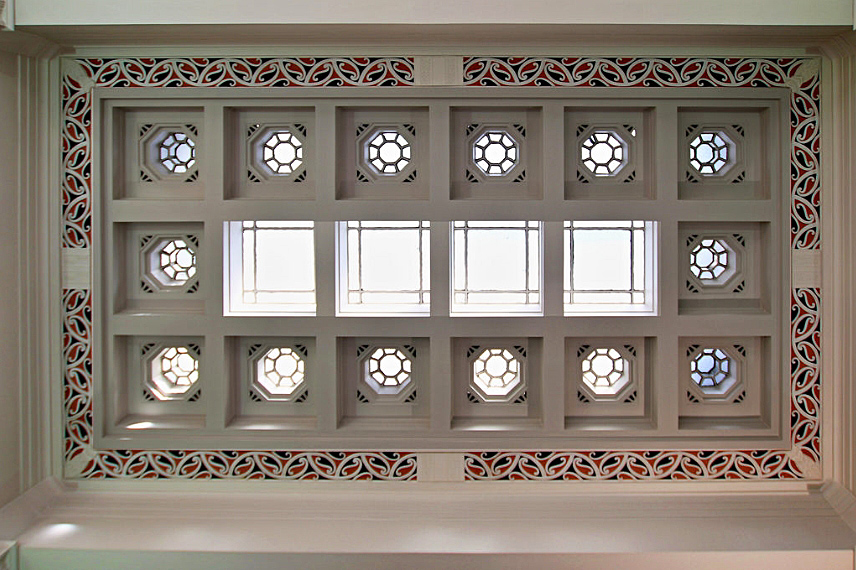
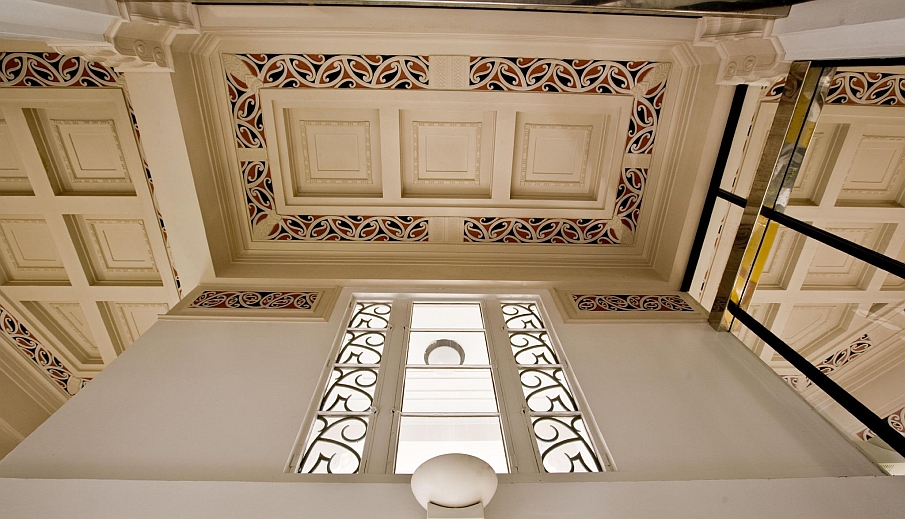
ARCHITECTURAL DESCRIPTION: An Art Deco building, this is Napier's - and possibly New Zealand's - tour de force in the use of Maori decoration on a European style building. The ground floor as originally laid out contained manager's office and a public space in rooms on either side of the entrance, two strong-rooms and stationery room at the back, and cloak rooms and toilets in an irregular section extending from the south-west corner. Most of the space, however, was taken up by the banking chamber, twenty-three metres long by thirteen metres wide with a lofty height of six metres. The roof is supported by four columns matching the pilasters around the perimeter, all having ornate, bench-cast fibrous plaster capitals. The coffered ceiling, with its two bays of bay-lights in both square and octagonal shapes, were plastered in situ. Each of the twelve ceiling bays is bordered by a plastered kowhaiwhai pattern painted in the traditional red, black and white. A matching frieze runs round the tops of the walls. The mezzanine floor at the upper rear of the building is divided into a number of rooms which originally contained a two bedroomed flat in which two of the bachelor staff members lived plus a lunch room and old book room. Little has changed over the years except for the introduction of modern aluminium entrance doors, the opening up of the panels of the south wall into a two-level extension which has not destroyed the quality of the space, and several re-arrangements of the interior facilities, one of which involved demolition of a strong-room. Outside a sadly inappropriate verandah, added in 1983 to meet City Council requirements, mars the two street facades and obscures the fine entrance. The opening is flanked by two corbels which echo the design of the column capitals, but with the addition of symbols representing the wealth of the tribe. Otherwise the carving patterns on the exterior are all above verandah level and easily 'readable' from the street. Above each window are panels in which zig zags, which symbolise waves, and patterns representing Ruamano, the whale, combine in a design which, like the ancient aukati (barring the way) border on the parapet, could be mistaken for pure Art Deco embellishment. The entrance can be closed by heavy sliding gates of wrought iron incorporating the whale motif again, which is also seen on the bronze grille over the window above the entrance doors. The opening is flanked by the original wall lamps. MODIFICATIONS: - 1956 Extension to the rear ground floor to enlarge staff facilities; Haughton, Son and Mair, Wellington, Architects. -1965 Removal of outer wall on south side and construction of two-storey (plus basement) addition. E A and L J Williams, Napier, Architects. -1983 Addition of awning to exterior on Emerson and Hastings Streets.
ARCHITECTURAL DESCRIPTION: An Art Deco building, this is Napier's - and possibly New Zealand's - tour de force in the use of Maori decoration on a European style building. The ground floor as originally laid out contained manager's office and a public space in rooms on either side of the entrance, two strong-rooms and stationery room at the back, and cloak rooms and toilets in an irregular section extending from the south-west corner. Most of the space, however, was taken up by the banking chamber, twenty-three metres long by thirteen metres wide with a lofty height of six metres. The roof is supported by four columns matching the pilasters around the perimeter, all having ornate, bench-cast fibrous plaster capitals. The coffered ceiling, with its two bays of bay-lights in both square and octagonal shapes, were plastered in situ. Each of the twelve ceiling bays is bordered by a plastered kowhaiwhai pattern painted in the traditional red, black and white. A matching frieze runs round the tops of the walls. The mezzanine floor at the upper rear of the building is divided into a number of rooms which originally contained a two bedroomed flat in which two of the bachelor staff members lived plus a lunch room and old book room. Little has changed over the years except for the introduction of modern aluminium entrance doors, the opening up of the panels of the south wall into a two-level extension which has not destroyed the quality of the space, and several re-arrangements of the interior facilities, one of which involved demolition of a strong-room. Outside a sadly inappropriate verandah, added in 1983 to meet City Council requirements, mars the two street facades and obscures the fine entrance. The opening is flanked by two corbels which echo the design of the column capitals, but with the addition of symbols representing the wealth of the tribe. Otherwise the carving patterns on the exterior are all above verandah level and easily 'readable' from the street. Above each window are panels in which zig zags, which symbolise waves, and patterns representing Ruamano, the whale, combine in a design which, like the ancient aukati (barring the way) border on the parapet, could be mistaken for pure Art Deco embellishment. The entrance can be closed by heavy sliding gates of wrought iron incorporating the whale motif again, which is also seen on the bronze grille over the window above the entrance doors. The opening is flanked by the original wall lamps. MODIFICATIONS: - 1956 Extension to the rear ground floor to enlarge staff facilities; Haughton, Son and Mair, Wellington, Architects. -1965 Removal of outer wall on south side and construction of two-storey (plus basement) addition. E A and L J Williams, Napier, Architects. -1983 Addition of awning to exterior on Emerson and Hastings Streets.
Historical and Associated Iwi / Hapū / Whānau
Information Sources
Cable, 2004
Nicolas Cable, 'An appraisal of Archaeological values within the Queen Mary Hospital Site, Hanmer Springs', Prepared for Hurunui District Council by Opus International, June 2004
Campbell, 1975
M. D. N. Campbell, Story of Napier, 1874-1974; Footprints Along the Shore
Chappell, 1961
N.M. Chappell, New Zealand Banker's Hundred: Bank of New Zealand 1861-1961, Wellington, 1961
Cyclopedia of New Zealand, 1908
Cyclopedia Company, Industrial, descriptive, historical, biographical facts, figures, illustrations, Wellington, N.Z, 1897-1908, Vol. 6, Taranaki, Hawke's Bay, Wellington, 1908
Daily Telegraph
Daily Telegraph
Fearnley, 1977
Charles Fearnley, Early Wellington Churches, Wellington, 1977
Ives, 1982
Heather Ives, The Art Deco Architecture of Napier, Napier, 1982
New Zealand Historic Places
New Zealand Historic Places
Plans
Architectural Drawings/Plans
Other Information
This historic place was registered under the Historic Places Act 1980. This report includes the text from the original Building Classification Committee report considered by the NZHPT Board at the time of registration. Please note that entry on the New Zealand Heritage List/Rarangi Korero identifies only the heritage values of the property concerned, and should not be construed as advice on the state of the property, or as a comment of its soundness or safety, including in regard to earthquake risk, safety in the event of fire, or insanitary conditions.
Historical and Associated Iwi / Hapū / Whānau
Information Sources
Cable, 2004
Nicolas Cable, 'An appraisal of Archaeological values within the Queen Mary Hospital Site, Hanmer Springs', Prepared for Hurunui District Council by Opus International, June 2004
Campbell, 1975
M. D. N. Campbell, Story of Napier, 1874-1974; Footprints Along the Shore
Chappell, 1961
N.M. Chappell, New Zealand Banker's Hundred: Bank of New Zealand 1861-1961, Wellington, 1961
Cyclopedia of New Zealand, 1908
Cyclopedia Company, Industrial, descriptive, historical, biographical facts, figures, illustrations, Wellington, N.Z, 1897-1908, Vol. 6, Taranaki, Hawke's Bay, Wellington, 1908
Daily Telegraph
Daily Telegraph
Fearnley, 1977
Charles Fearnley, Early Wellington Churches, Wellington, 1977
Ives, 1982
Heather Ives, The Art Deco Architecture of Napier, Napier, 1982
New Zealand Historic Places
New Zealand Historic Places
Plans
Architectural Drawings/Plans
Other Information
This historic place was registered under the Historic Places Act 1980. This report includes the text from the original Building Classification Committee report considered by the NZHPT Board at the time of registration. Please note that entry on the New Zealand Heritage List/Rarangi Korero identifies only the heritage values of the property concerned, and should not be construed as advice on the state of the property, or as a comment of its soundness or safety, including in regard to earthquake risk, safety in the event of fire, or insanitary conditions.
Current Usages
Uses: Finance
Specific Usage: Bank
Former Usages
General Usage: Finance
Specific Usage: Bank
Current Usages
Uses: Finance
Specific Usage: Bank
Former Usages
General Usage: Finance
Specific Usage: Bank