

The musical life of the church also resulted in a need for extra space. The 1873 extensions provided an organ chamber for the newly acquired organ. In 1881 the new tower again enlarged the organ space and also provided for the recently purchased bell, while the 1889 extension to the vestry gave accommodation for the choir. In 1925 the original (now Basset Road) church was found to be borer Infested. It was destroyed by fire, but the main door, which was sound, was used for the outside door of the ladies choir vestry at St Marks.
In 1935 a disastrous fire destroyed the organ, much of the woodwork in the chancel and the east window. Restoration work was undertaken. In 1954 a new window was installed. Many notable families of Remuera and Auckland have worshipped at St Marks and have been associated with its development over the years.
List Entry Information
Status
Listed
List Entry Status
Historic Place Category 1
Access
Private/No Public Access
List Number
113
Date Entered
15th February 1990
Date of Effect
15th February 1990
City/District Council
Auckland Council
Region
Auckland Council
Legal description
Lot 3 DP 44814 Pt Allot 2 Sec 11 Subs of Auckland
Status
Listed
List Entry Status
Historic Place Category 1
Access
Private/No Public Access
List Number
113
Date Entered
15th February 1990
Date of Effect
15th February 1990
City/District Council
Auckland Council
Region
Auckland Council
Legal description
Lot 3 DP 44814 Pt Allot 2 Sec 11 Subs of Auckland
Why is this place significant?
Historic Significance
Historical Significance or Value This historic place was registered under the Historic Places Act 1980. This report includes the text from the original Building Classification Committee report considered by the NZHPT Board at the time of registration. St Marks Church has been long associated with the parish, Remuera district and Auckland City. It has grown and developed in response to the needs of the community for a place to worship.
Physical Significance
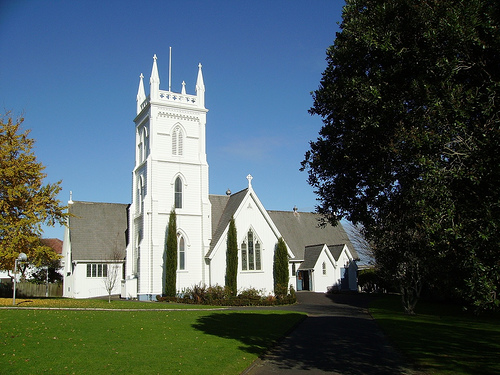
This historic place was registered under the Historic Places Act 1980. This report includes the text from the original Building Classification Committee report considered by the NZHPT Board at the time of registration. ARCHITECTURAL QUALITY: St Marks Church, Remuera, exhibits many of the characteristic features of the Carpenter Gothic style favoured by Bishop Selwyn. After the passing of the Church Building Act 1818, Gothic Revival became the accepted style for a church building. Selwyn was strongly influenced by the Camden Society which was founded at Cambridge, England, in 1839. He adapted their principles of Ecclesiology (the science of Church building and decoration) to suit colonial conditions. Earlier attempts to build New Zealand stone churches similar to those in England proved disastrous. Gothic details, originally a stone, were therefore translated into timber construction. St Marks Church exhibits some of the simpler features of the Selwyn style, such as vertical board and batten cladding, diamond-pane windows, and an unpainted interior. Stained glass windows were usually added later as finance permitted. The church was constructed in situ and not prefabricated as the previous church on the site had been. Inside the framing timbers were not exposed as the roof construction is much simpler than in most Selwyn churches. Unlike the Selwyn churches it does not have an apse. Characteristically, the church was developed in stages as money became available. With the exception of the tower, the addition to St Marks adhered to the Carpenter Gothic style. The Perpendicular Gothic style tower gives the church a particularly picturesque rural England appearance. TOWNSCAPE/LANDMARK VALUE: Originally the property was surrounded by farmland. It is now part of a built-up residential area, with native trees. The tower is still a prominent feature of the local skyline.
Why is this place significant?
Historic Significance
Historical Significance or Value This historic place was registered under the Historic Places Act 1980. This report includes the text from the original Building Classification Committee report considered by the NZHPT Board at the time of registration. St Marks Church has been long associated with the parish, Remuera district and Auckland City. It has grown and developed in response to the needs of the community for a place to worship.
Physical Significance
This historic place was registered under the Historic Places Act 1980. This report includes the text from the original Building Classification Committee report considered by the NZHPT Board at the time of registration. ARCHITECTURAL QUALITY: St Marks Church, Remuera, exhibits many of the characteristic features of the Carpenter Gothic style favoured by Bishop Selwyn. After the passing of the Church Building Act 1818, Gothic Revival became the accepted style for a church building. Selwyn was strongly influenced by the Camden Society which was founded at Cambridge, England, in 1839. He adapted their principles of Ecclesiology (the science of Church building and decoration) to suit colonial conditions. Earlier attempts to build New Zealand stone churches similar to those in England proved disastrous. Gothic details, originally a stone, were therefore translated into timber construction. St Marks Church exhibits some of the simpler features of the Selwyn style, such as vertical board and batten cladding, diamond-pane windows, and an unpainted interior. Stained glass windows were usually added later as finance permitted. The church was constructed in situ and not prefabricated as the previous church on the site had been. Inside the framing timbers were not exposed as the roof construction is much simpler than in most Selwyn churches. Unlike the Selwyn churches it does not have an apse. Characteristically, the church was developed in stages as money became available. With the exception of the tower, the addition to St Marks adhered to the Carpenter Gothic style. The Perpendicular Gothic style tower gives the church a particularly picturesque rural England appearance. TOWNSCAPE/LANDMARK VALUE: Originally the property was surrounded by farmland. It is now part of a built-up residential area, with native trees. The tower is still a prominent feature of the local skyline.
Construction Professional
Name
Rix-Trott, Geoffrey Alwyn
Type
Architect
Biography
Rix-Trott was a partner in the firm Massey, Beatson, Rix-Trott and Carter. They were responsible for a wide variety of buildings including several educational buildings such as Auckland Grammar School, Takapuna Grammar School (1956) and Auckland University (1961-1965) and commercial buildings such as the Norwich Union Insurance Society building, Queen Street (1963).
Name
Patterson, Daniel Boys
Type
Architect
Biography
Patterson (1880-1962) was born and trained in England. He immigrated to New Zealand about 1910, and became a member of the New Zealand Institute of Architects in 1914. He was senior partner in the firm of D B Patterson, Lewis and Sutcliffe, which was responsible for churches, hotels and commercial buildings throughout the Auckland province, the largest being the Mater Misericordiae Hospital. He died 7 May 1962 aged 82.
Name
Mahoney, Edward
Type
Architect
Biography
Edward Mahoney (1824-1895) Edward Mahoney emigrated from Cork, Ireland with his wife Margaret and three children. The Mahoneys arrived in Auckland in 1856 where Edward set up as a building and timber merchant. In 1876 he established the architectural practice that later became Edward Mahoney & Sons, which for over thirty years designed and supervised construction of many Catholic buildings as well as churches for other denominations. The Church of St John the Baptist, Parnell (1861) and St Mary's Convent Chapel (1866) are two of the earliest surviving ecclesiastical buildings designed by Edward Mahoney and reflect the gradual evolution from simple Gothic Revival structures to more ambitious and creative use of the Gothic form such as may be seen in the Church of the Holy Sepulchre, Khyber Pass (1881); and St Patrick's Cathedral, the latter completed in 1901. Edward Mahoney was a founding member of the Auckland Institute of Architects, attending the first meeting in December 1880 where he was appointed honorary treasurer. He became president of the Institute in 1883. His sons Thomas (1855?-1923) and Robert (1862-1895) joined him in practice in 1876 and the early 1880s respectively. Upon Edward's retirement in 1885, Thomas and Robert carried on the practice. After Robert's death in 1895, Thomas changed the firm's name to E. Mahoney & Son. The Mahoneys designed a wide variety of buildings including the Auckland Customhouse, hotels, commercial buildings and houses, their best-known surviving domestic buildings being the Pah, at Hillsborough (1877) and the Dilworth Terrace Houses, Parnell (1899). Their ecclesiastical buildings included St Mary's Church of the Assumption, Onehunga (1888) and St Benedict's Church, Newton (1888). The firm of Edward Mahoney & Son continued to practice for a short period after Thomas Mahoney’s death in 1923, but was eventually dissolved in 1926. Source: NZHPT Registration Report for Bank of New Zealand (Former), Devonport (Register no. 4511).
Name
Gummer, William Henry
Type
Architect
Biography
Gummer (1884-1966) was articled to W.A. Holman, an Auckland architect, and qualified as an Associate of the Royal Institute of British Architects in 1910. From 1908 to 1913 he travelled in the United Kingdom, Europe and the United States. During this time he worked for Edwin Lutyens, a leading English architect of the time, and for Daniel Burnham in Chicago. Burnham was a major American architect and one of the founders of the influential Chicago School of Architecture. Gummer joined the firm of Hoggard and Prouse of Auckland and Wellington in 1913. Significant commissions undertaken during this period included the New Zealand Insurance (later known as the Guardian Trust) Building, Auckland (1914-18). In 1923 Gummer, one of the most outstanding architects working in New Zealand in the first half of the twentieth century, joined with Charles Reginald Ford (1880-1972) to create an architectural partnership of national significance. The practice was responsible for the design of the Dilworth Building (1926), Auckland, the Dominion Museum (1936) and the State Insurance Building (1940), both Wellington. Gummer and Ford were awarded Gold Medals by the New Zealand Institute of Architects for their designs of the Auckland Railway Station and Remuera Library. Gummer was also responsible for the Bridge of Remembrance, Christchurch and the Cenotaph in Dunedin (1927), and the stylistically and structurally advanced Tauroa (1916), Craggy Range (1919), Arden (1926) and Te Mata (1935) homesteads at Havelock North. Elected a Fellow of the New Zealand Institute of Architects in 1914, he was president of the Institute from 1933-4 and was later elected a life member.
Name
Herapath, Philip
Type
Architect
Biography
Herapath became a member of the Auckland Institute of Architects in 1885. His designs included institutional and ecclesiastical buildings, such as the main block of Auckland Hospital (1875, demolished 1964) and Wesleyan churches in Pitt St (1865), Onehunga (1877), Pukekohe and Pokeno (1878). The most important remaining example of his work is the Beresford Street Congregational Church (1875), now St James's Presbyterian Church. This was a pioneer design in concrete.
Construction Details
Start Year
1871
Type
Addition
Description
Transepts added
Start Year
1871
Type
Partial Demolition
Description
Small bell tower to west removed
Start Year
1873
Type
Addition
Description
Original chancel moved alongside the south transept, and replaced by a wider chancel
Start Year
1878
Type
Modification
Description
Extension of south transept by 15 feet
Start Year
1879
Type
Modification
Description
Extension of north transept by 15 feet
Start Year
1881
Type
Addition
Description
Addition of tower
Start Year
1889
Type
Modification
Description
Vestry extended by 14 feet
Start Year
1935
Type
Demolished - Fire
Description
fire destroyed the organ, much of the woodwork in the chancel and the east window
Start Year
1935
Type
Other
Description
Restoration of fire damaged portion of building
Start Year
1953
Type
Modification
Description
Sanctuary enlarged
Start Year
1954
Type
Modification
Description
Installation of new east windows
Start Year
1956
Finish Year
1957
Type
Modification
Description
Extension of entrance porch
Start Year
1860
Type
Original Construction
Construction Materials
Foundation of scoria blocks. Floors and walls are of kauri; external walls are clad with vertical boards and battens. The roof was originally shingled, but now in asbestos cement slates. Internally the sarking is of kauri.
Notable Features
Stained glass windows Rood screen incorporating Gothic tracery installed in 1873 to divide the chancel from the nave.
Construction Professional
Name
Rix-Trott, Geoffrey Alwyn
Type
Architect
Biography
Rix-Trott was a partner in the firm Massey, Beatson, Rix-Trott and Carter. They were responsible for a wide variety of buildings including several educational buildings such as Auckland Grammar School, Takapuna Grammar School (1956) and Auckland University (1961-1965) and commercial buildings such as the Norwich Union Insurance Society building, Queen Street (1963).
Name
Patterson, Daniel Boys
Type
Architect
Biography
Patterson (1880-1962) was born and trained in England. He immigrated to New Zealand about 1910, and became a member of the New Zealand Institute of Architects in 1914. He was senior partner in the firm of D B Patterson, Lewis and Sutcliffe, which was responsible for churches, hotels and commercial buildings throughout the Auckland province, the largest being the Mater Misericordiae Hospital. He died 7 May 1962 aged 82.
Name
Mahoney, Edward
Type
Architect
Biography
Edward Mahoney (1824-1895) Edward Mahoney emigrated from Cork, Ireland with his wife Margaret and three children. The Mahoneys arrived in Auckland in 1856 where Edward set up as a building and timber merchant. In 1876 he established the architectural practice that later became Edward Mahoney & Sons, which for over thirty years designed and supervised construction of many Catholic buildings as well as churches for other denominations. The Church of St John the Baptist, Parnell (1861) and St Mary's Convent Chapel (1866) are two of the earliest surviving ecclesiastical buildings designed by Edward Mahoney and reflect the gradual evolution from simple Gothic Revival structures to more ambitious and creative use of the Gothic form such as may be seen in the Church of the Holy Sepulchre, Khyber Pass (1881); and St Patrick's Cathedral, the latter completed in 1901. Edward Mahoney was a founding member of the Auckland Institute of Architects, attending the first meeting in December 1880 where he was appointed honorary treasurer. He became president of the Institute in 1883. His sons Thomas (1855?-1923) and Robert (1862-1895) joined him in practice in 1876 and the early 1880s respectively. Upon Edward's retirement in 1885, Thomas and Robert carried on the practice. After Robert's death in 1895, Thomas changed the firm's name to E. Mahoney & Son. The Mahoneys designed a wide variety of buildings including the Auckland Customhouse, hotels, commercial buildings and houses, their best-known surviving domestic buildings being the Pah, at Hillsborough (1877) and the Dilworth Terrace Houses, Parnell (1899). Their ecclesiastical buildings included St Mary's Church of the Assumption, Onehunga (1888) and St Benedict's Church, Newton (1888). The firm of Edward Mahoney & Son continued to practice for a short period after Thomas Mahoney’s death in 1923, but was eventually dissolved in 1926. Source: NZHPT Registration Report for Bank of New Zealand (Former), Devonport (Register no. 4511).
Name
Gummer, William Henry
Type
Architect
Biography
Gummer (1884-1966) was articled to W.A. Holman, an Auckland architect, and qualified as an Associate of the Royal Institute of British Architects in 1910. From 1908 to 1913 he travelled in the United Kingdom, Europe and the United States. During this time he worked for Edwin Lutyens, a leading English architect of the time, and for Daniel Burnham in Chicago. Burnham was a major American architect and one of the founders of the influential Chicago School of Architecture. Gummer joined the firm of Hoggard and Prouse of Auckland and Wellington in 1913. Significant commissions undertaken during this period included the New Zealand Insurance (later known as the Guardian Trust) Building, Auckland (1914-18). In 1923 Gummer, one of the most outstanding architects working in New Zealand in the first half of the twentieth century, joined with Charles Reginald Ford (1880-1972) to create an architectural partnership of national significance. The practice was responsible for the design of the Dilworth Building (1926), Auckland, the Dominion Museum (1936) and the State Insurance Building (1940), both Wellington. Gummer and Ford were awarded Gold Medals by the New Zealand Institute of Architects for their designs of the Auckland Railway Station and Remuera Library. Gummer was also responsible for the Bridge of Remembrance, Christchurch and the Cenotaph in Dunedin (1927), and the stylistically and structurally advanced Tauroa (1916), Craggy Range (1919), Arden (1926) and Te Mata (1935) homesteads at Havelock North. Elected a Fellow of the New Zealand Institute of Architects in 1914, he was president of the Institute from 1933-4 and was later elected a life member.
Name
Herapath, Philip
Type
Architect
Biography
Herapath became a member of the Auckland Institute of Architects in 1885. His designs included institutional and ecclesiastical buildings, such as the main block of Auckland Hospital (1875, demolished 1964) and Wesleyan churches in Pitt St (1865), Onehunga (1877), Pukekohe and Pokeno (1878). The most important remaining example of his work is the Beresford Street Congregational Church (1875), now St James's Presbyterian Church. This was a pioneer design in concrete.
Construction Details
Start Year
1871
Type
Addition
Description
Transepts added
Start Year
1871
Type
Partial Demolition
Description
Small bell tower to west removed
Start Year
1873
Type
Addition
Description
Original chancel moved alongside the south transept, and replaced by a wider chancel
Start Year
1878
Type
Modification
Description
Extension of south transept by 15 feet
Start Year
1879
Type
Modification
Description
Extension of north transept by 15 feet
Start Year
1881
Type
Addition
Description
Addition of tower
Start Year
1889
Type
Modification
Description
Vestry extended by 14 feet
Start Year
1935
Type
Demolished - Fire
Description
fire destroyed the organ, much of the woodwork in the chancel and the east window
Start Year
1935
Type
Other
Description
Restoration of fire damaged portion of building
Start Year
1953
Type
Modification
Description
Sanctuary enlarged
Start Year
1954
Type
Modification
Description
Installation of new east windows
Start Year
1956
Finish Year
1957
Type
Modification
Description
Extension of entrance porch
Start Year
1860
Type
Original Construction
Construction Materials
Foundation of scoria blocks. Floors and walls are of kauri; external walls are clad with vertical boards and battens. The roof was originally shingled, but now in asbestos cement slates. Internally the sarking is of kauri.
Notable Features
Stained glass windows Rood screen incorporating Gothic tracery installed in 1873 to divide the chancel from the nave.
This historic place was registered under the Historic Places Act 1980. This report includes the text from the original Building Classification Committee report considered by the NZHPT Board at the time of registration. ARCHITECTURAL DESCRIPTION: The 1860 church was a simple gabled building in the Carpenter Gothic style favoured by Bishop Selwyn. The gable ends featured simple barge boards and the ridgeline of the sanctuary and porch was lower than that of the nave. The original single windows in the nave had small diamond panes and cusped heads. The windows were recessed within the board and batten detail and did not have hoods. The gable end window had three lights. The interior follows most of the line of the exterior. However, a flat ceiling conceals the apex of the gable. The roof has metal tie rods, and is lined internally with diagonal sarking. The transepts added in 1871 continue the style of the nave. A Perpendicular Gothic tower was added in 1881. This tower has a parapet with quatrefoils supported on corbelling. Originally the centre of the parapet had battlements. The second storey of the bell tower has wooden slats within the tracery to allow the bells to be heard. NB. ARCHITECT: The architect and builder of the 1860 church-are not known; the Rev Dr John Kinder, Philip Herapath and James Baber (Jnr) are all possibilities. However, alterations and modifications are attributable to leading Auckland architects.
This historic place was registered under the Historic Places Act 1980. This report includes the text from the original Building Classification Committee report considered by the NZHPT Board at the time of registration. ARCHITECTURAL DESCRIPTION: The 1860 church was a simple gabled building in the Carpenter Gothic style favoured by Bishop Selwyn. The gable ends featured simple barge boards and the ridgeline of the sanctuary and porch was lower than that of the nave. The original single windows in the nave had small diamond panes and cusped heads. The windows were recessed within the board and batten detail and did not have hoods. The gable end window had three lights. The interior follows most of the line of the exterior. However, a flat ceiling conceals the apex of the gable. The roof has metal tie rods, and is lined internally with diagonal sarking. The transepts added in 1871 continue the style of the nave. A Perpendicular Gothic tower was added in 1881. This tower has a parapet with quatrefoils supported on corbelling. Originally the centre of the parapet had battlements. The second storey of the bell tower has wooden slats within the tracery to allow the bells to be heard. NB. ARCHITECT: The architect and builder of the 1860 church-are not known; the Rev Dr John Kinder, Philip Herapath and James Baber (Jnr) are all possibilities. However, alterations and modifications are attributable to leading Auckland architects.
Historical and Associated Iwi / Hapū / Whānau
Completion Date
2nd August 1989
Information Sources
Cyclopedia of New Zealand, 1902
Cyclopedia Company, Industrial, descriptive, historical, biographical facts, figures, illustrations, Wellington, N.Z, 1897-1908, Vol.2, Christchurch, 1902
Knight, 1972
Cyril Knight, The Selwyn Churches of Auckland, Auckland, 1972.
McLintock, 1966
An Encyclopedia of New Zealand, Government Printer, Wellington, 1966
Pearce, 1986
G. L. Pearce, A Heritage in Trust, Auckland, 1986 Auckland Dilworth Trust Board
Reid, 1982
Hilary F. Reid, St Mark's Remuera 1847-1981: The Story of a Parish, Auckland, 1982.
Jordan, 1966
R F Jordan Victorian Architecture, Harmondsworth 1966
Fletcher, 1948
B. Fletcher, A History of Architecture on the Comparative Method, London 1948
Journal of the Auckland-Waikato Historical Societies
Journal of the Auckland-Waikato Historical Societies
St Mark's Remuera, 1947
St Mark's Remuera Centenary, 1847-1947, Auckland, 1947
Other Information
A copy of this report is available from the NZHPT Northern Region office. Please note that entry on the New Zealand Heritage List/Rarangi Korero identifies only the heritage values of the property concerned, and should not be construed as advice on the state of the property, or as a comment of its soundness or safety, including in regard to earthquake risk, safety in the event of fire, or insanitary conditions. This historic place was registered under the Historic Places Act 1980. This report includes the text from the original Building Classification Committee report considered by the NZHPT Board at the time of registration.
Historical and Associated Iwi / Hapū / Whānau
Completion Date
2nd August 1989
Information Sources
Cyclopedia of New Zealand, 1902
Cyclopedia Company, Industrial, descriptive, historical, biographical facts, figures, illustrations, Wellington, N.Z, 1897-1908, Vol.2, Christchurch, 1902
Knight, 1972
Cyril Knight, The Selwyn Churches of Auckland, Auckland, 1972.
McLintock, 1966
An Encyclopedia of New Zealand, Government Printer, Wellington, 1966
Pearce, 1986
G. L. Pearce, A Heritage in Trust, Auckland, 1986 Auckland Dilworth Trust Board
Reid, 1982
Hilary F. Reid, St Mark's Remuera 1847-1981: The Story of a Parish, Auckland, 1982.
Jordan, 1966
R F Jordan Victorian Architecture, Harmondsworth 1966
Fletcher, 1948
B. Fletcher, A History of Architecture on the Comparative Method, London 1948
Journal of the Auckland-Waikato Historical Societies
Journal of the Auckland-Waikato Historical Societies
St Mark's Remuera, 1947
St Mark's Remuera Centenary, 1847-1947, Auckland, 1947
Other Information
A copy of this report is available from the NZHPT Northern Region office. Please note that entry on the New Zealand Heritage List/Rarangi Korero identifies only the heritage values of the property concerned, and should not be construed as advice on the state of the property, or as a comment of its soundness or safety, including in regard to earthquake risk, safety in the event of fire, or insanitary conditions. This historic place was registered under the Historic Places Act 1980. This report includes the text from the original Building Classification Committee report considered by the NZHPT Board at the time of registration.
Current Usages
Uses: Religion
Specific Usage: Church
Former Usages
General Usage: Religion
Specific Usage: Church
Web Links
description:
Current Usages
Uses: Religion
Specific Usage: Church
Former Usages
General Usage: Religion
Specific Usage: Church
Web Links
description:
Location
Stay up to date with Heritage this month
