Early Māori History
Tribal traditions, whakapapa and archaeological evidence all indicate many centuries of Māori occupation in Ahuriri (Napier), centrally located within the wider area of Te Matau-a-Māui (Hawke’s Bay). Te Matau-a-Māui translates to the ‘fish hook of Māui’ and is an allegorical reference to the legendary explorer and ancestor Māui who fished up Te Ika-a-Maui (the North Island). Early Māori tribes in the region descended from Māui and down through Toi-kai-rākau, and included Ngāti Hotu, Ngāti Mahu and Whatumamoa. When Ngāti Kahungunu arrived in the region in the sixteenth century, Whatumamoa, Rangitāne, Ngāti Awa and elements of Ngāti Tara were living in Pētane, Te Whanganui-a-Orotū (the Napier Inner Harbour, also known as Ahuriri Harbour) and Waiohiki. These groups are all ancestors of the current hapū within Te Matau-a-Māui.
Ngāti Kahungunu became the dominant tribal group in the region through both warfare and strategic marriage though large numbers left the area in the 1820s due to armed raids from both the west and north, and most sought refuge at Māhia. They started ‘filtering back’ to Ahuriri-Heretaunga in the 1830s and 1840s with the Treaty of Waitangi providing the prospect of ‘being able to return to their ancestral lands in peace’. European traders, whalers and missionaries were living in the region by this time, and by 1851 small beach communities had taken up residence on both sides of Te Whanganui-a-Orutū (at Onepoto and on the western spit). That same year Land Commissioner Donald McLean negotiated the purchase of the circa 265 000 acre Ahuriri Block which included Mataruahou (Napier Hill, formerly Scinde Island).
Mataruahou referred to the mirror images of faces which appeared in the pools alongside the tracks over what was effectively an island. Mataruahou and other smaller islands surrounded Te Whanganui-a-Orutū which was highly prized by Māori for its plentiful resources including fish, shellfish and birds, making it an attractive place for early settlement. A number of whare wānanga (houses of learning) were established on Mataruahou such as at Hukarere (Bluff Hill) at the north-eastern end. Hukarare was also the site of Tūhinapō, ‘the most sacred spot in the district for here stood the altar at which were offered the first fruits of the season. None but the tohunga himself dared approach the spot’.
Mataruahou was additionally a tapu place in that it housed the caves of Io Pikopiko, an important atua (god) for maintaining the mauri ora (life force) of Hawke’s Bay Māori. It is known that there were pā and kāinga on the hill, such as Matapane Pā, Hukarere Pā and Pukemokimoki Pā (since destroyed by quarrying), and several midden have been recorded. There was also a freshwater spring on the site of the Drill Hall which was associated with the famous sea maiden Pānia.
Laying out of Napier Township and Reservation of Suburban Section 96
Whilst it was not considered an ‘attractive or healthy site’ for a township, Mataruahou was the perfect location for a port, and three years after the Ahuriri Block purchase, newly appointed Commissioner of Crown Lands and Resident Magistrate Alfred Domett laid out the first plan of the township known as Napier. Domett’s 1855 plan included ‘reserves and sites’ for various public facilities and to that end, on 1 February 1861 the Crown granted Suburban Section 96 on the corner of Coote Road and Marine Parade to Thomas Fitzgerald, the first Superintendent of the Hawke’s Bay province. Fitzgerald was granted the land ‘in trust’ as a site for an emigration barracks and native hostelry.
Establishment of Napier’s Volunteer Corps
Volunteer forces were first established in New Zealand in the 1840s in response to settlers’ fear of conflict with Māori, but were only formally provided for under the 1858 Militia Act, which set out appropriate approvals and regulations. They were a key part of the regional system that made up New Zealand’s armed forces and were involved alongside British forces in the various campaigns of the New Zealand Wars. Napier’s Volunteer movement has its origins in the early days of the second Taranaki war (1863-1866), when the conflict reportedly ‘caused a stir in Napier and the Hawke’s Bay’, leading to the formation of a local military organisation. The Napier Rifles were the first Volunteer corps to form in 1863, and three companies of militia were also established, with military training commencing, including morning and evening drills.
In 1869 the Napier Rifle Corps was joined by the F Battery of Field Artillery (‘Artillery Volunteers’). Volunteering interest waned after the New Zealand Wars and the original Napier Rifles disbanded in 1874. However, the Napier Engineers Corps was formed in March 1878, later changing into a rifle company known as the Napier Rifle Volunteers (the ‘Rifles’) which earned a reputation as a leader among the North Island companies, with a ‘strong and welldrilled [sic] force’. The Napier Naval Brigade (also known as the Naval Artillery Volunteers Corps or ‘Naval Volunteers’) was established in late 1884.
Reservation of the Napier Drill-Shed Site (1886)
‘Without a proper drill-hall we cannot have properly drilled men’.
Local Volunteer forces needed their own headquarters at which to meet and drill, and a ‘proper drill-shed’ had long been desired in Napier. Discussions continued with the government throughout the early 1880s, during which time a temporary drill shed was established for a period on ‘Mr Tiffin’s grounds’ in Tennyson Street, with outdoor drills also held during the summer months. Meanwhile, in November 1884 Dransfield’s store at ‘the Spit’ was placed at the disposal of the newly formed Naval Brigade for their drill-shed.
A permanent drill-shed was still greatly desired though and in 1885 the local Napier Volunteers drafted a petition to government to try and obtain one for the town. In April 1886 the Defence Department wrote to the government suggesting a Coote Road site for the drill-shed – a site which had the advantage of being further away from the centre of town. Whilst Napier was proud of its Volunteer garrison and wanted its members to have an ‘ample’ drill-shed, there was also a desire to see the parades held anywhere else than in the public streets where they could be an ‘unmitigated nuisance’. The Coote Road site was subsequently set apart in August 1886 and vested in Trustees for ‘the use of Volunteers in the Hawke’s Bay Provincial District’.
Construction of Naval Drill-Shed, Port Ahuriri
Despite progress with the Coote Road site, the Naval Volunteers subsequently decided to construct their own drill-shed on the section to the rear of Messrs Kinross and Co.’s store at Port Ahuriri, which had been granted to them by the Harbour Board. It seems in fact that the Naval Volunteers had already taken steps towards the construction of their own drill-shed, commissioning architect Walter Phillip Finch (1860-1943) to prepare plans ‘some months ago’. They were also determined to independently fund the drill-shed’s construction without recourse to any financial assistance, including the government subsidy, thereby ‘showing the true spirit of volunteering, and setting an example that is without precedent in New Zealand’.
In late September 1886, tenders were invited for the construction of a ‘large drill-shed’ and builders Messrs Davis and Ruston were the successful tenderers. By November 1886 contractor Mr E. Walker was making good progress – the frame was up and it was expected that the ‘very large’ shed measuring 54 feet (16.45 metres) by 92 feet (28.04 metres) would be weather-tight within the next fortnight. The drill-shed was officially opened at a celebratory ball on 3 March 1887, for which it was lavishly decorated with shrubs, flowers, bunting and Chinese lanterns. It was described as a splendid building ‘and certainly the best in Napier in which to hold a ball, while it should prove equally as convenient for the purposes for which it is intended – a drill-hall’. Particular features were noted such as its high ceiling and stage with proscenium arch. Indeed, the drill-shed was regularly used for drills, balls and other social events such as concerts and exhibitions over the next two years.
Relocation of the Navals’ Drill-Shed to Coote Road
By August 1889 a decision had been made to relocate the Navals’ existing drill-shed to the Coote Road site, instead of the Artillery and Rifle Volunteers building their own drill-shed. The ‘main portion’ of the Navals’ building would be purchased for £432, with lean-tos to be added upon re-erection on Coote Road, with a total estimated project cost of £750. The three Napier Volunteer corps had already raised a sum of £500 towards this cost and also received a £300 government subsidy. Staff-Sergeant Major Huddleston was apparently instrumental in persuading the different Volunteer companies to buy the Navals’ drill-shed and remove it to town, as part of his efforts to ‘promote harmony and emulation’ between them. Architect Walter Arthur Dugleby (1845–1922) was entrusted to drawn up designs for the lean-to additions and tenders were called for the building’s removal and re-erection.
By mid-October 1889, prisoners from the Napier Prison on Coote Road had made ‘considerable progress’ in preparing the drill-shed site for the building’s arrival. By 21 November 1889 contractor Harold Bey had shifted the whole building to Coote Road and walls were up, with other parts of the building being prepared for placing into position. An arrangement had been made to acquire a 16 foot strip of land of the telegraph reserve to the east, as the drill-shed site was not going to be sufficiently large enough to accommodate the enlarged building.
On 1 December 1889, a heavy gust of wind caused the total collapse of the partially erected drill-shed - a large portion of the building including all the principal rafters was apparently ‘destroyed’. The Garrison officers subsequently decided to have the plans altered slightly, and called for new tenders for the work. The new tenders received were all too high to be accepted though, and the Garrison officers decided to carry out the work using ‘day labor [sic]’, so far as their funds would permit, though they did also subsequently seek further funds to enable completion of the work. There was an ensuing civil court case over the collapse of the drill-shed, as Bey had ‘cleared out’.
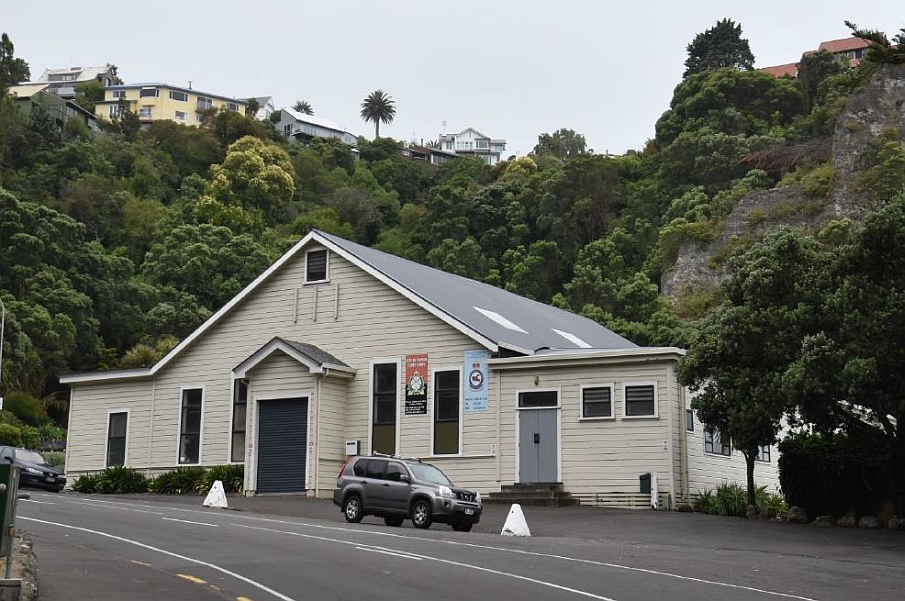
The re-erection of the drill-shed was completed by 12 March 1890, when the Garrison corps paraded for inspection. From this time it seems to also have become known as the ‘Garrison Hall’ or ‘Drill Hall’. In April 1891, six gentlemen were appointed as Trustees of the hall in accordance with the relevant legislation. An 1891 description of the building gives an insight into its layout at that time, which was as follows: ‘Drill Hall 50 x 90, 3 Orderly Rooms, 1 Band Room, 1 Cloak room, 1 Morris Tube Gallery, 1 Gun Room, 1 Retiring Room, 1 Lecture Room, 1 Detached iron building’.
The Drill Hall was used throughout the 1890s for weekly drills and parades; meetings of the various Volunteer corps; numerous social and fundraising balls; concerts; and community events such as Mr Thomson’s bicycle riding school and flower shows. The regular holding of ‘Cinderella dances’ in the hall was a cause for some criticism though, with one correspondent noting that the floor was now ‘holy ground, and must not be trodden on, because instead of being devoted to drill purposes the hall is chiefly kept for dancing’.
In 1895 a caretaker was appointed to live on-site at the hall and the Napier Garrison Drill Shed Committee (‘the Committee’) agreed to undertake renovations to create a Military and Volunteers District Office in the hall by partitioning off a small room towards the front where the ‘supper room’ was, with a door connecting to the main hall. The following year a military ball was held to raise funds to help improve the hall and secure proper ventilation and the Committee also successfully applied for a government pound for pound grant (up to £100). The improvement works were underway by July 1896 and appear to have been completed by a ‘Mr Ward’ by September 1896.
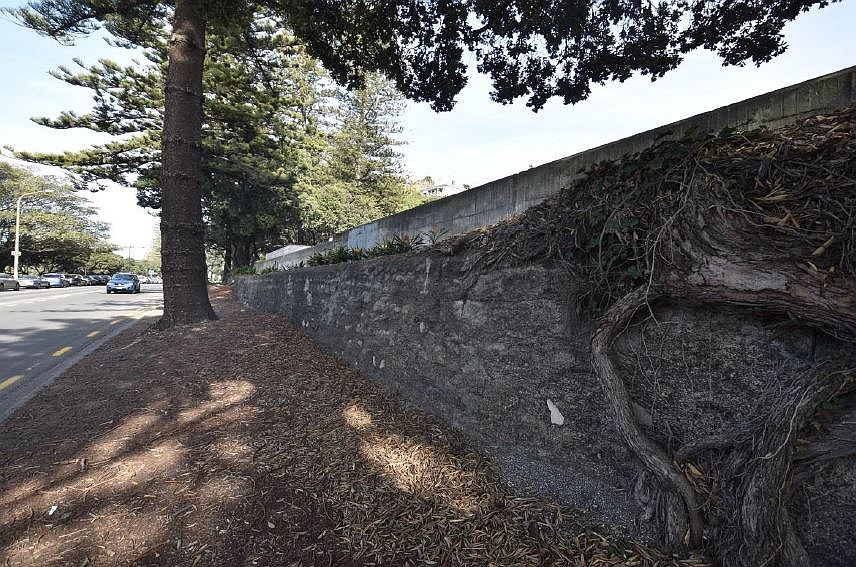
In 1900 the land to the seaward side of the Drill Hall was granted for a parade ground. The following year the Volunteers applied to the government to have Napier Prison inmates erect a stone rubble wall along the seaward side of the telegraph reserve, as part of preparations to create a ‘proper’ parade ground – this was urgently needed as the Drill Hall was not large enough accommodate Battalion drill with three companies of the 3rd Battalion of the East Coast Rifle Volunteers (formed in 1898) now garrisoned in Napier. The Volunteer’s application was successful and the parade ground was completed in December 1901, with prisoners undertaking the initial levelling work and surface tarring, as well as construction of the stone rubble wall.
Use of the Drill Hall and Subsequent Improvements and Repairs (1900s-1950s)
The hall itself continued to be used throughout the early 1900s for regular military drills and training as well as a variety of balls and other community events. During the South African War (1899-1902) the hall was the venue for celebratory events for men departing, or returning again, from the war, and also served as a testing and selection centre for recruits on occasion. The South African War was really the first chance for many local Rifle Volunteers to get involved with active service, and it is reported that more men were sent to South Africa from the Hawke’s Bay than from any other district (in relation to population).
In 1906 Napier architect Charles Tilleard Natusch (1859-1951) drew up plans for improvements to repair and extend the Drill Hall. The Napier Volunteers raised £650 towards the work (with a further £50 donation promised) and also applied for a £600 grant from the Defence Department. The grant was not approved but the Napier Volunteers pressed on with the improvements anyway, and they were completed in 1907, comprising repairs to the hall’s roof and interior and exterior painting, as well as the addition of lecture and social rooms, a gymnasium and miniature rifle range.
The 1909 Defence Act saw the introduction of compulsory military training for teenage males and this training largely took place in the country’s drill halls, including Napier’s Drill Hall. Two years later the Napier Drill Hall trustees resigned to allow the Defence Department to take over the building in accordance with the Defence Amendment Act 1912, which saw the ‘property and liabilities’ of Volunteer forces transferred to the Crown. In 1912 internal alterations were undertaken to create additional storerooms in the eastern lean-to of the building and roofing repairs (including re-roofing of the main hall) were also undertaken following a rather damning report by architect D.B. Frame on the ‘unsanitary’ and poor condition of the building.
During the First World War, Napier men of the 9th regiment (infantry) ‘assembled in full force’ at the Drill Hall on 16 August 1914 to receive the war kits that had been assembled by local women. The following morning, after a short service, they marched from the Drill Hall with men from Gisborne through Napier to the train station. The hall continued to be a collection centre for goods and a muster point throughout the war.
In 1920 the Drill Hall’s failing gas lighting system was replaced with electric lighting and other repairs and additions were undertaken throughout the 1920s, as funds allowed in such fiscally restrained times. The Drill Hall reportedly suffered only minor damage during the devastating February 1931 Napier earthquake, a lucky escape given its position beneath a large cliff which caused a substantial slip into Breakwater Road. The neighbouring parade ground/telegraph reserve did not fare so well though - its ‘store-garage-workshop building’ suffered ‘serious damage’ and most of it was subsequently dismantled and re-erected elsewhere. In late 1931, the first of many wool sales commenced in the Drill Hall – these were soon to become a regular occurrence.
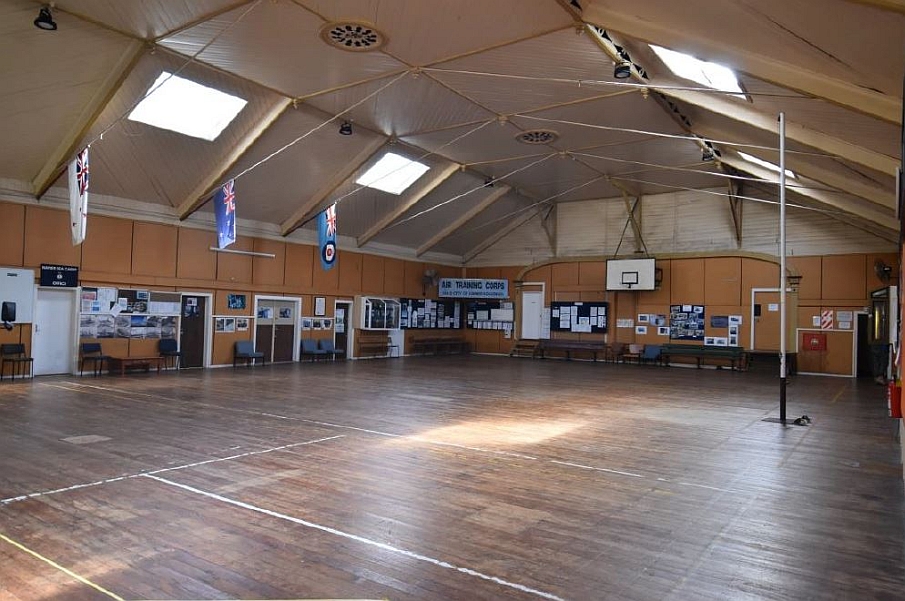
In 1935 outstanding matters concerning the status of the land occupied by the Drill Hall were finally resolved in the Reserves and Other Lands Disposal Act 1935 – essentially ‘washing up’ legislation. This enabled the appropriate area of land to be formally reserved at last for a drill-shed site. Changes to the Drill Hall during the later 1930s and 1940s included relaying of the main hall floor with heart mataī in 1938, as the original floor had worn down to the tongues, and had 62 patches. In 1941 the No 13 (City of Napier) Squadron formed as one of New Zealand’s earliest Air Training Corps, and commenced parades at the Drill Hall. During the Second World War the Drill Hall also served as an administration and records centre for both the Air Force and Army, storing documents such as ballot papers.
Shortly after the end of the Second World War, alterations and renovations were undertaken to accommodate the Army’s Area 7 Headquarters within the hall, including removal of the miniature rifle range along its western side. During the 1951 waterfront dispute, the Drill Hall was urgently converted into a miniature barracks in preparation for 60 Air Force personnel who were brought in to undertake emergency work at the port, later joined by 20 sailors and 50 soldiers.
Subsequent History
Discussions about the Army’s future at the Coote Road site commenced in 1961 and continued through until the 1970s, and during this time many different community organisations and groups hired the hall under casual letting arrangements, using the space for everything from darts to marching, yoga and indoor basketball. Meanwhile, the former telegraph reserve had been purchased by the Napier City Council and developed as a carpark in association with the Centennial Gardens to the west of the Drill Hall (the former prison quarry). The Drill Hall had apparently looked ‘cheery enough’ beside the former quarry but was now outclassed by its new neighbour, Centennial Gardens.
Ultimately, the Army remained in residence at the Drill Hall until shifting to the Defence Force office in Faraday Street, and a Royal New Zealand Air Force recruiting office was housed in the hall until the 1990s. In 2001 the City of Napier Cadet Unit took on a lease for the hall, which was also still being used by the No. 13 (City of Napier) Squadron) for training and related events. In early 2019 they were joined by the Sea Cadets, now known as the TS Ahuriri Naval Cadets. Today, around 80-90 cadets from across the three units use the Drill Hall - each unit has its own office space and stores but they share the main hall space, classrooms and service areas, and parade outside in the adjacent Centennial Gardens carpark as required. The hall is additionally available for hire by community groups and clubs.