Quick links


Quick links
Quick links
Quick links
Quick links
Quick links
Harstons Building
33-35 Hastings Street, NAPIER
Private
Historic Place Category 1
List No. 1143
Quick links:
List GalleryLocationDetails
33-35 Hastings Street, NAPIER
Private
Historic Place Category 1
List No. 1143
List Entry Information
Status
Listed
List Entry Status
Historic Place Category 1
Access
Private/No Public Access
List Number
1143
Date Entered
21st September 1989
Date of Effect
21st September 1989
City/District Council
Napier City
Region
Hawke's Bay Region
Legal description
Lot 1 DP 5069
Status
Listed
List Entry Status
Historic Place Category 1
Access
Private/No Public Access
List Number
1143
Date Entered
21st September 1989
Date of Effect
21st September 1989
City/District Council
Napier City
Region
Hawke's Bay Region
Legal description
Lot 1 DP 5069
Why is this place significant?
Historic Significance
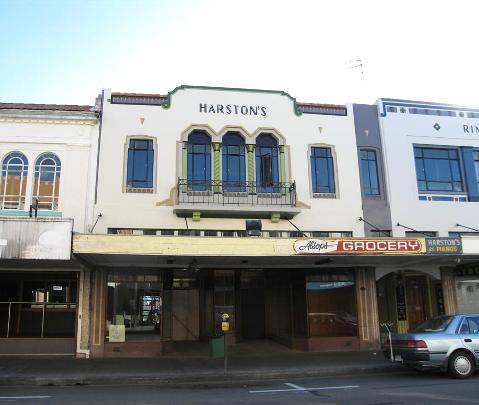
Historical Significance or Value This historic place was registered under the Historic Places Act 1980. This report includes the text from the original Building Classification Committee report considered by the NZHPT Board at the time of registration. The firm of Messrs Harstons Ltd established in Napier in 1904 was the agent for many leading makes of piano, at a time in which almost every home was furnished with a piano, and musical evenings were an important part of the social scene. For over fifty years, 1930-1985, Mr NevIlle Harston operated a music shop out of one half of this building, leasing the other half to various businesses trading under the name of Alsops Grocery. Both are fixtures in the consciousness of many locals. With the introduction of radio, Harston's began to sell radios. However, Harstons never moved into modern stereo or hi-fidelity equipment, and after c.1950 began to specialise in imported sheet music. The store was owned and operated by Neville Harston, himself a musician and an established local identity. Alsop's Grocery has always operated alongside Harston's.
Physical Significance
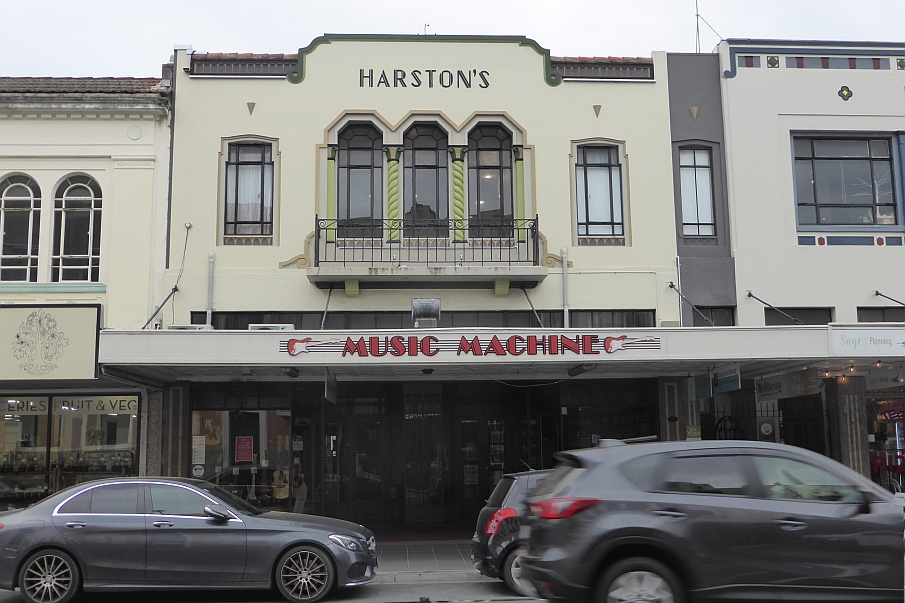
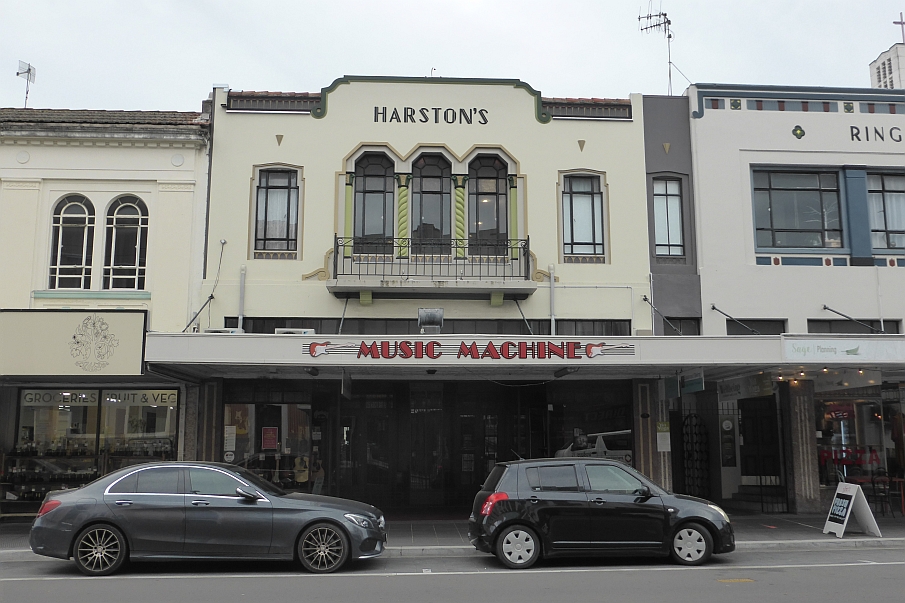
This historic place was registered under the Historic Places Act 1980. This report includes the text from the original Building Classification Committee report considered by the NZHPT Board at the time of registration. ARCHITECTURAL SIGNIFICANCE: The Harston's building is in the Spanish Mission style, a twentieth century revival of a Californian building type which was used by Spanish missionaries who in the eighteenth century settled in the Western Americas and began a programme of educating and caring for the indigenous American populations. The first Spanish missions were built in adobe (mud brick construction) and then whitewashed to deflect the intense heat of the Californian sunshine. The form of the buildings emphasised horizontality with long low structures extending along a plateau, and the decoration was minimal; arched openings and barley twist columns with occasional bell-tower providing the only embellishment. Simplicity and sincerity were the keynotes of this style and in the twentieth century revival of this style of building, although the religious character or content of Spanish Mission style is gone, these characteristics remain. The use of this style In Napier is very appropriate to the climate and conditions and has been skilfully adapted to the permanent materials used. The first major prototype for Spanish Mission style revival building was the Californian Building at the World's Columbian Exposition in Chicago in 1893. The style was a common feature of buildings appearing in architectural periodicals of the late twenties and early thirties. E A Williams had a staff of recently-travelled architects who were keen to explore the possibilities of the style in concrete, brick and plaster. The 1932 alterations were to a design "greatly similar to that existing prior to the earthquake" (Daily Telegraph 18/10/32 p.9). TOWNSCAPE/LANDMARK SIGNIFICANCE: The sculpting of the forecourt of Harston's building is a unique feature in this part of Hastings Street, and its Spanish Mission style upper level links to other essays in this style such as the former Gaiety de Luxe Cinema (1932) in Dickens Street, the Provincial Hotel (1932) in Clive Square and E A Williams' other major building in the Spanish Mission style, the Criterion Hotel in Emerson Street (1932).
Why is this place significant?
Historic Significance
Historical Significance or Value This historic place was registered under the Historic Places Act 1980. This report includes the text from the original Building Classification Committee report considered by the NZHPT Board at the time of registration. The firm of Messrs Harstons Ltd established in Napier in 1904 was the agent for many leading makes of piano, at a time in which almost every home was furnished with a piano, and musical evenings were an important part of the social scene. For over fifty years, 1930-1985, Mr NevIlle Harston operated a music shop out of one half of this building, leasing the other half to various businesses trading under the name of Alsops Grocery. Both are fixtures in the consciousness of many locals. With the introduction of radio, Harston's began to sell radios. However, Harstons never moved into modern stereo or hi-fidelity equipment, and after c.1950 began to specialise in imported sheet music. The store was owned and operated by Neville Harston, himself a musician and an established local identity. Alsop's Grocery has always operated alongside Harston's.
Physical Significance
This historic place was registered under the Historic Places Act 1980. This report includes the text from the original Building Classification Committee report considered by the NZHPT Board at the time of registration. ARCHITECTURAL SIGNIFICANCE: The Harston's building is in the Spanish Mission style, a twentieth century revival of a Californian building type which was used by Spanish missionaries who in the eighteenth century settled in the Western Americas and began a programme of educating and caring for the indigenous American populations. The first Spanish missions were built in adobe (mud brick construction) and then whitewashed to deflect the intense heat of the Californian sunshine. The form of the buildings emphasised horizontality with long low structures extending along a plateau, and the decoration was minimal; arched openings and barley twist columns with occasional bell-tower providing the only embellishment. Simplicity and sincerity were the keynotes of this style and in the twentieth century revival of this style of building, although the religious character or content of Spanish Mission style is gone, these characteristics remain. The use of this style In Napier is very appropriate to the climate and conditions and has been skilfully adapted to the permanent materials used. The first major prototype for Spanish Mission style revival building was the Californian Building at the World's Columbian Exposition in Chicago in 1893. The style was a common feature of buildings appearing in architectural periodicals of the late twenties and early thirties. E A Williams had a staff of recently-travelled architects who were keen to explore the possibilities of the style in concrete, brick and plaster. The 1932 alterations were to a design "greatly similar to that existing prior to the earthquake" (Daily Telegraph 18/10/32 p.9). TOWNSCAPE/LANDMARK SIGNIFICANCE: The sculpting of the forecourt of Harston's building is a unique feature in this part of Hastings Street, and its Spanish Mission style upper level links to other essays in this style such as the former Gaiety de Luxe Cinema (1932) in Dickens Street, the Provincial Hotel (1932) in Clive Square and E A Williams' other major building in the Spanish Mission style, the Criterion Hotel in Emerson Street (1932).
Construction Professional
Name
Williams, Ernest Arthur (1875-1962)
Type
Architect
Biography
Williams was an architect and engineer who was prominent in Hawkes Bay as a result of his contribution towards the reconstruction of Napier following the 1931 earthquake. Born in London he immigrated to New Zealand with his family early in 1908, spending a few months in Christchurch before settling in Napier. Initially he joined the Napier firm of architects W P Finch and Company as an architectural draughtsman, employing the skills he had learned during his training in architecture and joinery in England. He was a member of the engineering staff of the Napier Borough Council until 1912, holding the position of Clerk of Works. He held this position during the building of the Napier Municipal Baths. Williams set up his own architectural practice in 1912. He was, however, co-opted as Napier Borough Engineer during World War 1, resuming independent architectural practice in 1921. After the 1931 earthquake his practice expanded to include eight architectural draughtsmen to cope with the large number of commissions to replace buildings which had been destroyed. His completed works include the Criterion Hotel (192), the Central Hotel (1931), Harston's Building (1930 and 1932), the Daily Telegraph Building (1932), the Napier Harbour Board Offices, and hospital buildings on Bluff Hill.
Name
Angus, William McKenzie
Type
Builder
Biography
William McKenzie Angus was born in Naseby in 1883. At age 14 he moved to Wellington to work as a blacksmith but changed to carpentry and worked in several North Island centres before coming to Napier in approximately 1907. He founded the firm W M Angus Ltd in 1923, with approximately 4-5 employees. At the time of his death in July 1968 the firm had 200 employees. His first major job in Napier, the Chief Post Office, withstood the 1931 Hawkes Bay earthquake as did the other buildings he had erected in Napier by this time. (Registration Report for the Waiapu Diocesan Office Building and Synod Hall, 2008).
Construction Details
Start Year
1932
Type
Original Construction
Description
Spanish Mission (art Nouveau detailing), 1930, 1932 (reinstated)
Start Year
1931
Type
Other
Description
Gutted by post-earthquake fire
Start Year
1986
Type
Modification
Description
Internal modifications following the death of Neville Harston and conversion of the southern wing to a restaurant.
Start Year
2008
Type
Other
Description
Fire June 2008
Construction Materials
Wood, brick and plaster with terra cotta tile roof.
Notable Features
Geometricised leadlight windows and interior shop fittings which carry applied lettering in gold similar to that found on the exterior at ground floor level.
Construction Professional
Name
Williams, Ernest Arthur (1875-1962)
Type
Architect
Biography
Williams was an architect and engineer who was prominent in Hawkes Bay as a result of his contribution towards the reconstruction of Napier following the 1931 earthquake. Born in London he immigrated to New Zealand with his family early in 1908, spending a few months in Christchurch before settling in Napier. Initially he joined the Napier firm of architects W P Finch and Company as an architectural draughtsman, employing the skills he had learned during his training in architecture and joinery in England. He was a member of the engineering staff of the Napier Borough Council until 1912, holding the position of Clerk of Works. He held this position during the building of the Napier Municipal Baths. Williams set up his own architectural practice in 1912. He was, however, co-opted as Napier Borough Engineer during World War 1, resuming independent architectural practice in 1921. After the 1931 earthquake his practice expanded to include eight architectural draughtsmen to cope with the large number of commissions to replace buildings which had been destroyed. His completed works include the Criterion Hotel (192), the Central Hotel (1931), Harston's Building (1930 and 1932), the Daily Telegraph Building (1932), the Napier Harbour Board Offices, and hospital buildings on Bluff Hill.
Name
Angus, William McKenzie
Type
Builder
Biography
William McKenzie Angus was born in Naseby in 1883. At age 14 he moved to Wellington to work as a blacksmith but changed to carpentry and worked in several North Island centres before coming to Napier in approximately 1907. He founded the firm W M Angus Ltd in 1923, with approximately 4-5 employees. At the time of his death in July 1968 the firm had 200 employees. His first major job in Napier, the Chief Post Office, withstood the 1931 Hawkes Bay earthquake as did the other buildings he had erected in Napier by this time. (Registration Report for the Waiapu Diocesan Office Building and Synod Hall, 2008).
Construction Details
Start Year
1932
Type
Original Construction
Description
Spanish Mission (art Nouveau detailing), 1930, 1932 (reinstated)
Start Year
1931
Type
Other
Description
Gutted by post-earthquake fire
Start Year
1986
Type
Modification
Description
Internal modifications following the death of Neville Harston and conversion of the southern wing to a restaurant.
Start Year
2008
Type
Other
Description
Fire June 2008
Construction Materials
Wood, brick and plaster with terra cotta tile roof.
Notable Features
Geometricised leadlight windows and interior shop fittings which carry applied lettering in gold similar to that found on the exterior at ground floor level.
This historic place was registered under the Historic Places Act 1980. This report includes the text from the original Building Classification Committee report considered by the NZHPT Board at the time of registration. ARCHITECTURAL DESCRIPTION (STYLE): The Harston's building is in the Spanish Mission style with Art Nouveau detailing for the shop fronts. The flat roofline shows a use of terracotta tiling to provide a contrast with the white painted plaster which is characteristic of the Spanish Mission style. Below the roofline, the central window area is divided into three windows with angle-arched window heads fronting a balcony. The windows are separated by engaged barley twist columns which have freely adapted Corinthian capitals. Square engaged pilasters with half-capitals link the flanking windows to the surrounding wall. The whole feature is supported by volutes on either side which repeat the patterned wrought iron work of the balcony and the central pediment which carries the name "Harston's" in geometricised lettering raised from the plaster behind. The ground floor level provides a marked contrast with this Mediterranean inspired effect. Varnished wood is used to frame angled windows which sculpt the forecourt area of the shop and provide large display areas. The clear glass of the display windows is surmounted by leadlights featuring a repeated stylised rose motif at the centre of geometric patterns of stained glass. Above this, in curvilinear lettering, are words describing the goods sold, so that the effect created is more Art Nouveau than Spanish Mission style. However, the decorative feature of the door handles with their parallel squared rods suggests an Art Deco, or Streamline Moderne influence. Thus the building is eclectic, drawing upon several of the architectural styles prevailing in the twenties and thirties, and combining them in a unique and distinctive mix.
This historic place was registered under the Historic Places Act 1980. This report includes the text from the original Building Classification Committee report considered by the NZHPT Board at the time of registration. ARCHITECTURAL DESCRIPTION (STYLE): The Harston's building is in the Spanish Mission style with Art Nouveau detailing for the shop fronts. The flat roofline shows a use of terracotta tiling to provide a contrast with the white painted plaster which is characteristic of the Spanish Mission style. Below the roofline, the central window area is divided into three windows with angle-arched window heads fronting a balcony. The windows are separated by engaged barley twist columns which have freely adapted Corinthian capitals. Square engaged pilasters with half-capitals link the flanking windows to the surrounding wall. The whole feature is supported by volutes on either side which repeat the patterned wrought iron work of the balcony and the central pediment which carries the name "Harston's" in geometricised lettering raised from the plaster behind. The ground floor level provides a marked contrast with this Mediterranean inspired effect. Varnished wood is used to frame angled windows which sculpt the forecourt area of the shop and provide large display areas. The clear glass of the display windows is surmounted by leadlights featuring a repeated stylised rose motif at the centre of geometric patterns of stained glass. Above this, in curvilinear lettering, are words describing the goods sold, so that the effect created is more Art Nouveau than Spanish Mission style. However, the decorative feature of the door handles with their parallel squared rods suggests an Art Deco, or Streamline Moderne influence. Thus the building is eclectic, drawing upon several of the architectural styles prevailing in the twenties and thirties, and combining them in a unique and distinctive mix.
Historical and Associated Iwi / Hapū / Whānau
Completion Date
19th April 1989
Information Sources
Alexander Turnbull Library
Alexander Turnbull Library, Wellington
Daily Telegraph
Daily Telegraph
Ives, 1982
Heather Ives, The Art Deco Architecture of Napier, Napier, 1982
Shaw, 1990
P. Shaw and P. Hallet, Art Deco Napier: Styles of the Thirties, Cosmos Publications, Napier, 1990
Other Information
A copy of this report is available from the NZHPT Central region office Please note that entry on the New Zealand Heritage List/Rarangi Korero identifies only the heritage values of the property concerned, and should not be construed as advice on the state of the property, or as a comment of its soundness or safety, including in regard to earthquake risk, safety in the event of fire, or insanitary conditions.
Historical and Associated Iwi / Hapū / Whānau
Completion Date
19th April 1989
Information Sources
Alexander Turnbull Library
Alexander Turnbull Library, Wellington
Daily Telegraph
Daily Telegraph
Ives, 1982
Heather Ives, The Art Deco Architecture of Napier, Napier, 1982
Shaw, 1990
P. Shaw and P. Hallet, Art Deco Napier: Styles of the Thirties, Cosmos Publications, Napier, 1990
Other Information
A copy of this report is available from the NZHPT Central region office Please note that entry on the New Zealand Heritage List/Rarangi Korero identifies only the heritage values of the property concerned, and should not be construed as advice on the state of the property, or as a comment of its soundness or safety, including in regard to earthquake risk, safety in the event of fire, or insanitary conditions.
Current Usages
Uses: Trade
Specific Usage: Pub/bar/tavern/public hotel
Former Usages
General Usage: Trade
Specific Usage: Shop
Current Usages
Uses: Trade
Specific Usage: Pub/bar/tavern/public hotel
Former Usages
General Usage: Trade
Specific Usage: Shop
Get the latest heritage news, features and events delivered
straight to your inbox.