DonateMembershipVisit Heritage
  • Tūrangawaewae
    Places
  • Tira Māori
    Māori Heritage
  • Poutairangahia
    Archaeology
  • Rauemi
    Resources
  • Mō Tātou
    About Us
  • New Zealand Heritage List
  • Nominate and submit
  • Explore the List
  • National Historic Landmarks
  • Plaques
  • Rainbow List Project
  • Lost heritage
  • Visit Heritage
  • Our properties
  • Turnbull House Project
  • Collections
  • Shop
  • Tohu Whenua
  • Tira Māori
  • Conserving Māori heritage
  • Marae built heritage
  • Māori heritage on the List
  • Hinemihi—Te Hokinga Mai
  • What is archaeology?
  • Is there a site on my property?
  • What are my legal requirements?
  • Affecting an archaeological site
  • Declaring an archaeological site
  • Archaeology FAQs
  • Archaeology Digital Library
  • Archaeology guidelines and templates
  • Resources
  • Funding
  • Publications
  • Sustainable management guides
  • Disaster recovery
  • Podcasts & digital resources
  • Education Hub
  • Conservation plans
  • About
  • Board
  • Māori Heritage Council
  • Senior Staff
  • Offices
  • Contact us
  • Careers
  • Covenants
  • Fast-track
  • Corporate documents
  • Currently consulting on
  • Our submissions
  • News
  • Covid-19 response
Quick links
Rārangi Kōrero | The List
Explore the List
National Historic Landmarks
Ngā Manawhenua o Aotearoa me ōna Kōrero Tūturu
Quick links
Tapuwae
A Vision for Places of Māori Heritage
Funding for Māori Heritage
Resources
Quick links
Archaeological Authority Portal
Applying for an archaeological authority
Archaeology FAQs
Browse the most frequently asked questions about archaeological authorities and the archaeological process.
Quick links
Quick links
News
News Keep up to date with Heritage New Zealand Pouhere Taonga
Membership
Membership Find out more and sign up today
DonateMembershipVisit Heritage
  • Tūrangawaewae
    Places
  • Tira Māori
    Māori Heritage
  • Poutairangahia
    Archaeology
  • Rauemi
    Resources
  • Mō Tātou
    About Us
  • New Zealand Heritage List
  • Nominate and submit
  • Explore the List
  • National Historic Landmarks
  • Plaques
  • Rainbow List Project
  • Lost heritage
  • Visit Heritage
  • Our properties
  • Turnbull House Project
  • Collections
  • Shop
  • Tohu Whenua
  • Tira Māori
  • Conserving Māori heritage
  • Marae built heritage
  • Māori heritage on the List
  • Hinemihi—Te Hokinga Mai
  • What is archaeology?
  • Is there a site on my property?
  • What are my legal requirements?
  • Affecting an archaeological site
  • Declaring an archaeological site
  • Archaeology FAQs
  • Archaeology Digital Library
  • Archaeology guidelines and templates
  • Resources
  • Funding
  • Publications
  • Sustainable management guides
  • Disaster recovery
  • Podcasts & digital resources
  • Education Hub
  • Conservation plans
  • About
  • Board
  • Māori Heritage Council
  • Senior Staff
  • Offices
  • Contact us
  • Careers
  • Covenants
  • Fast-track
  • Corporate documents
  • Currently consulting on
  • Our submissions
  • News
  • Covid-19 response
Quick links
Rārangi Kōrero | The List
Explore the List
National Historic Landmarks
Ngā Manawhenua o Aotearoa me ōna Kōrero Tūturu
Quick links
Tapuwae
A Vision for Places of Māori Heritage
Funding for Māori Heritage
Resources
Quick links
Archaeological Authority Portal
Applying for an archaeological authority
Archaeology FAQs
Browse the most frequently asked questions about archaeological authorities and the archaeological process.
Quick links
Quick links
News
News Keep up to date with Heritage New Zealand Pouhere Taonga
Membership
Membership Find out more and sign up today
  • Places
  • Nominate and submit
  • National Historic Landmarks
  • Places
  • Nominate and submit
  • National Historic Landmarks
  • Tira Māori
  • Conserving Māori heritage
  • Marae built heritage
  • Tira Māori
  • Conserving Māori heritage
  • Marae built heritage
  • Archaeological authorities
  • Archaeology Digital Library
  • Archaeological authorities
  • Archaeology Digital Library
  • All resources
  • Publications
  • Funding
  • All resources
  • Publications
  • Funding
  • FAQs
  • FAQs
Follow us on:
Places
  • Places
  • Nominate and submit
  • National Historic Landmarks
Tira Māori
  • Tira Māori
  • Conserving Māori heritage
  • Marae built heritage
Archaeology
  • Archaeological authorities
  • Archaeology Digital Library
Resources
  • All resources
  • Publications
  • Funding
FAQs
  • FAQs
Follow us on
HomePrivacyTerms and conditionsAbout this site
© Heritage New Zealand Pouhere Taonga 2026.
 
National Tobacco Company Building

1 Ossian Street and Bridge Street, Ahuriri, NAPIER

Private

Historic Place Category 1

List No. 1170
Quick links:
List GalleryLocationDetails
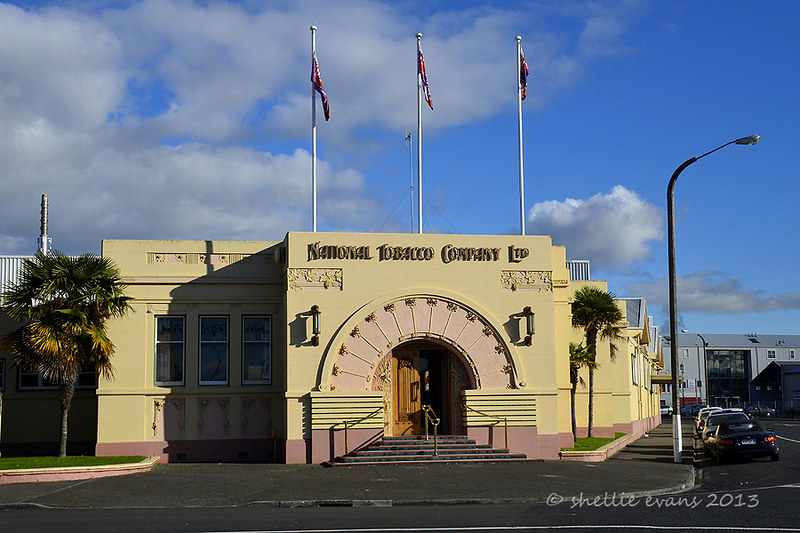
The Rothman's Building, also known as the National Tobacco Company Building, is regarded by many as one of Napier's most elegant commercial buildings dating to the 1930s. It can be regarded as a monument to Gerhard Husheer, one the founding members of the New Zealand tobacco industry, and an important work of the architect Louis Hay.

Johann Gerhard Husheer (1864-1954), a German by birth, immigrated with his family to New Zealand from South Africa in 1911, with the intention of establishing a tobacco industry in the country. In 1913, following successful experiments in growing tobacco crops at Paki Paki, Hastings, Husheer established the New Zealand Tobacco Company and opened a processing factory at Ahuriri, Napier, in 1915. Although the company did well, Husheer and his sons were forced to leave through the actions of some of its directors. Husheer moved to Auckland where he set up in 1921 the National Tobacco Company, eventually purchasing the assets of the New Zealand Tobacco Company, which had gone out of the business in the meantime. He returned to Napier in 1924. The company prospered and in 1925 Husheer commissioned Louis Hay (1881-1948), a Napier based architect, to design a factory at the Ahuriri site. Hay had previously been involved in renovating Husheer's three houses in Elizabeth Street, on Bluff Hill. Although the external walls of the factory were to collapse during the 1931 Hawke's Bay earthquake, the internal structure remained largely intact and production continued relatively unhindered following the disaster. The Depression also had little impact on the National Tobacco Company, as demand for the company's product remained high.

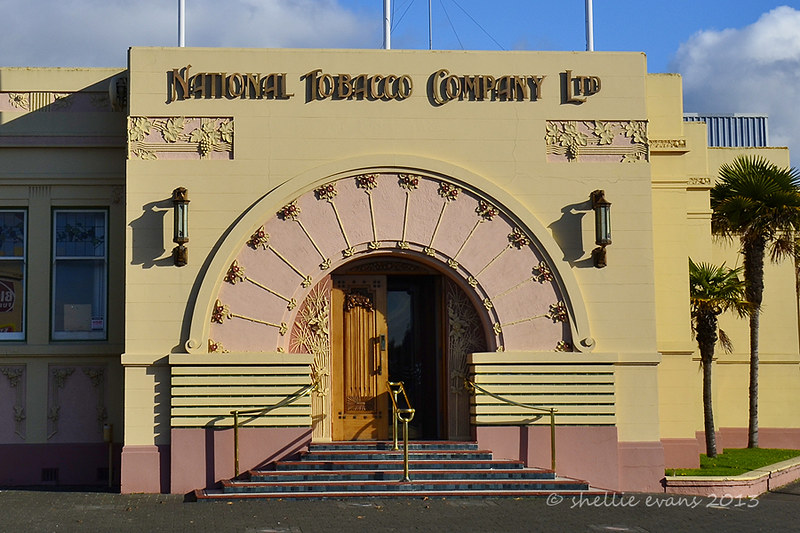
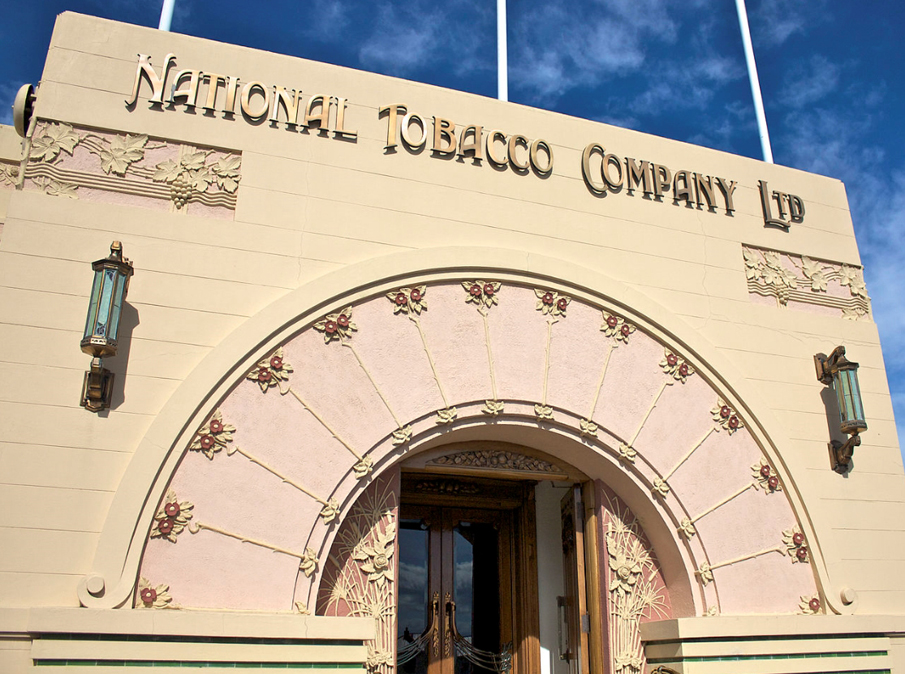
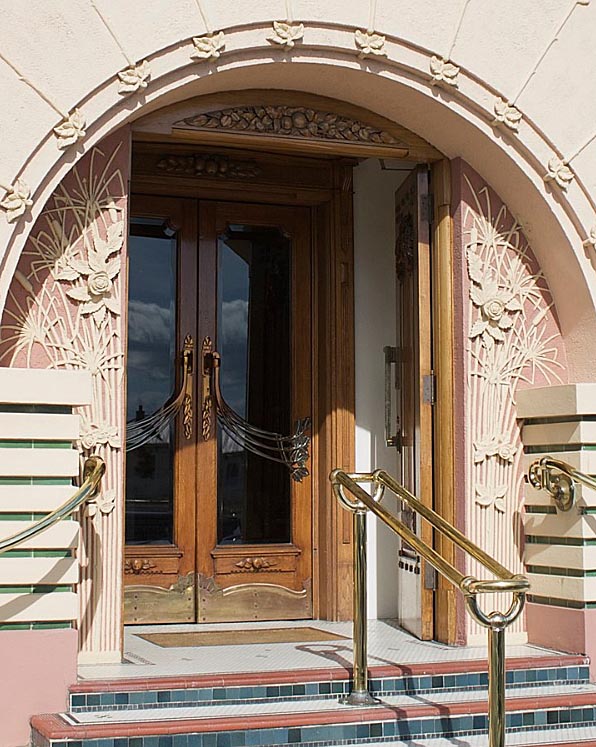
By 1932 the National Tobacco Company was one of the wealthiest industries in Napier and certainly the largest employer of local labour. In that year Husheer commissioned Louis Hay to design a main frontage for his factory to replace the structure that had collapsed in the earthquake. Hay's initial sketches were rejected by Husheer for not being extravagant enough. Hay's second plan, which was eventually built, was for a deceptively simple building based on the idea of an 'arch within a square', decorated with detailed representations of plants such as roses, raupo, and vine leaves. The motif of roses also featured on the lamps on the side of the entrance and lead-light windows. Leading up to the doors were steps decorated with tiles, and brass handrails. Entering through an elaborately carved set of doors, the foyer featured a marble dado, and oak panelling, combined with a domed lead-light skylight to create an overall feeling of elegance and luxury. The entire design, particularly the use of simple geometric forms decorated with applied decoration, reflected Hay's interest in the Art Nouveau or Secession style developed in Europe at the turn of the twentieth century. Hay was to use similar ideas in the design of Napier's AMP Building (1933/34) and the Hawke's Bay Art Gallery and Museum (1935). Tenders for the construction of the National Tobacco Company Building were called for in October 1932, and the work was nearly finished by the end of December 1932.

Although built in the middle of the Depression, Husheer suffered no adverse reaction for this obvious display of wealth, as he was also known for his philanthropic gestures, handing out food to those in need in during the hardest years of the economic crisis. The high regard for the company within the community at the time can be seen in the actions of the Napier Chamber of Commerce when, in 1933, it sought to defend the National Tobacco Company's objection to the introduction of taxation on local tobacco.

After Husheer's death in 1954 the company was acquired by Rothmans of Pall Mall. The entranceway was largely disused after the 1960s when a new administration building was built adjacent. In the mid 1980s interest in the older building increased and work was begun on restoring the building to its former glory. A glazed screen that had been removed at some time was rebuilt based on a photograph of the original. During the 1990s the paint-work was restored to its original colour and a number of the lead-light windows that had been removed, were remade. In 1999 Rothman's merged with British American Tobacco Ltd. The company continues to process tobacco at the Ahuriri plant, and the Hay designed entrance building is open to the public during working hours.

The Rothman's Building (recently renamed the National Tobacco Company Building) is a testimony to the success of the tobacco industry in New Zealand in the early twentieth century, and in particular the role of Gerhard Hussheer, considered to be one of New Zealand's foremost industrialist. At a local level it was the entranceway to what was once Napier's largest employer. Architecturally it is regarded as the jewel in Napier's architectural crown. The building is perhaps one of Louis Hay's best preserved public buildings, and it is an excellent example of the craftsmanship of local artists in post earthquake Napier. Today, located on a corner site amongst the industrial buildings of Ahuriri, it is a noted landmark, and is a popular destination for visitors to Napier.
National Tobacco Company Building, Napier. Image courtesy of www.flickr.com | Shellie Evans – flyingkiwigirl | 14/06/2013 | Shellie Evans
National Tobacco Company Building, Napier. Building detail. CC BY 2.0 Image courtesy of commons.wikimedia.org | Russell James Smith | 22/03/2010 | Russell James Smith - Wikimedia Commons
National Tobacco Company Building, Napier. Image courtesy of www.flickr.com | Shellie Evans – flyingkiwigirl | 14/06/2013 | Shellie Evans
National Tobacco Company Building, Napier. Building detail. CC BY 2.0 Image courtesy of commons.wikimedia.org | Russell James Smith | 22/03/2010 | Russell James Smith - Wikimedia Commons

List Entry Information

Overview

Status
Listed

List Entry Status
Historic Place Category 1

Access
Private/No Public Access

List Number
1170

Date Entered
21st September 1989

Date of Effect
21st September 1989

City/District Council
Napier City

Region
Hawke's Bay Region

Extent of List Entry

Extent of registration includes the land described as Lots 1 & 4 DP 8332 (RT HB143/12), Lot 2 DP 8332 (RT HB142/254), Town Sec 604 (RT HBA4/965), Town Sec 605 (RT HBM3/426), Town Sec 606 (RT HBA4/964), Town Sec 607 (RT HB93/12), Town Sec 608 (RT HBM3/425), Napier Land District, and the buildings and structures thereon known as National Tobacco Company Building. The buildings and structures post-dating ownership by the National Tobacco Company are within the boundary of the registration but have not been identified in the original registration report as being of significance.

Legal description

Lots 1 & 4 DP 8332 (RT HB143/12), Lot 2 DP 8332 (RT HB 142/254), Town Sec 604 (RT HBA 4/965), Town Sec 605 (RT HBM3/426), Town Sec 606 (RT HBA4/964), Town Sec 607 (RT93/12), Town Sec 608 (RT HBM3/425), Napier Land District

Detailed List Entry
Significance

Historic Significance

Historical Significance or Value Tobacco growing and processing was an important industry in Hawke's Bay in the early 20th century, but it was in competition with imported products. Husheer resolved the challenge this competition with a local product. By 1933 the company had become one of the wealthiest industries in Napier, and the largest local employer of labour. Local support for the industry was great and the Napier Chamber of Commerce defended the National Tobacco Company when taxation on local tobacco was first introduced. The firm's prosperity and standing in the community is reflected in the fittings and appearance of the 1933 additions, making the building Napier's most luxurious post-earthquake building with no expense being spared in the design and finishing of the building.

Physical Significance

In its use of simple geometric forms, enlivened by applied decoration, the Rothman's building recalls Joseph Olbrich's Secession building, Vienna, 1898. The unusual combination of raupo and roses as the sources for the decorative forms found to either side of the wooden doors suggests that Hay was conscious of the Frank Lloyd Wright/Sullivan dictum to use applied decoration with characteristics of the region in which the building is situated. Although the appearance of the building does not suggest historicism there are some vestigial classical features, like the metope-triglyph alternating motifs on the top of the parapet and the incised parallel links which suggest column capitals. These appear above the window heads on the side portions of the building.

Construction Professional

Name

Hay, James Augustus Louis

Type

Architect

Biography

J A Louis Hay (1881-1948) was born at Akaroa, Banks Peninsula. He attended Napier Boys' High School and worked for both D T Natusch and Walter P Finch. Hay developed a strong interest in the work of William Morris (1834-1869), Louis Sullivan (1856-1924) and Frank Lloyd Wright (1869-1959). On completion of his training Hay worked both in Dunedin and Australia before returning to Napier to commence practice on his own account. Hay was chairman of the Hawkes Bay branch of the New Zealand Institute of Architects and was the Institute representative on the Napier Reconstruction Committee after the 1931 earthquake. He also did extensive work toward the reconstruction of Napier in the 1930s as a member of Associated Architects, a co-operative design organisation whose members included the principals of the three other major architectural practices in Napier at that time - C T Natusch and Sons, Finch and Westerholm and E A Williams. In collaboration with these architects Hay contributed to the Marine Parade Development plan, and the reconstruction of Napier Public Hospital. In his own practice Hay was responsible for the designs of the National Tobacco Company Building (now Rothman's), Ahuriri (1933), the Hawkes Bay Art Gallery and Museum (1935), and the Hildebrandt Building, Tennyson Street (1932). His domestic work includes 'Waiohika', Greys Bush, Gisborne (1920).

Construction Details

Start Year

1925

Type

Original Construction

Description

Construction of main administration building

Start Year

1931

Type

Other

Description

External walls collapsed during earthquake

Start Year

1933

Type

Reconstruction

Description

Entrance rebuilt

Start Year

1980

Finish Year

2000

Type

Other

Description

Restoration of entranceway

Construction Materials

Concrete

Notable Features

All of the components of the arched entrance are special features of the building: the sculpted concrete raupo and roses; the highly decorated wooden doors carved by Walter Marquand, of Hastings; the brass handrails and mosaic tiles, external lamps, all contribute to a sumptuous effect. On the interior, marble panelling and carve wood are combined with a domed skylight to create an impressive foyer, which was detailed by Hay's assistant Thelma Williamson.

Physical Description

Art Nouveau style of Secession style cubic forms (single storeyed) stepped back from the entrance block. The Rothman's building is notable for the applied decoration which enlivens its simple cubic form. The ornament, inspired by plant forms, is not intrinsically geometric but is contained within geometric forms. The grape and vine frieze along the sides of the front of the block is contained within an oblong. Similarly the rose ornamentation beneath the windows is contained within rectangular panels and the decoration around the entrance has strict geometric sectioning. Although the decoration is very original, the central arch is suggestive of a 'sunburst', a motif commonly used in Art Deco architecture. Sunburst motifs are also incorporated in the door panels of the Rothman's building.

Reference

Completion Date

28th November 2002

Report Written By

Helen McCracken

Information Sources

Daily Telegraph

Daily Telegraph

Dictionary of New Zealand Biography

Dictionary of New Zealand Biography

McGregor, 2001

Robert McGregor, 'The National Tobacco Company Building', Art Deco Trust Information Sheet No.1, Napier, 2001

Shaw, 1987

Shaw, Peter and Peter Hallett. Art Deco Napier: Styles of the Thirties, Reed Methuen, Auckland, 1987.

Shaw, 1999

Peter Shaw, Louis Hay Architect, Napier, 1999

Report Written By

Please note that entry on the New Zealand Heritage List/Rarangi Korero identifies only the heritage values of the property concerned, and should not be construed as advice on the state of the property, or as a comment of its soundness or safety, including in regard to earthquake risk, safety in the event of fire, or insanitary conditions.

Further Information

Current Usages

Uses: Civic Facilities

Specific Usage: Museum

Uses: Trade

Specific Usage: Office building/Offices

Former Usages

General Usage:: Trade

Specific Usage: Office building/Offices

Themes

Web Links

Overview

Status

Listed

List Entry Status

Historic Place Category 1

Access

Private/No Public Access

List Number

1170

Date Entered

21st September 1989

Date of Effect

21st September 1989

City/District Council

Napier City

Region

Hawke's Bay Region

Extent of List Entry

Extent of registration includes the land described as Lots 1 & 4 DP 8332 (RT HB143/12), Lot 2 DP 8332 (RT HB142/254), Town Sec 604 (RT HBA4/965), Town Sec 605 (RT HBM3/426), Town Sec 606 (RT HBA4/964), Town Sec 607 (RT HB93/12), Town Sec 608 (RT HBM3/425), Napier Land District, and the buildings and structures thereon known as National Tobacco Company Building. The buildings and structures post-dating ownership by the National Tobacco Company are within the boundary of the registration but have not been identified in the original registration report as being of significance.

Legal description

Lots 1 & 4 DP 8332 (RT HB143/12), Lot 2 DP 8332 (RT HB 142/254), Town Sec 604 (RT HBA 4/965), Town Sec 605 (RT HBM3/426), Town Sec 606 (RT HBA4/964), Town Sec 607 (RT93/12), Town Sec 608 (RT HBM3/425), Napier Land District

Status

Listed

List Entry Status

Historic Place Category 1

Access

Private/No Public Access

List Number

1170

Date Entered

21st September 1989

Date of Effect

21st September 1989

City/District Council

Napier City

Region

Hawke's Bay Region

Extent of List Entry

Extent of registration includes the land described as Lots 1 & 4 DP 8332 (RT HB143/12), Lot 2 DP 8332 (RT HB142/254), Town Sec 604 (RT HBA4/965), Town Sec 605 (RT HBM3/426), Town Sec 606 (RT HBA4/964), Town Sec 607 (RT HB93/12), Town Sec 608 (RT HBM3/425), Napier Land District, and the buildings and structures thereon known as National Tobacco Company Building. The buildings and structures post-dating ownership by the National Tobacco Company are within the boundary of the registration but have not been identified in the original registration report as being of significance.

Legal description

Lots 1 & 4 DP 8332 (RT HB143/12), Lot 2 DP 8332 (RT HB 142/254), Town Sec 604 (RT HBA 4/965), Town Sec 605 (RT HBM3/426), Town Sec 606 (RT HBA4/964), Town Sec 607 (RT93/12), Town Sec 608 (RT HBM3/425), Napier Land District

Significance

Why is this place significant?

Historic Significance

Historical Significance or Value Tobacco growing and processing was an important industry in Hawke's Bay in the early 20th century, but it was in competition with imported products. Husheer resolved the challenge this competition with a local product. By 1933 the company had become one of the wealthiest industries in Napier, and the largest local employer of labour. Local support for the industry was great and the Napier Chamber of Commerce defended the National Tobacco Company when taxation on local tobacco was first introduced. The firm's prosperity and standing in the community is reflected in the fittings and appearance of the 1933 additions, making the building Napier's most luxurious post-earthquake building with no expense being spared in the design and finishing of the building.

Physical Significance

In its use of simple geometric forms, enlivened by applied decoration, the Rothman's building recalls Joseph Olbrich's Secession building, Vienna, 1898. The unusual combination of raupo and roses as the sources for the decorative forms found to either side of the wooden doors suggests that Hay was conscious of the Frank Lloyd Wright/Sullivan dictum to use applied decoration with characteristics of the region in which the building is situated. Although the appearance of the building does not suggest historicism there are some vestigial classical features, like the metope-triglyph alternating motifs on the top of the parapet and the incised parallel links which suggest column capitals. These appear above the window heads on the side portions of the building.

Why is this place significant?

Historic Significance

Historical Significance or Value Tobacco growing and processing was an important industry in Hawke's Bay in the early 20th century, but it was in competition with imported products. Husheer resolved the challenge this competition with a local product. By 1933 the company had become one of the wealthiest industries in Napier, and the largest local employer of labour. Local support for the industry was great and the Napier Chamber of Commerce defended the National Tobacco Company when taxation on local tobacco was first introduced. The firm's prosperity and standing in the community is reflected in the fittings and appearance of the 1933 additions, making the building Napier's most luxurious post-earthquake building with no expense being spared in the design and finishing of the building.

Physical Significance

In its use of simple geometric forms, enlivened by applied decoration, the Rothman's building recalls Joseph Olbrich's Secession building, Vienna, 1898. The unusual combination of raupo and roses as the sources for the decorative forms found to either side of the wooden doors suggests that Hay was conscious of the Frank Lloyd Wright/Sullivan dictum to use applied decoration with characteristics of the region in which the building is situated. Although the appearance of the building does not suggest historicism there are some vestigial classical features, like the metope-triglyph alternating motifs on the top of the parapet and the incised parallel links which suggest column capitals. These appear above the window heads on the side portions of the building.

Construction Information

Construction Professional

Name

Hay, James Augustus Louis

Type

Architect

Biography

J A Louis Hay (1881-1948) was born at Akaroa, Banks Peninsula. He attended Napier Boys' High School and worked for both D T Natusch and Walter P Finch. Hay developed a strong interest in the work of William Morris (1834-1869), Louis Sullivan (1856-1924) and Frank Lloyd Wright (1869-1959). On completion of his training Hay worked both in Dunedin and Australia before returning to Napier to commence practice on his own account. Hay was chairman of the Hawkes Bay branch of the New Zealand Institute of Architects and was the Institute representative on the Napier Reconstruction Committee after the 1931 earthquake. He also did extensive work toward the reconstruction of Napier in the 1930s as a member of Associated Architects, a co-operative design organisation whose members included the principals of the three other major architectural practices in Napier at that time - C T Natusch and Sons, Finch and Westerholm and E A Williams. In collaboration with these architects Hay contributed to the Marine Parade Development plan, and the reconstruction of Napier Public Hospital. In his own practice Hay was responsible for the designs of the National Tobacco Company Building (now Rothman's), Ahuriri (1933), the Hawkes Bay Art Gallery and Museum (1935), and the Hildebrandt Building, Tennyson Street (1932). His domestic work includes 'Waiohika', Greys Bush, Gisborne (1920).

Construction Details

Start Year

1925

Type

Original Construction

Description

Construction of main administration building

Start Year

1931

Type

Other

Description

External walls collapsed during earthquake

Start Year

1933

Type

Reconstruction

Description

Entrance rebuilt

Start Year

1980

startYearCirca

Finish Year

2000

finishYearCirca

Type

Other

Description

Restoration of entranceway

Construction Materials

Concrete

Notable Features

All of the components of the arched entrance are special features of the building: the sculpted concrete raupo and roses; the highly decorated wooden doors carved by Walter Marquand, of Hastings; the brass handrails and mosaic tiles, external lamps, all contribute to a sumptuous effect. On the interior, marble panelling and carve wood are combined with a domed skylight to create an impressive foyer, which was detailed by Hay's assistant Thelma Williamson.

Construction Professional

Name

Hay, James Augustus Louis

Type

Architect

Biography

J A Louis Hay (1881-1948) was born at Akaroa, Banks Peninsula. He attended Napier Boys' High School and worked for both D T Natusch and Walter P Finch. Hay developed a strong interest in the work of William Morris (1834-1869), Louis Sullivan (1856-1924) and Frank Lloyd Wright (1869-1959). On completion of his training Hay worked both in Dunedin and Australia before returning to Napier to commence practice on his own account. Hay was chairman of the Hawkes Bay branch of the New Zealand Institute of Architects and was the Institute representative on the Napier Reconstruction Committee after the 1931 earthquake. He also did extensive work toward the reconstruction of Napier in the 1930s as a member of Associated Architects, a co-operative design organisation whose members included the principals of the three other major architectural practices in Napier at that time - C T Natusch and Sons, Finch and Westerholm and E A Williams. In collaboration with these architects Hay contributed to the Marine Parade Development plan, and the reconstruction of Napier Public Hospital. In his own practice Hay was responsible for the designs of the National Tobacco Company Building (now Rothman's), Ahuriri (1933), the Hawkes Bay Art Gallery and Museum (1935), and the Hildebrandt Building, Tennyson Street (1932). His domestic work includes 'Waiohika', Greys Bush, Gisborne (1920).

Construction Details

Start Year

1925

Type

Original Construction

Description

Construction of main administration building

Start Year

1931

Type

Other

Description

External walls collapsed during earthquake

Start Year

1933

Type

Reconstruction

Description

Entrance rebuilt

Start Year

1980

startYearCirca

Finish Year

2000

finishYearCirca

Type

Other

Description

Restoration of entranceway

Construction Materials

Concrete

Notable Features

All of the components of the arched entrance are special features of the building: the sculpted concrete raupo and roses; the highly decorated wooden doors carved by Walter Marquand, of Hastings; the brass handrails and mosaic tiles, external lamps, all contribute to a sumptuous effect. On the interior, marble panelling and carve wood are combined with a domed skylight to create an impressive foyer, which was detailed by Hay's assistant Thelma Williamson.

Physical Description

Art Nouveau style of Secession style cubic forms (single storeyed) stepped back from the entrance block. The Rothman's building is notable for the applied decoration which enlivens its simple cubic form. The ornament, inspired by plant forms, is not intrinsically geometric but is contained within geometric forms. The grape and vine frieze along the sides of the front of the block is contained within an oblong. Similarly the rose ornamentation beneath the windows is contained within rectangular panels and the decoration around the entrance has strict geometric sectioning. Although the decoration is very original, the central arch is suggestive of a 'sunburst', a motif commonly used in Art Deco architecture. Sunburst motifs are also incorporated in the door panels of the Rothman's building.

Art Nouveau style of Secession style cubic forms (single storeyed) stepped back from the entrance block. The Rothman's building is notable for the applied decoration which enlivens its simple cubic form. The ornament, inspired by plant forms, is not intrinsically geometric but is contained within geometric forms. The grape and vine frieze along the sides of the front of the block is contained within an oblong. Similarly the rose ornamentation beneath the windows is contained within rectangular panels and the decoration around the entrance has strict geometric sectioning. Although the decoration is very original, the central arch is suggestive of a 'sunburst', a motif commonly used in Art Deco architecture. Sunburst motifs are also incorporated in the door panels of the Rothman's building.

Reference

Historical and Associated Iwi / Hapū / Whānau

Completion Date

28th November 2002

Report Written By

Helen McCracken

Information Sources

Daily Telegraph

Daily Telegraph

Dictionary of New Zealand Biography

Dictionary of New Zealand Biography

McGregor, 2001

Robert McGregor, 'The National Tobacco Company Building', Art Deco Trust Information Sheet No.1, Napier, 2001

Shaw, 1987

Shaw, Peter and Peter Hallett. Art Deco Napier: Styles of the Thirties, Reed Methuen, Auckland, 1987.

Shaw, 1999

Peter Shaw, Louis Hay Architect, Napier, 1999

Other Information

Please note that entry on the New Zealand Heritage List/Rarangi Korero identifies only the heritage values of the property concerned, and should not be construed as advice on the state of the property, or as a comment of its soundness or safety, including in regard to earthquake risk, safety in the event of fire, or insanitary conditions.

Historical and Associated Iwi / Hapū / Whānau

Completion Date

28th November 2002

Report Written By

Helen McCracken

Information Sources

Daily Telegraph

Daily Telegraph

Dictionary of New Zealand Biography

Dictionary of New Zealand Biography

McGregor, 2001

Robert McGregor, 'The National Tobacco Company Building', Art Deco Trust Information Sheet No.1, Napier, 2001

Shaw, 1987

Shaw, Peter and Peter Hallett. Art Deco Napier: Styles of the Thirties, Reed Methuen, Auckland, 1987.

Shaw, 1999

Peter Shaw, Louis Hay Architect, Napier, 1999

Other Information

Please note that entry on the New Zealand Heritage List/Rarangi Korero identifies only the heritage values of the property concerned, and should not be construed as advice on the state of the property, or as a comment of its soundness or safety, including in regard to earthquake risk, safety in the event of fire, or insanitary conditions.

Further Information

Current Usages

Uses: Civic Facilities

Specific Usage: Museum

Uses: Trade

Specific Usage: Office building/Offices

Former Usages

General Usage: Trade

Specific Usage: Office building/Offices

Current Usages

Uses: Civic Facilities

Specific Usage: Museum

Uses: Trade

Specific Usage: Office building/Offices

Former Usages

General Usage: Trade

Specific Usage: Office building/Offices

Location

Loading
Stay up to date with Heritage this month