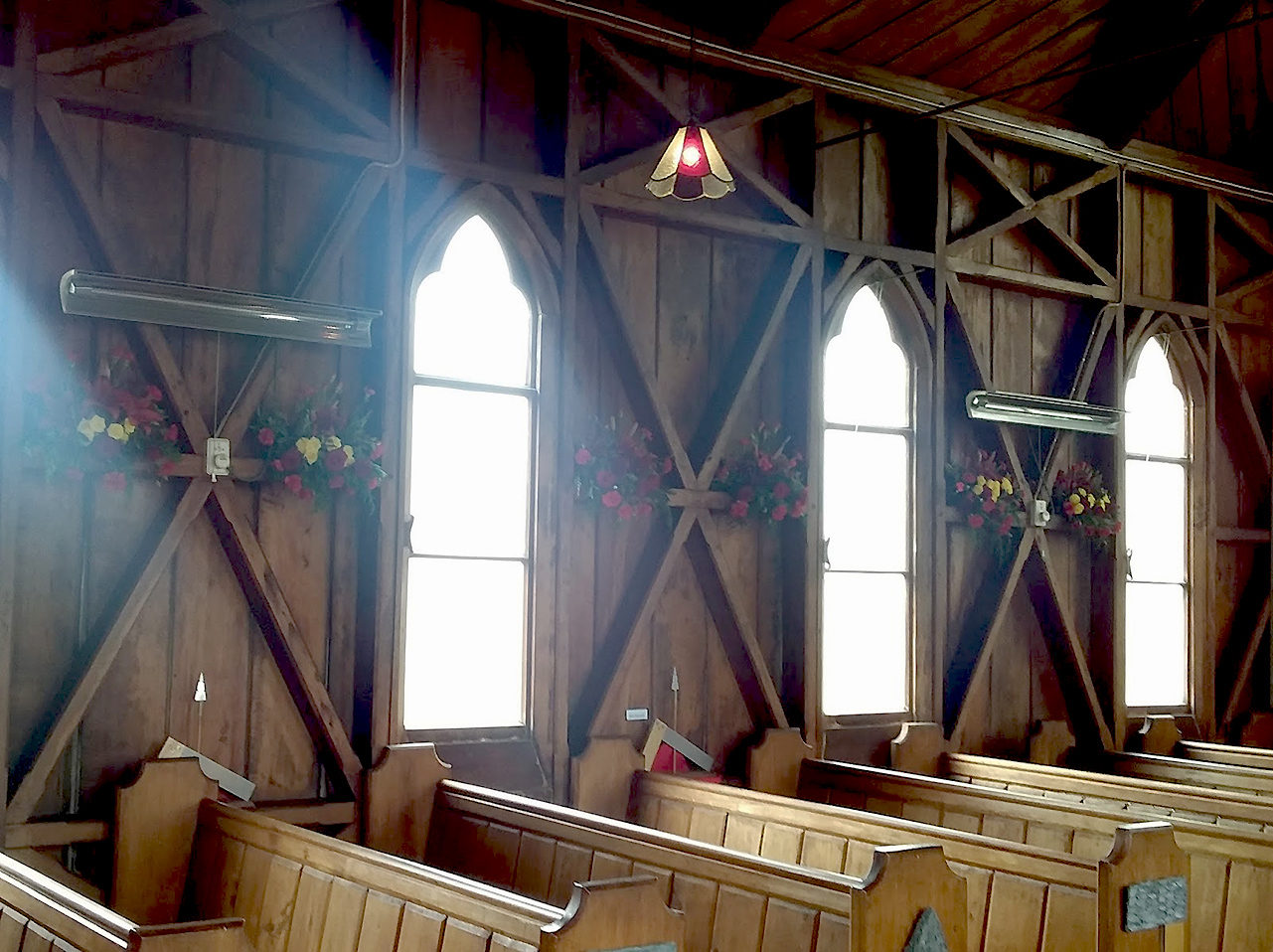
St Thomas' Church, constructed in 1877, is a timber country church located on the edge of Sanson. This building, designed by Charles Tringham, demonstrates Gothic Revival influences and the architect's aptitude in working in this architectural style.
European settlement in the Manawatu was relatively late and it was not until the completion of many Native Land Court cases that it started in earnest during the early 1870s. These proceedings meant that the establishment of Sanson, a town within a larger farming block called Sandon Township, was delayed until 1872. However, Sanson soon acquired facilities, such as St Thomas' Church, that signalled its maturity as both a junction and rural service centre. Prior to the construction of the church local Anglicans attended services in residences when either their, or Methodist, clergy or lay readers were available. However, after the area's parish was established in 1875 the Sanson Anglican community instigated plans for a purpose-built place of worship, contributing significantly to the project through direct donations of money and labour, or through attending fundraising events. After its completion the community continued to support the church and this resulted in some mid twentieth century additions, such as the memorial windows, and an organ that required a specially constructed niche. These activities were associated with the 75th anniversary of the church and the lead-up to its centenary. Other people are also honoured in the church through features like the World War One roll of honour.
St Thomas' Church can be clearly placed within the Gothic Revival tradition of country church architecture in New Zealand because of the extensive use of timber in its construction, its chancel and sacristy adjoined to a modestly sized steep pitch gabled nave, its tower, tracery and lancet windows, and the use of motifs such as quatrefoils throughout the building. The building has undergone few changes since construction, with the exception of the building of the organ lean-to, the installation of the memorial windows, and the replacement of some furniture in the mid twentieth century.
St Thomas' Church has significance as a confident example of the vernacular style of country church architecture prevalent in the late nineteenth century which derived its characteristics from Gothic Revival architecture. This building has historical and social value because its construction is a key indicator of the progression of the Sandon block settlement and because it became an integral part of that community's social fabric. This community esteem has been physically demonstrated within the building. The church also has considerable historical importance because it is one of the earliest remaining churches in the Manawatu.