

The earliest Anglican services at Greatford had been held by the early Anglican missionary Reverend Richard Taylor at Westoe (Category I), which was the home of Sir William Fox (1812?-1893). From 1875, a former British army officer named Major William Jarvis Willis began holding lay services in the town's newly opened school. In 1881, Clere was commissioned to design a church building on land that had been part of Woodendean, Willis' estate.
The son of an Anglican clergyman, Clere was born in Lancashire, England, and had trained as an architect from the age of 16. He immigrated with his family to New Zealand in 1877 when he was 21 years old. He moved to Feilding in 1879, initially staying at Westoe. The commission to design the church at Greatford was the first commission Clere received as an architect and, years later, Clere recalled the event, writing that 'The first church entrusted to me was Greatford, the first of the several scores which I had been privileged to design'.
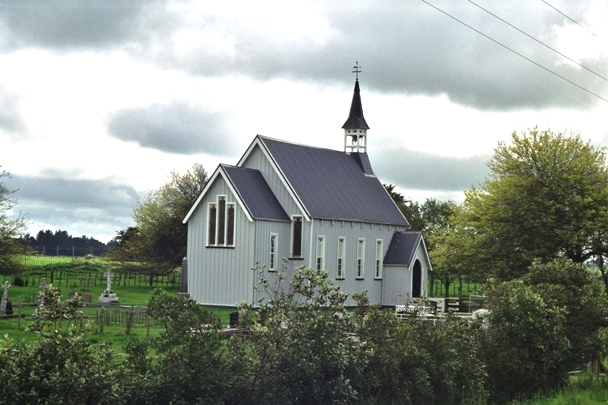
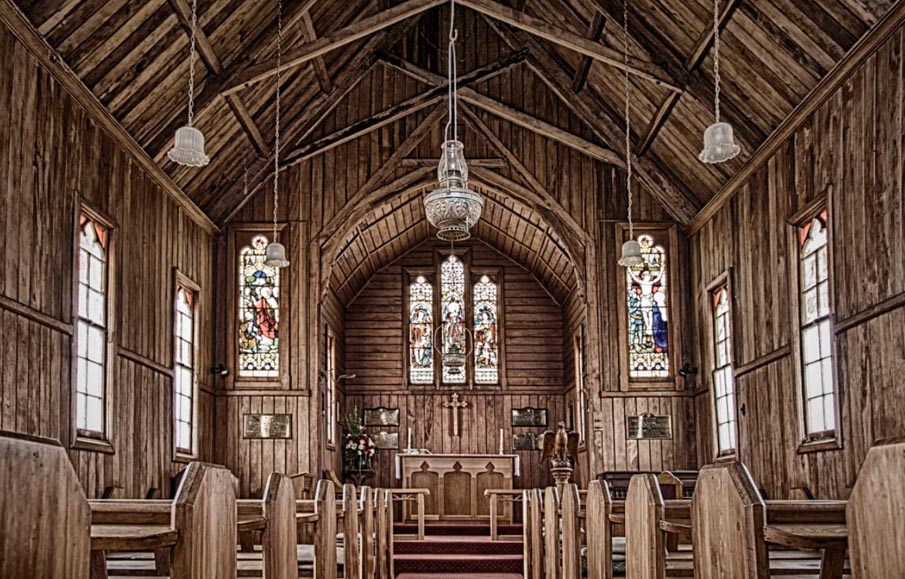
Clere adopted the Victorian Free Gothic style which was then a popular choice for churches throughout New Zealand. The small, rectangular church was built entirely from native timbers. The exterior was originally clad in board and battens, and its steeply pitched roof was covered with shingles, although these have since been replaced with long-run steel. The church consists of a nave, chancel, a small bell tower, a southern transept containing the porch, and a vestry and baptistery at the rear of the building. The interior has exposed timber framing, cross bracing and cladding.
The design of the Church reflects Clere's early architectural principles and ideas. Convinced that parishes were being overcharged for the construction of their churches, Clere set out to demonstrate how economically it could be done. 'After all', Clere noted, a small church is little more than a glorified barn and no farmer would dream of spending anything like as large a sum as £1000 on such a building'. The church at Greatford cost the parish a mere £230.
The church was constructed by brothers J and A Broadbelt of Greatford. It was built entirely from native timbers, which were supplied by Edward Nash of Halcombe for £77 3s 3d. It was roofed with heart totara shingles that were split on the site by Thomas Frampton at the cost of £13 15s. It was opened, free of debt, on 30 July 1882, just five months after the completion of St John the Evangelist Church in Feilding, which had been designed by Clere in 1881.
Less than a year after the completion of the Greatford church, Clere became the chief architect for the Wellington Anglican diocese. He designed over 100 churches in this capacity and is highly regarded for his success in marrying European architectural styles to New Zealand conditions.
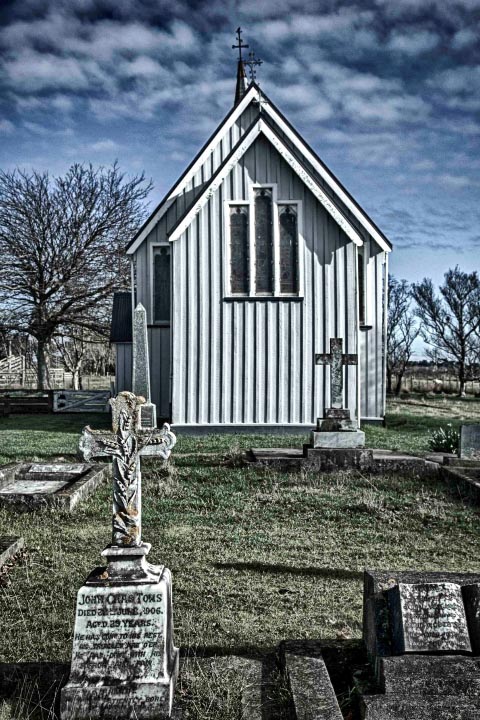
Due to a personal dispute between Major Willis and the Anglican Bishop Octavius Hadfield (1814-1904), the church was not consecrated until Willis' death in 1885, three years after its construction. Named St Martin's, the church was provided with a bell, weighing 69 pounds (31.3 kilograms), a lecturn, and a sanctuary chair. From funds raised by the local community, stained glass windows and a stone font were also purchased. The Reverend F. B. Gorton, who held the first service in the new church, donated the altar cloth. In 1889 Edward Read gifted land he had purchased from Willis's estate Woodendean eleven years earlier, to the Church. Two years later, in 1891, land located adjacent to the church was donated by James Bull, and consecrated as a cemetery. The church's caretaker and bell-ringer, Joshua Thoms, was buried there in 1892. St Martin's church, still in use by the Anglican community of Greatford, has served as a parish church for over 120 years and, apart from minor alterations, continues to demonstrate the early skill of its architect.
List Entry Information
Status
Listed
List Entry Status
Historic Place Category 2
Access
Private/No Public Access
List Number
1216
Date Entered
2nd April 2004
Date of Effect
2nd April 2004
City/District Council
Rangitīkei District
Region
Horizons (Manawatū-Whanganui) Region
Extent of List Entry
Registration includes the building, its fixtures, fittings and chattels, the adjacent cemetery and land on RT WN330/273
Legal description
Secs 14, 17 and 20 on Plan 92 Blk VII Rangitoto SD (RT WN330/273)
Status
Listed
List Entry Status
Historic Place Category 2
Access
Private/No Public Access
List Number
1216
Date Entered
2nd April 2004
Date of Effect
2nd April 2004
City/District Council
Rangitīkei District
Region
Horizons (Manawatū-Whanganui) Region
Extent of List Entry
Registration includes the building, its fixtures, fittings and chattels, the adjacent cemetery and land on RT WN330/273
Legal description
Secs 14, 17 and 20 on Plan 92 Blk VII Rangitoto SD (RT WN330/273)
Why is this place significant?
Historic Significance
Historical Significance or Value St Martin's Church in Greatford is of architectural and historical significance for its connection to New Zealand's eminent ecclesiastical architect Frederick de Jersey Clere (1856-1952). The church was the very first building he designed and one of the earliest examples of his work to be constructed. The simple Victorian Free Gothic style adopted for the church has considerable aesthetic appeal, while the building's location adjacent to a main highway makes it a highly visible landmark. St Martin's cemetery, which was consecrated in 1891 and first used in 1892, lends the site archaeological significance. The church is also of considerable local significance. It is connected with Major William Jarvis Willis, a large landholder and well-known figure in the area of Greatford, and the person primarily responsible for the church's construction. The building has spiritual importance as it has served in its capacity as an Anglican church for over 120 years. The esteem in which the church was and still is held by the community is demonstrated by its continuing use, the addition of plaques and memorials and the development of a Trust to ensure its continued protection.
Why is this place Category 1 / Category 2?
Detail Of Assessed Criteria
(a) The extent to which the place reflects important or representative aspects of New Zealand history: St Martin's Church is representative of the numerous, small, timber churches constructed throughout New Zealand in the Victorian Free Gothic style in the late nineteenth century. It demonstrates the importance of religion to the early settler community and the size and style of the building provides insight into the nature of the community that it served. (b) The association of the place with events, persons, or ideas of importance in New Zealand history: St Martin's Church in Greatford is associated with two persons of note in New Zealand's history. Its construction was made possible by Major William Jarvis Willis, who was an important landowner in the area. It was designed by New Zealand's eminent ecclesiastical architect Frederick de Jersey Clere (1856-1952). It was the first of Clere's designs to be accepted for construction and was one of the earliest of his buildings to be completed. (c) The potential of the place to provide knowledge of New Zealand history: As the first church to be designed by Clere, the building has considerable potential to provide insight into New Zealand's history. It is also one of the last remaining structures in Greatford and of importance to the history of the area. It is also an important landmark in the area. (e)The community association with, or public esteem for, the place: The Church is held in high esteem by the local community. This has been demonstrated by the continuing use of the building for over 120 years, the addition of memorial plaques and gifts such as the font, windows and altar, and by the establishment of a Trust to ensure the building is provided for in perpetuity. (g)The technical accomplishment or value, or design of the place: The design of St Martin's Church exemplifies Clere's contemporary concepts about church design. While working within the Victorian Free Gothic style popular among church architects of the period, Clere designed a church that was highly cost effective and yet one that still met the requirements of the parishioners. (h)The symbolic or commemorative value of the place: The church is a symbol of the development of the Anglican parish in the Greatford area and its continuing strength over the 120 years in which the building has remained in use.
Why is this place significant?
Historic Significance
Historical Significance or Value St Martin's Church in Greatford is of architectural and historical significance for its connection to New Zealand's eminent ecclesiastical architect Frederick de Jersey Clere (1856-1952). The church was the very first building he designed and one of the earliest examples of his work to be constructed. The simple Victorian Free Gothic style adopted for the church has considerable aesthetic appeal, while the building's location adjacent to a main highway makes it a highly visible landmark. St Martin's cemetery, which was consecrated in 1891 and first used in 1892, lends the site archaeological significance. The church is also of considerable local significance. It is connected with Major William Jarvis Willis, a large landholder and well-known figure in the area of Greatford, and the person primarily responsible for the church's construction. The building has spiritual importance as it has served in its capacity as an Anglican church for over 120 years. The esteem in which the church was and still is held by the community is demonstrated by its continuing use, the addition of plaques and memorials and the development of a Trust to ensure its continued protection.
Why is this place Category 1 / Category 2?
Detail Of Assessed Criteria
(a) The extent to which the place reflects important or representative aspects of New Zealand history: St Martin's Church is representative of the numerous, small, timber churches constructed throughout New Zealand in the Victorian Free Gothic style in the late nineteenth century. It demonstrates the importance of religion to the early settler community and the size and style of the building provides insight into the nature of the community that it served. (b) The association of the place with events, persons, or ideas of importance in New Zealand history: St Martin's Church in Greatford is associated with two persons of note in New Zealand's history. Its construction was made possible by Major William Jarvis Willis, who was an important landowner in the area. It was designed by New Zealand's eminent ecclesiastical architect Frederick de Jersey Clere (1856-1952). It was the first of Clere's designs to be accepted for construction and was one of the earliest of his buildings to be completed. (c) The potential of the place to provide knowledge of New Zealand history: As the first church to be designed by Clere, the building has considerable potential to provide insight into New Zealand's history. It is also one of the last remaining structures in Greatford and of importance to the history of the area. It is also an important landmark in the area. (e)The community association with, or public esteem for, the place: The Church is held in high esteem by the local community. This has been demonstrated by the continuing use of the building for over 120 years, the addition of memorial plaques and gifts such as the font, windows and altar, and by the establishment of a Trust to ensure the building is provided for in perpetuity. (g)The technical accomplishment or value, or design of the place: The design of St Martin's Church exemplifies Clere's contemporary concepts about church design. While working within the Victorian Free Gothic style popular among church architects of the period, Clere designed a church that was highly cost effective and yet one that still met the requirements of the parishioners. (h)The symbolic or commemorative value of the place: The church is a symbol of the development of the Anglican parish in the Greatford area and its continuing strength over the 120 years in which the building has remained in use.
Construction Professional
Name
Clere, Frederick De Jersey
Type
Architect
Biography
Clere (1856-1952) was born in Lancashire, the son of an Anglican clergyman, and was articled to Edmund Scott, an ecclesiastical architect of Brighton. He then became chief assistant to R J Withers, a London architect. Clere came to New Zealand in 1877, practising first in Feilding and then in Wanganui. He later came to Wellington and practised there for 58 years. He was elected a Fellow of the Royal Institute of British Architects in 1886 and held office for 50 years as one of four honorary secretaries in the Empire. In 1883 he was appointed Diocesan Architect of the Anglican Church; he designed more than 100 churches while he held this position. Clere was a pioneer in reinforced concrete construction; the outstanding example of his work with this material is the Church of St Mary of the Angels (1922), Wellington. As well as being pre-eminent in church design, Clere was responsible for many domestic and commercial buildings including Wellington's Harbour Board Offices and Bond Store (1891) and Overton in Marton. Clere was also involved in the design of large woolsheds in Hawkes Bay and Wairarapa. He was active in the formation of the New Zealand Institute of Architects and served on their council for many years. He was a member of the Wellington City Council until 1895, and from 1900 a member of the Wellington Diocesan Synod and the General Synod. He was also a member of the New Zealand Academy of Fine Arts.
Name
J & A Broadbelt
Type
Builder
Biography
No biography is currently available for this construction professional
Construction Details
Start Year
1881
Type
Designed
Start Year
1882
Type
Original Construction
Start Year
1885
Type
Addition
Description
Bell (A &T Burt, Dunedin) and stained glass windows incorporated
Type
Modification
Description
Roof replaced with tiles
Start Year
1988
startYearCirca
Finish Year
1989
finishYearCirca
Type
Modification
Description
Exterior re-clad
Start Year
2002
Type
Modification
Description
Building re-roofed in long-run steel
Construction Materials
The church is constructed from native timbers. It originally featured a roof of totara shingles but this has been replaced with one of long-run steel.
Notable Features
Chattels include the original pews, baptism font and brass plaque memorials.
Construction Professional
Name
Clere, Frederick De Jersey
Type
Architect
Biography
Clere (1856-1952) was born in Lancashire, the son of an Anglican clergyman, and was articled to Edmund Scott, an ecclesiastical architect of Brighton. He then became chief assistant to R J Withers, a London architect. Clere came to New Zealand in 1877, practising first in Feilding and then in Wanganui. He later came to Wellington and practised there for 58 years. He was elected a Fellow of the Royal Institute of British Architects in 1886 and held office for 50 years as one of four honorary secretaries in the Empire. In 1883 he was appointed Diocesan Architect of the Anglican Church; he designed more than 100 churches while he held this position. Clere was a pioneer in reinforced concrete construction; the outstanding example of his work with this material is the Church of St Mary of the Angels (1922), Wellington. As well as being pre-eminent in church design, Clere was responsible for many domestic and commercial buildings including Wellington's Harbour Board Offices and Bond Store (1891) and Overton in Marton. Clere was also involved in the design of large woolsheds in Hawkes Bay and Wairarapa. He was active in the formation of the New Zealand Institute of Architects and served on their council for many years. He was a member of the Wellington City Council until 1895, and from 1900 a member of the Wellington Diocesan Synod and the General Synod. He was also a member of the New Zealand Academy of Fine Arts.
Name
J & A Broadbelt
Type
Builder
Biography
No biography is currently available for this construction professional
Construction Details
Start Year
1881
Type
Designed
Start Year
1882
Type
Original Construction
Start Year
1885
Type
Addition
Description
Bell (A &T Burt, Dunedin) and stained glass windows incorporated
Type
Modification
Description
Roof replaced with tiles
Start Year
1988
startYearCirca
Finish Year
1989
finishYearCirca
Type
Modification
Description
Exterior re-clad
Start Year
2002
Type
Modification
Description
Building re-roofed in long-run steel
Construction Materials
The church is constructed from native timbers. It originally featured a roof of totara shingles but this has been replaced with one of long-run steel.
Notable Features
Chattels include the original pews, baptism font and brass plaque memorials.
St Martin's is located amidst a cemetery on Willis Street, in Greatford, and is a striking landmark from the main highway. Now painted in greys, the small, rectangular church consists of nave, chancel, and small bell tower, southern transept containing the porch, and a vestry and baptistery at the rear of the building. Apart from its new roof of long-run steel, the church is constructed entirely from native timbers. Designed in the Victorian Free Gothic style the church features a steeply pitched roof and exposed timber framing, cross bracing and cladding on the interior. The original wooden pews and the stone font remain extant in the church, and brass plaque memorials have been added by parishioners over time.
St Martin's is located amidst a cemetery on Willis Street, in Greatford, and is a striking landmark from the main highway. Now painted in greys, the small, rectangular church consists of nave, chancel, and small bell tower, southern transept containing the porch, and a vestry and baptistery at the rear of the building. Apart from its new roof of long-run steel, the church is constructed entirely from native timbers. Designed in the Victorian Free Gothic style the church features a steeply pitched roof and exposed timber framing, cross bracing and cladding on the interior. The original wooden pews and the stone font remain extant in the church, and brass plaque memorials have been added by parishioners over time.
Historical and Associated Iwi / Hapū / Whānau
Completion Date
7th September 2004
Report Written By
Rebecca O'Brien
Information Sources
Alexander Turnbull Library
Alexander Turnbull Library, Wellington
Land Information New Zealand (LINZ)
Land Information New Zealand
Maclean, 2003
S. Mclean, Architect of the Angels; the churches of Frederick de Jersey Clere, Wellington, 2003
Tannock, 1982
D. Tannock, People of his pasture: a history of the Parochial District of Bulls-Rongotea, Bulls, 1982
Other Information
A fully referenced registration report is available from the NZHPT Central Region Office Please note that entry on the New Zealand Heritage List/Rarangi Korero identifies only the heritage values of the property concerned, and should not be construed as advice on the state of the property, or as a comment of its soundness or safety, including in regard to earthquake risk, safety in the event of fire, or insanitary conditions.
Historical and Associated Iwi / Hapū / Whānau
Completion Date
7th September 2004
Report Written By
Rebecca O'Brien
Information Sources
Alexander Turnbull Library
Alexander Turnbull Library, Wellington
Land Information New Zealand (LINZ)
Land Information New Zealand
Maclean, 2003
S. Mclean, Architect of the Angels; the churches of Frederick de Jersey Clere, Wellington, 2003
Tannock, 1982
D. Tannock, People of his pasture: a history of the Parochial District of Bulls-Rongotea, Bulls, 1982
Other Information
A fully referenced registration report is available from the NZHPT Central Region Office Please note that entry on the New Zealand Heritage List/Rarangi Korero identifies only the heritage values of the property concerned, and should not be construed as advice on the state of the property, or as a comment of its soundness or safety, including in regard to earthquake risk, safety in the event of fire, or insanitary conditions.
Current Usages
Uses: Religion
Specific Usage: Church
Former Usages
General Usage: Religion
Specific Usage: Church
Current Usages
Uses: Religion
Specific Usage: Church
Former Usages
General Usage: Religion
Specific Usage: Church
Location
Stay up to date with Heritage this month
