

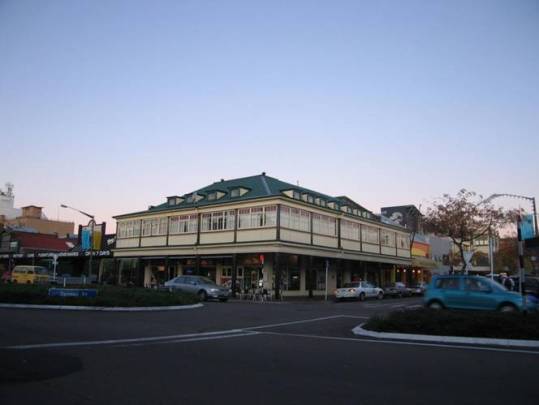
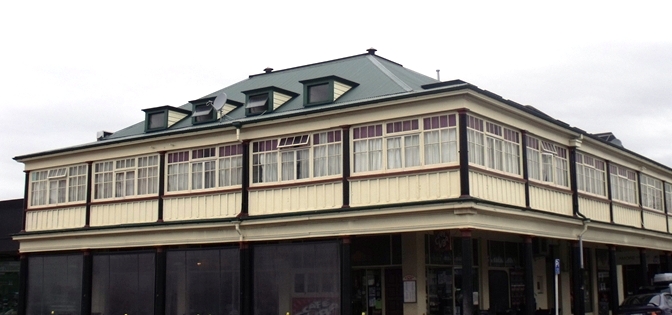
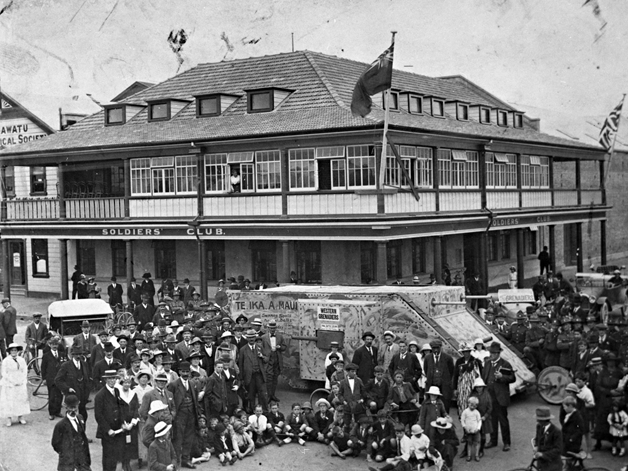
The original plans were for a four storey building with three large shops on the ground floor. The first floor was to contain a social room, a parcel room and a club office; the second floor was planned to have a reading room, a billiard room, two writing rooms and a smoking room; while the top floor was to have a sitting room, a kitchen and dining room and a number of dormitories. This ambitious plan was cut down to two stories of social rooms, eliminating the ground floor shops. The foundation stone was ceremonially laid by Mr McHardy on the 28 February 1917. The building was designed by architects L G West and Sons, and constructed by Rolf(e) and Dickel builders. Mr Ludolph Georg West was born and educated in Denmark, immigrating to New Zealand in 1868. He designed many of the private dwellings and public buildings in early Palmerston North and was mayor of the borough 1886-7. The design features the first floor balcony overhanging the footpath, which is architecturally unique in Palmerston North. The overall building style owes much to the new world Regency and later Georgian styles; characterised by simple hipped roofs, flat dormer windows below the roofline and colonnade verandahs. The Manawatu Standard published a description of the building on the 19th November 1917:
‘The building has a substantial well-built appearance, and is a welcome addition to that quarter of town. The front elevation shows a design in fine Doric colonnade of the double order, finished off with a roofing in French tiles.’
The building was used as clubrooms by the RSA until the 1960s. During this time various alterations were undertaken, the first being the conversion of the ground floor into shops in 1930. In late 1944 and during 1945 the balcony area was glazed in and incorporated as club space. In 1952 the then two corner shops were converted back into a billiard room for club purposes. The building was sold to ‘Anchor Holdings’ in 1970 when the RSA moved to new premises in Broadway Avenue. The building was sold to the Palmerston North City Council in 1974. Since then the building has had a number of different owners and occupants, resulting in an array of internal alterations. The ground floor is currently occupied by ‘Café Cuba.’
The building represents the expression of community concern for returning World War One troops and their rehabilitation. The building is also representative of the rare Regency architectural style, and the work of designer L G West who was responsible for many prominent Palmerston North buildings.
List Entry Information
Status
Listed
List Entry Status
Historic Place Category 2
Access
Private/No Public Access
List Number
1269
Date Entered
2nd July 1982
Date of Effect
2nd July 1982
City/District Council
Palmerston North City
Region
Horizons (Manawatū-Whanganui) Region
Legal description
Lot 1 DP 76945 (RT WN44A/81), Wellington Land District
Location Description
Corner George Street and Cuba Street, Palmerston North.
Status
Listed
List Entry Status
Historic Place Category 2
Access
Private/No Public Access
List Number
1269
Date Entered
2nd July 1982
Date of Effect
2nd July 1982
City/District Council
Palmerston North City
Region
Horizons (Manawatū-Whanganui) Region
Legal description
Lot 1 DP 76945 (RT WN44A/81), Wellington Land District
Location Description
Corner George Street and Cuba Street, Palmerston North.
Construction Professional
Name
West, Ernst Vilhem
Type
Architect
Biography
No biography is currently available for this construction professional
Name
West, Ludolph Georg
Type
Architect
Biography
No biography is currently available for this construction professional
Construction Details
Start Year
1917
Type
Original Construction
Description
Construction (£6500)
Start Year
1930
Type
Modification
Description
Ground floor converted into shops
Start Year
1944
Finish Year
1945
Type
Modification
Description
Substantial portion of balcony area glazed and incorporated as club space
Start Year
1952
Type
Modification
Description
Two corner shops converted back into billiard room for club
Construction Professional
Name
West, Ernst Vilhem
Type
Architect
Biography
No biography is currently available for this construction professional
Name
West, Ludolph Georg
Type
Architect
Biography
No biography is currently available for this construction professional
Construction Details
Start Year
1917
Type
Original Construction
Description
Construction (£6500)
Start Year
1930
Type
Modification
Description
Ground floor converted into shops
Start Year
1944
Finish Year
1945
Type
Modification
Description
Substantial portion of balcony area glazed and incorporated as club space
Start Year
1952
Type
Modification
Description
Two corner shops converted back into billiard room for club
Historical and Associated Iwi / Hapū / Whānau
Completion Date
31st July 2012
Report Written By
Elise Meyrick
Information Sources
Manawatu Evening Standard
Manawatu Evening Standard
New Zealand Historic Places Trust (NZHPT)
New Zealand Historic Places Trust
Scholefield, 1940
G. H. Scholefield, A Dictionary of New Zealand Biography, Department of Internal Affairs, Wellington, 1940
Other Information
This place was identified as significant under previous legislation with different information requirements. It remains significant under the current legislation. There is opportunity under our legislation and policies to add to this information. Further information about this place may be available from the Central Regional Office of Heritage New Zealand Pouhere Taonga. A referenced copy of this report is available from the Central Region of the NZHPT. Please note that entry on the New Zealand Heritage List/Rarangi Korero identifies only the heritage values of the property concerned, and should not be construed as advice on the state of the property, or as a comment of its soundness or safety, including in regard to earthquake risk, safety in the event of fire, or insanitary conditions.
Historical and Associated Iwi / Hapū / Whānau
Completion Date
31st July 2012
Report Written By
Elise Meyrick
Information Sources
Manawatu Evening Standard
Manawatu Evening Standard
New Zealand Historic Places Trust (NZHPT)
New Zealand Historic Places Trust
Scholefield, 1940
G. H. Scholefield, A Dictionary of New Zealand Biography, Department of Internal Affairs, Wellington, 1940
Other Information
This place was identified as significant under previous legislation with different information requirements. It remains significant under the current legislation. There is opportunity under our legislation and policies to add to this information. Further information about this place may be available from the Central Regional Office of Heritage New Zealand Pouhere Taonga. A referenced copy of this report is available from the Central Region of the NZHPT. Please note that entry on the New Zealand Heritage List/Rarangi Korero identifies only the heritage values of the property concerned, and should not be construed as advice on the state of the property, or as a comment of its soundness or safety, including in regard to earthquake risk, safety in the event of fire, or insanitary conditions.
Current Usages
Uses: Civic Facilities
Specific Usage: Club rooms/building
Uses: Trade
Specific Usage: Cafe
Uses: Trade
Specific Usage: Shop
Former Usages
General Usage: Civic Facilities
Specific Usage: Returned Services Association Building
General Usage: Trade
Specific Usage: Office building/Offices
General Usage: Trade
Specific Usage: Shop
Current Usages
Uses: Civic Facilities
Specific Usage: Club rooms/building
Uses: Trade
Specific Usage: Cafe
Uses: Trade
Specific Usage: Shop
Former Usages
General Usage: Civic Facilities
Specific Usage: Returned Services Association Building
General Usage: Trade
Specific Usage: Office building/Offices
General Usage: Trade
Specific Usage: Shop
Location
Stay up to date with Heritage this month
