Constructed in 1940, the Iona Memorial Cross commemorates the centennial of the first Presbyterian service held in New Zealand, which was attended by newly-arrived New Zealand Company immigrants on 23 February 1840. The service was conducted on Petone beach by John MacFarlane, a minister of the Church of Scotland, who arrived in Wellington Harbour on board the 'Bengal Merchant' on 21 February 1840.
In 1938 the Presbyterian Church decided to mark the centenary of the church in New Zealand with, among other initiatives, the erection of a cross with a plaque on the Petone foreshore. The commissioning of the Cross was undertaken by a memorial sub-committee of the Presbyterian Centennial Committee. They engaged H. Glover, a monumental mason in Wellington, to oversee the project, the total cost of which was not expected to be more than £200. The cross was supposed to be a copy of the MacLean (or Macleane) Cross, which stands on the island of Iona, Scotland. That cross, dating from the fifteenth century, was made from schist and carved on both sides with Celtic designs. Published photographs of the MacLean Cross show that there is only a slight resemblance to the one erected at Petone. (The Petone cross is, however, an exact replica of one erected near Southampton, England, as a First World War memorial with a distinctive Celtic design.)
The Petone cross is carved on one side, and is made of Coromandel Tonalite, a light grey plutonic rock formerly quarried at Paritu near the northern tip of the Coromandel Peninsula. It is believed that the 2.7m cross was carved in either Auckland or Coromandel. Although attempts were made to find the exact location of the first service, it was eventually decided that the monument would be placed near the new Wellington Provincial Centennial Memorial (now know as the Petone Settlers Museum/Te Whare Whakaaro o Pito-one). The Petone Borough Council constructed the concrete platform, and provided the concrete paths free of charge. The cross was dedicated in front of a large crowd on 23 February 1940 by the Right Reverend J. Lawson Robinson, Moderator of the General Assembly, Presbyterian Church of New Zealand.
The Iona Memorial Cross has representative significance as it commemorates the first Presbyterian church service in New Zealand. It has also been a landmark on the Petone foreshore for more than half a century. Together with the adjacent Petone Settlers Museum/Te Whare Whakaaro o Pito-one, the Memorial forms part of a precinct celebrating both Maori and Pakeha settlement in the Wellington region.
In 1938 the Presbyterian Church decided to mark the centenary of the church in New Zealand with, among other initiatives, the erection of a cross with a plaque on the Petone foreshore. The commissioning of the Cross was undertaken by a memorial sub-committee of the Presbyterian Centennial Committee. They engaged H. Glover, a monumental mason in Wellington, to oversee the project, the total cost of which was not expected to be more than £200. The cross was supposed to be a copy of the MacLean (or Macleane) Cross, which stands on the island of Iona, Scotland. That cross, dating from the fifteenth century, was made from schist and carved on both sides with Celtic designs. Published photographs of the MacLean Cross show that there is only a slight resemblance to the one erected at Petone. (The Petone cross is, however, an exact replica of one erected near Southampton, England, as a First World War memorial with a distinctive Celtic design.)
The Petone cross is carved on one side, and is made of Coromandel Tonalite, a light grey plutonic rock formerly quarried at Paritu near the northern tip of the Coromandel Peninsula. It is believed that the 2.7m cross was carved in either Auckland or Coromandel. Although attempts were made to find the exact location of the first service, it was eventually decided that the monument would be placed near the new Wellington Provincial Centennial Memorial (now know as the Petone Settlers Museum/Te Whare Whakaaro o Pito-one). The Petone Borough Council constructed the concrete platform, and provided the concrete paths free of charge. The cross was dedicated in front of a large crowd on 23 February 1940 by the Right Reverend J. Lawson Robinson, Moderator of the General Assembly, Presbyterian Church of New Zealand.
The Iona Memorial Cross has representative significance as it commemorates the first Presbyterian church service in New Zealand. It has also been a landmark on the Petone foreshore for more than half a century. Together with the adjacent Petone Settlers Museum/Te Whare Whakaaro o Pito-one, the Memorial forms part of a precinct celebrating both Maori and Pakeha settlement in the Wellington region.
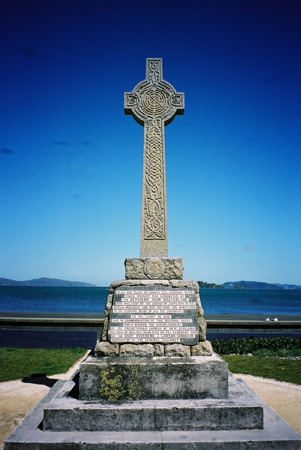
Ioan Memorial Cross, Petone, Lower Hutt | Helen McCracken | 18/10/2001 | Heritage New Zealand Pouhere Taonga
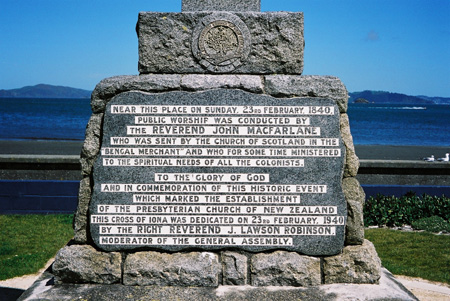
Iona Memorial Cross, Petone, Lower Hutt | Helen McCracken | 18/10/2001 | Heritage New Zealand Pouhere Taonga
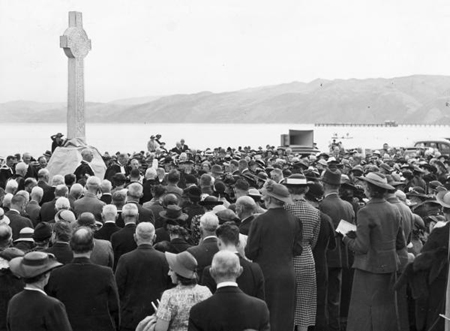
Iona Memorial Cross, Petone, Lower Hutt. 'Crowd at Petone, attending the unveiling of the Iona Cross', 1940. Permission of the Alexander Turnbull Library, National Library of New Zealand Te Puna Matauranga o Aotearoa, must be obtained before any re-use of this image. PAColl-5927-48 | Alexander Turnbull Library, Wellington, N.Z.
Ioan Memorial Cross, Petone, Lower Hutt | Helen McCracken | 18/10/2001 | Heritage New Zealand Pouhere Taonga
Iona Memorial Cross, Petone, Lower Hutt | Helen McCracken | 18/10/2001 | Heritage New Zealand Pouhere Taonga
Iona Memorial Cross, Petone, Lower Hutt. 'Crowd at Petone, attending the unveiling of the Iona Cross', 1940. Permission of the Alexander Turnbull Library, National Library of New Zealand Te Puna Matauranga o Aotearoa, must be obtained before any re-use of this image. PAColl-5927-48 | Alexander Turnbull Library, Wellington, N.Z.