

The Ngāi Tara people were early inhabitants of Wellington and the harbour came to be known as Te Whanganui-a-Tara, the great harbour of Tara, after the rangatira of the same name. In the seventeenth century Ngāti Ira of Hawke’s Bay joined Ngāi Tara and extensive intermarriage occurred between the two tribes. Other iwi who made a home in the region included Ngāti Kahungunu, Rangitāne, Ngāi Tahu and Ngāti Māmoe. Te Ātiawa, Ngāti Tama and Ngāti Mutunga migrated south from Taranaki in the 1820s and early 1830s during a period of great upheaval associated with the introduction of Pākehā muskets into te ao Māori. In 1824 Ngāti Mutunga built the five-acre Te Aro Pā in what is now central Wellington, and the pā gave its name to the wider area. Te Aro Flat, as it became known, was included in the purchase of land at Te Whanganui-a-Tara by British colonising firm the New Zealand Company in 1839.
The land around and inland from the harbour was divided into town acres. Town acre 118 was the future site of Dr John Ewart’s house and surgery. Ewart was superintendent of Wellington Hospital from 1889 to 1909. An excellent administrator, outstanding surgeon and a good employer, he was held in high public and professional regard and made significant improvements at the hospital, including the implementation of aseptic treatment and longer nursing training. He retired in 1909 and entered private practice in Willis Street, having commissioned Wellington firm Hoggard and Prouse to design a combined residence and surgery. Known as the ‘Harley Street’ of Wellington, Willis Street was full of medical practices and doctors typically lived in the buildings.
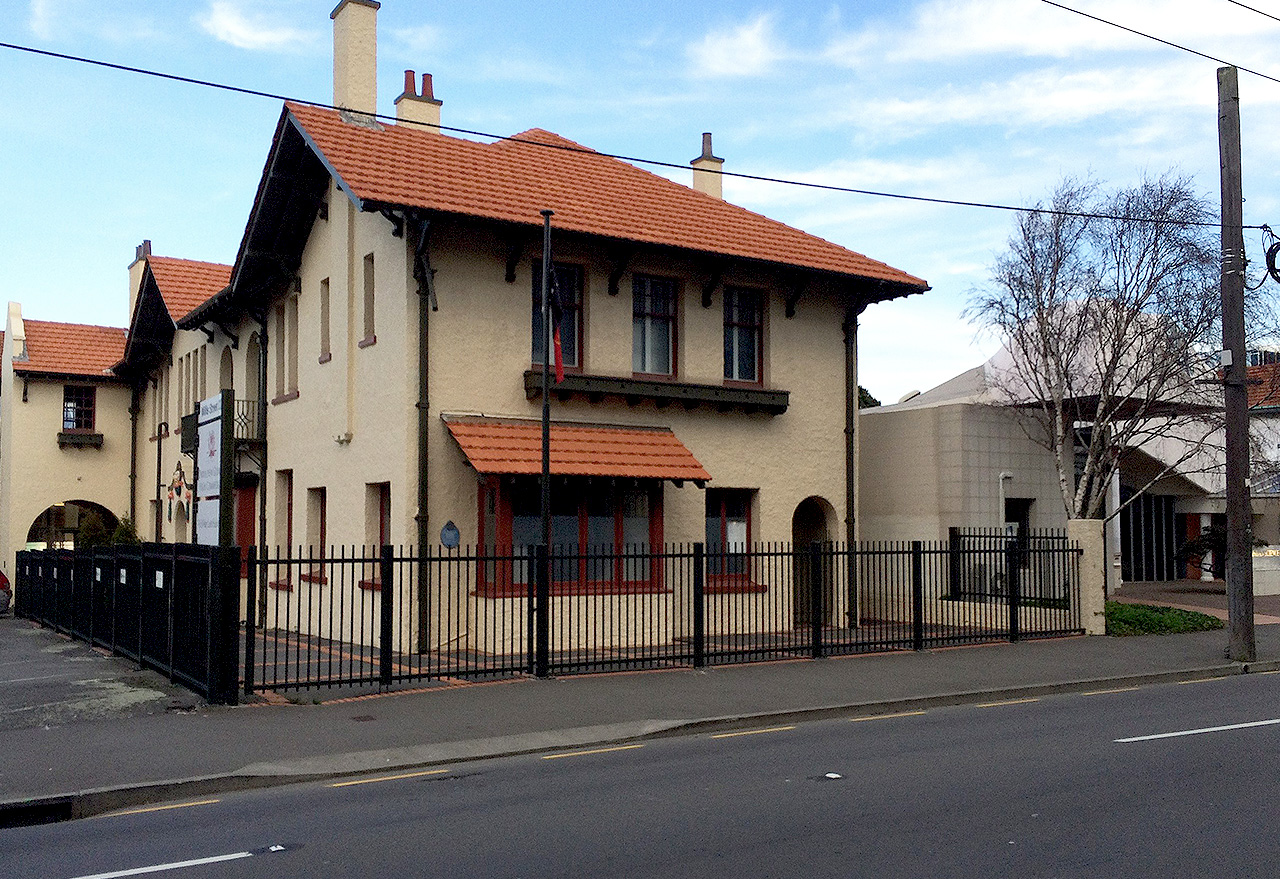
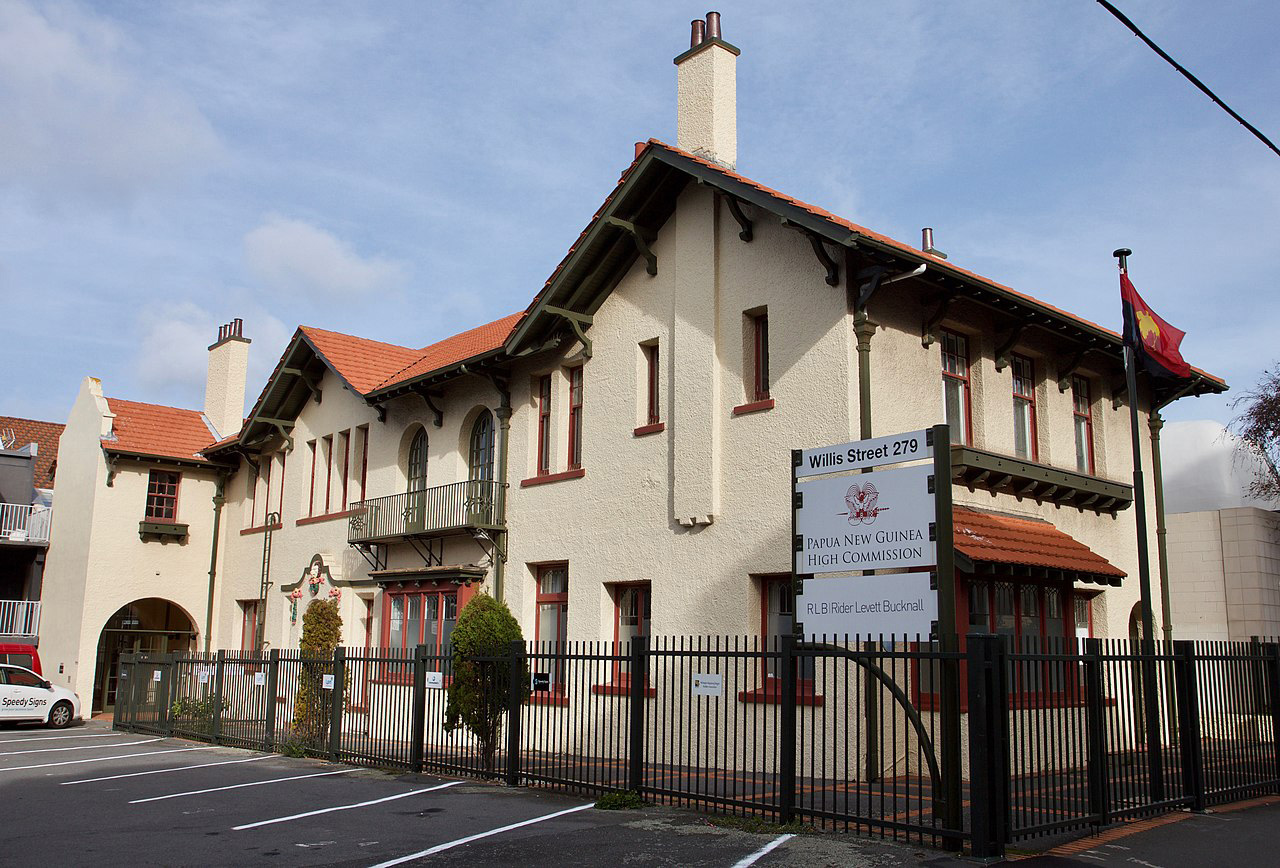
The two-storey building Hoggard and Prouse produced was Arts and Crafts in style, with textured stucco walls, a Marseille tile roof with prominent gables and overhanging bracketed eaves, an arched main entrance porch, arched secondary entrances and a combination of deeply recessed and bay windows. Somewhat unusually, the building’s main elevation did not face west to the street but rather was north-facing. Ewart sold the building to Dr Ernest Giesen in 1924 and it was used for medical purposes by a series of practitioners, including Sir Thomas Stout and David Whyte, both prominent figures, until 1971. Various commercial tenants occupied the building until approximately 1993, when it was purchased for high commission by the government of Papua New Guinea.
The interior was converted into six apartments in 1943 though these appear to have been used as consulting rooms. In 1985 a large wing was added to the Victoria Street end of the building. Designed by Athfield Architects, it is sympathetic in design to the original. The 1909 building was earthquake-strengthened in 2012.
List Entry Information
Status
Listed
List Entry Status
Historic Place Category 2
Access
Private/No Public Access
List Number
1334
Date Entered
18th March 1982
Date of Effect
18th March 1982
City/District Council
Wellington City
Region
Wellington Region
Extent of List Entry
Extent includes the land described as Pt Sec 118 City of Wellington (RT WN20A/862), Wellington Land District and the building known as Dr Ewart’s House and Surgery (Former) thereon. The extent excludes the 1985 addition at the Victoria Street end of the property.
Legal description
Pt Sec 118 City of Wellington (RT WN20A/862), Wellington Land District
Status
Listed
List Entry Status
Historic Place Category 2
Access
Private/No Public Access
List Number
1334
Date Entered
18th March 1982
Date of Effect
18th March 1982
City/District Council
Wellington City
Region
Wellington Region
Extent of List Entry
Extent includes the land described as Pt Sec 118 City of Wellington (RT WN20A/862), Wellington Land District and the building known as Dr Ewart’s House and Surgery (Former) thereon. The extent excludes the 1985 addition at the Victoria Street end of the property.
Legal description
Pt Sec 118 City of Wellington (RT WN20A/862), Wellington Land District
Construction Professional
Name
Hoggard & Prouse
Type
Architectural Partnership
Biography
The partnership of Hoggard and Prouse practised initally in Wellington. The firm was one of the pioneers in the use of steel framed and concrete floored construction in New Zealand. Their four storey Cadbury Warehouse (1908) was an extremely early example of this type of construction to be found outside America.
Name
Athfield Architects
Type
Architect
Biography
No biography is currently available for this construction professional
Construction Details
Start Year
1909
Type
Original Construction
Start Year
1943
Type
Modification
Description
Conversion to apartments
Start Year
1985
Type
Addition
Description
new wing
Start Year
2012
Type
Structural upgrade
Description
Earthquake-strengthening
Construction Professional
Name
Hoggard & Prouse
Type
Architectural Partnership
Biography
The partnership of Hoggard and Prouse practised initally in Wellington. The firm was one of the pioneers in the use of steel framed and concrete floored construction in New Zealand. Their four storey Cadbury Warehouse (1908) was an extremely early example of this type of construction to be found outside America.
Name
Athfield Architects
Type
Architect
Biography
No biography is currently available for this construction professional
Construction Details
Start Year
1909
Type
Original Construction
Start Year
1943
Type
Modification
Description
Conversion to apartments
Start Year
1985
Type
Addition
Description
new wing
Start Year
2012
Type
Structural upgrade
Description
Earthquake-strengthening
Historical and Associated Iwi / Hapū / Whānau
Completion Date
18th September 2020
Report Written By
Kerryn Pollock and Natasha Naus
Information Sources
Dictionary of New Zealand Biography
Dictionary of New Zealand Biography
Pollock and Naus, 2006
Pollock, Kerryn and Natasha Naus, Heritage of Health: a Brief History of Medical Practices, Maternity Homes and Motorways in Te Aro, Wellington, Wellington, 2006
Other Information
This place was identified as significant under previous legislation with different information requirements. It remains significant under the current legislation. There is opportunity under our legislation and policies to add to this information. Further information about this place may be available from the Central Regional Office of Heritage New Zealand Pouhere Taonga. Please note that entry on the New Zealand Heritage List/Rarangi Korero identifies only the heritage values of the property concerned, and should not be construed as advice on the state of the property, or as a comment of its soundness or safety, including in regard to earthquake risk, safety in the event of fire, or insanitary conditions. A fully referenced upgrade report is available on request from the Central Region Office of Heritage New Zealand.
Historical and Associated Iwi / Hapū / Whānau
Completion Date
18th September 2020
Report Written By
Kerryn Pollock and Natasha Naus
Information Sources
Dictionary of New Zealand Biography
Dictionary of New Zealand Biography
Pollock and Naus, 2006
Pollock, Kerryn and Natasha Naus, Heritage of Health: a Brief History of Medical Practices, Maternity Homes and Motorways in Te Aro, Wellington, Wellington, 2006
Other Information
This place was identified as significant under previous legislation with different information requirements. It remains significant under the current legislation. There is opportunity under our legislation and policies to add to this information. Further information about this place may be available from the Central Regional Office of Heritage New Zealand Pouhere Taonga. Please note that entry on the New Zealand Heritage List/Rarangi Korero identifies only the heritage values of the property concerned, and should not be construed as advice on the state of the property, or as a comment of its soundness or safety, including in regard to earthquake risk, safety in the event of fire, or insanitary conditions. A fully referenced upgrade report is available on request from the Central Region Office of Heritage New Zealand.
Current Usages
Uses: Government
Specific Usage: Consulate
Uses: Government
Specific Usage: Government - other
Former Usages
General Usage: Accommodation
Specific Usage: House
General Usage: Health
Specific Usage: Doctor’s Surgery
General Usage: Trade
Specific Usage: Retail & Wholesale - other
Current Usages
Uses: Government
Specific Usage: Consulate
Uses: Government
Specific Usage: Government - other
Former Usages
General Usage: Accommodation
Specific Usage: House
General Usage: Health
Specific Usage: Doctor’s Surgery
General Usage: Trade
Specific Usage: Retail & Wholesale - other
Location
Sign up to hear more
Get the latest heritage news, features and events delivered
straight to your inbox.
