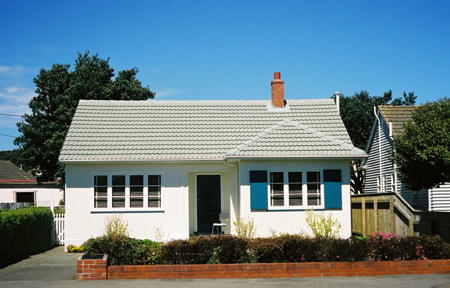
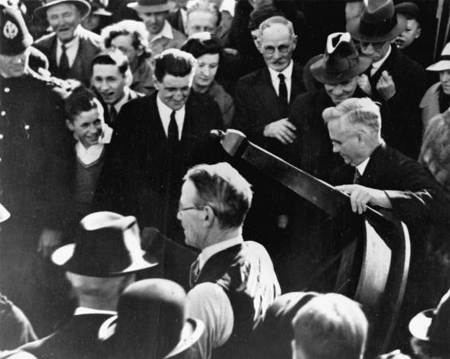
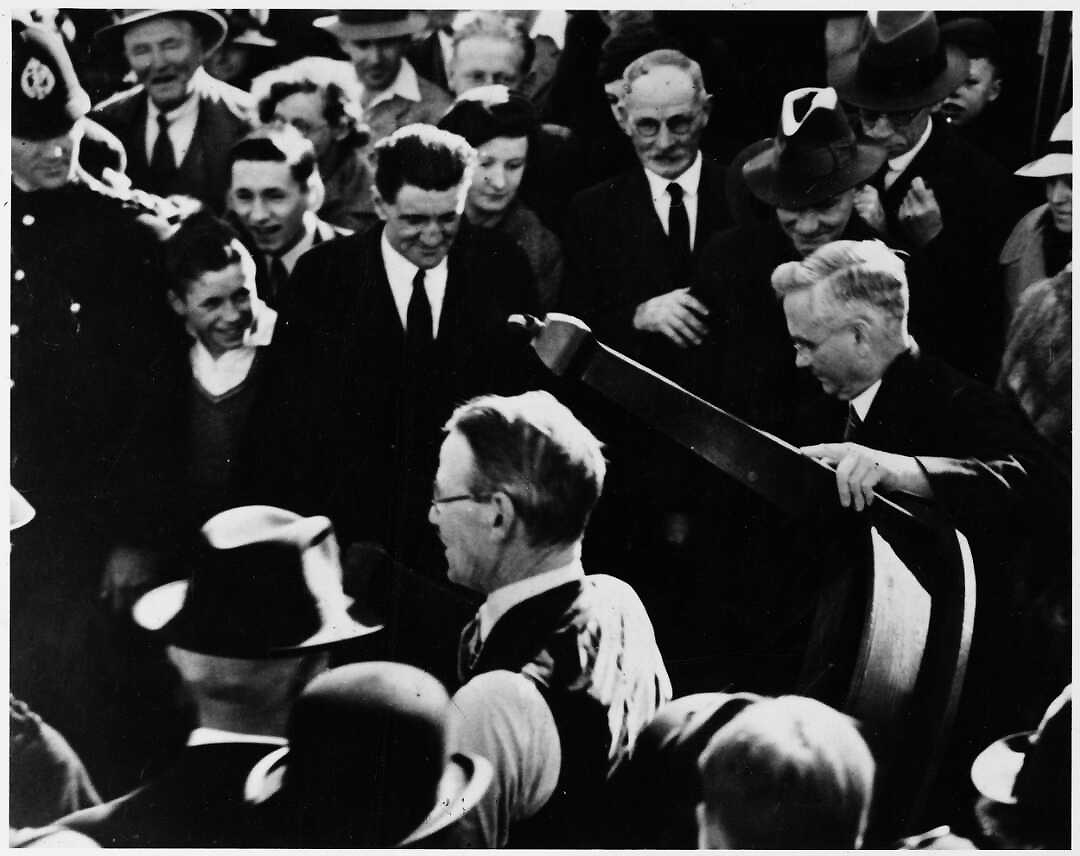
First State House at 12 Fife Lane, Miramar, Wellington, was constructed in 1937 and opened that same year by Prime Minister Michael Joseph Savage. The house has historical significance as a symbol of the beginning of the First Labour Government’s state housing initiative – a landmark policy shift towards state supported welfare. Whilst its symbolic status has long been recognised, the house is also socially and architecturally significant for the insight it offers into the evolution of New Zealand’s social infrastructure, reflecting broader narratives around urban planning, domestic architecture, and the lived experience of state tenants.
The renowned Polynesian navigator Kupe first explored the Wellington area during his voyage to Aotearoa from Hawaiki, the ancestral homeland of Māori. The earliest permanent settlers in the area were the descendants of Whātonga, a chief from Hawke’s Bay. His son, Tara, travelled south from the Mahia peninsula and established a settlement at Te Whanganui-a-Tara, the great harbour of Tara. According to legend, when the great taniwha Whātaitai died his body turned to stone forming what is now Hataitai, Kilbirnie and Miramar, and giving his name to part of the area. Prior to European arrival, the fertile soils of the inner harbour supported abundant food sources, and the rohe saw successive waves of tribal occupation. The strategic position of Te Motu Kairangi (Miramar peninsula) sustained several prominent pā sites for generations. Between 1824 and 1834, several migrations from Taranaki brought hapū to settle the coastline of Te Whanganui-a-Tara and into Wairarapa. In 1835 Ngāti Mutunga and Ngāti Tama migrated to Wharekauri (Chatham Islands) prompting Te Ātiawa hapū to return to Te Whanganui-a-Tara from Wairarapa. The rohe remains significant to Te Ātiawa, Taranaki Whānui ki Te Upoko o Te Ika, Ngāti Toa Rangatira, and Muaūpoko.
Following European arrival and subsequent acquisition of land in the nineteenth century, urban subdivision continued apace into the twentieth century and Te Motu Kairangi underwent significant transformation as the landscape became dominated by European-style buildings. The Workers’ Dwellings Act 1905 introduced public housing for families on low incomes. This initiative formed part of early New Zealand government efforts to promote population growth by improving child and maternal health and fostering greater stability within communities. These houses, built on large sections on city outskirts, were effectively the first State Houses in the world. They were high-quality builds, but the accompanying high rental cost proved too expensive for low-income families, particularly when coupled with the expense of public transport to the outer suburbs in which they were located.
From the 1920s the government supported low-cost loans for housing that fuelled a nationwide boom in house building and property development. However, the boom was reversed by the mid-1930s, and a critical shortage of affordable housing, compounded by the economic effects of the Great Depression, spurred the newly-elected Labour Government to implement a comprehensive state housing programme. The scheme built on earlier state housing initiatives, aiming to provide well-designed, durable homes that were financially accessible to working families – a foundational move in the establishment of New Zealand’s welfare state. Designed by the Department of Housing, state houses reflected simplicity and functional design and openly promoted family values with the living room placed as the symbolic heart of the house.
At 12 Fife Lane the modest, three-bedroom dwelling features a symmetrical façade, integrated garden space, and an internal layout that prioritises light, ventilation, and privacy. The house and its counterparts in the Miramar subdivision were prototypes for subsequent state houses – clad in weatherboard with tiled roofs, and with plain detailing. The only exterior ornamentation on First State House are the window shutters, the multi-paned windows, and the waved timber in the gable ends. Its first tenants were the McGregor family, chosen through the standard application process. The McGregors elected to buy the house in 1968, but it was sold back to the state by their son after their deaths in the 1980s.
Whilst the First State House symbolises a new era of government intervention in housing, the broader state housing programme did not serve all communities equally. For many Māori whānau, the system failed in the design of state housing to accommodate cultural values, extended family structures, and aspirations for kāinga rooted in whenua. Early policies often excluded Māori from mainstream housing provision, and later efforts – such as the ‘pepperpotting’ assimilation strategy – reinforced marginalisation. Despite promises of security and dignity, Māori tenants frequently faced overcrowding, poor housing quality, and limited tenure stability. These experiences reflect systemic gaps that continue to shape housing outcomes, prompting calls for housing solutions led by Māori, for Māori, and with Māori.
First State House remains an intact example of early state housing. Since its construction the house has undergone relatively few alterations, retaining much of its original form and material integrity. Whilst modest in scale, its layered history embodies key themes of social reform, postcolonial urban development, and the politics of domestic space, offering enduring relevance in discussions around equity, community, and social policy. While government policy on the provision of state housing continues to fluctuate, First State House remains in state ownership and in 2025 is managed and maintained by Kāinga Ora.
The renowned Polynesian navigator Kupe first explored the Wellington area during his voyage to Aotearoa from Hawaiki, the ancestral homeland of Māori. The earliest permanent settlers in the area were the descendants of Whātonga, a chief from Hawke’s Bay. His son, Tara, travelled south from the Mahia peninsula and established a settlement at Te Whanganui-a-Tara, the great harbour of Tara. According to legend, when the great taniwha Whātaitai died his body turned to stone forming what is now Hataitai, Kilbirnie and Miramar, and giving his name to part of the area. Prior to European arrival, the fertile soils of the inner harbour supported abundant food sources, and the rohe saw successive waves of tribal occupation. The strategic position of Te Motu Kairangi (Miramar peninsula) sustained several prominent pā sites for generations. Between 1824 and 1834, several migrations from Taranaki brought hapū to settle the coastline of Te Whanganui-a-Tara and into Wairarapa. In 1835 Ngāti Mutunga and Ngāti Tama migrated to Wharekauri (Chatham Islands) prompting Te Ātiawa hapū to return to Te Whanganui-a-Tara from Wairarapa. The rohe remains significant to Te Ātiawa, Taranaki Whānui ki Te Upoko o Te Ika, Ngāti Toa Rangatira, and Muaūpoko.
Following European arrival and subsequent acquisition of land in the nineteenth century, urban subdivision continued apace into the twentieth century and Te Motu Kairangi underwent significant transformation as the landscape became dominated by European-style buildings. The Workers’ Dwellings Act 1905 introduced public housing for families on low incomes. This initiative formed part of early New Zealand government efforts to promote population growth by improving child and maternal health and fostering greater stability within communities. These houses, built on large sections on city outskirts, were effectively the first State Houses in the world. They were high-quality builds, but the accompanying high rental cost proved too expensive for low-income families, particularly when coupled with the expense of public transport to the outer suburbs in which they were located.
From the 1920s the government supported low-cost loans for housing that fuelled a nationwide boom in house building and property development. However, the boom was reversed by the mid-1930s, and a critical shortage of affordable housing, compounded by the economic effects of the Great Depression, spurred the newly-elected Labour Government to implement a comprehensive state housing programme. The scheme built on earlier state housing initiatives, aiming to provide well-designed, durable homes that were financially accessible to working families – a foundational move in the establishment of New Zealand’s welfare state. Designed by the Department of Housing, state houses reflected simplicity and functional design and openly promoted family values with the living room placed as the symbolic heart of the house.
At 12 Fife Lane the modest, three-bedroom dwelling features a symmetrical façade, integrated garden space, and an internal layout that prioritises light, ventilation, and privacy. The house and its counterparts in the Miramar subdivision were prototypes for subsequent state houses – clad in weatherboard with tiled roofs, and with plain detailing. The only exterior ornamentation on First State House are the window shutters, the multi-paned windows, and the waved timber in the gable ends. Its first tenants were the McGregor family, chosen through the standard application process. The McGregors elected to buy the house in 1968, but it was sold back to the state by their son after their deaths in the 1980s.
Whilst the First State House symbolises a new era of government intervention in housing, the broader state housing programme did not serve all communities equally. For many Māori whānau, the system failed in the design of state housing to accommodate cultural values, extended family structures, and aspirations for kāinga rooted in whenua. Early policies often excluded Māori from mainstream housing provision, and later efforts – such as the ‘pepperpotting’ assimilation strategy – reinforced marginalisation. Despite promises of security and dignity, Māori tenants frequently faced overcrowding, poor housing quality, and limited tenure stability. These experiences reflect systemic gaps that continue to shape housing outcomes, prompting calls for housing solutions led by Māori, for Māori, and with Māori.
First State House remains an intact example of early state housing. Since its construction the house has undergone relatively few alterations, retaining much of its original form and material integrity. Whilst modest in scale, its layered history embodies key themes of social reform, postcolonial urban development, and the politics of domestic space, offering enduring relevance in discussions around equity, community, and social policy. While government policy on the provision of state housing continues to fluctuate, First State House remains in state ownership and in 2025 is managed and maintained by Kāinga Ora.