Best known for his domestic architecture, Chapman-Taylor was influenced by the ideas of the British Arts and Crafts movement, which promoted a return to the traditional English cottage style, with interior features of crafted timber work, whitewashed walls, large exposed beams and lintels, multi-paned windows and hand-crafted fittings. He adapted the principles of the movement to suit New Zealand clients and conditions and his architecture has remained popular.
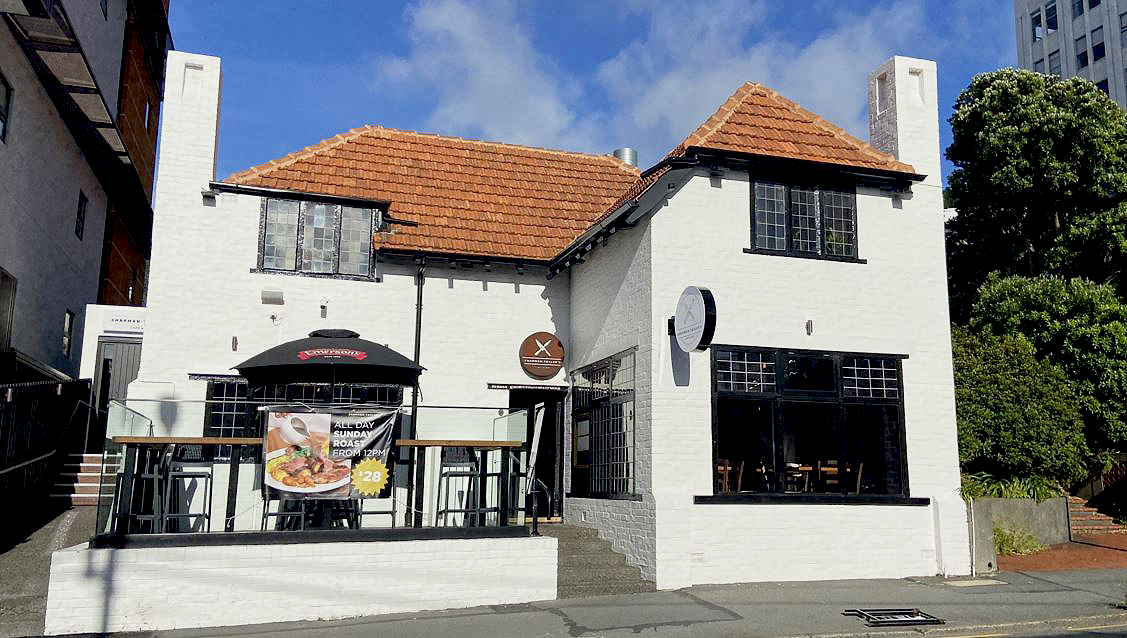
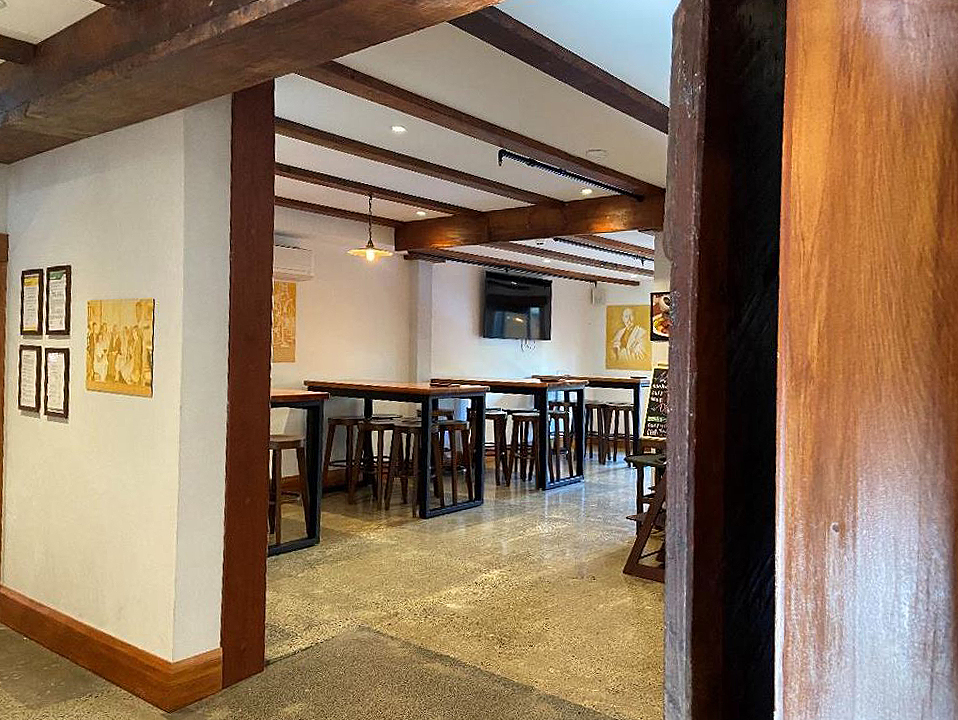
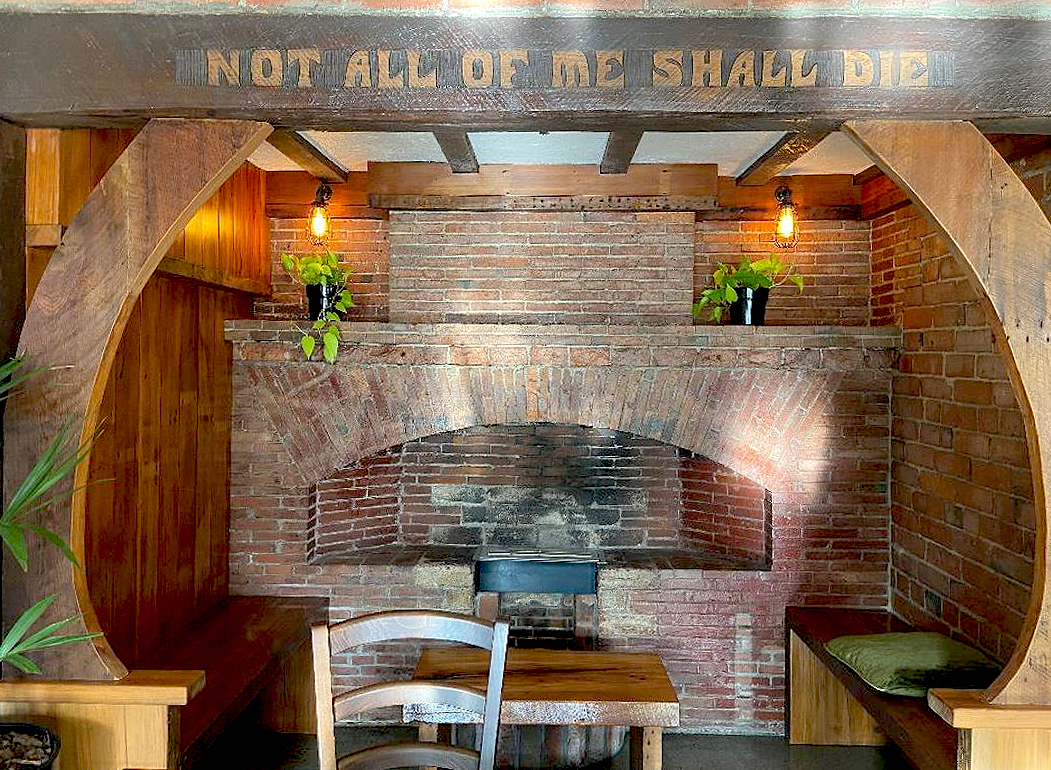
The building is two-storeyed, with a mezzanine landing. It was built in cavity brick, concrete floors and jarrah timber beams. The exterior walls were whitewashed, with some exposed timber surfaces and it has a Marseille tiled roof. The showroom was on the ground floor, as was Chapman-Taylor’s office. The interior included a large brick inglenook fireplace at the rear of the room, a characteristic Chapman-Taylor feature. A motto is carved on the lintel of the front door and another on the inglenook beam. A workshop at the back of the building opened on to a timber yard and delivery lane. Chapman-Taylor modified the top floor in 1914 to provide city accommodation for the family, where they lived until 1917.
Chapman-Taylor sold the property in 1919. Since then, it has provided premises (and sometimes accommodation) for a range of people and businesses. In the early 1950s, well-known Modernist architect Cedric Firth designed a new addition at the rear of the building. The interior spaces have changed over the years, but the characteristic features of Home Crafts are easily recognised, and the external appearance has changed little since it was constructed.


List Entry Information
Status
Listed
List Entry Status
Historic Place Category 1
Access
Private/No Public Access
List Number
1411
Date Entered
20th June 2024
Date of Effect
11th July 2024
City/District Council
Wellington City
Region
Wellington Region
Extent of List Entry
Extent includes the land described as Pt Sec 578 City of Wellington (RT WN43/227), Wellington Land District and the building known as Home Crafts (including the 1952 addition) thereon (Refer to map in Appendix 1 of the List entry report for further information).
Legal description
Pt Sec 578 City of Wellington (RT WN43/227), Wellington Land District
Status
Listed
List Entry Status
Historic Place Category 1
Access
Private/No Public Access
List Number
1411
Date Entered
20th June 2024
Date of Effect
11th July 2024
City/District Council
Wellington City
Region
Wellington Region
Extent of List Entry
Extent includes the land described as Pt Sec 578 City of Wellington (RT WN43/227), Wellington Land District and the building known as Home Crafts (including the 1952 addition) thereon (Refer to map in Appendix 1 of the List entry report for further information).
Legal description
Pt Sec 578 City of Wellington (RT WN43/227), Wellington Land District
Why is this place significant?
Historic Significance
Historical Significance or Value Home Crafts was designed by one of New Zealand's most accomplished architects as his own office and workshop and a showroom for his furniture designs and architecture practice. Built not long after his return from studying in the United Kingdom in 1909, it demonstrated the success of his business since he had moved to Wellington in 1905 and the application of methods and styles observed in the UK. Home Crafts is therefore an important in the work of this architect, built as his own commercial premises, and shows his design and construction standards at a seminal time in his career. The building is also associated with leading architect Cedric Firth and arts practitioner Theodore Trezise.
Physical Significance
Aesthetic Significance or Value With its dark-timbered window frames, multi-paned windows, white-washed walls and orange-tiled roof, Home Crafts provides visual appeal at the northern end of Molesworth Street. It is essentially an English-style Arts and Crafts domestic building set in a commercial area. However, it is not dominated by taller buildings in the immediate vicinity and has retained streetscape appeal. Home Crafts has aesthetic significance as it provides an elegant domestic-scaled building in a commercial area. Architectural Significance or Value Home Crafts is one of James Walter Chapman-Taylor’s early brick buildings but shares many typical features of his houses, such as multi-paned casement windows, tall chimneys, a steep roof of Marseille tiles, whitewashed exteriors, Australian jarrah timber with adzed finishes, mottoes on lintels, and an inglenook fireplace in the interior. These features are largely intact, as is the exterior, making the building an outstanding example of his architectural work and the principles promoted by the Arts and Crafts movement as applied to building construction. It was one of several buildings Chapman-Taylor built between 1909 and 1913 that mark the development of his principles on building design. Designed for commercial uses it is unusual amongst his oeuvre of mostly domestic houses and is his only commercial building to employ a domestic aesthetic. It was an important building in the development of his career as it gave him a presence in Wellington city.
Why is this place Category 1 / Category 2?
Detail Of Assessed Criteria
This place was assessed against the Section 66(3) criteria and found to qualify under the following criteria: b, f, g. The assessment concludes that this place should be listed as a Category 1 historic place. (b) The association of the place with events, persons, or ideas of importance in New Zealand history James Walter Chapman-Taylor was one of New Zealand’s foremost architects in the Arts and Crafts tradition. He was also a builder and furniture designer and maker. He adapted the English movement to local conditions and his architecture remained popular despite changing fashions. Chapman-Taylor adhered to Arts and Crafts principles over the 50 years of his career and showed a keen awareness of local forms and materials. He also designed the furniture and fittings for many of his houses, including details such as wrought iron door and window fittings. Home Crafts has a direct connection with the architect as it was not only designed by him, but built as his own showroom, office and workshop (from 1912 to 1919), as well as providing accommodation for the family for a few years (1914–17), and is an outstanding representation of his work. (f) The potential of the place for public education Home Crafts is located near Wellington’s central business district and is easily visible from a main road, unlike much of his architectural work, which comprises private residences. As a hospitality venue whose branding and identity is wholly based on Chapman-Taylor and open to the public during business hours, interested people can easily appreciate his work. (g) The technical accomplishment, value, or design of the place Home Crafts contains the key elements in Chapman-Taylor’s architectural oeuvre, was specifically designed to showcase his work and therefore executed to a high standard. The ground floor of the original building is particularly intact, as is the street-facing exterior, and serves as an outstanding representation of the Arts and Craft style. Summary of Significance or Values Home Crafts is outstanding for its historical connection to leading Arts and Crafts architect James Walter Chapman-Taylor and excellent ability to serve as an authentic, intact and accomplished example of this architectural style. Designed for commercial uses it is unusual amongst his oeuvre of mostly domestic houses and is his only commercial building to employ a domestic aesthetic. While the building has been added to and renovated over time, the changes are sympathetic to the original building, which remains largely intact inside and out.
Why is this place significant?
Historic Significance
Historical Significance or Value Home Crafts was designed by one of New Zealand's most accomplished architects as his own office and workshop and a showroom for his furniture designs and architecture practice. Built not long after his return from studying in the United Kingdom in 1909, it demonstrated the success of his business since he had moved to Wellington in 1905 and the application of methods and styles observed in the UK. Home Crafts is therefore an important in the work of this architect, built as his own commercial premises, and shows his design and construction standards at a seminal time in his career. The building is also associated with leading architect Cedric Firth and arts practitioner Theodore Trezise.
Physical Significance
Aesthetic Significance or Value With its dark-timbered window frames, multi-paned windows, white-washed walls and orange-tiled roof, Home Crafts provides visual appeal at the northern end of Molesworth Street. It is essentially an English-style Arts and Crafts domestic building set in a commercial area. However, it is not dominated by taller buildings in the immediate vicinity and has retained streetscape appeal. Home Crafts has aesthetic significance as it provides an elegant domestic-scaled building in a commercial area. Architectural Significance or Value Home Crafts is one of James Walter Chapman-Taylor’s early brick buildings but shares many typical features of his houses, such as multi-paned casement windows, tall chimneys, a steep roof of Marseille tiles, whitewashed exteriors, Australian jarrah timber with adzed finishes, mottoes on lintels, and an inglenook fireplace in the interior. These features are largely intact, as is the exterior, making the building an outstanding example of his architectural work and the principles promoted by the Arts and Crafts movement as applied to building construction. It was one of several buildings Chapman-Taylor built between 1909 and 1913 that mark the development of his principles on building design. Designed for commercial uses it is unusual amongst his oeuvre of mostly domestic houses and is his only commercial building to employ a domestic aesthetic. It was an important building in the development of his career as it gave him a presence in Wellington city.
Why is this place Category 1 / Category 2?
Detail Of Assessed Criteria
This place was assessed against the Section 66(3) criteria and found to qualify under the following criteria: b, f, g. The assessment concludes that this place should be listed as a Category 1 historic place. (b) The association of the place with events, persons, or ideas of importance in New Zealand history James Walter Chapman-Taylor was one of New Zealand’s foremost architects in the Arts and Crafts tradition. He was also a builder and furniture designer and maker. He adapted the English movement to local conditions and his architecture remained popular despite changing fashions. Chapman-Taylor adhered to Arts and Crafts principles over the 50 years of his career and showed a keen awareness of local forms and materials. He also designed the furniture and fittings for many of his houses, including details such as wrought iron door and window fittings. Home Crafts has a direct connection with the architect as it was not only designed by him, but built as his own showroom, office and workshop (from 1912 to 1919), as well as providing accommodation for the family for a few years (1914–17), and is an outstanding representation of his work. (f) The potential of the place for public education Home Crafts is located near Wellington’s central business district and is easily visible from a main road, unlike much of his architectural work, which comprises private residences. As a hospitality venue whose branding and identity is wholly based on Chapman-Taylor and open to the public during business hours, interested people can easily appreciate his work. (g) The technical accomplishment, value, or design of the place Home Crafts contains the key elements in Chapman-Taylor’s architectural oeuvre, was specifically designed to showcase his work and therefore executed to a high standard. The ground floor of the original building is particularly intact, as is the street-facing exterior, and serves as an outstanding representation of the Arts and Craft style. Summary of Significance or Values Home Crafts is outstanding for its historical connection to leading Arts and Crafts architect James Walter Chapman-Taylor and excellent ability to serve as an authentic, intact and accomplished example of this architectural style. Designed for commercial uses it is unusual amongst his oeuvre of mostly domestic houses and is his only commercial building to employ a domestic aesthetic. While the building has been added to and renovated over time, the changes are sympathetic to the original building, which remains largely intact inside and out.
Construction Professional
Name
Chapman-Taylor, James Walter
Type
Architect
Biography
Chapman-Taylor (1878-1958) was born in London and his family came to New Zealand in 1880. He was apprenticed to a builder in Stratford, and there he studied architecture by correspondence. In 1909 Chapman-Taylor went on a voyage to England where he acquainted himself with the English vernacular and the Arts and Crafts movement. This trip had a profound effect on Chapman-Taylor's future work as he followed the principles of the Arts and Crafts movement, a movement with origins in the English Gothic Revival. Chapman-Taylor adhered to the Arts and Crafts principles of permanence, honesty, simplicity and beauty as espoused by architects C.F.A. Voysey (1857-1941), Baillie Scott, Parker and Unwin whom he met on this trip to England. He adapted the English movement to local conditions. His is an honest architecture which remained popular despite changing fashions. Chapman-Taylor adhered to Arts and Crafts principles over the 50 years of his career and showed a keen awareness of local forms and materials. He designed the furniture and fittings for many of his houses, including details such as wrought iron door and window fittings. As an architect and a craftsman, Chapman-Taylor designed and then built his houses himself - approximately 80 of them dated between 1904 and 1953. While most of these houses are situated in Wellington and Heretaunga, there are others throughout the North Island and one in the South Island.
Construction Details
Start Year
1911
Type
Designed
Start Year
1914
Type
Refurbishment/renovation
Description
Upstairs and office adapted for family accommodation
Start Year
1952
Type
Modification
Description
Two-storey extension built at the back of the building
Start Year
2021
Finish Year
2022
Type
Modification
Description
Conversion into restaurant and cafe
Start Year
1912
Type
Original Construction
Construction Materials
Brick, concrete, timber, tiles
Construction Professional
Name
Chapman-Taylor, James Walter
Type
Architect
Biography
Chapman-Taylor (1878-1958) was born in London and his family came to New Zealand in 1880. He was apprenticed to a builder in Stratford, and there he studied architecture by correspondence. In 1909 Chapman-Taylor went on a voyage to England where he acquainted himself with the English vernacular and the Arts and Crafts movement. This trip had a profound effect on Chapman-Taylor's future work as he followed the principles of the Arts and Crafts movement, a movement with origins in the English Gothic Revival. Chapman-Taylor adhered to the Arts and Crafts principles of permanence, honesty, simplicity and beauty as espoused by architects C.F.A. Voysey (1857-1941), Baillie Scott, Parker and Unwin whom he met on this trip to England. He adapted the English movement to local conditions. His is an honest architecture which remained popular despite changing fashions. Chapman-Taylor adhered to Arts and Crafts principles over the 50 years of his career and showed a keen awareness of local forms and materials. He designed the furniture and fittings for many of his houses, including details such as wrought iron door and window fittings. As an architect and a craftsman, Chapman-Taylor designed and then built his houses himself - approximately 80 of them dated between 1904 and 1953. While most of these houses are situated in Wellington and Heretaunga, there are others throughout the North Island and one in the South Island.
Construction Details
Start Year
1911
Type
Designed
Start Year
1914
Type
Refurbishment/renovation
Description
Upstairs and office adapted for family accommodation
Start Year
1952
Type
Modification
Description
Two-storey extension built at the back of the building
Start Year
2021
Finish Year
2022
Type
Modification
Description
Conversion into restaurant and cafe
Start Year
1912
Type
Original Construction
Construction Materials
Brick, concrete, timber, tiles
The Māori history and settlement of Te Upoko o te Ika a Māui reflects many changes and waves of migration over hundreds of years. The famed Polynesian explorer Kupe visited the area and ‘left a heritage of names which are still in use today’. Descendants of the rangatira Tara (son of Whātonga of the Kurahaupo waka) later settled in Wellington and the harbour Te Whanganui-a-Tara was named after him. Around the seventeenth century Ngāi Tara were joined by migrants who had journeyed south from the Hawke’s Bay and the groups ‘melded’ over time to become Ngāti Ira. There were no pā or kainga at Ahumairangi above Haukawakawa (present-day Thorndon); fortifications were concentrated on Te Ranga a Hiwi stretching from Matairangi (Mt Victoria) to Uruhau Pā at Island Bay. Other iwi also occupied parts of the region, including Rangitāne, Ngāti Kahungunu, Ngāti Māmoe and Ngāi Tahu. Taranaki whānui migrated south to the region in the early nineteenth century with Ngāti Mūtunga and Ngāti Tama. Settlements were clustered around the harbour and Pipitea Pā was established by Ngāti Mūtunga at the southern end of Haukawakawa in 1824. Pipitea Pā was one of the larger pā located around Te Whanganui-a-Tara and it was a thriving community, well-resourced due to the nearby harbour and foreshore, waterways such as Pipitea Stream (referred to as the ‘lifeblood of the pā’) and surrounding fertile lands. The pā was named for the pipi beds located below the pā. The water so was clear that the beds were visible from land. Kaimoana was abundant, as were birds (both seabirds and forest birds) and other resources such as pūhā which grew along the streams. Extensive gardens also spread across the area later developed into Parliament and the Botanical Gardens. When Ngāti Mūtunga migrated again to Wharekauri/Rekohu (Chatham Islands) in 1835, they renounced their rights to the land by pānui (notice) to their Te Āti Awa kin and Te Matehou (Ngāti Hāmua) then occupied the pā. Raurimu, Tiakiwai, Paekākā and Kopae-parawai kāinga were located nearby. There were burial grounds at Kaiota, where the Parliamentary Library is now situated. In addition to Pipitea, the Whakahikuwai, Tiakiwai and Waipaekākā streams flowed down Ahumairangi. Pipitea and environs remain highly significant for mana whenua and the establishment of the modern Pipitea Marae in the early 1980s highlighted the restoration of its mana. Pākehā Settlement In 1826 two ships belonging to the London-based immigration firm the New Zealand Company sailed into Te Whanganui-a-Tara and identified it as a promising site for Pākehā settlement. Nothing came of this venture and the company became inactive, but the place was not forgotten. When the company was revived the following decade Te Whanganui-a-Tara was again in its sights. By then, Pākehā had been in Aotearoa New Zealand for some time. Missionaries were concerned about the impact of Pākehā settlement on Māori communities and feared the growing encroachment of land speculators. They encouraged the British government to act and by early 1839 it was clear that annexation was nigh. The New Zealand Company raced to buy Māori land before the government banned sales and in August 1839 agent William Wakefield bought ‘vast tracts of land’ around Te Whanganui-a-Tara from Te Ātiawa rangatira Te Puni and Te Wharepōuri. The highly controversial purchase was challenged by other Māori leaders but Pākehā settlement nevertheless ensued, and the first immigrant ships arrived early in 1840 to a dynamic environment that was intensively settled. The first New Zealand Company settlement at Pito-one was abandoned after it was flooded by Te Awa Kairangi (Hutt River) and the settlers decamped to Haukawakawa, despite there being no purchase agreement with mana whenua, many of whom subsequently moved to the Hutt Valley or returned to Taranaki. The land on which the Chapman Taylor building was later constructed in 1912 was designated Town Acre 578 in the New Zealand Company’s Wellington town plan of 1840 and purchased by S. Thwaite. The acre was subsequently divided in 11 lots; one of which facing Molesworth Street was acquired by bank messenger John Ross around 1886. By then, the section had a 6 room, two-story house on the street frontage. Architect James Walter Chapman-Taylor (1878–1958) purchased the property in 1912. Chapman-Taylor’s early career Chapman-Taylor was born in London, England, on 24 June 1878. His father Theodore migrated to New Zealand in 1879, and purchased 62 acres of hilly, heavily forested land a few miles south of Stratford in Taranaki. His wife and two young children joined him in June 1880. After completing his schooling, Chapman-Taylor was apprenticed to Boon Bros, builders in Stratford. He studied architecture by correspondence, probably qualifying in 1905 or 1906. He married in 1900 and in 1905 the family moved from Taihape to Wellington. To start his business he worked as a house builder, carpenter and joiner, building furniture to his own designs and slowly building up his architectural clientele. This was an unusual combination of skills. He described his work as ‘craftsman-styled’ and within two years had built up a viable business. He built his family’s first home at 7 Liffey Street, Island Bay between 1905 and 1906. In 1906 he purchased a second site in Island Bay for his second home where he also built a workshop; the latter no longer exists. This was a time of substantial new building in Wellington; the peak construction year in a number of Wellington suburbs was in 1907. In 1908 he built a family holiday cottage in Chatsworth Road, Silverstream called ‘Sunshine’. During Chapman-Taylor’s early years in Wellington he used the Australian native timber jarrah almost exclusively for interior surfaces and furniture, and his preference for this heavy dark wood earned him the nickname 'Jarrah-Taylor'. He admired the architectural work of Charles Voysey, Mackay Hugh Baillie Scott, Ernest Gimson, Sir Edwin Lutyens, Ernest and Sidney Barnsley and C. R. Ashbee. In 1909, and again in 1914, he travelled to England to view the work of these architects and to study traditional English cottages first hand. He came away impressed by the longevity, non-flammable and thermal qualities of brick as a building material, which was not much used in Wellington for seismic reasons. On his return, he built his first house in brick for Harry Tombs, commercial printer and Wellington manager of Whitcombe and Tombs, in 1910 (Tombs House (Former), Thorndon, List No. 1376). As well as the influence of his trip, another factor for building in brick was the availability of Archibald McMahon (1879–1964), an experienced stonemason and bricklayer. McMahon had built chimneys and fireplaces for Chapman-Taylor’s early Wellington houses and he also followed Arts and Crafts ideals. Chapman-Taylor’s Workshop and Showroom (‘Home Crafts’) By March 1911, Chapman-Taylor had enlarged the Silverstream house and the family moved there from Island Bay that year. He also wanted to establish himself in the city and purchased the property at 113 Molesworth Street. In 1911 he drew up plans for the new building, an office, studio and workshop, and the old one on site was demolished. Home Crafts was completed the following year. Archibald McMahon did the bricklaying. The two-storeyed building had a mezzanine landing between the two floors, which included a room designated on the plans as ‘typist’s room’, and a toilet. It was built in cavity brick with jarrah timber beams, and although bricks were the major construction material, there was greater use of concrete than in his earlier buildings. The exterior walls were whitewashed, the exposed jarrah timber was oiled and the roof was finished in Marseille tiles. The windows, while generous in size, were small-paned. As Chapman-Taylor historian Judy Siers noted, it resembles an ‘elegant town house’ rather than a workshop, and is his only commercial building to employ a domestic aesthetic. The workshop was at the rear of the building, with three doors opening onto the timber yard, and a delivery lane ran along the back. On the top floor the plan indicates a drafting room and a store room. In January 1912 he advertised to let the top floor as a ‘suitable studio, office or workroom’. However this floor was soon modified to a small flat to provide city accommodation for the family. The multi-purpose building indicated Chapman Taylor’s astute approach to business as it was a marketing tool as well as a commercial and domestic space that efficiently demonstrated a diverse portfolio of work. Chapman-Taylor carved a motto over the front door lintel: ‘Dominus Frustra AD 1912’ [‘without the Lord’s presence all is in vain’] and the beam over the fireplace has the motto ‘Not all of me shall die’. His son Rex recalled that his father enjoyed etching quotes in wood and had seen examples of it in England. Home Crafts was featured in in the architectural journal Progress in three issues. Chapman-Taylor was also involved with the Theosophical Society and a group in Havelock North called Havelock Work. While in England in 1909 he met Dr Robert Felkin and his wife Harriet, whom he encouraged to come to New Zealand to lead the Havelock group. The Felkins arrived in 1912 and were hosted by the Chapman-Taylors at Home Crafts. Chapman-Taylor designed the Felkins’ house in Havelock North, Whare Ra (List No. 4407, Category 1). Of family life at the time, Rex Chapman-Taylor remembered: ‘Each weekday [my father] went by train to the workshop and office at Molesworth Street. He had two good men working for him – the Urquhart brothers, top craftsmen who would go out and work on buildings or be in the workshop and make a table or a chair. Other good men were there too, from time to time, that I met when I was sent in to sweep up the shavings and adze chips.’ Chapman-Taylor’s wife, Mary (May) was also involved in the business and used to pay the workmen’s wages, especially if Chapman-Taylor was away on a building site. May had a serious heart condition and Molesworth Street provided proximity to medical facilities, so the family moved from Silverstream to the city. The flat on the second floor was converted into children’s space, with Chapman-Taylor’s office converted into a bed-sitting room for him and May. In July they left for England to seek treatment for May, and left the children with a housekeeper, and staff to manage the showroom and maintain production of furniture and joinery work. They arrived back in January 1915. In September 1916, May gave birth to a son at Home Crafts, but she died the following month. Chapman-Taylor married Clara Walton in September 1917. After the marriage the three older children moved out and Chapman-Taylor, his new wife, and the two younger children moved back to their Island Bay house, which had been rented in the interim. Home Crafts became solely a workshop and showroom. But by 1919 much of Chapman-Taylor’s work was in Havelock North and the family moved there, selling both the Island Bay house and Home Crafts. Chapman-Taylor’s later career The Chapman-Taylors moved to Havelock North in 1919 and then to Auckland in 1922, but by the early 1930s they were living at Silverstream in the Upper Hutt Valley. His second marriage was dissolved in 1937 and on 21 May that year at Lower Hutt he married Dorothy Pocock. After her death in March 1938 he was married at Silverstream on 27 May 1938 to Marion Hurst Gottwaltz. James Chapman-Taylor died on 28 October 1958 at Lower Hutt, survived by his fourth wife and six children. The Evening Post obituary described him as a 'creative artist whose life was an inspiration to hundreds of New Zealanders in many walks of life'. Best known for his domestic architecture, Chapman-Taylor was influenced by the ideas of the Arts and Crafts movement, which promoted a return to the simple, traditional English cottage style, with interior features in crafted timber, whitewashed walls, large beams and lintels, small framed windows and hand-crafted fittings. He also designed the furniture and fittings for many of his houses, including details such as wrought iron door and window fittings. He adapted the English movement to local conditions and his architecture remained popular despite changing fashions. His legacy includes 110 known architectural designs and the construction of 97 of these, as well as photography, furniture and essays. Most Chapman-Taylor buildings are extant, proof of their quality (his Hawke's Bay houses withstood the major earthquake of 1931) and their aesthetic appeal. Home Crafts in subsequent years Tailor Ernest Chilcott purchased Home Crafts in 1919 and had his home and premises there until 1922, when the well-known performance artist, nightclub owner, and member of Wellington’s homosexual community Theodore Trezise (1882-1977) bought it. Trezise trained in opera and musical comedy in London and served as a field engineer during the First World War. He was also a member of the army entertainment troupe the Digger Pierrots, stationed on the Western Front, and producer of the Kiwis, otherwise known as the New Zealand Divisional Entertainers. Trezise returned to Wellington in late 1918 and worked as a dance instructor, opened a nightclub in Thorndon and appeared in many shows and operas, becoming a ‘minor celebrity’ in the words of historian Chris Brickell. He lived at Home Crafts, possibly with his mother, until 1927, when he moved to Auckland, and subsequently rented it out before selling in 1948. In 1927 Trezise was name-dropped in an indecent assault case (the primary way men were charged and convicted with homosexual offences), the defendant claiming he ‘introduced young men around the country to same-sex pleasures’; Trezise himself was never himself charged. Chapman-Taylor historian Judy Siers wrote in 2007 that Ernst Plischke designed a two-storey addition at the back of the building in the 1940s, over what was once the timber yard. However, the extension was built in 1952 and while Plischke and Firth were the architects, Cedric Firth signed the documents and is likely to have drawn the designs. Cedric Firth (1908–1994) was an important modernist architect. By 1939 when he began working for the newly formed Department of Housing Construction, Firth was already well recognised as an architect, architectural writer and champion for low-cost housing. After the Second World War, he worked for the United Nations on housing schemes for Brazil and Africa, followed by a brief spell with well-known British architect Basil Spence before returning to New Zealand to work on Massey House, Wellington (List No. 7661, Category 1 historic place) in collaboration with Plischke. The extension and alterations were made for Wayside Automatic Laundries Ltd, owners since 1951. The work comprised the removal of the one-story workshop space at the rear of the original building, which was described as rather dilapidated by then. In its place an addition was constructed that comprised office space on the ground floor, an extension to living space and a terrace on the first floor, and the installation of a self-help laundry in the original shop. The laundry operated until the 1970s. The ground floor subsequently housed a succession of restaurants, and the upper floors were office space used by small businesses. In 2021-22 the entire building was converted into a multi-level hospitality venue, which opened as Chapman-Taylor’s Café and Inn in 2023. The building has been sympathetically restored, with the architect’s life and work embraced as the venue’s identity.
Current Description Home Crafts is located near the suburban end of Thorndon and the west end of Molesworth Street in Wellington. Formerly a street of houses, shops and hotels, Molesworth Street now comprises mainly office buildings, some retail shops, apartments, and a large supermarket. Parliament grounds are at the city end of the street and a number of government departments occupy offices near Home Crafts. A building of a similar scale is at right while the building on the left is a high-rise. The east (main) elevation of Home Crafts is predominately intact with the original door and ‘AD 1912 NISI DOMINUS FRUSTRA’ legend carved above the lintel, original multi-paned casement windows, two chimneys on the front corners and hipped roof with Marseilles tiles. The original courtyard garden at the front has been converted to a small outdoor dining area. The showroom windows (at right) have lost most of their original lead calmes and the glass has likely been replaced, but they otherwise remain intact, as do the first floor windows. The building was originally whitewashed, and the present-day paint scheme replicates this aesthetic. It looks much the same as it did in Chapman-Taylor’s time. The 1952 Cedric Firth addition is not immediately visible from the street front and works harmoniously with the original building. The side (north and south) elevations are in close proximity to neighbouring buildings and the rear (west) elevation is dominated by the covered courtyard bar and outdoor seating area on the terrace of the floor above. Inside, the ground floor is one large L-shaped room with two jarrah timber posts dividing the space. The two halves were originally visually separated by a panelled screen at the posts. On the left side is the original office room containing the inglenook with the legend ‘NOT ALL OF ME SHALL DIE’ carved in capitals on the hand-adzed jarrah lintel. The lintel and upright supports are intact but the arch and built in-furniture may be a later replacement, as they are not constructed of jarrah as outlined in the specifications and look to be rimu or matai. The brick fireplace is original, as is the safe to the right of the inglenook. On the right side is the original showroom bar with the large windows at the front. The back of the showroom is now occupied by a small bar and café counter. The original exposed brick forms the east and north elevation internal wall lining. The south elevation lining appears to be new concrete. The original hand-adzed jarrah beams on the ceiling are in situ. This space is very intact. The remainder of the first floor is essentially a mezzanine room a half-level up accessed by a small flight of concrete steps. The original typist’s room to the right of the steps has been converted into a gender-neutral bathroom. The original workshop at the back (west elevation) of the building was replaced by the Cedric Firth extension in 1952 and is now a second, larger bar/dining area and restaurant kitchen. The interior walls are plastered. The back timber yard was converted to an enclosed and partially covered outdoor dining space with a narrow cool store running down the north side, constructed as part of the recent restaurant conversion. The original second floor – the drafting room and store that was subsequently converted to living space for the Chapman-Taylor family – is accessed by a flight of timber stairs. This space is now two linked dining rooms, and both contain the original metal fireplaces. An elevated mezzanine room at the back is accessed by an additional small flight of stairs at the back. This section of the floor (essentially a third story) was created as part of the Firth addition and it is now a third bar, with outdoor dining on the terraced rooftop of the ground floor extension. The restaurant is a homage to the architect - throughout the building are large wall panels with photographs of Chapman-Taylor and family with accompanying blurbs, leaving diners in no doubt that they are visiting a place of historical and architectural significance. The original portion of the building remains highly authentic, and the recent restaurant conversion aligns with Chapman-Taylor’s original aesthetic. The building remains an exemplar of Chapman-Taylor’s work. Comparative Analysis In 2007 Chapman-Taylor historian Judy Siers recorded that 97 of Chapman-Taylor’s designs were constructed, and that most of them were extant at the time of publication. In 2024, there were 14 Chapman-Taylor buildings entered onto the New Zealand Heritage List/Rārangi Kōrero. All are houses, except for the Transformer House and Shelter, Havelock North (List No. 4797, Category 2, 1915), which is a combined substation and shelter for bus passengers and pedestrians, currently used as an information centre and much altered internally. Three of the 13 houses were built before the Molesworth Street building: House, Silverstream (List No. 4148, Category 2, 1908) is Chapman-Taylor’s own home ‘Sunshine’; House, Wellington (List No. 1387, Category 2, 1909); and Tombs House (Former), Wellington (List No. 1376, Category 2, 1910) which is the house he designed for his friend Harry Tombs. Two of the other houses date from 1913, while the remaining were built in the 1920s and 1930s. Five of his houses are registered as Category 1 places: Plas Mawr, New Plymouth, 1913 (List No. 146) was his first ‘sun trap’ design, an open L shape; Whare Ra, Havelock North, 1913 (List No. 4407) was the house he designed for the Felkins; Reuben Watts House (Former), Auckland, 1923 (List No. 9686); Tweed House, Upper Hutt, 1929/30 (List No. 4152), and Woodhill, Silverstream, 1933 (List No. 4153). Almost all of Chapman-Taylor’s architectural designs were for domestic houses, which makes this building unusual in his oeuvre. However, in many ways, this building shares several of the same characteristic architectural design features It therefore mainly differs from the Chapman-Taylor houses in its original function, rather than in its design – it was his showroom, office and workshop (from 1912 to 1919), as well as providing accommodation for the family (1914 to 1917) and subsequent owners and leaseholders until 1951. The interior spaces have been adapted over the years for different commercial and office uses; Judy Siers notes that it is the only example of Chapman-Taylor’s domestic design adapted for commercial use. Construction Professionals James Walter Chapman-Taylor (Architect) Archibald McMahon (1879–1964) (Bricklayer) Cedric Firth (Architect) 1952 extension at rear of building
Historical and Associated Iwi / Hapū / Whānau
Completion Date
10th June 2024
Report Written By
Vivienne Morrell, Judy Siers, Joanna Barnes-Wylie and Kerryn Pollock
Information Sources
Siers, 2007
Judy Siers, The life and time of James Walter Chapman-Taylor. Napier, New Zealand: Millwod Heritage Productions, 2007
Wellington City Council, ‘Former Chapman-Taylor Workshop’, 2015
Other Information
A fully referenced copy of the List Report is available upon request from the Central Regional Office of Heritage New Zealand Pouhere Taonga Disclaimer Please note that entry on the New Zealand Heritage List/Rārangi Kōrero identifies only the heritage values of the property concerned, and should not be construed as advice on the state of the property, or as a comment of its soundness or safety, including in regard to earthquake risk, safety in the event of fire, or insanitary conditions. Archaeological sites are protected by the Heritage New Zealand Pouhere Taonga Act 2014, regardless of whether they are entered on the New Zealand Heritage List/Rārangi Kōrero or not. Archaeological sites include ‘places associated with pre-1900 human activity, where there may be evidence relating to the history of New Zealand’. This List entry report should not be read as a statement on whether or not the archaeological provisions of the Act apply to the property (s) concerned. Please contact your local Heritage New Zealand office for archaeological advice.
Historical and Associated Iwi / Hapū / Whānau
Completion Date
10th June 2024
Report Written By
Vivienne Morrell, Judy Siers, Joanna Barnes-Wylie and Kerryn Pollock
Information Sources
Siers, 2007
Judy Siers, The life and time of James Walter Chapman-Taylor. Napier, New Zealand: Millwod Heritage Productions, 2007
Wellington City Council, ‘Former Chapman-Taylor Workshop’, 2015
Other Information
A fully referenced copy of the List Report is available upon request from the Central Regional Office of Heritage New Zealand Pouhere Taonga Disclaimer Please note that entry on the New Zealand Heritage List/Rārangi Kōrero identifies only the heritage values of the property concerned, and should not be construed as advice on the state of the property, or as a comment of its soundness or safety, including in regard to earthquake risk, safety in the event of fire, or insanitary conditions. Archaeological sites are protected by the Heritage New Zealand Pouhere Taonga Act 2014, regardless of whether they are entered on the New Zealand Heritage List/Rārangi Kōrero or not. Archaeological sites include ‘places associated with pre-1900 human activity, where there may be evidence relating to the history of New Zealand’. This List entry report should not be read as a statement on whether or not the archaeological provisions of the Act apply to the property (s) concerned. Please contact your local Heritage New Zealand office for archaeological advice.
Current Usages
Uses: Trade
Specific Usage: Restaurant/cafe/tearoom
Former Usages
General Usage: Manufacturing
Specific Usage: Factory/workshop
General Usage: Trade
Specific Usage: Office building/Offices
General Usage: Trade
Specific Usage: Pub/bar/tavern/public hotel
General Usage: Trade
Specific Usage: Retail and Commercial - other
Themes
Rainbow List
Current Usages
Uses: Trade
Specific Usage: Restaurant/cafe/tearoom
Former Usages
General Usage: Manufacturing
Specific Usage: Factory/workshop
General Usage: Trade
Specific Usage: Office building/Offices
General Usage: Trade
Specific Usage: Pub/bar/tavern/public hotel
General Usage: Trade
Specific Usage: Retail and Commercial - other
Themes
Rainbow List
Location
Stay up to date with Heritage this month