

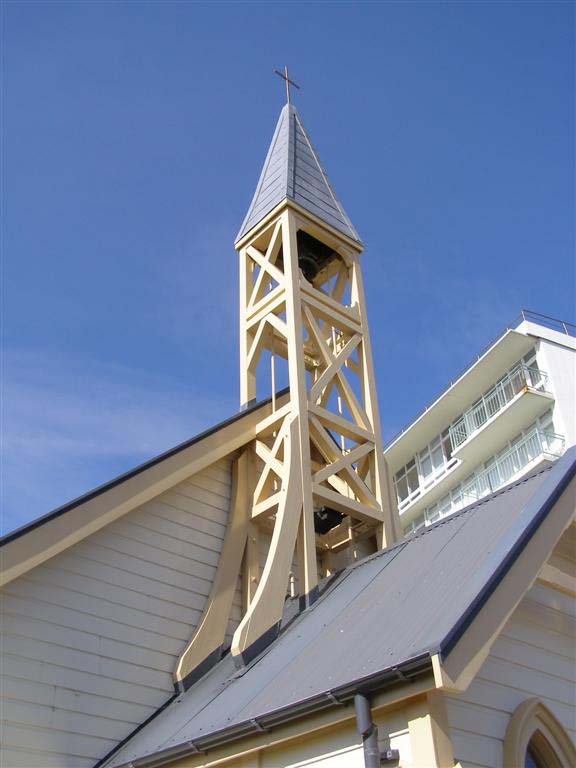
The original building was designed by Joshua Charlesworth, architect of the Wellington Town Hall (1902-4, Register no. 3275, Category 1) and Brancepeth Station homestead (1905, Register no. 7649, Category 1) among other buildings. However it was extensively damaged by fire in 1924; signs of which can be seen in the polished but still blackened floorboards near the altar rails. The repairs were designed by Frederick de Jersey Clere and included concrete buttresses on the east side, new windows in the east end, and the interior was relined in rimu. The belfry which was designed by Clere and added in 1907 appears not to have been damaged in the fire.
In 1938 a new hall was built, and in 1944 a choir vestry, porch, an extension to the sanctuary and an alcove for a new organ were completed. Author Susan Maclean notes further renovations were carried out in 1964 and to the belfry in 1986. In 2007 a full scale restoration project was begun to plans by Ian Bowman, with funding assistance from the local and wider Wellington community and past and present parishioners.
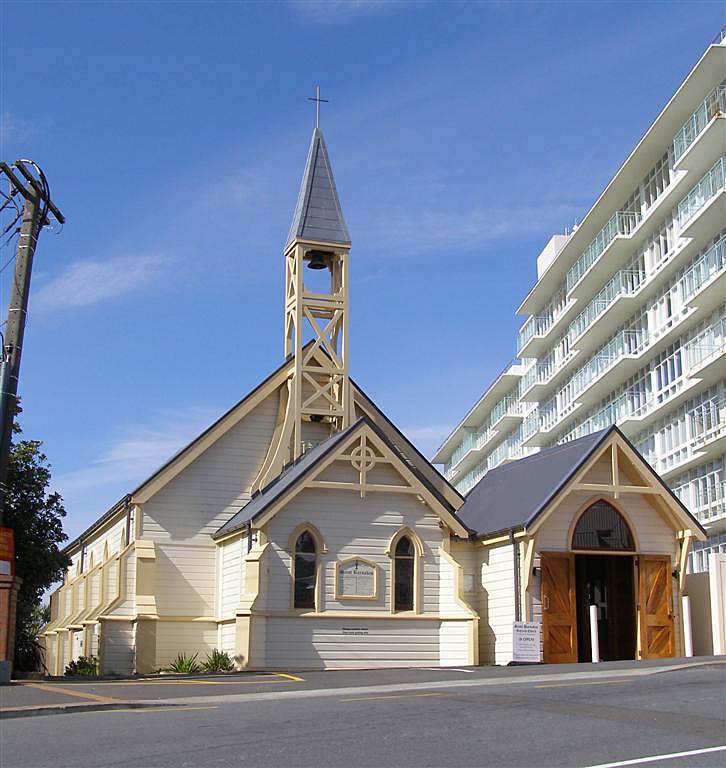
St Barnabas Church (Anglican) is a single-gabled building clad in rusticated weatherboards with a corrugated steel roof. The main gable is repeated in a smaller front gable which has two arched windows. The entry porch was renovated in 2007 with a matching gable.
The interior is panelled timber with an exposed roof-truss system of double Queen posts. Above the choir on a cross beam are sculptures of Christ, Virgin Mary and Saint John – these were originally located on a rood screen, which was removed in 1964 and there is a statue of St Barnabas above the organ. The stained glass windows above the altar were gifted in 1967 and three more windows were gifted in 1974, all made by Miller Studios of Dunedin.
St Barnabas Church’s plain Gothic style, belfry tower, and corner site make it a prominent local landmark. The interior with its timber panelling, exposed beams and sculptures further contributes to its aesthetic and architectural significance. The church also has social and spiritual significance to the many parishioners who have used it over the last 113 years.
List Entry Information
Status
Listed
List Entry Status
Historic Place Category 2
Access
Private/No Public Access
List Number
1421
Date Entered
25th November 1982
Date of Effect
25th November 1982
City/District Council
Wellington City
Region
Wellington Region
Extent of List Entry
Extent includes the land described as Lot 1 DP 6959 (RT WN322/195), Wellington Land District and the building known as St Barnabas Church (Anglican) thereon.
Legal description
Lot 1 DP 6959 (RT WN322/195), Wellington Land District
Status
Listed
List Entry Status
Historic Place Category 2
Access
Private/No Public Access
List Number
1421
Date Entered
25th November 1982
Date of Effect
25th November 1982
City/District Council
Wellington City
Region
Wellington Region
Extent of List Entry
Extent includes the land described as Lot 1 DP 6959 (RT WN322/195), Wellington Land District and the building known as St Barnabas Church (Anglican) thereon.
Legal description
Lot 1 DP 6959 (RT WN322/195), Wellington Land District
Construction Professional
Name
Johnson and Spargle
Type
Builder
Biography
No biography is currently available for this construction professional
Name
Miller Studios, Dunedin (stained glass)
Type
Artist
Biography
Roy Miller came from a family of artists and craftstmen. His grandfather Henry Miller was a Master Coachbuilder whose handsome-cabs won several championship awards at the Melbourne Exhibition. Roy’s father Oswell set the standard of signwriting in Dunedin with his firm O G Miller which started in 1913 and became Miller Studios in 1958. Roy’s brother Ralph Miller also worked in the family firm, establishing modern design techniques and was a talented artist, but tragically died aged 37 in 1956. Roy started working with his father as a signwriter after leaving primary school in the days when paint was mixed each morning from powder. Acid etching on glass was a large part of the work in those days and Roy spent a large part of his time with this work. It was very specialized with various effects being obtained by using different acids over each other, resulting in badly burned hands at times. Robert Fraser who was the first glass painter in New Zealand had a room next to O G Miller in Rattray St and in 1942 he offered to teach Roy the art of stained glass, as he was about to retire. In 1943 O G Miller purchased Fraser’s Art Glass Works and Roy Miller started producing his own stained glass window beginning initially with about one commission a year. A progressive change came when the design work for Roy’s stained glass windows was done by Frederick Ellis A.R.C.A.of Wellington who produced designs from 1948 - 1961. Then to match competition from the English Studios Roy used designs from Kenneth Bunton (from 1959 - 1969) who lived in England. Roy, however, was always sure the ultimate was to be able to produce the complete window in New Zealand and he achieved this in 1969 when he combined with designer Beverley Shore Bennett to produce the Holm window in the Wellington Cathedral. Beverley produced designs for Miller Studios from 1969 top the studio closed in 1987. Roy Miller and Beverley Shore Bennett were made the first New Zealand ‘Fellows of the British Society of Master Glass Painters’, a society formed approximately 500 years ago. Roy Miller’s stained glass windows can now be seen all over New Zealand from small churches to leading churches and cathedrals. Paul Hutchins from Wales joined Miller Studios in 1977 and worked with Roy for several years. Roy retired in the early 1980s but came out of retirement to work with Paul on three windows in the Christchurch Cathedral. He died just before the windows were completed. Miller Studios closed the glass department in 1987 following a recession and consequent drop in orders from churches. http://www.millerstudios.co.nz/about.aspx
Name
Clere, Frederick De Jersey
Type
Architect
Biography
Clere (1856-1952) was born in Lancashire, the son of an Anglican clergyman, and was articled to Edmund Scott, an ecclesiastical architect of Brighton. He then became chief assistant to R J Withers, a London architect. Clere came to New Zealand in 1877, practising first in Feilding and then in Wanganui. He later came to Wellington and practised there for 58 years. He was elected a Fellow of the Royal Institute of British Architects in 1886 and held office for 50 years as one of four honorary secretaries in the Empire. In 1883 he was appointed Diocesan Architect of the Anglican Church; he designed more than 100 churches while he held this position. Clere was a pioneer in reinforced concrete construction; the outstanding example of his work with this material is the Church of St Mary of the Angels (1922), Wellington. As well as being pre-eminent in church design, Clere was responsible for many domestic and commercial buildings including Wellington's Harbour Board Offices and Bond Store (1891) and Overton in Marton. Clere was also involved in the design of large woolsheds in Hawkes Bay and Wairarapa. He was active in the formation of the New Zealand Institute of Architects and served on their council for many years. He was a member of the Wellington City Council until 1895, and from 1900 a member of the Wellington Diocesan Synod and the General Synod. He was also a member of the New Zealand Academy of Fine Arts.
Name
Charlesworth, Joshua
Type
Architect
Biography
Charlesworth (1861-1925) was born in Yorkshire and the first record of his practice in Wellington was in the New Zealand Post Office Directory of 1885-87. He won a competition for the design of the Home for the Aged and Needy in June, 1887, and in the same year won another for the design of the Nelson Town Hall. Charlesworth set up practice in Wellington in his early twenties, designing many institutional buildings and showing command of the revival styles of architecture. His work includes the Wellington Town Hall (1901), Brancepeth Station Homestead addition, Wairarapa (1905), Te Aro Post Office (1908), St Hilda's Church, Upper Hutt (1909), and seventeen branch banks for the Bank of New Zealand, situated throughout the country (1907-17). Charlesworth was elected a Fellow of the New Zealand Institute of Architects in 1905, and became a life member of the Institute. He was its vice-president in 1909-10, and was the first chairman of a society of architects which was formed in 1912. Charlesworth also belonged to the Yorkshire Society in Wellington and was its president for many years.
Construction Details
Start Year
1899
startYearCirca
Type
Original Construction
Start Year
1907
Type
Addition
Description
Belfry added
Start Year
1924
Type
Modification
Description
Extensive fire damage and repairs
Start Year
1964
Type
Modification
Description
Renovations
Start Year
1986
Type
Modification
Description
Renovations to the belfry
Start Year
2007
Type
Modification
Description
Renovations
Construction Materials
Exterior: timber; corrugated steel roof Interior: panelled timber
Construction Professional
Name
Johnson and Spargle
Type
Builder
Biography
No biography is currently available for this construction professional
Name
Miller Studios, Dunedin (stained glass)
Type
Artist
Biography
Roy Miller came from a family of artists and craftstmen. His grandfather Henry Miller was a Master Coachbuilder whose handsome-cabs won several championship awards at the Melbourne Exhibition. Roy’s father Oswell set the standard of signwriting in Dunedin with his firm O G Miller which started in 1913 and became Miller Studios in 1958. Roy’s brother Ralph Miller also worked in the family firm, establishing modern design techniques and was a talented artist, but tragically died aged 37 in 1956. Roy started working with his father as a signwriter after leaving primary school in the days when paint was mixed each morning from powder. Acid etching on glass was a large part of the work in those days and Roy spent a large part of his time with this work. It was very specialized with various effects being obtained by using different acids over each other, resulting in badly burned hands at times. Robert Fraser who was the first glass painter in New Zealand had a room next to O G Miller in Rattray St and in 1942 he offered to teach Roy the art of stained glass, as he was about to retire. In 1943 O G Miller purchased Fraser’s Art Glass Works and Roy Miller started producing his own stained glass window beginning initially with about one commission a year. A progressive change came when the design work for Roy’s stained glass windows was done by Frederick Ellis A.R.C.A.of Wellington who produced designs from 1948 - 1961. Then to match competition from the English Studios Roy used designs from Kenneth Bunton (from 1959 - 1969) who lived in England. Roy, however, was always sure the ultimate was to be able to produce the complete window in New Zealand and he achieved this in 1969 when he combined with designer Beverley Shore Bennett to produce the Holm window in the Wellington Cathedral. Beverley produced designs for Miller Studios from 1969 top the studio closed in 1987. Roy Miller and Beverley Shore Bennett were made the first New Zealand ‘Fellows of the British Society of Master Glass Painters’, a society formed approximately 500 years ago. Roy Miller’s stained glass windows can now be seen all over New Zealand from small churches to leading churches and cathedrals. Paul Hutchins from Wales joined Miller Studios in 1977 and worked with Roy for several years. Roy retired in the early 1980s but came out of retirement to work with Paul on three windows in the Christchurch Cathedral. He died just before the windows were completed. Miller Studios closed the glass department in 1987 following a recession and consequent drop in orders from churches. http://www.millerstudios.co.nz/about.aspx
Name
Clere, Frederick De Jersey
Type
Architect
Biography
Clere (1856-1952) was born in Lancashire, the son of an Anglican clergyman, and was articled to Edmund Scott, an ecclesiastical architect of Brighton. He then became chief assistant to R J Withers, a London architect. Clere came to New Zealand in 1877, practising first in Feilding and then in Wanganui. He later came to Wellington and practised there for 58 years. He was elected a Fellow of the Royal Institute of British Architects in 1886 and held office for 50 years as one of four honorary secretaries in the Empire. In 1883 he was appointed Diocesan Architect of the Anglican Church; he designed more than 100 churches while he held this position. Clere was a pioneer in reinforced concrete construction; the outstanding example of his work with this material is the Church of St Mary of the Angels (1922), Wellington. As well as being pre-eminent in church design, Clere was responsible for many domestic and commercial buildings including Wellington's Harbour Board Offices and Bond Store (1891) and Overton in Marton. Clere was also involved in the design of large woolsheds in Hawkes Bay and Wairarapa. He was active in the formation of the New Zealand Institute of Architects and served on their council for many years. He was a member of the Wellington City Council until 1895, and from 1900 a member of the Wellington Diocesan Synod and the General Synod. He was also a member of the New Zealand Academy of Fine Arts.
Name
Charlesworth, Joshua
Type
Architect
Biography
Charlesworth (1861-1925) was born in Yorkshire and the first record of his practice in Wellington was in the New Zealand Post Office Directory of 1885-87. He won a competition for the design of the Home for the Aged and Needy in June, 1887, and in the same year won another for the design of the Nelson Town Hall. Charlesworth set up practice in Wellington in his early twenties, designing many institutional buildings and showing command of the revival styles of architecture. His work includes the Wellington Town Hall (1901), Brancepeth Station Homestead addition, Wairarapa (1905), Te Aro Post Office (1908), St Hilda's Church, Upper Hutt (1909), and seventeen branch banks for the Bank of New Zealand, situated throughout the country (1907-17). Charlesworth was elected a Fellow of the New Zealand Institute of Architects in 1905, and became a life member of the Institute. He was its vice-president in 1909-10, and was the first chairman of a society of architects which was formed in 1912. Charlesworth also belonged to the Yorkshire Society in Wellington and was its president for many years.
Construction Details
Start Year
1899
startYearCirca
Type
Original Construction
Start Year
1907
Type
Addition
Description
Belfry added
Start Year
1924
Type
Modification
Description
Extensive fire damage and repairs
Start Year
1964
Type
Modification
Description
Renovations
Start Year
1986
Type
Modification
Description
Renovations to the belfry
Start Year
2007
Type
Modification
Description
Renovations
Construction Materials
Exterior: timber; corrugated steel roof Interior: panelled timber
Historical and Associated Iwi / Hapū / Whānau
Completion Date
19th November 2012
Report Written By
Vivienne Morrell
Information Sources
Fearnley, 1977
Charles Fearnley, Early Wellington Churches, Wellington, 1977
Maclean, 2003
S. Mclean, Architect of the Angels; the churches of Frederick de Jersey Clere, Wellington, 2003
McCaul, 1975
McCaul, John, History of St Barnabas’ Church, Roseneath, Wellington (1915-1975), 1975.
Other Information
This place was identified as significant under previous legislation with different information requirements. It remains significant under the current legislation. There is opportunity under our legislation and policies to add to this information. Further information about this place may be available from the Central Regional Office of Heritage New Zealand Pouhere Taonga. A fully referenced proposal summary report is available from the Central Region office of NZHPT. Please note that entry on the New Zealand Heritage List/Rarangi Korero identifies only the heritage values of the property concerned, and should not be construed as advice on the state of the property, or as a comment of its soundness or safety, including in regard to earthquake risk, safety in the event of fire, or insanitary conditions.
Historical and Associated Iwi / Hapū / Whānau
Completion Date
19th November 2012
Report Written By
Vivienne Morrell
Information Sources
Fearnley, 1977
Charles Fearnley, Early Wellington Churches, Wellington, 1977
Maclean, 2003
S. Mclean, Architect of the Angels; the churches of Frederick de Jersey Clere, Wellington, 2003
McCaul, 1975
McCaul, John, History of St Barnabas’ Church, Roseneath, Wellington (1915-1975), 1975.
Other Information
This place was identified as significant under previous legislation with different information requirements. It remains significant under the current legislation. There is opportunity under our legislation and policies to add to this information. Further information about this place may be available from the Central Regional Office of Heritage New Zealand Pouhere Taonga. A fully referenced proposal summary report is available from the Central Region office of NZHPT. Please note that entry on the New Zealand Heritage List/Rarangi Korero identifies only the heritage values of the property concerned, and should not be construed as advice on the state of the property, or as a comment of its soundness or safety, including in regard to earthquake risk, safety in the event of fire, or insanitary conditions.
Current Usages
Uses: Religion
Specific Usage: Church
Former Usages
General Usage: Religion
Specific Usage: Church
Current Usages
Uses: Religion
Specific Usage: Church
Former Usages
General Usage: Religion
Specific Usage: Church
Location
Stay up to date with Heritage this month
