The human presence in Wellington began with the explorer Kupe, who travelled to Aotearoa New Zealand from Hawaiki, the ancestral Polynesian homeland of Māori. Following permanent settlement in Aotearoa, the rangatira Tara, son of Whātonga and the eponymous ancestor of Ngāi Tara, travelled south from Māhia Peninsula and settled at what came to be known as Te Whanganui-a-Tara, the great harbour of Tara. They were later joined by Ngāti Ira; other iwi who made a home there included Ngāti Kahungunu, Rangitāne, Ngāi Tahu and Ngāti Māmoe. Te Ātiawa, Ngāti Tama and Ngāti Mutunga migrated south from Taranaki in the 1820s and early 1830s during a period of great upheaval associated with the introduction of Pākehā muskets into te ao Māori. Ngāti Tama and Ngāti Mutunga established Kumutoto Pā at the mouth of the Kumutoto Stream (which runs down present-day Woodward Street).
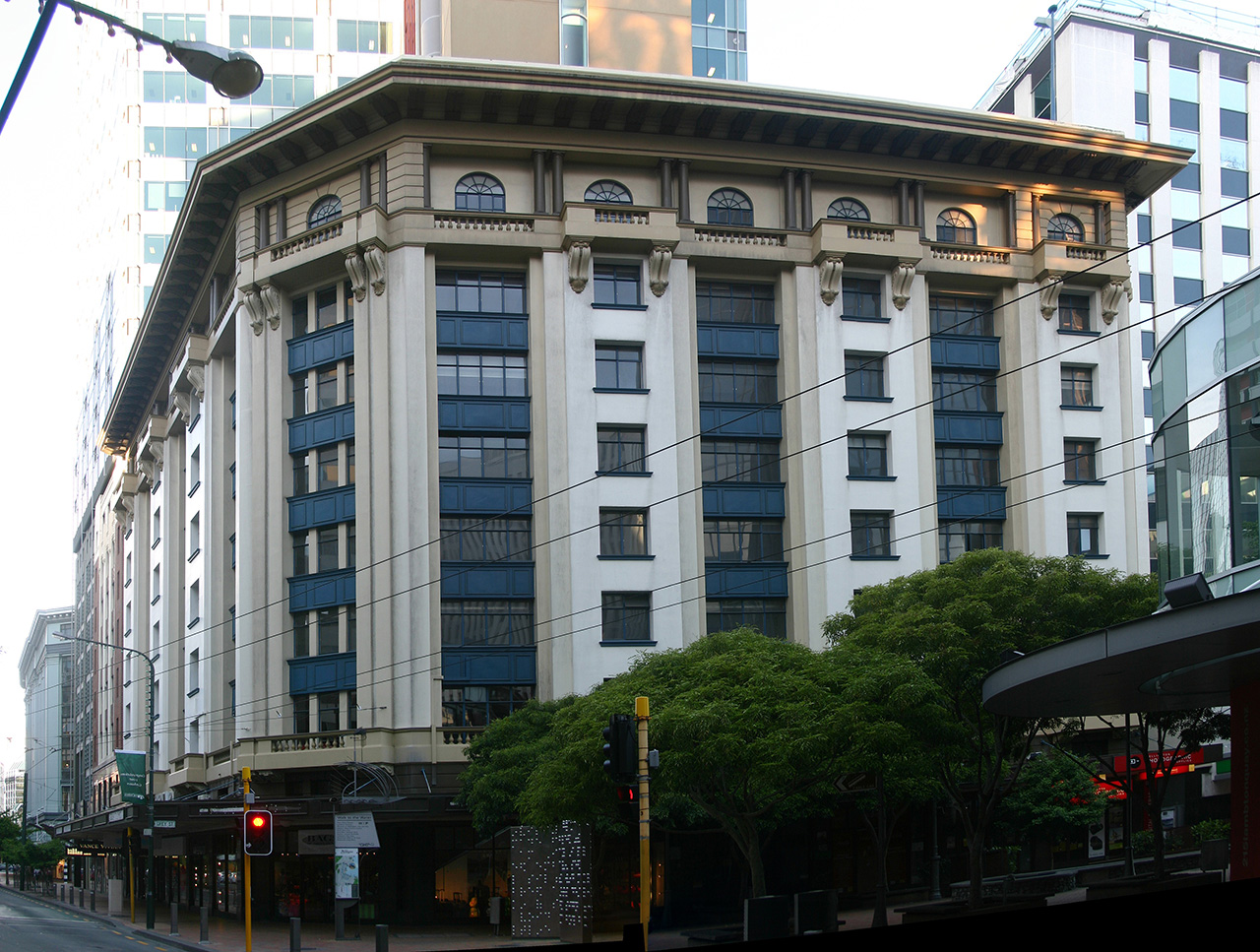
Following Pākehā settlement in 1840, land was reclaimed from the harbour including, in 1859, the land on which the Australian Temperance and General Mutual Life Assurance Society Limited (T&G)’s New Zealand head office and Wellington branch would be constructed. The site was previously occupied by the Oddfellows Hall (demolished 1882) and timber commercial buildings. The new eight-story T&G building was designed by Australian architectural firm Anketell and Kingsley Henderson in the distinctive ‘house style’ developed for the company, and construction was supervised by local firm Mitchell and King. Classical in style with components such as the plain windows demonstrating transitional elements, the building shows the impact of the influential Chicago School. Modern construction techniques, including a steel framework and reinforced concrete foundations, were employed.
Completed in 1928, the ground, first and fifth floors were occupied by T&G, with the remainder leased to a variety of tenants, including lawyers, accountants and dentists. The company occupied more floors over succeeding decades but the highly compartmentalised internal space meant the building always housed many different tenants. In 1983 T&G merged with insurance company National Mutual and all staff moved out the following year. Real estate firm Harcourts was the major tenant from then until 2010. Following the building’s acquisition by property developer Mark Dunajtschik in 2000, office space was made freely available to the likes of community groups, non-profit organisations and small businesses, in exchange for one month’s notice of tenancy end. Once such tenant was Intersex Trust Aotearoa New Zealand, a national advocacy and peer support group for intersex people. founded by Mani Mitchell in 1996. This was one of first groups of its kind in the world, while Mitchell was the first out intersex person in Aotearoa New Zealand. The building was converted to the Doubleday Hilton Hotel, which opened in 2018. While the numerous offices were replaced by hotel rooms, the lobby retains its original features, including the marble staircase and lifts.

List Entry Information
Status
Listed
List Entry Status
Historic Place Category 1
Access
Private/No Public Access
List Number
1435
Date Entered
28th June 1990
Date of Effect
28th June 1990
City/District Council
Wellington City
Region
Wellington Region
Legal description
Pt Lot 1 A 207, Lot 1 DP 8093 (RT WN56A/636), Wellington Land District
Status
Listed
List Entry Status
Historic Place Category 1
Access
Private/No Public Access
List Number
1435
Date Entered
28th June 1990
Date of Effect
28th June 1990
City/District Council
Wellington City
Region
Wellington Region
Legal description
Pt Lot 1 A 207, Lot 1 DP 8093 (RT WN56A/636), Wellington Land District
Why is this place significant?
Historic Significance
Historical Significance or Value Until its merger with National Mutual T & G was one of New Zealand's most successful insurance companies. Inaugurated in Australia it had its New Zealand head office in Wellington for eighty years. The imposing building which still bears the T & G name continues a 100 year association of this site with insurance companies.
Physical Significance
ARCHITECTURAL SIGNIFICANCE: The T & G building is a worthy representative of the transitional period between the Classical revival and Art Deco movements. The building uses contemporary materials of structural steel and reinforced concrete in an imaginative manner combined with the formality of classicism. A recognisable style became associated with the company and the building owes much to the designs of T & G offices in the major Australian cities such as Melbourne, Brisbane and Adelaide. The building, however, lacks the characteristic tiered tower. Largely in original condition its substantial size, bold form and decoration make it a major landmark on Wellington's principal thoroughfare. TOWNSCAPE/LANDMARK VALUE: The character and scale of the land and building are comparable to the nearby DIC building and together they form a coherent statement. The T & G building adds significantly to the east side architecture of Lambton Quay. Its corner siting gives it a strikingly handsome appearance.
Why is this place significant?
Historic Significance
Historical Significance or Value Until its merger with National Mutual T & G was one of New Zealand's most successful insurance companies. Inaugurated in Australia it had its New Zealand head office in Wellington for eighty years. The imposing building which still bears the T & G name continues a 100 year association of this site with insurance companies.
Physical Significance
ARCHITECTURAL SIGNIFICANCE: The T & G building is a worthy representative of the transitional period between the Classical revival and Art Deco movements. The building uses contemporary materials of structural steel and reinforced concrete in an imaginative manner combined with the formality of classicism. A recognisable style became associated with the company and the building owes much to the designs of T & G offices in the major Australian cities such as Melbourne, Brisbane and Adelaide. The building, however, lacks the characteristic tiered tower. Largely in original condition its substantial size, bold form and decoration make it a major landmark on Wellington's principal thoroughfare. TOWNSCAPE/LANDMARK VALUE: The character and scale of the land and building are comparable to the nearby DIC building and together they form a coherent statement. The T & G building adds significantly to the east side architecture of Lambton Quay. Its corner siting gives it a strikingly handsome appearance.
Construction Professional
Name
Henderson, Anketell & K.
Type
Architectural Partnership
Biography
Anketell Matthew Henderson (1853-1922) and his son Kingsley Anketell Henderson, formed the partnership Anketell and K. Henderson in 1906. The partnership was based in Melbourne and at one time Collins Street had seven buildings designed by this practice. They specialised in banks, insurance company buildings, hospitals and universities. K.A. Henderson placed great emphasis on the commercial and functional aspects of city office planning, including maximum space to let and maximum levels of natural lighting. In New Zealand the firm was responsible for the design of the T & G Building, Wellington (1927-28). This design was closely related to other T and G buildings in Australia particularly the head office in Melbourne. After the death of K.A. Henderson in 1942 the firm continued until the 1960s.
Name
Atkins & Mitchell
Type
Architectural Partnership
Biography
The firm of Atkins and Bacon was established in Wellington in 1908 by Alfred Atkins (1850-1919) and Roger Bacon. Cyril Hawthorn Mitchell (1891-1949) was taken on as a draughtsman in 1909 and became a partner in 1918. This partnership was shortlived, however, as Roger Bacon moved to Blenheim owing to failing health and Alfred Atkins died in 1919 leaving the young Mitchell on his own. C.H. Mitchell built up the firm of Atkins and Mitchell, renaming it Mitchell and Mitchell when joined by his brother Allan Hawthorn Mitchell (d.-1973) in 1932. The firm of Mitchell and Mitchell continues today as Gooch Mitchell Macdiarmid. During his time in the firm (1909-1949) C.H. Mitchell was responsible for such buildings as the Commercial Travellers Club Building (1929), the Waterloo Hotel (1936), the Central Fire Station (1935) M.L.C. Building, 33-37 Hunter Street, (1940). He was architect to the Reserve Bank of New Zealand and studied the construction of banking chambers in Europe.
Construction Details
Start Year
1928
Type
Original Construction
Construction Materials
Steel framed building, with concrete fireproofing. Foundations, reinforced concrete. Roof finished with asphalt. Exterior walls are 330mm brick, plastered. Interior walls are brick or reinforced concrete.
Notable Features
The spandrels The balustraded balconies Entrance foyer and staircase
Construction Professional
Name
Henderson, Anketell & K.
Type
Architectural Partnership
Biography
Anketell Matthew Henderson (1853-1922) and his son Kingsley Anketell Henderson, formed the partnership Anketell and K. Henderson in 1906. The partnership was based in Melbourne and at one time Collins Street had seven buildings designed by this practice. They specialised in banks, insurance company buildings, hospitals and universities. K.A. Henderson placed great emphasis on the commercial and functional aspects of city office planning, including maximum space to let and maximum levels of natural lighting. In New Zealand the firm was responsible for the design of the T & G Building, Wellington (1927-28). This design was closely related to other T and G buildings in Australia particularly the head office in Melbourne. After the death of K.A. Henderson in 1942 the firm continued until the 1960s.
Name
Atkins & Mitchell
Type
Architectural Partnership
Biography
The firm of Atkins and Bacon was established in Wellington in 1908 by Alfred Atkins (1850-1919) and Roger Bacon. Cyril Hawthorn Mitchell (1891-1949) was taken on as a draughtsman in 1909 and became a partner in 1918. This partnership was shortlived, however, as Roger Bacon moved to Blenheim owing to failing health and Alfred Atkins died in 1919 leaving the young Mitchell on his own. C.H. Mitchell built up the firm of Atkins and Mitchell, renaming it Mitchell and Mitchell when joined by his brother Allan Hawthorn Mitchell (d.-1973) in 1932. The firm of Mitchell and Mitchell continues today as Gooch Mitchell Macdiarmid. During his time in the firm (1909-1949) C.H. Mitchell was responsible for such buildings as the Commercial Travellers Club Building (1929), the Waterloo Hotel (1936), the Central Fire Station (1935) M.L.C. Building, 33-37 Hunter Street, (1940). He was architect to the Reserve Bank of New Zealand and studied the construction of banking chambers in Europe.
Construction Details
Start Year
1928
Type
Original Construction
Construction Materials
Steel framed building, with concrete fireproofing. Foundations, reinforced concrete. Roof finished with asphalt. Exterior walls are 330mm brick, plastered. Interior walls are brick or reinforced concrete.
Notable Features
The spandrels The balustraded balconies Entrance foyer and staircase
ARCHITECT/ENGINEER OR DESIGNER: A. & K. HENDERSON K. A. HENDERSON (1883-1942) ATKINS & MITCHELL (Supervising Architects) ARCHITECTURAL DESCRIPTION: The eight storey building is transitional, coming between the Classic Revival and the Art Deco movements. It also shows the influence of Louis Sullivan and the Chicago School with the expression of its three distinct parts - base, shaft and capital. The shaft of the building emphasises verticality with the use of traditional heavy white walls alternating with deeply recessed panels of glass and dark coloured metal spandrels. The capital of the building expresses classicism. It has paired Doric columns above the solid portions. There are arched windows between the columns. The capital or entablature is defined by balustraded balconies on large corbels and is topped by a classical cornice emphasised by the use of modillions. The interior features an impressive ground floor foyer. Again classically inspired, it has polished marble cladding on the lower part of the walls and plaster above. The wooden panelled lifts are original. A fine balustraded staircase ascends from here. MODIFICATIONS: No major alterations to date.
Historical and Associated Iwi / Hapū / Whānau
Completion Date
23rd April 2024
Report Written By
Kerryn Pollock
Information Sources
Evening Post
Evening Post, 27 Jun 1919, p.7.
New Zealand Historic Places Trust (NZHPT)
New Zealand Historic Places Trust
Stacpoole, 1972
John Stacpoole and Peter Beaven, 'Architecture 1820-1970', Wellington, 1972
Wellington Regional Council
Wellington City Council, 2012
Wellington City Council, ‘Australian Temperance and General Mutual Life Assurance Society (T&G Building)’ inventory report, 2012 https://www.wellingtoncityheritage.org.nz/buildings/151-300/185-australian-temperance-and-general-mutual-life-assurance-society?q=
Other Information
A fully referenced copy of the upgrade report is available upon request from the Central Regional Office of Heritage New Zealand Pouhere Taonga. This historic place was registered under the Historic Places Act 1980. This report includes the text from the original Building Classification Committee report considered by the NZHPT Board at the time of registration. Please note that entry on the New Zealand Heritage List/Rārangi Kōrero identifies only the heritage values of the property concerned, and should not be construed as advice on the state of the property, or as a comment of its soundness or safety, including in regard to earthquake risk, safety in the event of fire, or insanitary conditions.
Historical and Associated Iwi / Hapū / Whānau
Completion Date
23rd April 2024
Report Written By
Kerryn Pollock
Information Sources
Evening Post
Evening Post, 27 Jun 1919, p.7.
New Zealand Historic Places Trust (NZHPT)
New Zealand Historic Places Trust
Stacpoole, 1972
John Stacpoole and Peter Beaven, 'Architecture 1820-1970', Wellington, 1972
Wellington Regional Council
Wellington City Council, 2012
Wellington City Council, ‘Australian Temperance and General Mutual Life Assurance Society (T&G Building)’ inventory report, 2012 https://www.wellingtoncityheritage.org.nz/buildings/151-300/185-australian-temperance-and-general-mutual-life-assurance-society?q=
Other Information
A fully referenced copy of the upgrade report is available upon request from the Central Regional Office of Heritage New Zealand Pouhere Taonga. This historic place was registered under the Historic Places Act 1980. This report includes the text from the original Building Classification Committee report considered by the NZHPT Board at the time of registration. Please note that entry on the New Zealand Heritage List/Rārangi Kōrero identifies only the heritage values of the property concerned, and should not be construed as advice on the state of the property, or as a comment of its soundness or safety, including in regard to earthquake risk, safety in the event of fire, or insanitary conditions.
Current Usages
Uses: Accommodation
Specific Usage: Hotel
Former Usages
General Usage: Trade
Specific Usage: Office building/Offices
Themes
Rainbow List
Current Usages
Uses: Accommodation
Specific Usage: Hotel
Former Usages
General Usage: Trade
Specific Usage: Office building/Offices
Themes
Rainbow List
Location
Stay up to date with Heritage this month

