Early History
The land around Makara was very important to early Māori, especially the coastline; a number of different tribes were associated with the area at different times during pre-European settlement. Cape Terawhiti, on the coast, was an important site for Māori, as it guarded the whole of the northern entrance into Whanga-nui-a-Tara (Wellington Harbour), controlling those who wished to cross the strait. There were Māori settlements located all along the coastline, with the westernmost range of Terawhiti being used by Māori to observe the weather and sea conditions before any decision was made about crossing the strait. Furthermore, it has been said that the discoverer Kupe dried his sails on Makara Beach during his voyages in the tenth century. To live along this coastline in the bays around Terawhiti meant control over one of the most important waterways in New Zealand.
European Settlement
The survey of the Wellington land district began in 1839 with the arrival of the New Zealand Company. The first surveyor general, Captain William Mein Smith, was ordered to find rural areas that would be divided into 100-acre sections for selection by holders of land orders. Smith laid out the Makara area in this fashion where there were initially 39 sections surveyed, of which four sections were designated as Native Reserves.
One of the first sections selected under the New Zealand Land Order No. 349 was at the junction of the Makara and South Makara Roads recorded as Section 23. One of Section 23’s joint owners, Samuel Revans was publisher of Wellington’s first newspaper, and his section became known as ‘Printers section’. One surveyor noted the section as having a house and two fenced gardens, one of which he recorded as ‘printers garden’. In 1847, some of Revans’ publishing colleagues took up neighbouring land on section 20, unsurprisingly with the influx of printers and publishers to the area, the land at the junction of South Makara and Makara Road became known as ‘Printers Flat’, a name that stuck for the next fifty years.
At first, European settlement at Makara was slow. The New Zealand Company had an ongoing struggle with the access to Makara; however, with the completion of a road via Karori in February 1858, settlement began to take place. By the 1860s, Makara was becoming a thriving little district. As with many new settlements in New Zealand, the first settlers cleared the bush before land was converted for farming. In Makara a number of the early settlers survived by selling timber for new houses being built in Wellington. There was a rush to the district when gold was discovered in 1862, however, it was not as prosperous as had been hoped and by 1883, many claims had been abandoned. Initially forestry and sawmilling was very productive, but as land was cleared farming became the main form of income.
Military Background
A lot of the land surveyed at Makara was available for military men to take up as their land grants. During 1860, individual men from Makara were called up to serve in the Militia. The first Militia Ordinance had been passed by the Legislative Council on 25 March 1845, after the threat of Hone Heke’s rebellion in Auckland. The Militia Ordinance required that all able-bodied men were to be available for annual training and ready for active service whenever there was any sort of conflict, in particular a conflict over land.
In 1861, Militia Notices printed in the papers stated that all men between the ages of 16 and 55 were liable to serve under the Militia Act Amendment Act 1860; all eligible men were to be enrolled to serve in the militia for the Wellington District of the City of Wellington including Karori and Makara. Men from Makara answered this call and drills were set up. Drills for the men from Makara were held on Tuesdays at 2pm, and later the second Tuesday of the month.
It was not long before men from Makara were going overseas to war - the South African War. Premier Richard Seddon offered to send troops to South Africa in September 1899 and there was a great response from New Zealand men, however only members of the New Zealand permanent forces and the part-time volunteer forces were eligible to serve. Men were required to meet physical requirements such as height and age, as well as possess the ability to ride and shoot. While most men readily met the first two requirements many were rejected due to poor horsemanship.
World War One
The assassination of Archduke Franz Ferdinand on 28 June 1914, and England’s subsequent declaration of war on Germany on 4 August 1914 would have a lasting effect on New Zealand. Prime Minister W.F. Massey declared that New Zealand’s main contribution would be the supply of troops to fight, and accordingly New Zealand sent over 100,000 men overseas to the war, with the main body of the New Zealand Expeditionary Force leaving on 16 October 1914. New Zealand became involved to not only support ‘Mother England’, but also because it was dependent on the British market: anything that threatened this market directly threatened New Zealand. New Zealand quickly began preparations for war.
Makara also quickly became involved in the war effort and the subsequent preparations. Makara was the location of a ‘war training’ exercise between the Canterbury and Otago Regiments, who represented attacking and defending forces respectively. On 8 October 1914, the Evening Post reported on an ‘infantry engagement in the direction of Makara’. Troops left for Karori early in the morning; it was expected that manoeuvres would be completed in time for men to return to the troopships for dinner in the evening.
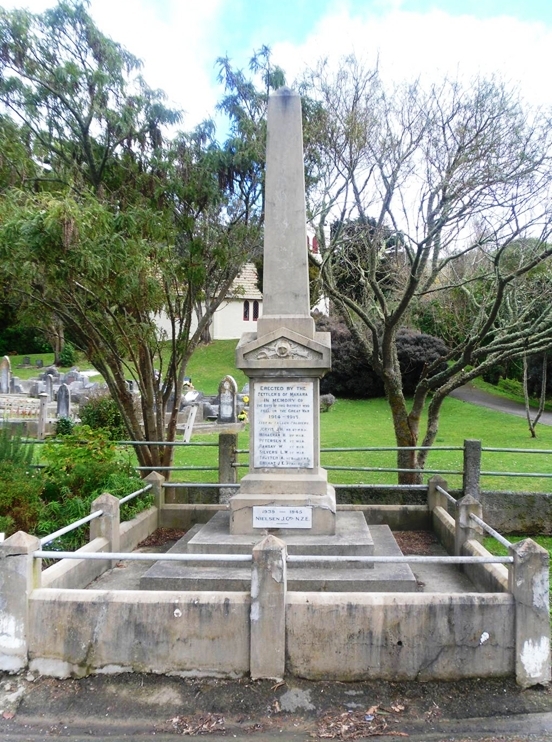
Records indicate that the first of the Makara men, William Gray Ramsay and John Howard Jervis, departed for war on 16 October 1914. At least 13 other Makara men departed at various times throughout the duration of the war. As the War Memorial indicates, seven men never returned home. Indeed, Percy Jervis might have found it difficult to leave for war on 5 April 1917, three years after his brother John Howard Jervis had departed and been killed in action at Gallipoli.
Makara also had a unique connection with a soldier who was not actually from the community. On 2 February 1916, the Evening Post reported that Mr H. Mills of Ohariu Valley picked up a toffee tin while walking along Makara Beach. Inside the tin was a message written by Private A. T. Bird of the 8th Platoon, B Company, 9th Reinforcements. The message indicated that the tin had been dropped from a troop ship 140 miles out from Wellington, and the letter requested that whoever found the tin might communicate with Bird while he was at the front. Records indicate that Arthur Thomas Bird left Wellington on 8 January 1916 aboard the Maunganui, bound for Egypt, and he appears to have survived the war.
War Memorial
Of the 120,000 New Zealanders who enlisted during World War One, 103,000 served overseas, 18,500 were killed and almost 50,000 were wounded. The War Memorial, Makara is one of nearly 500 World War One memorials throughout New Zealand, erected to commemorate those who lost their lives. There was much discussion around war memorials and how best to commemorate the dead. Some people wanted utilitarian forms such as libraries or town halls, while others wanted more ornamental forms such as statues or similar. By the end of 1919, it was generally agreed that memorials should be ornamental rather than for a utilitarian purpose. Agreement on the location of war memorials caused some of the most heated debates. Generally, it was agreed that memorials should be in a prominent position, that there should be room for people to gather around them and that they should be in a relatively central spot within the community.
The next debate that arose regarded subsidies. In December 1918, the Prime Minister hinted at the possibility of the government offering subsidies for local memorials, however on 21 March 1919, the government decided they would not offer any sort of funding. With this, the government lost any sort of jurisdiction over memorials. Decisions about the memorials and the funding of them were now up to the communities charged with erecting them. This has meant that every war memorial in New Zealand is unique, and a direct representation of the community that erected it.
War Memorial, Makara
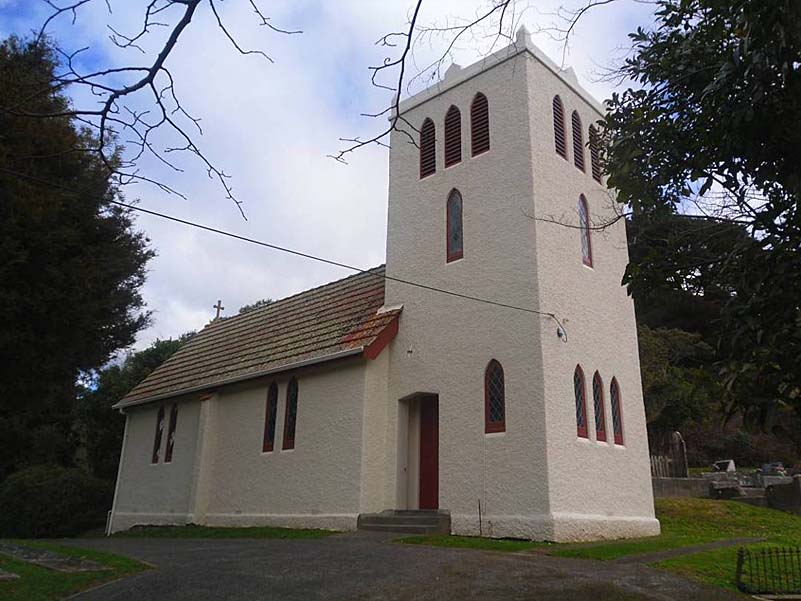
On 10 December 1920, it was reported that no reply had been received from the Minister of Internal Affairs regarding an application for the erection of a war memorial at Makara, and it was agreed that a second application should be made. On 23 December 1920, the Makara County Council was given permission to erect a war memorial ‘on that portion of the Makara road, fronting the Anglican Church’. During that time, the location would have been the focus of much work as the nearby St Matthias’ Anglican Church was also in the middle of a building upgrade. The original building had been demolished in 1920, and a more permanent church was under construction. The foundation stone of the building was laid on 12 February 1921, and the church was consecrated in August of that year. This was in addition to the plans being made for the erection of the war memorial.
Five months after permission was granted to erect a war memorial at Makara, plans for its unveiling were underway. On the afternoon of Sunday 23 May 1921, Brigadier-General Richardson unveiled the memorial. The Brigadier-General commented on how glad he was to see the monument placed in such a conspicuous position, and gave a poignant speech which concluded with a hope that the monument ‘should be an inspiration to the children of future generations, a constant reminder to them of those who died for us and posterity’. Upon his conclusion, he unveiled the memorial and the Last Post sounded.
Unfortunately, there is very little information regarding the plans or design for the memorial, and there is no inscription or marking on the memorial to indicate who the mason may have been. However, there is a very similar memorial located at Aro Street (Mitchelltown) in Wellington. Aro Valley’s War Memorial is a lot larger than Makara’s, and is in poorer condition. It was erected by the ‘Mitchelltown Welcome Home Association and Friends’ in 1920, only a year before the erection of Makara’s War Memorial. The Aro Memorial has a small plaque at the bottom right corner that reads ‘H. Glover, Kent Terrace’.
H. Glover was a monumental mason. It is uncertain when he began working in Wellington, however there is an advertisement in the Evening Post in 1912 advertising an available position for a ‘strong boy’ - wages would be £1 a week, and applications should be made to H. Glover, Monumental Mason, Molesworth Street. Then on 15 July 1913, notice is given in the Evening Post, that H. Glover is moving from Molesworth Street to 59 Kent Terrace, and that estimates are given for all classes of work. Later, from 1914 onwards there are frequent advertisements by H. Glover ‘Monumental Sculptor’, advertising ‘all kinds of cemetery work executed. Granite and marble curbs, reinforced concrete walls. Direct importer Granite and marble memorials.’ Due to the similarity of the two memorials and the fact that they were erected within one year of each other, there is a very high possibility that the same sculptor worked on both memorials.
Some years later, in 1964, the location of the War Memorial at Makara came into question. The Deputy Town Clerk of Wellington City Corporation wrote to the City Engineer of Hutt County Council stating that at some stage a stonewall would be erected on the road frontage of the Makara Cemetery, which would be an ideal site for the War Memorial. However, some confusion over road boundaries meant he was unable to recommend a suitable permanent site in the meantime and he requested that Hutt County Council undertake appropriate surveys. On 11 March 1965, Mr Donelley, the Hutt County Council Engineer, replied that survey work was up to date and pegs had been pointed out to a Mr Tucker from the Reserves Department of Wellington City Corporation. In regards to a site for the memorial, it was proposed that the Memorial could be moved to opposite the Makara Community Hall where appropriate work could be done to make the Memorial a feature. This was the last letter of correspondence on the subject, and it is possible that agreement could not be reached. As a result, the War Memorial remains in its original location, where it was unveiled in 1921.
Makara’s War Memorial was not utilised during ANZAC Day services and commemorations for some years, but it is, now once again the site of annual ANZAC Day commemoration ceremonies.