

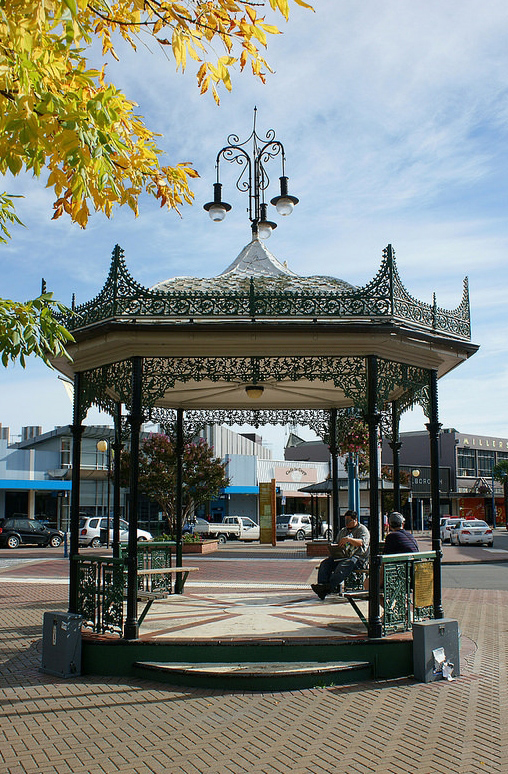
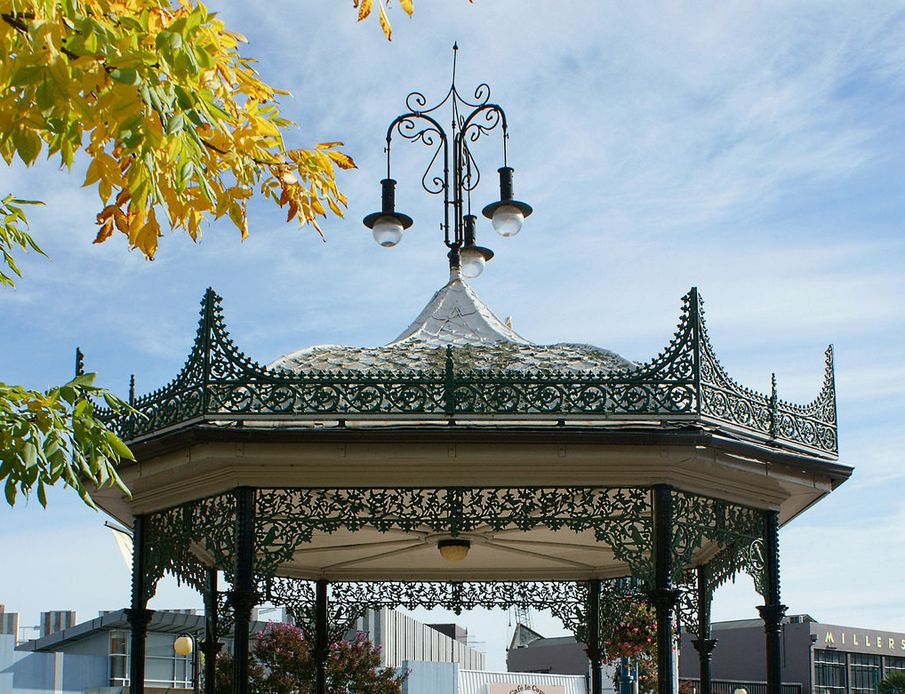
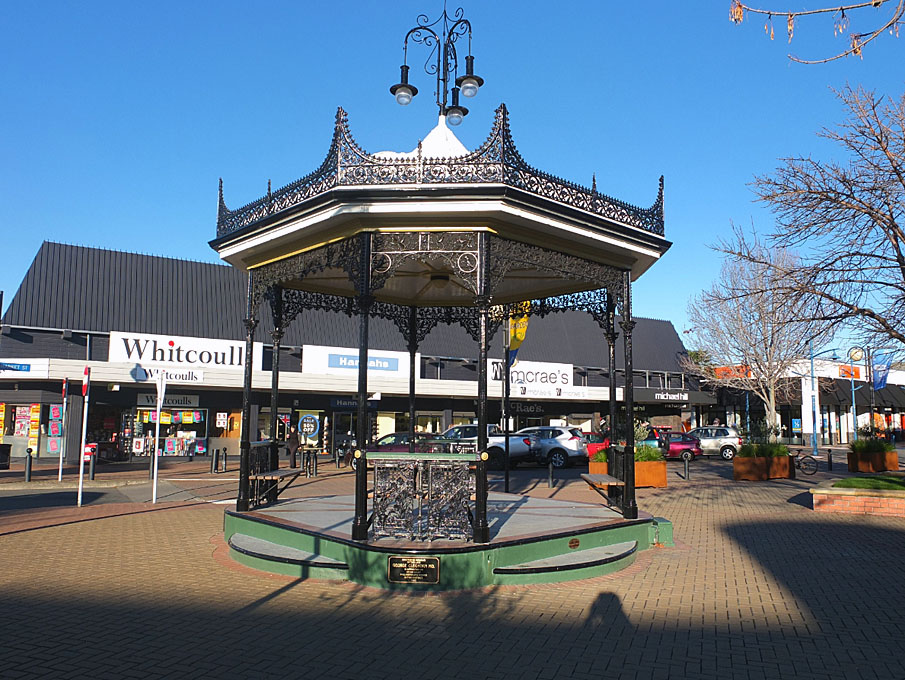
When the decision was made to complete the Rotunda a committee, headed by Mr G.W. McIntosh, was established to design it. The Rotunda is an excellent example of the ornate design and workmanship that characterised the turn of the century. The four-sided structure has impressive ornamental ironwork around the roof and between the tops of the eight iron poles that support it. There are also beautiful ironwork panels in each corner, which feature floral designs.
Paid for by public subscription, the Rotunda was finally completed in July 1903. A bronze dedication plaque noting the occasion was later attached to one of the panels. The building was named the Cleghorn Memorial to commemorate Blenheim's famous medical practitioner, George Cleghorn (1850-1902), who had died the previous year. Dr. Cleghorn was born in India and studied medicine at St Thomas's Hospital, London. He came to Blenheim in 1876 and entered into a partnership with Dr. L. K. Horns. Dr Cleghorn built up a reputation throughout New Zealand as a fine abdominal surgeon. His skill as a surgeon was demonstrated when he operated for appendicitis on Caleb Higgs in Renwicktown, in what is believed to be the earliest successful appendectomy in New Zealand. He was also one of the first to realise the value of antiseptics. Dr. Cleghorn endeared himself to the people of Blenheim for his understanding and kindness, and for his readiness to treat patients he knew did not have the money to pay him.
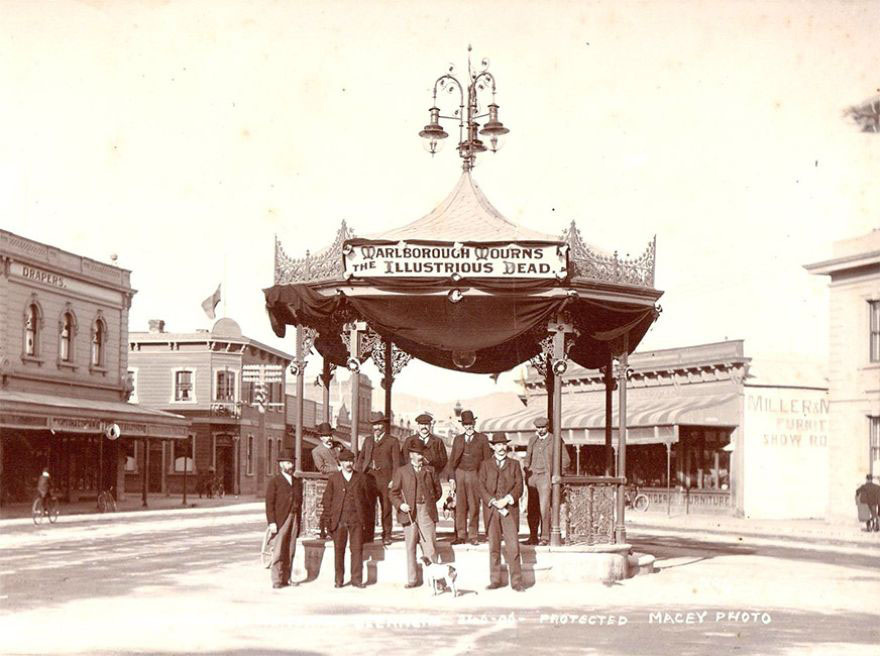
Since the Rotunda was built it has been used for more important occasions than any other place in Blenheim. On its platform have stood governor generals, mayors, royalty, lords and ladies, statesmen, generals, sportspeople and other notables. Every important occasion has seen crowds gather in Market Place. From the Rotunda, service men and women have been farewelled and welcomed home, and declarations of peace have been celebrated. In 1953, a proposal by a small group of citizens to remove the Rotunda led to an emotive debate against the proposal through letters to the editor in the Marlborough Express, demonstrating the strong cultural, social and historic values that Blenheim residents attribute to the Cleghorn Rotunda.
For its centennial in 2003, the Marlborough District Council carried out extensive restoration work on the Rotunda. This included the replacement of some ornamental ironwork and the addition of three mock gas lamps to adorn the top of the Rotunda. The Council used old photos of the Rotunda to make sure the restoration work was true to the original design of the Rotunda. A second plaque was installed on the Rotunda at the time of the restoration.
The Cleghorn Rotunda in Blenheim's Market Place was completed in memory of the late Dr. Cleghorn, to commemorate all he had done for Blenheim and people throughout New Zealand. The Rotunda has architectural value as an example of the design styles characteristic of turn of the century, and social value as a focal point in Blenheim.
List Entry Information
Status
Listed
List Entry Status
Historic Place Category 2
Access
Able to Visit
List Number
1506
Date Entered
2nd April 2004
Date of Effect
2nd April 2004
City/District Council
Marlborough District
Region
Marlborough Region
Extent of List Entry
Registration includes the Rotunda, its fixtures and fittings, and land in Part Legal Road DP 8881
Legal description
Part Legal Road as shown on DP 8881
Location Description
The Rotunda is located at Market Square, on Market Street, in Blenheim.
Status
Listed
List Entry Status
Historic Place Category 2
Access
Able to Visit
List Number
1506
Date Entered
2nd April 2004
Date of Effect
2nd April 2004
City/District Council
Marlborough District
Region
Marlborough Region
Extent of List Entry
Registration includes the Rotunda, its fixtures and fittings, and land in Part Legal Road DP 8881
Legal description
Part Legal Road as shown on DP 8881
Location Description
The Rotunda is located at Market Square, on Market Street, in Blenheim.
Why is this place significant?
Historic Significance
Historical Significance or Value The Cleghorn Rotunda has cultural, social and traditional significance. It is a focus for important events in Blenheim and was used to farewell and welcome thousands of servicemen and women during the wars. The Rotunda has historical significance as a memorial to a notable member the early Blenheim community, and as one of the best-known Blenheim landmarks. The Cleghorn Rotunda has architectural value as an example of the period of ornate design and workmanship that characterised the turn of the century.
Why is this place Category 1 / Category 2?
Detail Of Assessed Criteria
The Cleghorn Rotunda is a memorial to Dr. George Cleghorn, a famous New Zealand surgeon of such renown that he was called on to attend the Premier of New Zealand, John Ballance, when he was suffering appendicitis. The memorial is also associated with important events in New Zealand history, including such as troops leaving for war and royal visits. The two bronze plaques attached to the Rotunda provide knowledge of Dr. George Cleghorn's life in Blenheim, and therefore of an important member of society in early New Zealand. The Rotunda was funded by subscriptions from 273 members of public totalling £151 and 13 shillings. This, together with the fact that the Rotunda is often the focus of important events, shows a strong community association with the Rotunda. The Cleghorn Rotunda has design value as an example of the ornate design and workmanship characteristic of the turn of the century. Almost every original building around the Rotunda has been torn down and replaced. The few that remain have had the façades altered to keep up with modern trends. The Cleghorn Rotunda is the oldest structure in the Blenheim central business district and therefore is an important remainder of the historical landscape of the town.
Why is this place significant?
Historic Significance
Historical Significance or Value The Cleghorn Rotunda has cultural, social and traditional significance. It is a focus for important events in Blenheim and was used to farewell and welcome thousands of servicemen and women during the wars. The Rotunda has historical significance as a memorial to a notable member the early Blenheim community, and as one of the best-known Blenheim landmarks. The Cleghorn Rotunda has architectural value as an example of the period of ornate design and workmanship that characterised the turn of the century.
Why is this place Category 1 / Category 2?
Detail Of Assessed Criteria
The Cleghorn Rotunda is a memorial to Dr. George Cleghorn, a famous New Zealand surgeon of such renown that he was called on to attend the Premier of New Zealand, John Ballance, when he was suffering appendicitis. The memorial is also associated with important events in New Zealand history, including such as troops leaving for war and royal visits. The two bronze plaques attached to the Rotunda provide knowledge of Dr. George Cleghorn's life in Blenheim, and therefore of an important member of society in early New Zealand. The Rotunda was funded by subscriptions from 273 members of public totalling £151 and 13 shillings. This, together with the fact that the Rotunda is often the focus of important events, shows a strong community association with the Rotunda. The Cleghorn Rotunda has design value as an example of the ornate design and workmanship characteristic of the turn of the century. Almost every original building around the Rotunda has been torn down and replaced. The few that remain have had the façades altered to keep up with modern trends. The Cleghorn Rotunda is the oldest structure in the Blenheim central business district and therefore is an important remainder of the historical landscape of the town.
Construction Professional
Name
McIntosh, A. G.
Type
Architect
Biography
No biography is currently available for this construction professional
Construction Details
Start Year
1889
Type
Other
Description
Letter requesting band rotunda be erected received by Local Authority
Start Year
1889
Type
Original Construction
Description
Concrete for base poured
Start Year
1902
Type
Other
Description
Dr George Cleghorn dies and decision made to erect the rotund in his memory
Start Year
1903
Type
Original Construction
Description
Work begins on the rotunda and it is completed
Start Year
2003
Type
Other
Description
Rotunda restored by Local Authority for Centennial Celebrations
Type
Other
Description
Four seats installed
Construction Materials
The Cleghorn Rotunda has a 4.5 metre diameter concrete base. This was finished 4 years before any further work began. The intricate ironwork was made in Canada, and the three original lamps at the top of the rotunda were imported from England. These have since been removed. Replica gas lamps were installed in 2003. The cast bronze plaque was made by a Dunedin firm and was fitted later as it did not arrive for the opening ceremony. A second plaque was added to the opposite corner for the Rotunda's Centennial celebrations in 2003.
Notable Features
Registration includes the Rotunda and all its fittings and fixtures such as the lamps, decorations, attachments, and plaques, and the land on which it rests which is located on Market Place Legal Road (DP 8881), Marlborough Registry.
Construction Professional
Name
McIntosh, A. G.
Type
Architect
Biography
No biography is currently available for this construction professional
Construction Details
Start Year
1889
Type
Other
Description
Letter requesting band rotunda be erected received by Local Authority
Start Year
1889
Type
Original Construction
Description
Concrete for base poured
Start Year
1902
Type
Other
Description
Dr George Cleghorn dies and decision made to erect the rotund in his memory
Start Year
1903
Type
Original Construction
Description
Work begins on the rotunda and it is completed
Start Year
2003
Type
Other
Description
Rotunda restored by Local Authority for Centennial Celebrations
Type
Other
Description
Four seats installed
Construction Materials
The Cleghorn Rotunda has a 4.5 metre diameter concrete base. This was finished 4 years before any further work began. The intricate ironwork was made in Canada, and the three original lamps at the top of the rotunda were imported from England. These have since been removed. Replica gas lamps were installed in 2003. The cast bronze plaque was made by a Dunedin firm and was fitted later as it did not arrive for the opening ceremony. A second plaque was added to the opposite corner for the Rotunda's Centennial celebrations in 2003.
Notable Features
Registration includes the Rotunda and all its fittings and fixtures such as the lamps, decorations, attachments, and plaques, and the land on which it rests which is located on Market Place Legal Road (DP 8881), Marlborough Registry.
The Rotunda is situated in the middle of Market Place in the central town area. The structure is a magnificent example of the ornate design and workmanship that characterised the turn of the century. The four-sided Rotunda has impressive ornamental ironwork around the roof, and between the tops of the eight iron poles that support it. There are also ironwork panels in each corner, which feature floral designs. Two of these panels have bronze plaques attached. The first states that the Rotunda is a memorial to Dr. George Cleghorn, and the second provides a brief biography of Dr. George Cleghorn's life whilst in Blenheim. On the inside of the Rotunda there are four modern wooden bench seats. It is unclear when these were installed.
The Rotunda is situated in the middle of Market Place in the central town area. The structure is a magnificent example of the ornate design and workmanship that characterised the turn of the century. The four-sided Rotunda has impressive ornamental ironwork around the roof, and between the tops of the eight iron poles that support it. There are also ironwork panels in each corner, which feature floral designs. Two of these panels have bronze plaques attached. The first states that the Rotunda is a memorial to Dr. George Cleghorn, and the second provides a brief biography of Dr. George Cleghorn's life whilst in Blenheim. On the inside of the Rotunda there are four modern wooden bench seats. It is unclear when these were installed.
Historical and Associated Iwi / Hapū / Whānau
Completion Date
8th September 2004
Report Written By
Penelope Laurenson
Information Sources
Cleghorn, 1991
W. Cleghorn, The Cleghorn Family, Christchurch, 1991
Marlborough Express
Marlborough Express
Journal of the Nelson and Marlborough Historical Societies
Journal of the Nelson and Marlborough Historical Societies
Other Information
A fully referenced registration report can be viewed at the Central Region of the NZHPT. Please note that entry on the New Zealand Heritage List/Rarangi Korero identifies only the heritage values of the property concerned, and should not be construed as advice on the state of the property, or as a comment of its soundness or safety, including in regard to earthquake risk, safety in the event of fire, or insanitary conditions.
Historical and Associated Iwi / Hapū / Whānau
Completion Date
8th September 2004
Report Written By
Penelope Laurenson
Information Sources
Cleghorn, 1991
W. Cleghorn, The Cleghorn Family, Christchurch, 1991
Marlborough Express
Marlborough Express
Journal of the Nelson and Marlborough Historical Societies
Journal of the Nelson and Marlborough Historical Societies
Other Information
A fully referenced registration report can be viewed at the Central Region of the NZHPT. Please note that entry on the New Zealand Heritage List/Rarangi Korero identifies only the heritage values of the property concerned, and should not be construed as advice on the state of the property, or as a comment of its soundness or safety, including in regard to earthquake risk, safety in the event of fire, or insanitary conditions.
Current Usages
Uses: Civic Facilities
Specific Usage: Bandstand/Rotunda
Former Usages
General Usage: Civic Facilities
Specific Usage: Bandstand/Rotunda
Current Usages
Uses: Civic Facilities
Specific Usage: Bandstand/Rotunda
Former Usages
General Usage: Civic Facilities
Specific Usage: Bandstand/Rotunda
Location
Sign up to hear more
Get the latest heritage news, features and events delivered
straight to your inbox.
