

The Sundial was purchased from Troughton & Simms makers of philosophical instruments in London. The date of purchase is not certain because of differing historical accounts, but most accounts suggest that Arthur Penrose Seymour purchased the Sundial in 1871. Possibly it was ordered from England in the late 1860s and sat in the Survey Office at Blenheim until 1871. It was decided that this timepiece should be protected so that Picton should never again suffer the indignity of having its official timepiece removed. It was, therefore, placed in the Holy Trinity Church grounds in 1872. A conflicting account is that the Sundial was situated in the original provincial council grounds in Picton and was removed with the clock, when it was eventually returned to Picton after much protestation it was placed in the church grounds to protect it so that it would never again be removed.
When the H.M.S. Wallaroo came to Picton, either in 1896 or 1902, the ship's captain, Captain Graham, was approached regarding the Sundial, so he and his ships officers proceeded to the Church to check Picton's official timepiece, they found it correctly set and revealing excellent time.
The Sundial was originally situated to the right of the path leading up to the church, but was moved around behind the church in the 1960s. In 1987 the Sundial was vandalised with the shadow arm broken off and removed. In 1988 the church requested funding from the Picton Borough Council to restore the Sundial. This request was turned down, so in 1989 restoration work was undertaken funded by parishioner donations. The Sundial was restored using photos of the original as a reference point. It is likely that a new shadow arm was ordered from Troughton & Simms and London to replaced the stolen arm.
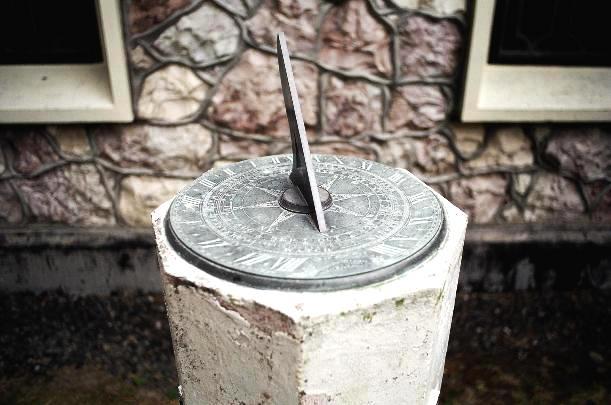
An eight pointed brass compass rose adorns the centre of the dial, encircled by equation of time scales within the outer hour-ring. The hour-ring is engraved with Roman numerals from 4am to 8pm, graduated in half-hours, ten-minute and two-minute intervals. The dial is configured for latitude of 41°17'30'' (S), and is inscribed with the signature 'Troughton & Simms, London'. It is set on a white painted octagonal pillar displaying the date '1872' on its side in brass.
The Sundial was brought both to provide an official timepiece, when no other reliable timekeeping device was present in Picton, and to symbolise a restoration of the towns pride after its status as provincial capital was removed. It was placed in the grounds of the Holy Trinity Church in order to protect it from the same fate as the original town clock. This desire to protect the Sundial shows the esteem in which the residents of Picton held it. The Sundial provides a reminder of the changes and uncertainties of life in early New Zealand settlements in relation to governance, and also symbolises the importance of the towns status to the individual residents identity. Thus the Sundial forms a part of the wider historical and cultural landscape of Picton.
List Entry Information
Status
Listed
List Entry Status
Historic Place Category 2
Access
Able to Visit
List Number
1543
Date Entered
2nd April 2004
Date of Effect
2nd April 2004
City/District Council
Marlborough District
Region
Marlborough Region
Extent of List Entry
Registration includes the sundial, its stand and fittings, and land on part RT MB2A/1098.
Legal description
Lot 1 DP 3783 (RT MB2A/1098), Marlborough Land District
Status
Listed
List Entry Status
Historic Place Category 2
Access
Able to Visit
List Number
1543
Date Entered
2nd April 2004
Date of Effect
2nd April 2004
City/District Council
Marlborough District
Region
Marlborough Region
Extent of List Entry
Registration includes the sundial, its stand and fittings, and land on part RT MB2A/1098.
Legal description
Lot 1 DP 3783 (RT MB2A/1098), Marlborough Land District
Why is this place significant?
Historic Significance
Historical Significance or Value Historic, Cultural, Social The transfer of the capital of Marlborough Province from Picton to Blenhiem, along with the town clock, was a significant event in the history of Picton. Prior to the transfer of the Marlborough provincial capital to Blenhiem, Picton had been considered as a location for the national capital of New Zealand, but hopes of this disappeared along with the title of provincial capital. The Sundial in the Holy Trinity Church grounds has both cultural and social value as the purchase and protection of a new town timepiece can be seen as a reassertion of Picton's worth.
Why is this place Category 1 / Category 2?
Detail Of Assessed Criteria
a, e, h, i. The story behind the Sundial is representative of aspects of New Zealand's political history and especially the changing nature of the new national and local governments during the early period of settlement in New Zealand. The community has high esteem for the sundial, as seen through the decision to protect it by placing it in the church grounds. The sundial also has symbolic value, as it represents Picton's reassertion of its pride and worth after it had, had the title of provincial capital removed from it. The events surrounding the placement of the sundial in the church grounds occurred during an early period of New Zealand settlement in which local and national government was still new and changeable.
Why is this place significant?
Historic Significance
Historical Significance or Value Historic, Cultural, Social The transfer of the capital of Marlborough Province from Picton to Blenhiem, along with the town clock, was a significant event in the history of Picton. Prior to the transfer of the Marlborough provincial capital to Blenhiem, Picton had been considered as a location for the national capital of New Zealand, but hopes of this disappeared along with the title of provincial capital. The Sundial in the Holy Trinity Church grounds has both cultural and social value as the purchase and protection of a new town timepiece can be seen as a reassertion of Picton's worth.
Why is this place Category 1 / Category 2?
Detail Of Assessed Criteria
a, e, h, i. The story behind the Sundial is representative of aspects of New Zealand's political history and especially the changing nature of the new national and local governments during the early period of settlement in New Zealand. The community has high esteem for the sundial, as seen through the decision to protect it by placing it in the church grounds. The sundial also has symbolic value, as it represents Picton's reassertion of its pride and worth after it had, had the title of provincial capital removed from it. The events surrounding the placement of the sundial in the church grounds occurred during an early period of New Zealand settlement in which local and national government was still new and changeable.
Construction Professional
Name
Troughton and Simms
Type
Architectural Partnership
Biography
London based
Construction Details
Start Year
1872
Type
Original Construction
Description
See discussion under 'other information'
Start Year
1960
startYearCirca
Type
Relocation
Description
Sundial moved around the back of the church
Start Year
1987
Type
Other
Description
Sundial vandalised, shadow arm broken off and taken
Start Year
1989
Type
Reconstruction
Description
Sundial restored using photographs of original as a reference
Construction Materials
The brass Sundial face is embedded in a white painted pillar with the brass numbers '1872' on its side.
Construction Professional
Name
Troughton and Simms
Type
Architectural Partnership
Biography
London based
Construction Details
Start Year
1872
Type
Original Construction
Description
See discussion under 'other information'
Start Year
1960
startYearCirca
Type
Relocation
Description
Sundial moved around the back of the church
Start Year
1987
Type
Other
Description
Sundial vandalised, shadow arm broken off and taken
Start Year
1989
Type
Reconstruction
Description
Sundial restored using photographs of original as a reference
Construction Materials
The brass Sundial face is embedded in a white painted pillar with the brass numbers '1872' on its side.
An eight pointed compass rose adorns the centre of the dial, encircled by equation of time scales within the outer hour-ring. The hour-ring is engraved with Roman numerals from 4am to 8pm, graduated in half-hours, ten-minute and two-minute intervals. The dial is made of brass for the given latitude of 41°17'30'' (S), and is inscribed with the signature 'Troughton & Simms, London'. It is set on a white painted concrete octagonal pillar, displaying in brass the date '1872' on its side. It is unlikely that the current pillar is the original, as concrete was not used in the 1870s. It is unknown when the pillar may have been constructed; the earliest photo we have of it was taken in 1977.
An eight pointed compass rose adorns the centre of the dial, encircled by equation of time scales within the outer hour-ring. The hour-ring is engraved with Roman numerals from 4am to 8pm, graduated in half-hours, ten-minute and two-minute intervals. The dial is made of brass for the given latitude of 41°17'30'' (S), and is inscribed with the signature 'Troughton & Simms, London'. It is set on a white painted concrete octagonal pillar, displaying in brass the date '1872' on its side. It is unlikely that the current pillar is the original, as concrete was not used in the 1870s. It is unknown when the pillar may have been constructed; the earliest photo we have of it was taken in 1977.
Historical and Associated Iwi / Hapū / Whānau
Completion Date
8th September 2004
Report Written By
Penelope Laurenson
Information Sources
Daniel, nd
C. Daniel, The Sundial Page: Troubled Times, Picton Museum file, copy held in NZHPT 12009-532
Kelly, 1976
H. Kelly, As High as the Hills: The Centennial History of Picton, Picton, 1976
Macdonald, 2003
J. Macdonald, Picton Memories, Picton, 2003
Mahan, 1989
J. Mahan, 'A Sun Dial with a long history by no time', The Picton Post, 14 March 1983
Taylor, 1985
M. Taylor, Picton's Official Timepiece, Marlborough, 1985
Other Information
There is some disagreement in references over when the Sundial was constructed and placed in the churchyard of the Holy Trinity Church, though there is consensus that the Sundial was purchased from Troughton and Simms in London. Three different accounts of when the Sundial came to Blenhiem follow: Picton decided to send to England for a Sundial sometime after 1865, it sat in the Survey Office at Blenheim until it was secured in 1871, it was then placed in the churchyard of the Holy Trinity Church In 1872 Arthur Penrose purchased a Sundial to replace the council clock. The Sundial was already in the church grounds before it, along with the Picton clock, were removed to Blenhiem in 1865. The Sundial was checked by Captain Graham of the H.M.S Wallaroo either in 1897 or 1902, it was shown to have perfect time. Please note that entry on the New Zealand Heritage List/Rarangi Korero identifies only the heritage values of the property concerned, and should not be construed as advice on the state of the property, or as a comment of its soundness or safety, including in regard to earthquake risk, safety in the event of fire, or insanitary conditions.
Historical and Associated Iwi / Hapū / Whānau
Completion Date
8th September 2004
Report Written By
Penelope Laurenson
Information Sources
Daniel, nd
C. Daniel, The Sundial Page: Troubled Times, Picton Museum file, copy held in NZHPT 12009-532
Kelly, 1976
H. Kelly, As High as the Hills: The Centennial History of Picton, Picton, 1976
Macdonald, 2003
J. Macdonald, Picton Memories, Picton, 2003
Mahan, 1989
J. Mahan, 'A Sun Dial with a long history by no time', The Picton Post, 14 March 1983
Taylor, 1985
M. Taylor, Picton's Official Timepiece, Marlborough, 1985
Other Information
There is some disagreement in references over when the Sundial was constructed and placed in the churchyard of the Holy Trinity Church, though there is consensus that the Sundial was purchased from Troughton and Simms in London. Three different accounts of when the Sundial came to Blenhiem follow: Picton decided to send to England for a Sundial sometime after 1865, it sat in the Survey Office at Blenheim until it was secured in 1871, it was then placed in the churchyard of the Holy Trinity Church In 1872 Arthur Penrose purchased a Sundial to replace the council clock. The Sundial was already in the church grounds before it, along with the Picton clock, were removed to Blenhiem in 1865. The Sundial was checked by Captain Graham of the H.M.S Wallaroo either in 1897 or 1902, it was shown to have perfect time. Please note that entry on the New Zealand Heritage List/Rarangi Korero identifies only the heritage values of the property concerned, and should not be construed as advice on the state of the property, or as a comment of its soundness or safety, including in regard to earthquake risk, safety in the event of fire, or insanitary conditions.
Current Usages
Uses: Civic Facilities
Specific Usage: Sundial
Former Usages
General Usage: Civic Facilities
Specific Usage: Sundial
Current Usages
Uses: Civic Facilities
Specific Usage: Sundial
Former Usages
General Usage: Civic Facilities
Specific Usage: Sundial
Location
Sign up to hear more
Get the latest heritage news, features and events delivered
straight to your inbox.
