Arthur Reynolds Griffin was the grandson of John Griffin the founder of Griffin & Sons Ltd, the Nelson-based biscuit company. Born and raised in Nelson, A.R. Griffin trained in architecture via the International Correspondence School based in Pennsylvania in the United States. Simultaneously, he worked as a draughtsman in the offices of JD and L Robertson before setting up his own offices in the Norwich Union Chambers. His work in Nelson was diverse and prolific including the Nelson Institute (1911, List No. 1603), the former Nelson Hospital (1925) and Nurses Home (1916), and the Church Steps (1913; List No. 253), funded by Griffin’s patron, Thomas Cawthron. He designed Nelson’s Plunket and Rest Rooms (1936; List No. 5169), and a host of commercial buildings including the Ritz Kerr Building (c.1930; List No. 3027), and the former Dalgety and Co Ltd Building (c.1930; List No. 1621). He was also successful in winning a number of design competitions, notably Hokitika’s Carnegie Free Public Library (List No. 1702) completed in 1908. It was noted in the local press that Griffin made trips to Australia and brought ideas back with him both for his commercial work, and for the hospital, illustrating the architectural connection between the two countries.
The Anchor Shipping & Foundry Co Ltd had its origins in a shipping firm and workshop established by Nathaniel Edwards, John Symons and George Bennett in 1866, and further developed by John Symons as sole proprietor in the 1870s. Alexander Brown purchased a major share of stock and assets from Symons’ estate in 1880 and the Anchor Steam Shipping Co was formed in 1883, changing its name to Anchor Shipping & Foundry Co in 1901.
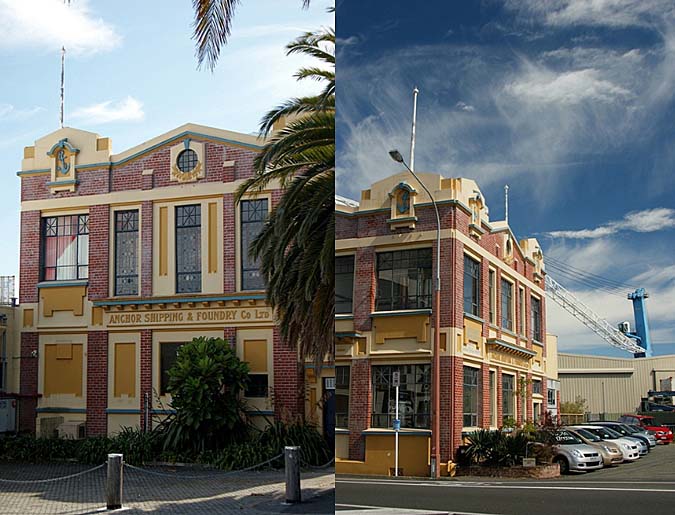
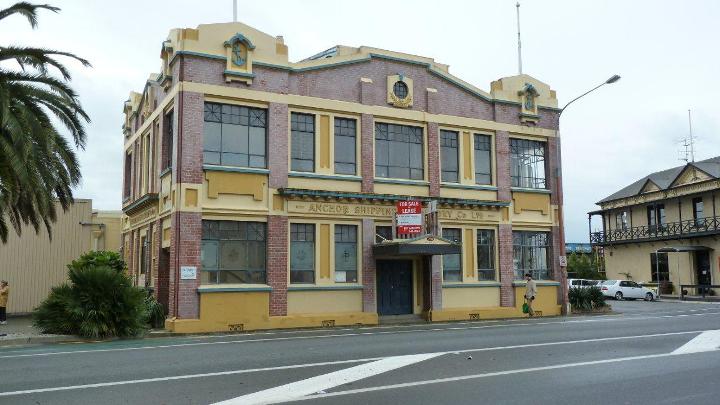
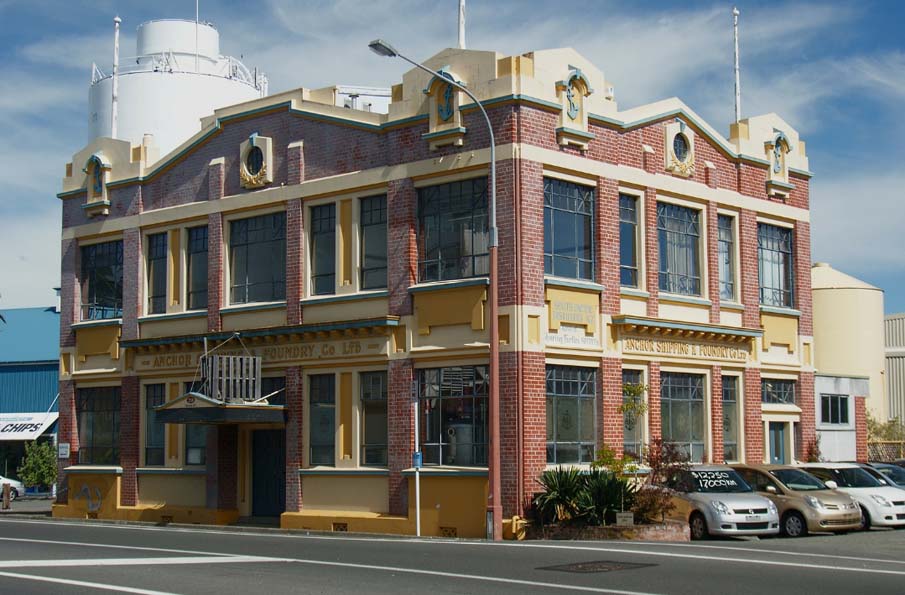
The Anchor Shipping & Foundry Co building was designed by A.R. Griffin in 1927. It consisted of a range of offices, both for booking and for managers and clerks, a strong-room, had boiler-fed central heating, and allowed for extensive daylight through large steel-framed windows. It even had a dedicated clerks’ bicycle room. The Nelson Evening Mail noted that the passageway floors had been finished with ‘Rublino Tiles’; a surface which its Sydney supplier described as ‘the elastic and noiseless tread’. The flat roof was praised as a vantage point from which to assess approaching weather or vessels. After the Anchor Shipping & Foundry Co folded in 1973, the building was subsequently used as a printers, and as a distillery before being purchased by the Nelson City Council in 2013. As the building was determined to be earthquake-prone in 2017, subsequent use depends on seismic strengthening.


List Entry Information
Status
Listed
List Entry Status
Historic Place Category 2
Access
Private/No Public Access
List Number
1554
Date Entered
25th November 1982
Date of Effect
25th November 1982
City/District Council
Nelson City
Region
Nelson Region
Extent of List Entry
Extent includes the land described as Pt Sec 1170 City of Nelson (RT NL5B/585), Nelson Land District and the building known as Anchor Shipping & Foundry Co Ltd Building thereon.
Legal description
Pt Sec 1170 City of Nelson (RT NL5B/585), Nelson Land District
Status
Listed
List Entry Status
Historic Place Category 2
Access
Private/No Public Access
List Number
1554
Date Entered
25th November 1982
Date of Effect
25th November 1982
City/District Council
Nelson City
Region
Nelson Region
Extent of List Entry
Extent includes the land described as Pt Sec 1170 City of Nelson (RT NL5B/585), Nelson Land District and the building known as Anchor Shipping & Foundry Co Ltd Building thereon.
Legal description
Pt Sec 1170 City of Nelson (RT NL5B/585), Nelson Land District
Construction Professional
Name
Griffin, Arthur Reynolds
Type
Architect
Biography
Griffin practised architecture in Nelson from the early 1900s to about 1960. Arthur Reynolds Griffin was the grandson of John Griffin the founder of Griffin & Sons Ltd, the Nelson-based biscuit company. Born and raised in Nelson, A.R. Griffin trained in architecture via the International Correspondence School based in Pennsylvania in the United States. Simultaneously, he worked as a draughtsman in the offices of JD and L Robertson before setting up his own offices in the Norwich Union Chambers. His work in Nelson was diverse and prolific including the Nelson Institute (1911, List No. 1603), the former Nelson Hospital (1925) and Nurses Home (1916), and the Church Steps (1913; List No. 253), funded by Griffin’s patron, Thomas Cawthron. He designed Nelson’s Plunket and Rest Rooms (1936; List No. 5169), and a host of commercial buildings including the Ritz Kerr Building (c.1930; List No. 3027), and the former Dalgety and Co Ltd Building (c.1930; List No. 1621). He was also successful in winning a number of design competitions, notably Hokitika’s Carnegie Free Public Library (List No. 1702) completed in 1908. It was noted in the local press that Griffin made trips to Australia and brought ideas back with him both for his commercial work, and for the hospital, illustrating the architectural connection between the two countries. FROM: Summary Report Anchor Shipping & Foundry Co Building, NELSON (List No. 1554) by M. Katz March 2020
Name
Robertson Bros Ltd
Type
Builder
Biography
Operated in Nelson in early 20th century. Built Anchor Shipping and Foundry Coy Building (List No. 1554)
Name
H. J. Savage and Sons
Type
Glazier
Biography
Painting and glazing services. Operating in Nelson in early 20th Century.
Construction Details
Start Year
1927
Type
Original Construction
Construction Professional
Name
Griffin, Arthur Reynolds
Type
Architect
Biography
Griffin practised architecture in Nelson from the early 1900s to about 1960. Arthur Reynolds Griffin was the grandson of John Griffin the founder of Griffin & Sons Ltd, the Nelson-based biscuit company. Born and raised in Nelson, A.R. Griffin trained in architecture via the International Correspondence School based in Pennsylvania in the United States. Simultaneously, he worked as a draughtsman in the offices of JD and L Robertson before setting up his own offices in the Norwich Union Chambers. His work in Nelson was diverse and prolific including the Nelson Institute (1911, List No. 1603), the former Nelson Hospital (1925) and Nurses Home (1916), and the Church Steps (1913; List No. 253), funded by Griffin’s patron, Thomas Cawthron. He designed Nelson’s Plunket and Rest Rooms (1936; List No. 5169), and a host of commercial buildings including the Ritz Kerr Building (c.1930; List No. 3027), and the former Dalgety and Co Ltd Building (c.1930; List No. 1621). He was also successful in winning a number of design competitions, notably Hokitika’s Carnegie Free Public Library (List No. 1702) completed in 1908. It was noted in the local press that Griffin made trips to Australia and brought ideas back with him both for his commercial work, and for the hospital, illustrating the architectural connection between the two countries. FROM: Summary Report Anchor Shipping & Foundry Co Building, NELSON (List No. 1554) by M. Katz March 2020
Name
Robertson Bros Ltd
Type
Builder
Biography
Operated in Nelson in early 20th century. Built Anchor Shipping and Foundry Coy Building (List No. 1554)
Name
H. J. Savage and Sons
Type
Glazier
Biography
Painting and glazing services. Operating in Nelson in early 20th Century.
Construction Details
Start Year
1927
Type
Original Construction
Historical and Associated Iwi / Hapū / Whānau
Completion Date
10th March 2020
Report Written By
Meghan Katz
Information Sources
McCarthy (ed) 2019
Christine McCarthy (ed), “The Raging fury of Edwardian ornamentation” meets “a virtual frenzy of stylism”: New Zealand Architecture in 1900s: a one day symposium, Centre for Building Performance Research, Faculty of Architecture and Design, Victoria University, Wellington, 2019.
Bowman, 2008
Ian Bowman, ‘Conservation Plan, Dalton House, Nelson, October 2008: Appendix I’
The Prow
http://www.theprow.org.nz/
Other Information
This place was identified as significant under previous legislation with different information requirements. It remains significant under the current legislation. There is opportunity under our legislation and policies to add to this information. Further information about this place may be available from the Central Regional Office of Heritage New Zealand Pouhere Taonga. A fully referenced upgrade report is available on request from the Central region Office of Heritage New Zealand. Please note that entry on the New Zealand Heritage List/Rarangi Korero identifies only the heritage values of the property concerned, and should not be construed as advice on the state of the property, or as a comment of its soundness or safety, including in regard to earthquake risk, safety in the event of fire, or insanitary conditions.
Historical and Associated Iwi / Hapū / Whānau
Completion Date
10th March 2020
Report Written By
Meghan Katz
Information Sources
McCarthy (ed) 2019
Christine McCarthy (ed), “The Raging fury of Edwardian ornamentation” meets “a virtual frenzy of stylism”: New Zealand Architecture in 1900s: a one day symposium, Centre for Building Performance Research, Faculty of Architecture and Design, Victoria University, Wellington, 2019.
Bowman, 2008
Ian Bowman, ‘Conservation Plan, Dalton House, Nelson, October 2008: Appendix I’
The Prow
http://www.theprow.org.nz/
Other Information
This place was identified as significant under previous legislation with different information requirements. It remains significant under the current legislation. There is opportunity under our legislation and policies to add to this information. Further information about this place may be available from the Central Regional Office of Heritage New Zealand Pouhere Taonga. A fully referenced upgrade report is available on request from the Central region Office of Heritage New Zealand. Please note that entry on the New Zealand Heritage List/Rarangi Korero identifies only the heritage values of the property concerned, and should not be construed as advice on the state of the property, or as a comment of its soundness or safety, including in regard to earthquake risk, safety in the event of fire, or insanitary conditions.
Current Usages
Uses: Vacant
Specific Usage: Vacant
Former Usages
General Usage: Manufacturing
Specific Usage: Printery
General Usage: Trade
Specific Usage: Office building/Offices
Current Usages
Uses: Vacant
Specific Usage: Vacant
Former Usages
General Usage: Manufacturing
Specific Usage: Printery
General Usage: Trade
Specific Usage: Office building/Offices
Location
Stay up to date with Heritage this month